





Decentralized finance strips away the banks, brokers, and middlemen that have controlled money for centuries and replaces them with open-source code anyone can inspect. The result is a parallel financial system running on blockchains where lending, trading, and earning interest happen automatically through smart contracts. Understanding how DeFi actually works, from the math behind automated market makers to the mechanics of over-collateralized loans, is essential for anyone evaluating this technology seriously.
Key Takeaways
- DeFi protocols use smart contracts on blockchains (primarily Ethereum) to automate financial services without intermediaries, holding over $90 billion in total value locked (TVL) as of early 2026.
- Automated market makers like Uniswap use a constant product formula (x * y = k) to enable token swaps without order books, with liquidity provided by everyday users.
- Lending protocols such as Aave and Compound require borrowers to deposit 150% or more in collateral, with interest rates set algorithmically based on supply and demand.
- Yield farming involves moving assets across protocols to maximize returns, but advertised APYs can be misleading due to token inflation, impermanent loss, and smart contract risk.
- Stablecoins are the backbone of DeFi liquidity, with USDT, USDC, and DAI serving as the primary trading pairs and collateral assets across most protocols.
- Smart contract bugs, oracle manipulation, and impermanent loss represent real financial risks that have collectively cost users billions of dollars since DeFi’s emergence.
What Is DeFi?
DeFi, short for decentralized finance, refers to financial applications built on blockchain networks that operate without centralized authorities. Instead of a bank approving your loan or a broker executing your trade, smart contracts handle the logic automatically. These self-executing programs live on blockchains like Ethereum, Solana, and Avalanche, and they run exactly as programmed without anyone being able to alter the rules after deployment.
The core idea is permissionless access. Anyone with a crypto wallet and an internet connection can lend, borrow, trade, or earn yield, regardless of location, credit score, or identity. This stands in sharp contrast to traditional finance, where opening a brokerage account requires identity verification, minimum balances, and geographic eligibility.
DeFi’s growth has been remarkable. From less than $1 billion in TVL in early 2020 to peaks exceeding $180 billion in late 2021, the sector demonstrated genuine demand for decentralized financial services. The history of DeFi shows how quickly this ecosystem evolved from a niche experiment into a multi-billion-dollar industry. Even after market corrections, the ecosystem maintains substantial activity and continues to attract developers building new financial primitives.
What makes DeFi different from simply using crypto is composability. Protocols can interact with each other like building blocks. A user can deposit ETH into a lending protocol, receive a receipt token, stake that token in a yield farm, and use the farm rewards to provide liquidity on a decentralized exchange. This layering creates complex financial strategies that would require multiple institutions and days of settlement in traditional finance.

How Automated Market Makers and DEXs Work
Traditional exchanges use order books where buyers and sellers place bids and asks. Decentralized exchanges (DEXs) took a fundamentally different approach by introducing automated market makers (AMMs). Instead of matching buyers with sellers, AMMs use liquidity pools and mathematical formulas to determine prices and execute trades instantly.
The most widely adopted model is the constant product formula pioneered by Uniswap: x * y = k. In this equation, x represents the quantity of one token in the pool, y represents the quantity of the other, and k is a constant that must remain the same after every trade. When someone buys Token A from the pool, they add Token B, which changes the ratio and automatically adjusts the price.
Liquidity providers (LPs) are the people who deposit token pairs into these pools. In return, they earn a share of the trading fees generated by swaps. On Uniswap v3, LPs can concentrate their liquidity within specific price ranges, which improves capital efficiency but requires more active management. This model has proven incredibly effective, with Uniswap alone processing over $2 trillion in cumulative trading volume since its launch.
How a Uniswap Trade Works: Step by Step
| Step | Action | What Happens Behind the Scenes |
|---|---|---|
| 1 | User connects wallet to Uniswap | The dApp reads the wallet’s token balances and available networks via a Web3 provider like MetaMask. |
| 2 | User selects token pair and amount | Uniswap’s router contract queries the relevant liquidity pool to calculate the expected output using x * y = k. |
| 3 | User reviews price impact and slippage | Large trades relative to pool size cause higher price impact. Slippage tolerance (typically 0.5%-1%) sets the minimum acceptable output. |
| 4 | User approves token spending | An ERC-20 approval transaction grants the Uniswap router permission to move the user’s tokens. This is a separate on-chain transaction. |
| 5 | User confirms the swap | The router contract sends input tokens to the pool and receives output tokens, maintaining the constant product invariant. |
| 6 | Pool rebalances | The token ratio in the pool shifts, moving the price. Arbitrage bots quickly align the new price with other exchanges. |
| 7 | LP fees are distributed | A 0.3% fee (on Uniswap v2) is added to the pool reserves, proportionally increasing each LP’s share. |
The elegance of this system is that it requires no centralized operator. The smart contract handles pricing, execution, and fee distribution autonomously. However, this design comes with trade-offs. Price impact on large trades can be significant in shallow pools, and the lack of order types (limit orders, stop losses) means traders have less control compared to centralized exchanges.

How Lending Protocols Work
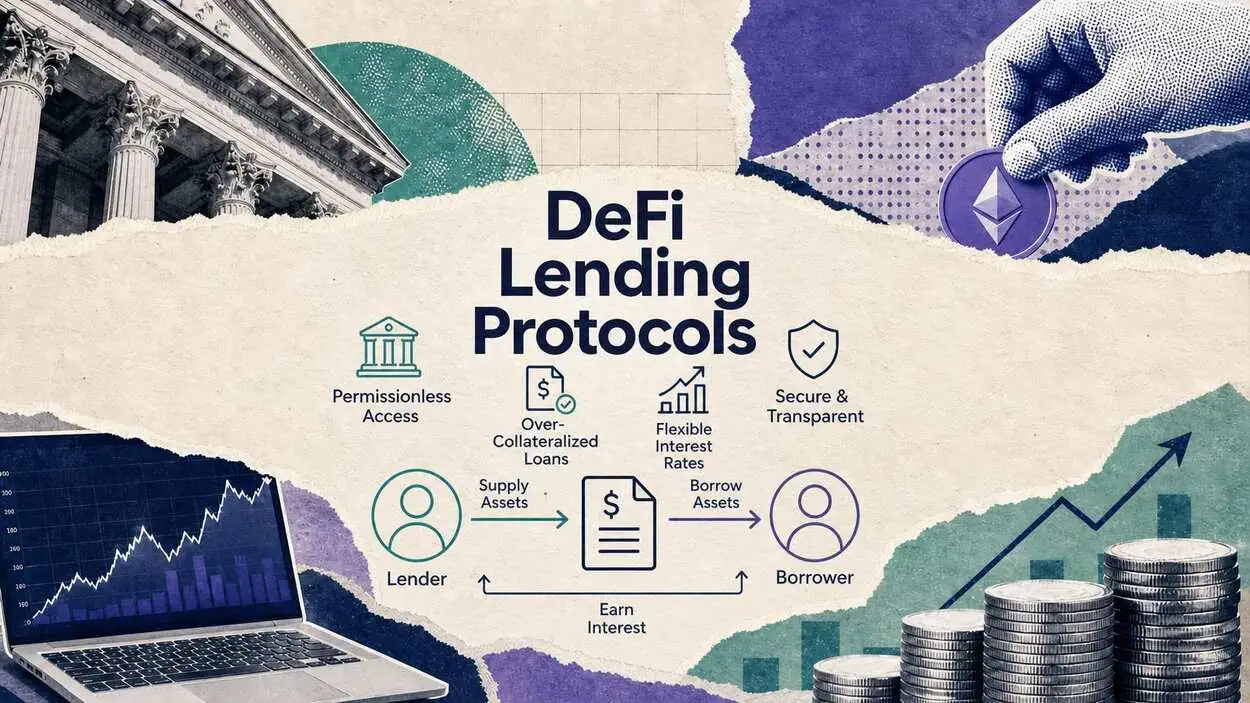
DeFi lending removes the bank from the equation entirely. Protocols like Aave and Compound create money markets where suppliers deposit assets to earn interest and borrowers take loans by posting collateral. No credit checks, no paperwork, no approval committees. The smart contract handles everything based on predefined rules.
The critical mechanism is over-collateralization. Because DeFi lending is pseudonymous and there is no legal recourse for defaults, borrowers must deposit more value than they borrow. A typical collateral factor is 150%, meaning to borrow $1,000 worth of USDC, you need to deposit at least $1,500 worth of ETH. If your collateral’s value drops below the liquidation threshold, anyone can repay part of your debt and claim your collateral at a discount.
Interest rates in these protocols are not fixed by a committee. They are determined algorithmically based on utilization rate, which is the percentage of deposited assets currently being borrowed. When utilization is low, borrowing is cheap to encourage demand. When utilization climbs toward 100%, rates spike sharply to incentivize repayments and attract new deposits. This creates a self-balancing system that adjusts in real time.
Flash loans are a DeFi innovation with no traditional finance equivalent. These allow users to borrow any amount with zero collateral, provided the loan is repaid within the same blockchain transaction. If the repayment fails, the entire transaction reverts as if it never happened. Flash loans are primarily used for arbitrage, collateral swaps, and self-liquidation, but they have also been weaponized in several high-profile exploits.
Lending Protocol Comparison
| Feature | Aave | Compound | MakerDAO |
|---|---|---|---|
| Primary Function | Lending and borrowing | Lending and borrowing | CDP-based stablecoin minting |
| Governance Token | AAVE | COMP | MKR |
| Flash Loans | Yes (0.05% fee) | No | Yes (via DssFlash) |
| Rate Modes | Variable and stable | Variable only | Stability fee (variable) |
| Chains Supported | Ethereum, Polygon, Arbitrum, Optimism, Avalanche, and others | Ethereum, Base, Polygon, Arbitrum | Ethereum |
| Typical Collateral Factor | 70%-85% | 65%-85% | 150%-175% minimum |
| Liquidation Mechanism | Auction-based with bonus | Fixed discount to liquidators | Dutch auction |
From an editorial perspective, the over-collateralization requirement is both DeFi lending’s greatest strength and its biggest limitation. It makes the system resilient to defaults but also makes it capital-inefficient compared to traditional lending, where a mortgage lets you borrow 80%-95% of a property’s value. Under-collateralized DeFi lending is an active area of research, but no protocol has solved it at scale without introducing centralized trust assumptions.
How Yield Farming Works
Yield farming is the practice of deploying crypto assets across DeFi protocols to maximize returns. At its simplest, this means depositing tokens into a liquidity pool or lending market and earning rewards. At its most complex, it involves multi-step strategies layering multiple protocols on top of each other to compound yield from several sources simultaneously.
The yields in DeFi come from three primary sources. First, trading fees earned by providing liquidity to DEXs. Second, interest payments from borrowers on lending platforms. Third, token incentives where protocols distribute their governance tokens to users who provide liquidity, a mechanism often called liquidity mining. It was this third category that fueled the “DeFi Summer” of 2020, when protocols like Compound began distributing COMP tokens, and APYs temporarily soared into the thousands of percent.
Yield aggregators like Yearn Finance automate much of this process. Users deposit assets into Yearn vaults, and the protocol’s strategies automatically move funds between lending platforms, compound rewards, and optimize for the best risk-adjusted returns. This saves users gas fees and the time required to monitor dozens of protocols manually.
The catch is that high yields almost always come with proportional risk. A pool advertising 200% APY is typically paying most of that in a newly minted governance token that may have limited long-term value. When the token price drops, the real yield measured in dollars can turn negative, especially after accounting for impermanent loss and transaction costs. According to DeFi market statistics, sustainable yields on blue-chip protocols typically range from 2% to 8% APY for stablecoin deposits, which is still competitive with traditional savings accounts but far from the triple-digit returns that make headlines.
How Stablecoins Fit Into DeFi
Stablecoins are the connective tissue of the DeFi ecosystem. Without them, every transaction would involve volatile crypto-to-crypto swaps, making lending, borrowing, and yield calculations unpredictable. By maintaining a peg to the US dollar (or other fiat currencies), stablecoins provide the stable unit of account that DeFi needs to function as a practical financial system.
There are three main categories of stablecoins used in DeFi, each with distinct trust assumptions and risk profiles. Centralized stablecoins like USDT and USDC are backed by reserves held by companies (Tether and Circle, respectively) and can be frozen or blocklisted at the issuer’s discretion. Crypto-collateralized stablecoins like DAI are backed by over-collateralized crypto deposits locked in smart contracts and governed by token holders. Algorithmic stablecoins attempt to maintain their peg through supply-and-demand mechanisms without full collateral backing, though the collapse of UST/Luna in 2022 demonstrated the catastrophic risks of this approach.
In practice, stablecoins serve multiple roles in DeFi. They are the most common borrowing asset on lending platforms, the dominant quote currency on DEXs, and the preferred asset for yield farming strategies that minimize volatility exposure. Curve Finance built its entire business around efficient stablecoin swaps, and its pools routinely hold billions of dollars in stablecoin liquidity. Stablecoin pools generally offer lower returns than volatile asset pools but carry significantly less impermanent loss risk, making them a popular choice for conservative DeFi participants.
DeFi Risks You Need to Understand
DeFi’s permissionless nature means there is no customer support line to call when things go wrong. The risks are real, quantifiable, and have resulted in billions of dollars in losses. Anyone participating in DeFi must understand these risks before committing capital.
Smart Contract Bugs
Every DeFi protocol is only as secure as its code. A single vulnerability in a smart contract can drain every dollar deposited into it. The Ronin Bridge hack in 2022 resulted in $625 million in losses. The Wormhole bridge exploit cost $320 million. Even audited protocols are not immune. Audits reduce risk but cannot guarantee the absence of bugs, especially in complex systems with multiple interacting contracts.
Impermanent Loss
Liquidity providers on AMMs face impermanent loss whenever the price ratio of their deposited tokens changes. The greater the divergence from the original deposit ratio, the larger the loss compared to simply holding the tokens. For a 50% price change in one token, impermanent loss is approximately 5.7%. For a 200% price change, it jumps to roughly 25%. The loss is “impermanent” only if prices return to the original ratio, which is not guaranteed.

Oracle Manipulation
Many DeFi protocols rely on price oracles (like Chainlink) to determine asset values for lending, liquidations, and derivatives. If an attacker can manipulate the price feed, even temporarily, they can drain a protocol. Flash loan attacks frequently exploit this vector by manipulating on-chain price sources within a single transaction to borrow assets at artificially favorable rates.
DeFi Protocol Risk Categories
| Protocol Category | Top Protocols | Primary Risks | Historical Loss Events |
|---|---|---|---|
| DEXs / AMMs | Uniswap, Curve, SushiSwap | Impermanent loss, smart contract exploits, MEV extraction | SushiSwap migration drama (2020), Curve pool exploits (2023) |
| Lending | Aave, Compound, MakerDAO | Liquidation cascades, oracle failures, bad debt | Compound oracle error ($80M COMP distributed, 2021), Mango Markets exploit ($114M, 2022) |
| Yield Aggregators | Yearn, Beefy, Convex | Strategy bugs, composability risk, underlying protocol failures | Yearn v1 vault exploit ($11M, 2021) |
| Bridges | Wormhole, LayerZero, Stargate | Validator compromise, smart contract bugs, centralization | Ronin ($625M, 2022), Wormhole ($320M, 2022), Nomad ($190M, 2022) |
| Derivatives | GMX, dYdX, Synthetix | Oracle dependency, liquidity crunches, governance attacks | bZx flash loan attacks ($8M, 2020) |
Beyond these technical risks, regulatory uncertainty remains a significant concern. Governments worldwide are still developing frameworks for DeFi regulation, and sudden policy changes could affect protocol accessibility, token values, or the legal status of DeFi activities in various jurisdictions. The SEC’s ongoing scrutiny of DeFi tokens and platforms underscores that “decentralized” does not automatically mean “unregulated.”
Frequently Asked Questions (FAQs)
DeFi users earn money through three main channels: trading fees from providing liquidity on decentralized exchanges, interest payments from lending protocols where borrowers pay to access capital, and governance token rewards distributed by protocols to attract users. Sustainable yields on established protocols typically range from 2% to 8% APY for stablecoin deposits, though higher returns are available with correspondingly higher risk.
DeFi carries risks that traditional banking does not, including smart contract vulnerabilities, impermanent loss for liquidity providers, and no deposit insurance or customer support if funds are lost. However, blue-chip protocols like Aave and Uniswap have processed billions of dollars and withstood multiple market cycles. Using audited protocols, diversifying across platforms, and never investing more than you can afford to lose are essential risk management practices.
You need a Web3-compatible wallet (such as MetaMask, Coinbase Wallet, or Rabby), cryptocurrency to pay for transaction fees (ETH for Ethereum-based protocols), and the tokens you want to deposit or trade. No identity verification or minimum balance is required. Most DeFi apps are accessed through a web browser by connecting your wallet to the protocol’s front-end interface.
DeFi (decentralized finance) operates through transparent smart contracts on public blockchains where users maintain custody of their assets. CeFi (centralized finance) includes crypto platforms like Coinbase and Binance that hold your assets on your behalf, similar to traditional banks. The collapses of CeFi platforms like FTX, Celsius, and BlockFi in 2022 highlighted the counterparty risk inherent in trusting centralized entities with crypto assets.
DeFi can replicate many banking functions, including lending, borrowing, trading, and savings, but it currently lacks the scale, user experience, and regulatory framework needed for mainstream adoption. Challenges such as high gas fees, complex interfaces, limited fiat on-ramps, and the absence of consumer protections prevent DeFi from serving as a full replacement for most users today. DeFi is more likely to complement traditional finance than fully replace it in the near to medium term.
Conclusion
DeFi works by replacing human intermediaries with transparent, auditable smart contracts that execute financial operations automatically. Automated market makers use mathematical formulas to enable trading without order books. Lending protocols use over-collateralization and algorithmic interest rates to create money markets without banks. Yield farming layers these components together to generate returns from multiple sources. Stablecoins provide the price stability that holds the entire system together.
The technology is genuinely innovative, but it is not without serious trade-offs. Capital inefficiency, smart contract risk, impermanent loss, and regulatory uncertainty are not minor footnotes. They are fundamental characteristics of the current system that users must weigh against the benefits of permissionless access and self-custody. The protocols that survive long term will be those that solve these problems without sacrificing the decentralization that makes DeFi worth building in the first place.
For anyone looking to participate, start with established protocols, use only funds you can afford to lose entirely, and take the time to understand the mechanics before committing capital. DeFi rewards informed participants and punishes careless ones with equal efficiency.