

• Skip to primary navigation
  • Skip to main content
  • Skip to primary sidebar
  • Skip to footer
CoinLaw LogoCoinLaw

Bringing Crypto and Finance Closer to You

  • Latest News
  • Statistics
  • About
  • Contact
Subscribe
CoinLaw Logo
  • Latest News
  • Statistics
  • About
  • Contact
Subscribe
Home Β» Cryptocurrency

Algorithmic Stablecoins Statistics 2026: Adoption, Performance, and Challenge

Published on: March 23, 2026
Barry Elad
Written By
Barry Elad
Barry Elad
Founder & Senior Journalist • 560 Articles
Barry Elad is a finance and tech journalist who loves breaking down complex ideas into simple, practical insights. Whether he's exploring fi... See full bio
LATEST POSTS:
How to Understand Crypto Market Cycles 2026: Winning Moves
How to Participate in a Crypto Airdrop Safely 2026: Avoid Scams
Toast Statistics 2026: ARR, GPV & Revenue Data
Kathleen Kinder
Reviewed By
Kathleen Kinder
Kathleen Kinder
Senior Editor • 1,682 Articles
Kathleen Kinder brings over 11 years of experience in the research industry, with deep expertise in finance, cryptocurrency, and insurance. ... See full bio
LATEST POSTS:
Winklevoss Twins Move $67.5M BTC Amid Sell Fears
Revolut Eyes U.S. Bank Launch With FDIC Insured Accounts
Visa, Mastercard and Stripe Plan New Stablecoin Platform
Algorithmic Stablecoins Statistics
As Featured In
FortuneYahoo! FinanceCoinDeskSeeking AlphaCoin Market Cap
Share on LinkedIn ChatGPT Perplexity Share on X Share on Facebook

This report has been updated 3 times. Last updated on March 23, 2026

  • Stablecoin market cap updated to $316–320 billion (March 2026) from $211 billion (mid-2025).
  • Tether dominance revised to about 58%–60% market share vs earlier 64.3% share.
  • The top 5 stablecoins concentration added at ~89% of the total market.
  • Ethereum share updated to 53.9% of stablecoin supply ($168.7 billion) vs earlier ~79% combined with Tron.
  • Tron supply quantified at $86.7 billion, newly added.
  • Combined Ethereum + Tron dominance refined to ~90% of supply.
  • New regulatory update: MiCA effectively bans algorithmic stablecoins in the EU.
  • New U.S. update: GENIUS Act pushes market toward $320 billion via TradFi inflows.
  • Weekly inflow metric added: +$2.5 billion stablecoin growth in a single week.
  • Stablecoin transaction volume updated to $33 trillion with 72% growth.
  • Stablecoins share of on-chain volume added at ~30%.
  • Fiat-backed dominance is clarified at over 95% of the market.
  • New forecast added: stablecoin circulation could exceed $1 trillion by late 2026.
  • New section added: Stablecoin Reserve Composition (Circle vs Tether breakdown).
  • Circle reserves detailed with 45.7% T-bills, 40.9% repos, 13.4% cash.
  • Tether reserves expanded with 66% Treasuries, 11.2% repos, 5.1% Bitcoin, 4.5% metals, etc.
  • Regional data completely updated to trillion-level flows (e.g., Europe $2.6T, NA $2.2T), replacing %-share comparisons.
  • APAC growth updated to 69% YoY with $2.36 trillion volume.
  • Illicit activity quantified at 1.2% ($154 billion).
  • New enterprise adoption insights added: 64% plan to use stablecoins, 34% already using.
  • Business benefits quantified: 72% faster payments, 60% cost savings.
  • Risk section updated with sharper metrics: 5–6 depegs in 2025 with 50–80% losses.
  • New example added: USR crash of 67% in 24 hours.
  • Regulatory exclusion expanded: algorithmic stablecoins are limited to 70%+ of markets.
  • Comparison section updated: USD-pegged collateralized stablecoins hold ~99% of fiat-backed supply.
  • Added insight: enterprises prefer collateralized models; algorithmic share remains minimal.
  • B2B flows growth added at +733% YoY (60% of volume).
  • Crypto card payments updated to $18 billion annualized (+106%).
  • Asia-originated payments quantified at $245 billion (~60% share).
  • Infrastructure growth added: enterprise transaction volume +690% YoY, users +146%.
  • Cost efficiency added: 0.1–0.5% stablecoin transfer cost vs 2–7% traditional.
  • User behavior added: 71% plan to use cards, 28% convert quickly.
  • Expansion metric added: Visa Bridge targeting 100+ countries and 175M+ merchants by 2026.

Imagine a world where digital currency remains stable without being pegged to traditional assets like the dollar or gold. Algorithmic stablecoins, a growing force in the cryptocurrency landscape, aim to do just that. These coins use complex algorithms to adjust their supply, maintaining a stable value even without a backing asset.

The rapid development and adoption of these algorithmic stablecoins have ignited conversations on their impact, functionality, and potential to transform both the crypto market and traditional finance. As we dive into the latest statistics, we’ll uncover the most influential trends and what they mean for the future of digital currencies.

Editor’s Choice

  • Stablecoin market cap is about $316 billion in March 2026, with total transfer volume around $33 trillion in 2025.
  • Tether (USDT) leads with roughlyΒ 58%Β market share and aboutΒ $187 billionΒ in circulation, reshaping digital payments.
  • Top 5 stablecoins control around 89% of the roughly $316 billion stablecoin market.
  • Ethereum hosts aboutΒ 53.9%Β of all stablecoin supply, or roughlyΒ $168.7 billion.
  • Tron holds around $86.7 billion in stablecoin supply and has recently led net monthly growth.
  • Ethereum and Tron together account for nearly 90% of the total stablecoin supply as primary settlement layers.
  • USDT’s market capitalization is approximately $184 billion, with the price holding close to $1.00.

Recent Developments

  • As of March 2026, the total stablecoin market cap has climbed to about $316–320 billion, marking fresh all-time highs.
  • MiCA’s stablecoin rules have been fully in force since June 30, 2024, driving EU delistings of non-compliant tokens through early 2025.
  • Under MiCA, algorithmic stablecoins are effectively banned in the EU, while asset-backed tokens must hold 100% liquid reserves and meet strict disclosure rules.
  • In the United States, the GENIUS Act helped push the stablecoin market cap to around $320 billion by attracting large TradFi inflows.
  • DeFiLlama data shows global stablecoin capitalization recently hitting about $315 billion, after adding roughly $2.5 billion in a single week.
  • The top five stablecoins now control about 89% of the roughly $316 billion market, with USDT alone near 58% share.
  • Post‑Terra, regulators globally flag algorithmic stablecoins as high‑risk, citing potential overnight depegs and multi‑billion‑dollar losses.
  • UST’s 2022 collapse erased roughly $60 billion in value and still anchors regulatory stress tests of algorithmic models in 2026.

Stablecoin Reserve Composition

  • Circle reserves are highly liquid, with 45.7% held in short-term Treasury debt (T-bills ≀60 days), emphasizing low-risk backing.
  • Treasury repurchase agreements account for 40.9% of Circle’s reserves, showing a strong reliance on collateralized overnight lending markets.
  • Cash holdings make up 13.4% of Circle reserves, ensuring immediate liquidity for redemptions.
  • Tether allocates a dominant 66.0% of its reserves to Treasury debt, indicating a heavy focus on government-backed assets.
  • 11.2% of Tether reserves are in Treasury repurchase agreements, supporting short-term liquidity management.
  • Tether holds 5.9% in other investments, reflecting diversification beyond traditional instruments.
  • Bitcoin represents 5.1% of Tether reserves, highlighting exposure to volatile crypto assets.
  • Precious metals account for 4.5% of Tether’s portfolio, adding a hedge against inflation and currency risk.
  • Money market funds (MMFs) contribute 4.2%, reinforcing liquidity and short-duration exposure.
  • Secured loans make up 3.0% of Tether reserves, introducing credit risk elements into the portfolio.
  • Circle maintains a simpler 3-asset structure, while Tether spreads reserves across 7 asset classes, indicating greater diversification but higher complexity.
  • Circle’s reserves are 100% traditional financial instruments, whereas Tether includes crypto and alternative assets, reflecting different risk profiles between major stablecoins.
Stablecoin Reserve Composition
(Reference: Chainstack)

Regional Trends in Stablecoin and Bitcoin Transaction Activity

  • In 2026, stablecoins make up about 13% of the global crypto market, with transaction value around $33 trillion in 2025.
  • Latin America received roughly $1.5 trillion in crypto value from July 2022–June 2025, driven by stablecoins.
  • Sub-Saharan Africa’s crypto activity rose about 52% YoY, with Nigeria leading stablecoin adoption.
  • APAC crypto transaction volume jumped 69% YoY to about $2.36 trillion.
  • Latin America’s crypto adoption grew roughly 63%, reflecting increased stablecoin use.
  • North America received over $2.2 trillion in crypto value in the last year.
  • Europe took in more than $2.6 trillion in crypto value, with growing stablecoin adoption.
  • Illicit activity accounted for about 1.2% of on-chain volume, totaling $154 billion in 2025.
Newsletter Img
Don't chase the news. Let us curate it.

You get one weekly briefing with only the stories that matter. If the market is quiet, we skip it.

βœ… Join readers from Visa, Vanguard, and the FDIC.

Stablecoin Adoption and Business Benefits

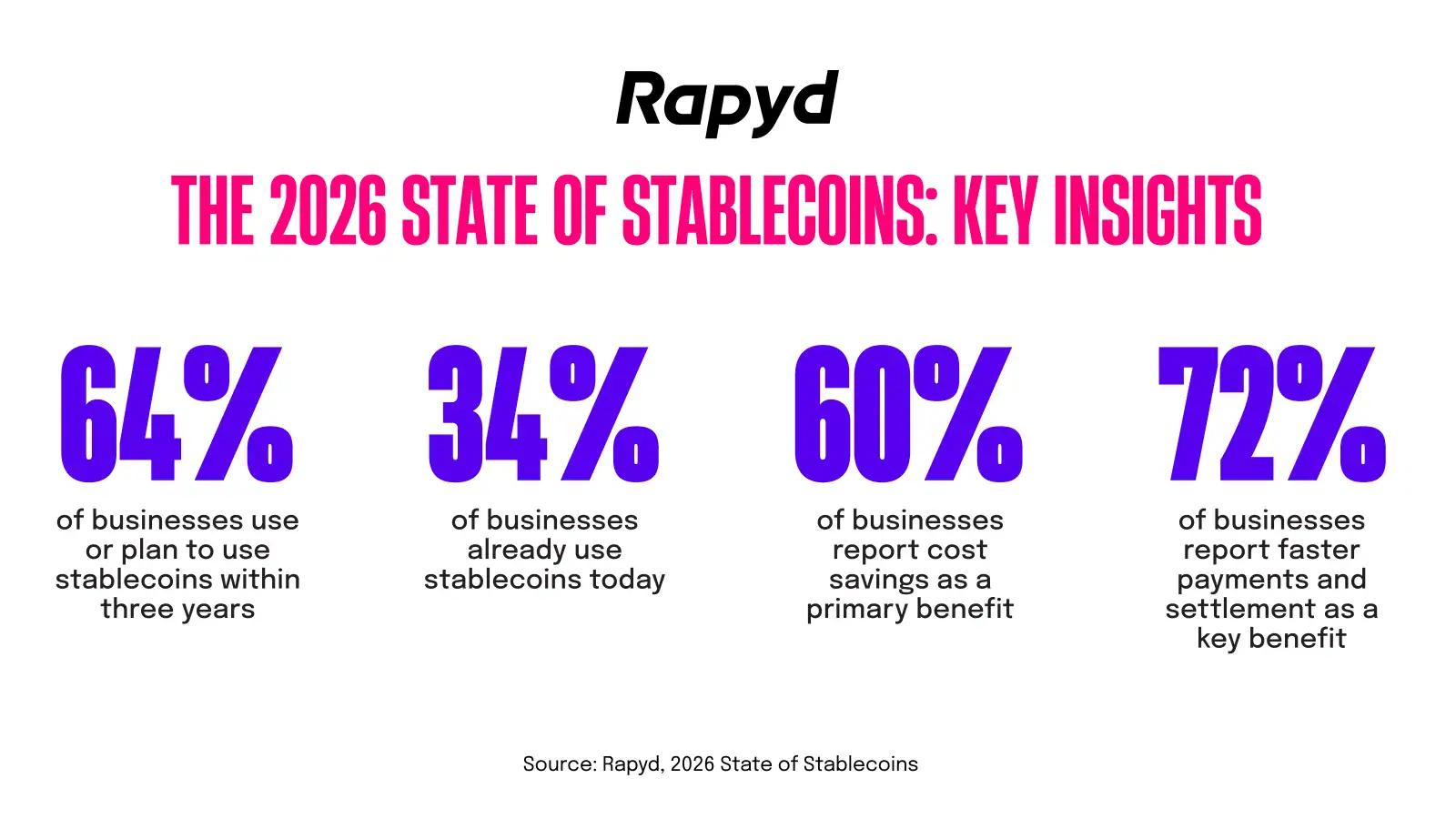
  • 64% of businesses are using or planning to use stablecoins within the next three years, signaling strong forward-looking adoption trends.
  • 34% of businesses already use stablecoins today, reflecting growing real-world implementation across global enterprises.
  • 60% of companies identify cost savings as a primary benefit, highlighting stablecoins’ ability to reduce fees and operational costs.
  • 72% of businesses report faster payments and settlement, making it the most cited advantage of stablecoin usage.
  • The difference between 34% current adoption and 64% planned usage indicates a major expansion pipeline in stablecoin adoption.
  • Over 70% of businesses prioritize faster transactions, reinforcing speed as a key adoption driver.
  • More than 60% of businesses focus on cost reduction, emphasizing efficiency in payment systems.
  • The data highlights a clear shift toward digital settlement solutions, driven by improvements in speed and cost efficiency.
Stablecoin Adoption And Business Benefits
(References: Newsweek, Rapyd)

Risks and Challenges of Algorithmic Stablecoins

  • In 2025, 5–6 decentralized algorithmic stablecoins depegged, with losses of 50–80%.
  • The 2022 LUNA–TerraUSD failure caused a roughly $60 billion wipeout, shaping 2026 stress tests.
  • Resolv’s USR crashed about 67% below its peg in 24 hours, highlighting tail risk.
  • Depegs over 50% often lead to permanent value loss with low recovery probability.
  • Most frameworks exclude algorithmic tokens from β€œstablecoins,” limiting access to over 70% of markets.
  • MiCA and the US GENIUS Act ban interest-bearing payment stablecoins, restricting algorithmic compliance by 2026.

Stability Mechanisms and Performance

  • Fiat-backed stablecoins make up over 95% of the market in 2026, with algorithmic designs at a single-digit share.
  • Global stablecoin transaction volume rose 72% in 2025 to about $33 trillion.
  • Tether (USDT) holds roughly 60% of the stablecoin market cap.
  • FRAX has a circulating supply of 88.2 million tokens and a market cap near $60.5 million.
  • Stablecoins represent about 30% of on-chain crypto transaction volume.
  • Stablecoin circulation could exceed $1 trillion by late 2026.
Stablecoin Market Share And Transaction Growth

Comparing Stability: Algorithmic vs. Collateralized Models

  • Fiat-backed stablecoins make up over 95% of the market in 2026, leaving algorithmic types with a low single-digit share.
  • USD-pegged collateralized stablecoins hold about 99% of fiat-pegged capitalization, with USDT near 60% share.
  • Algorithmic stablecoins are excluded from MiCA categories, reducing their addressable market by over 70%.
  • Regulatory guidance treats purely algorithmic stablecoins as high-risk, while fiat-backed ones are lower-risk in 2026.
  • Most enterprises prefer collateralized stablecoins, with algorithmic types capturing only a small minority of use.

Use Cases for Stablecoins in Business

  • Genuine stablecoin payment volume reached about $390 billion in 2025, with B2B flows up 733% year over year and making up roughly 60% of that total.
  • Crypto card payments, heavily funded by stablecoins, reached an annualized volume of roughly $18 billion, up 106% year over year.
  • Asian‑originated stablecoin payments account for around $245 billion, or about 60% of global stablecoin payment volume in key corridors.
Stablecoin Business Use Cases By Payment Volume
  • Enterprise stablecoin transaction volume grew aboutΒ 690%Β year over year on one major infrastructure platform, with active business users upΒ 146%.
  • Stablecoin cross‑border rails can cut all‑in payment costs to around 0.1–0.5%, compared with traditional transfer costs of 2–7%.
  • Surveys show construction and education firms expect 10–20% cost savings from shifting cross‑border B2B payments to stablecoins.

Stablecoins as Means of Payment

  • About 2% of stablecoin volume goes to retail payments, 2% to remittances, and 7% to real-world asset settlement.
  • Total stablecoin settlement volume reached roughly $33 trillion in 2025, up 72% YoY.
  • Global stablecoin transaction value rose from $668 billion in Feb 2025 to $1.78 trillion by early 2026.
  • Visa’s stablecoin-linked card and settlement volumes hit over $4.5 billion annualized in early 2026.
  • BVNK processed around $6 billion in annualized stablecoin payments in 2025, up 2.3x from 2024.
  • Total stablecoin payment volume across providers reached about $122 billion annualized in 2025.
  • Nearly 71% of holders plan to use cards for stablecoin spending, while 28% convert or spend within days.
  • Visa’s Bridge cards are live in 18 countries and aim for 100+ countries and 175 million+ merchant locations by the end of 2026.

Frequently Asked Questions (FAQs)

What proportion of EU‑circulating stablecoins must be reclassified under MiCA, and how does this affect algorithmic models?

AboutΒ 78%Β of EU‑circulating stablecoins must be reclassified under MiCA by 2025, while algorithmic stablecoins areΒ fully banned, cutting them off from the EU’s multi‑trillion‑dollar market.

What share of on‑chain crypto transaction volume do stablecoins represent, and how exposed is this flow to algorithmic failures?

Stablecoins make up aboutΒ 30%Β of all on‑chain crypto transaction volume, yet the vast majority is in fiat‑backed coins, leaving algorithmic stablecoins with only aΒ small fractionΒ of that flow.

What maximum regulatory fines can non‑compliant stablecoin issuers face under MiCA?

Under MiCA, non‑compliant stablecoin issuers can face fines up to €15 millionΒ orΒ 3%Β of annual turnover.

Conclusion

As algorithmic stablecoins continue to evolve, they offer a compelling alternative to traditional stablecoins by utilizing decentralized and autonomous mechanisms. The innovation, adoption, and regulatory focus surrounding these digital assets today show a maturing market with an eye toward long-term stability and mainstream acceptance.

With rapid technological advancements and growing global interest, algorithmic stablecoins could soon reshape financial transactions, particularly within decentralized finance and international markets. However, their future success will depend on achieving a balance between stability, usability, and regulatory compliance.


Definition of Cross-Chain. Link to full glossary entry follows the description.Cross-Chain

Cross-chain is the ability to move data or assets between separate blockchains via bridges, messaging protocols, or interoperability networks.

Read more

Definition of Stablecoin. Link to full glossary entry follows the description.Stablecoin

A stablecoin is a cryptocurrency tied to a reserve asset like the US dollar, designed to maintain a stable value for trading, payments, and transfers.

Read more

This article has been reviewed and fact-checked by Kathleen Kinder. CoinLaw follows strict Publishing Principles and a documented Fact-Check Policy to ensure accuracy, transparency, and editorial independence across all content. Our statistics are verified using a documented Research Process.

Add CoinLaw as a Preferred Source on Google for instant updates! Follow on Google News
Share ChatGPT Perplexity

References

  • Statista
  • Statista
  • Forbes
  • LLP Obeid & Partners
  • Oxford Business Law
  • World Economic Forum
  • CoinDesk
Barry Elad

Barry Elad

Founder & Senior Journalist


Barry Elad is a finance and tech journalist who loves breaking down complex ideas into simple, practical insights. Whether he's exploring fintech trends or reviewing the latest apps, his goal is to make innovation easy to understand. Outside the digital world, you'll find Barry cooking up healthy recipes, practicing yoga, meditating, or enjoying the outdoors with his child.

Related Posts

Cryptocurrency Payments vs. Fiat Payments Statistics 2026: Big Trends
Payments

Cryptocurrency Payments vs. Fiat Payments Statistics 2026: Big Trends

Cryptocurrency Adoption Statistics 2026: Key Global Shifts Now
Cryptocurrency

Cryptocurrency Adoption Statistics 2026: Key Global Shifts Now

Cryptocurrency Staking Statistics 2026: Yields Driving Wealth
Cryptocurrency

Cryptocurrency Staking Statistics 2026: Yields Driving Wealth

Disclaimer:Β The content published on CoinLaw is intended solely for informational and educational purposes. It does not constitute financial, legal, or investment advice, nor does it reflect the views or recommendations of CoinLaw regarding the buying, selling, or holding of any assets. All investments carry risk, and you should conduct your own research or consult with a qualified advisor before making any financial decisions. You use the information on this website entirely at your own risk.

Reader Interactions

7 Comments

  1. ASAlex Smith

    December 28, 2024 at 2:46 PM

    Interesting take on stability mechanisms, Barry Elad. How do these actually ensure that the value doesn’t plummet overnight? Curious about the math behind it.

    Reply
    • Barry EladBarry Elad Post Author

      December 29, 2024 at 10:00 AM

      The mechanics vary by design, Alex. Fiat-backed stablecoins rely on reserves held in escrow to maintain the peg, while algorithmic stablecoins use on-chain supply contraction and expansion rules triggered by price signals. The stability mechanisms section of the article walks through the key designs if you want the specifics on each approach.

      Reply
  2. SSamanthaK

    January 16, 2025 at 4:09 AM

    The use cases for stablecoins in the business section really caught my eye. We’ve been considering blockchain for a while in supply chain management, and this adds a new perspective. Would love to see more real-world examples.

    Reply
    • Barry EladBarry Elad Post Author

      January 17, 2025 at 10:00 AM

      Glad it was relevant, Samantha. Supply chain is one of the more compelling real-world applications precisely because cross-border settlement costs and delays are so significant in that sector. The programmable payment rails that stablecoins enable could make multi-party supply chain finance considerably more efficient. A dedicated follow-up on that use case is worth exploring.

      Reply
  3. DDanny_boy

    February 9, 2025 at 1:49 AM

    All this buzz about algorithmic stablecoins sounds too good to be true. Isn’t this just another bubble waiting to burst? Seen too many of these ‘revolutionary’ financial products come and go.

    Reply
    • CCrypto_fan101

      February 22, 2025 at 12:00 AM

      Not really, Danny_boy. Algorithmic stablecoins have solid math and community trust behind them. Sure, there’s always risk, but dismissing it as a bubble is missing out on the innovation.

      Reply
  4. BLBecca L.

    February 22, 2025 at 12:00 AM

    Loved the article, especially the part on technological innovations. It’s super fascinating to see how far we’ve come with stablecoins and blockchain in general. I’m doing a project on digital currencies, and this article was a goldmine of info. Thanks, Barry Elad, for the clear and concise info!

    Reply

Leave a Comment Cancel reply

Primary Sidebar

Connect With Us

facebook x linkedin google-news telegram pinterest whatsapp email
google-preferred-source-badge Add as a preferred source on Google

You Should Also Read

Stablecoin Statistics 2026: Growth, Adoption, and Regulation
Decentralized Stablecoins Adoption Statistics 2026: How DeFi, Wallets & Regulation Are Fueling Usage
How Stablecoins Work: Easy Breakdown Guide

Table of Contents

  • Editor’s Choice
  • Recent Developments
  • Stablecoin Reserve Composition
  • Regional Trends in Stablecoin and Bitcoin Transaction Activity
  • Stablecoin Adoption and Business Benefits
  • Risks and Challenges of Algorithmic Stablecoins
  • Stability Mechanisms and Performance
  • Comparing Stability: Algorithmic vs. Collateralized Models
  • Use Cases for Stablecoins in Business
  • Stablecoins as Means of Payment
  • Frequently Asked Questions (FAQs)
  • Conclusion
Connect on Telegram

Footer

CoinLaw Logo

Bringing Finance Closer to You.

Connect With Us

Follow Us on Google News

Editorial & Trust

  • About
  • Publishing Principles
  • Fact-Check Policy
  • Corrections Policy
  • Ethics Policy
  • Disclaimer

Worth Checking

  • Ethereum Gas Fees Statistics
  • Zelle vs. Venmo Statistics
  • Millennial vs. Gen Z Banking
  • Binance vs. Coinbase Statistics
  • Traditional Banks vs. Neobanks
Contact Us
13570 Grove Dr #189,
Maple Grove, MN 55311,
United States
10β€―a.m. – 6β€―p.m. | Every day

Copyright Β© 2024–2026 CoinLaw. All Rights Reserved. Powered by the HODL Force ❀️

  • Privacy Policy
  • Terms
Company
  • About Us
  • Our Team
  • Our Mission
  • Core Values
Discover
  • glossary icon
    Glossary
  • Stats
    Stats Research Process
  • Brand Guide Icon
    Brand Assets
Categories
  • Cryptocurrency
  • Payments
  • Finance
  • Banking
  • Insurance
Cryptocurrency
Coinbase vs Kraken Statistics 2026: Volume, Fees, Licenses
Solana vs Ethereum Statistics 2026: TVL, Fees, Validators, ETFs
Uniswap vs PancakeSwap Statistics 2026: Head-to-Head DEX Data
Cryptojacking Statistics 2026: 80+ Cloud, Cost & Threat Numbers
MetaMask vs Phantom Wallet Statistics 2026: Big Growth Data
Crypto Wallet Ecosystem Statistics 2026: Addresses, Security, Adoption
Payments
Toast Statistics 2026: ARR, GPV & Revenue Data
Rapyd Statistics 2026: TPV, Valuation & Licences
Marqeta Statistics 2026: TPV, Revenue and Customer Mix
Digital Payments Statistics 2026: Market Size, Users, and Growth
Cash App vs Venmo vs Zelle Statistics 2026: What You Must Know Now
Worldpay Statistics 2026: Massive Payment Growth
Finance
Emergency Fund Statistics 2026: How Much Americans Have Saved (and How Much They Should)
Financial Advisor Statistics 2026: Headcount, AUM, and Demographics
Wealth Inequality Statistics 2026: Hidden Wealth Divide
Blockchain in Supply Chain Finance Statistics 2026: Trade Breakthrough
Blockchain in Healthcare Finance Statistics 2026: Cost Breakthrough
AI-Powered Robo Trading Statistics 2026: Big Insights
Banking
N26 Statistics 2026: Customers, Deposits, Revenue and the BaFin Growth Cap
Revolut vs Monzo Statistics 2026: Customers & Profit
Islamic Banking Statistics 2026: Assets, Growth, and Top Markets
Credit Union Statistics 2026: Assets, Members, Loans
Banking API Statistics 2026: Market Size, Adoption, and Growth
Citigroup Statistics 2026: Growth Secrets Inside
Insurance
Lemonade Insurance Statistics 2026: Customers, In-Force Premium, Loss Ratio, Pet & Auto Segments
Chubb Statistics 2026: Powerful Data Insights
Virtual Reality In Insurance Statistics 2026: Innovations, Risks, and Opportunities
US Life Insurance Industry Statistics 2026: Growth Facts
US Auto Insurance Industry Statistics 2026: What You Must Know Now
UK Insurance Industry Statistics 2026: Growth Data
Categories
  • Cryptocurrency
  • Investments
  • Compliance
  • Fintech
  • Finance
Cryptocurrency
FG Nexus Moves 10,000 ETH as Ethereum Losses Exceed $85M
Arthur Hayes Shocks Hyperliquid Holders With $18M HYPE Exit
Coinbase Freezes $3M Linked to Southeast Asia Scams
Mt. Gox Moves $8M BTC to Bitstamp as Bitcoin Falls
Winklevoss Twins Move $67.5M BTC Amid Sell Fears
Visa, Mastercard and Stripe Plan New Stablecoin Platform
Investments
Goldman Sachs Backs Blockchain Real Estate Fund
Keyrock to Buy Bankrupt Crypto Lender BlockFills for $3.25M
OKX Buys 19.6% of Coinone in $53M Korea Crypto Deal
Samsung Buys $408M Stake in Upbit Parent Dunamu
Nvidia to Invest $150 Billion a Year in Taiwan AI Expansion
Binance Launches SpaceX Pre-IPO Futures for Retail Traders
Compliance
FCA Flags Crypto Sponsorship Risks for Premier League Clubs
Polymarket May Enforce KYC as Regulators Tighten Oversight
CFTC and Gemini Ask Court to Undo $5M Settlement
Kenya Proposes New Crypto Taxes Under Finance Bill 2026
Poland Passes MiCA Crypto Bill Amid Zondacrypto Probe
Bitget Secures Mexico Crypto Approval for LatAm Expansion
Fintech
Moomoo Debuts Kalshi Powered Event Contracts for Retail Traders
Shinhan Financial Joins Canton Network for Tokenized Assets
Tether Launches First Gold Backed Visa Card With Fasset
OpenPayd Targets Nasdaq Listing With $1.145B Deal
Sui Identifies Bugs Behind Three Mainnet Network Outages
OKX X Layer Introduces Exchange OS for Onchain Markets
Finance
Bitmine Launches $300M Preferred Stock to Buy More ETH
Coinbase Lists SpaceX Pre IPO Perpetual Futures
Binance Expands Into US Stocks With New bStocks Service
SEC Clears Paxos to Settle U.S. Stocks on Blockchain
Mastercard Expands Stablecoin Strategy With NY BitLicense
Russia Plans Full Exit of Visa and Mastercard From Market
Newsletter Img

Too much noise in crypto?

We respect your time. You get one high-impact briefing a week. If the market is quiet, so are we.

βœ… Join readers from Visa, Vanguard, and the FDIC.
Newsletter Img

The Weekly Briefing

We track the market 24/7. You get a 5-minute summary. If it’s quiet, we skip it.

βœ… Read by pros at Visa, Vanguard, and the FDIC.