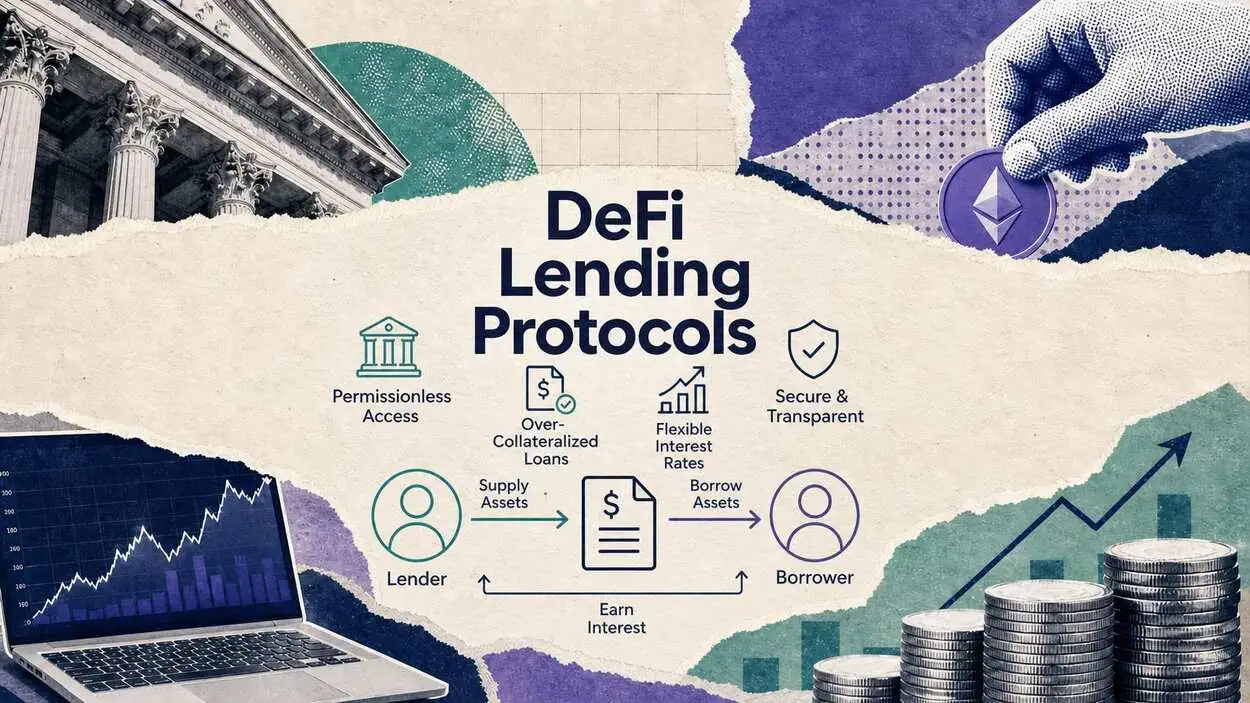






On June 15, 2020, lending protocol Compound distributed its governance token COMP to users, and decentralized finance changed overnight. Within a week, the total value locked in Compound quadrupled. Within three months, DeFi’s TVL grew from under $1 billion to over $10 billion. By November 2021, that number reached $178 billion. The history of DeFi stretches back further than that summer, though, from MakerDAO’s first collateralized loan in 2017 to the post-collapse rebuilding that followed the 2022 crash. This is the complete timeline.
Key Takeaways
- MakerDAO launched on the Ethereum mainnet in December 2017, creating the first decentralized lending protocol and the DAI stablecoin
- Uniswap pioneered the automated market maker (AMM) model in November 2018, replacing traditional order books
- Compound’s COMP token launch on June 15, 2020, triggered “DeFi Summer” and the yield farming phenomenon
- DeFi TVL grew from $1 billion (early 2020) to $178 billion (November 2021), a 178x increase
- The Terra/LUNA collapse in May 2022 erased $40+ billion from DeFi protocols and triggered cascading failures
- DeFi hackers stole over $3 billion in 2022 alone, exposing systemic bridge and smart contract vulnerabilities
- Post-collapse DeFi has shifted from yield-driven speculation to sustainable models, including real-world asset tokenization
The Foundations (2017 to 2019)
DeFi’s building blocks were laid before the term existed. The concept of decentralized financial services on blockchain dates back to Ethereum’s 2015 launch, but the first functional protocols arrived in 2017.
| Date | Protocol | Innovation | Why It Mattered |
|---|---|---|---|
| Dec 2017 | MakerDAO | Collateralized lending; DAI stablecoin | First decentralized loan system |
| Nov 2018 | Uniswap V1 | Automated market maker (AMM) | Solved DEX liquidity problem without order books |
| Sep 2018 | Compound V1 | Algorithmic money markets | Automated interest rate setting based on supply/demand |
| Jan 2020 | Aave | Flash loans; variable/stable rate switching | Enabled uncollateralized instant borrowing |
| Jan 2020 | Curve Finance | Stablecoin-optimized AMM | Low-slippage swaps between similar assets |
Sources: Protocol Documentation, DefiLlama
MakerDAO and the Birth of Decentralized Lending
MakerDAO’s December 2017 mainnet launch was the defining moment. The system used Collateralized Debt Positions (CDPs), smart contracts where users deposited ETH and minted DAI, a dollar-pegged stablecoin, against it. The critical requirement was a minimum 150% collateralization ratio, meaning a user needed to lock at least $150 worth of ETH to mint 100 DAI.
If the collateral value dropped below 150%, anyone could trigger a liquidation auction that sold the ETH to cover the debt. This mechanism, entirely code-enforced, proved that lending could operate without banks, credit scores, or human intermediaries. The MKR governance token gave holders voting power over risk parameters like stability fees and collateral types.
Single-collateral DAI (backed only by ETH) launched first. Multi-collateral DAI followed in November 2019, accepting assets like BAT and USDC as additional collateral types. By early 2020, MakerDAO held over $500 million in locked collateral, making it the largest DeFi protocol at the time.
Uniswap V1 and the AMM Revolution
Uniswap’s November 2018 launch solved a different problem. Previous decentralized exchanges used order books and struggled with low liquidity because they needed active market makers willing to place bids and asks. Hayden Adams, Uniswap’s creator, implemented the constant product formula (x * y = k), where x and y represent the quantities of two tokens in a pool, and k is their constant product.
When a trader swaps token A for token B, they add A to the pool and remove B. The formula automatically adjusts the price based on the ratio change. Larger trades relative to pool size cause more price impact (slippage). This meant anyone could become a liquidity provider by depositing equal values of two tokens into a pool and earning 0.3% of every trade as fees. No sign-up, no approval, no minimum deposit. The AMM model became the foundation for nearly every DEX that followed.

Compound’s Algorithmic Interest Rates
Compound launched its V1 protocol in September 2018 with a fundamentally different approach to interest rates. Instead of fixed rates set by governance votes, Compound used utilization-based algorithms. When a lending pool’s utilization rate was low (few borrowers relative to deposited supply), interest rates stayed low to encourage borrowing. As utilization climbed toward 100%, rates increased sharply to attract more depositors and discourage excessive borrowing.
This created a self-balancing money market. Depositors earned variable yields that adjusted every Ethereum block (roughly every 12 seconds). Borrowers paid floating rates tied to real-time supply and demand. No loan officer decides rates. No committee met quarterly to adjust them. The algorithm handled everything.
Aave and Flash Loan Innovation
Aave (rebranded from ETHLend) launched in January 2020 with one feature that had no traditional finance equivalent: flash loans. A flash loan lets a user borrow any amount of tokens with zero collateral, as long as they repay the full amount within the same transaction. If the borrower fails to repay, the entire transaction reverts as if it never happened.
This sounds abstract, but flash loans enabled powerful arbitrage strategies. A trader could borrow $10 million in USDC, use it to exploit a price difference between two DEXs, repay the loan plus a 0.09% fee, and pocket the profit, all in a single atomic transaction. Flash loans also became tools for governance attacks and, unfortunately, for exploiting vulnerable protocols. Aave processed over $5 billion in flash loan volume during its first year.
DeFi Summer (June to September 2020)
On June 15, 2020, Compound launched its COMP governance token through a liquidity mining program. Users who lent or borrowed on the platform received COMP tokens as rewards. The COMP token surged to over $372 at its June 21 peak, and the economic incentives created a frenzy.
The concept was simple but powerful: protocols could bootstrap liquidity by distributing governance tokens to users. Within weeks, dozens of protocols launched their own yield farming programs:
- Balancer launched BAL mining (June 2020)
- Curve Finance launched CRV mining (August 2020)
- SushiSwap forked Uniswap with SUSHI rewards (August 2020), triggering the “vampire attack” strategy
- Yearn Finance launched YFI with a “fair distribution” (no pre-mine, no VC allocation) in July 2020
- Uniswap responded by retroactively airdropping 400 UNI tokens to every past user (September 2020)

The Vampire Attack and Fair Launch Era
SushiSwap’s “vampire attack” on Uniswap became one of DeFi Summer’s defining episodes. Chef Nomi, an anonymous developer, forked Uniswap’s open-source code and added a twist: liquidity providers who staked their Uniswap LP tokens on SushiSwap earned SUSHI rewards. After a migration deadline, those LP tokens would be redeemed, and the underlying liquidity would be moved from Uniswap to SushiSwap. Over $1.14 billion in liquidity migrated in the first week. The strategy proved that in open-source DeFi, protocol loyalty was only as strong as the incentives backing it.
Yearn Finance’s YFI token launched with what became known as the “fairest launch in DeFi.” Creator Andre Cronje minted a fixed supply of 30,000 YFI tokens with no pre-mine, no team allocation, and no venture capital involvement. Every token was distributed to liquidity providers over one week. YFI launched at roughly $3 and reached over $43,000 within two months, a return that exemplified the mania of the period.
Uniswap’s UNI airdrop on September 17, 2020, became the largest retroactive reward in DeFi history. Every wallet that had ever used Uniswap (even a single swap) received 400 UNI tokens. At the listing price, that was worth roughly $1,200 per wallet. Over 250,000 addresses qualified. The airdrop was widely seen as Uniswap’s defensive response to SushiSwap’s vampire attack and set a precedent that other protocols would imitate for years.
Unsustainable Yields and the Warning Signs
Yield farming APYs during DeFi Summer regularly exceeded 1,000% and in some cases topped 10,000% for newly launched pools. These numbers were real in a narrow mathematical sense: the tokens being distributed did trade at those prices, temporarily. But the yields depended on a continuous inflow of new capital and rising token prices. When the music stopped and token prices fell, those headline APYs evaporated.
Stablecoin lending on Compound paid 50-100% APY when factoring in COMP rewards, compared to 0.5% at a bank savings account. Sophisticated “yield farmers” developed multi-step strategies: deposit stablecoins on Compound, borrow against them, deposit the borrowed tokens on another protocol, and stack rewards from each layer. This recursive leverage amplified both gains and risks. Some farmers moved millions between protocols daily, chasing the highest-yielding pools before rewards diluted as more capital entered.
DeFi TVL grew from approximately $1 billion in May 2020 to $15 billion by the end of September 2020. Ethereum gas fees spiked to over $50 per transaction during peak demand, pricing out smaller users and concentrating farming profits among large “whale” wallets.
The Bull Market Peak (2021)
DeFi’s 2021 growth was driven by three factors: rising crypto prices (which inflated collateral values), Layer 2 expansion (which reduced gas costs), and new protocol categories.
| Category | Key Protocols | Peak TVL (2021) | Innovation |
|---|---|---|---|
| Lending | Aave, Compound, MakerDAO | ~$50 billion | Over-collateralized borrowing; flash loans |
| DEX/AMM | Uniswap, Curve, SushiSwap | ~$30 billion | Concentrated liquidity (Uniswap V3) |
| Yield Aggregators | Yearn, Convex, Beefy | ~$20 billion | Auto-compounding; vote-locked strategies |
| Derivatives | dYdX, Synthetix, Perpetual Protocol | ~$5 billion | On-chain perpetual futures; synthetic assets |
| Insurance | Nexus Mutual, InsurAce | ~$1 billion | Smart contract cover; protocol risk pools |
Source: DefiLlama
Uniswap V3 and Concentrated Liquidity
Uniswap V3 launched in May 2021 with concentrated liquidity, a fundamental redesign of how AMMs work. Instead of spreading capital evenly across all possible prices (from zero to infinity), V3 lets liquidity providers choose specific price ranges where their capital would be active. A USDC/ETH LP could concentrate its funds between $2,000 and $4,000, earning fees only when ETH traded within that range but earning proportionally far more per dollar deployed.
This improved capital efficiency by up to 4,000x compared to V2 for certain pairs. The tradeoff was complexity: LPs now needed to actively manage their positions, rebalancing as prices moved outside their chosen ranges. Professional market makers thrived under this model, while passive LPs often earned less than they would have on V2. The DeFi market statistics we track show Uniswap consistently processing more daily volume than many centralized exchanges.
The Curve Wars
One of 2021’s most consequential DeFi battles had nothing to do with price speculation. The “Curve Wars” were a governance fight over Curve Finance’s CRV token emissions. Curve directed CRV rewards to different liquidity pools based on weekly governance votes, and protocols with stablecoin products desperately wanted those rewards directed to their pools to attract liquidity.
Convex Finance emerged as the dominant player by aggregating CRV deposits. Users locked their CRV on Convex in exchange for cvxCRV, and Convex used the accumulated voting power to direct emissions. At its peak, Convex controlled over 50% of all vote-locked CRV. Protocols like Frax, Abracadabra, and Terra spent millions acquiring CVX tokens just to influence where Curve’s liquidity incentives flowed. The Curve Wars demonstrated that in DeFi, controlling governance tokens was as valuable as controlling liquidity itself.
Cross-Chain DeFi Expansion
Ethereum’s high gas fees (regularly $50-200 per swap during peak 2021 demand) pushed DeFi onto alternative Layer 1 chains. Binance Smart Chain (BSC) attracted users with sub-dollar fees and PancakeSwap, a Uniswap fork that became the most-used DEX by transaction count. Avalanche launched its “Avalanche Rush” liquidity incentive program with $180 million in rewards, pulling DeFi protocols like Aave and Curve to deploy on its network.
Solana built its own DeFi ecosystem around Raydium and Serum, an on-chain order book that combined AMM liquidity with traditional limit orders. By late 2021, Ethereum’s share of total DeFi TVL had dropped from 97% to roughly 62%, with BSC, Terra, Avalanche, and Solana capturing the rest. This expansion also created the bridge infrastructure that would later become DeFi’s biggest attack surface.
Total DeFi TVL peaked at approximately $178 billion in November 2021, coinciding with Bitcoin’s all-time high of $69,000.
The DeFi Hack Era
As DeFi’s total value locked grew into the tens of billions, it became an increasingly attractive target for hackers. Cross-chain bridges, which held large pools of locked assets to facilitate transfers between blockchains, proved especially vulnerable. The years 2021 and 2022 saw the largest thefts in DeFi history, with several exploits exceeding $300 million each.

| Date | Protocol | Amount Stolen | Attack Type | Outcome |
|---|---|---|---|---|
| Aug 2021 | Poly Network | $611 million | Smart contract exploit (cross-chain message verification) | Hacker returned all funds within 2 weeks |
| Feb 2022 | Wormhole | $320 million | Signature verification bypass on Solana bridge | Jump Crypto (Wormhole backer) replaced the funds |
| Mar 2022 | Ronin Bridge | $625 million | Compromised 5 of 9 validator private keys | Attributed to North Korea’s Lazarus Group; funds partially recovered |
| Apr 2022 | Beanstalk | $182 million | Flash loan governance attack | Attributed to the Lazarus Group, the bridge permanently shut down |
| Jun 2022 | Harmony Horizon | $100 million | Compromised 2 of 5 multisig keys | Attributed to the Lazarus Group, the bridge was permanently shut down |
Sources: Chainalysis, Rekt News, Protocol Post-Mortems
The Poly Network hack in August 2021 was, at the time, the largest DeFi exploit ever. The attacker exploited a flaw in how Poly Network verified cross-chain messages, draining $611 million across Ethereum, BSC, and Polygon. In an unusual twist, the hacker (dubbed “Mr. White Hat”) claimed the attack was meant to highlight the vulnerability and returned all funds over the following two weeks. Poly Network controversially offered the hacker a $500,000 bug bounty and a job as chief security advisor.
The Ronin Bridge hack in March 2022 surpassed Poly Network’s record. Ronin was the bridge connecting Axie Infinity (a play-to-earn game with millions of users) to Ethereum. The attacker compromised 5 of 9 validator nodes that secured the bridge, including four run by Sky Mavis (Axie’s developer) and one by Axie DAO. The exploit went undetected for six days before a user tried to withdraw and found the bridge drained. The FBI attributed the attack to North Korea’s Lazarus Group, which used the stolen funds to finance state operations.
The Wormhole exploit in February 2022 targeted the bridge connecting Solana to Ethereum. The attacker bypassed Wormhole’s signature verification system on Solana, minting 120,000 wrapped ETH (worth $320 million) without actually depositing any collateral on the Ethereum side. Jump Crypto, the trading firm that backed Wormhole, replaced the entire $320 million from its own funds to maintain the bridge’s solvency.
These hacks exposed a structural weakness in DeFi’s multi-chain architecture. Bridges concentrated enormous value in smart contracts that often relied on small validator sets or single points of failure. According to Chainalysis, cross-chain bridge hacks accounted for 69% of all crypto funds stolen in 2022.
The Collapse and Contagion (2022)
The Terra/LUNA collapse in May 2022 devastated DeFi. Anchor Protocol, which held over $17 billion in deposits offering ~20% APY on UST, became ground zero. The yield was funded partly by borrower interest and partly by subsidies from Terra’s reserves, a structure that critics had warned was unsustainable for over a year.
When large withdrawals from Anchor began on May 7, 2022, UST started losing its dollar peg. Terra’s algorithmic stabilization mechanism (burning LUNA to mint UST and vice versa) entered a death spiral: as UST fell below $1, arbitrageurs minted new LUNA, crashing its price, which further undermined confidence in UST. Within five days, LUNA dropped from $80 to fractions of a cent, and UST settled near $0.10, erasing over $40 billion in combined value. The ripple effects cascaded through the entire DeFi ecosystem.
Three Arrows Capital (3AC), a crypto hedge fund heavily exposed to LUNA and leveraged DeFi positions, defaulted on loans totaling approximately $3 billion. Its collapse pulled down Celsius (which froze $4.7 billion in user deposits in June 2022), Voyager Digital, and BlockFi.
DeFi TVL dropped from $178 billion to under $40 billion by the end of 2022. The decline reflected both falling asset prices and genuine capital flight from protocols.
The Rebuilding Era (2023 to Present)
Post-collapse DeFi has shifted focus from yield-driven speculation to sustainable models built on real economic value rather than circular token incentives.
Real-World Asset Tokenization
The most significant shift in post-crash DeFi has been the integration of traditional financial assets. MakerDAO led this transition by allocating over $1 billion of its treasury reserves into US Treasury bonds through partnerships with entities like Monetalis and BlockTower Capital. By mid-2023, real-world assets had become MakerDAO’s single largest revenue source, generating more income than crypto-native lending.
BlackRock launched its BUIDL fund (BlackRock USD Institutional Digital Liquidity Fund) on Ethereum in March 2024, a tokenized money market fund investing in US Treasury bills. BUIDL attracted over $500 million in deposits within months, making it the largest tokenized Treasury product. The fund issues ERC-20 tokens representing shares, letting DeFi protocols integrate Treasury yield directly into their products. Franklin Templeton’s BENJI fund and Ondo Finance’s USDY followed similar models.
Total RWA value on-chain (excluding stablecoins) grew from under $1 billion in early 2023 to over $12 billion by early 2026, according to DefiLlama’s RWA dashboard. This category includes tokenized Treasuries, private credit, real estate, and commodities.
Liquid Staking and the Rise of Lido
After Ethereum’s September 2022 transition to proof-of-stake (“The Merge”), liquid staking protocols became DeFi’s largest category by TVL. Lido allows users to stake any amount of ETH (Ethereum’s native staking requires a 32 ETH minimum, worth over $60,000 at 2024 prices) and receive stETH, a liquid token representing their staked position plus accumulated rewards.
stETH can be used as collateral on Aave, traded on Curve, or deposited into other DeFi protocols, meaning stakers earn the base Ethereum staking yield (roughly 3-4% APR) while simultaneously using their capital in DeFi. This composability turned stETH into one of DeFi’s most important building blocks, with billions in stETH circulating through lending markets and liquidity pools across multiple chains.
By 2024, Lido had become the single largest DeFi protocol with over $30 billion in TVL, holding roughly 29% of all staked ETH. This concentration raised decentralization concerns, since a single liquid staking provider controlling nearly a third of staked ETH could theoretically influence Ethereum’s consensus layer. Lido’s governance responded by implementing measures to limit its market share, and competitors like Rocket Pool (which uses a permissionless node operator model requiring just 8 ETH per minipool) gained traction as decentralized alternatives.
EigenLayer and the Restaking Model
EigenLayer, launched on Ethereum mainnet in June 2023, introduced “restaking,” a model where already-staked ETH (or liquid staking tokens like stETH) can be used to secure additional protocols and services simultaneously. Instead of each new protocol bootstrapping its own validator set from scratch, EigenLayer lets these protocols (called Actively Validated Services, or AVSs) rent security from Ethereum’s existing staker base.
Restakers earn additional yield on top of their base Ethereum staking rewards, but accept additional slashing risk if the AVS they secure behaves maliciously or goes offline. EigenLayer’s TVL exceeded $15 billion at its 2024 peak, making it one of the fastest-growing DeFi protocols in history. The EIGEN token launched in late 2024, creating a governance and slashing layer for the restaking ecosystem.
Critics argue restaking creates hidden leverage, where the same capital backs multiple systems simultaneously. If a major AVS suffers a slashing event, restakers could lose a portion of their staked ETH, potentially triggering forced selling and cascading liquidations similar to 2022’s contagion events. Proponents counter that the additional yield compensates for this risk and that EigenLayer’s slashing conditions are narrowly defined to prevent systemic failures.
Layer 2 DeFi Growth
DeFi activity has increasingly migrated to Ethereum Layer 2 rollups, which batch transactions off-chain and post compressed proofs back to the Ethereum mainnet. Arbitrum became the leading L2 for DeFi with over $10 billion in TVL by mid-2024, hosting native protocols like GMX (perpetual futures) and Radiant Capital (cross-chain lending) alongside L1 stalwarts like Aave and Uniswap.
Base, the L2 built by Coinbase, grew from zero to over $7 billion in TVL during 2024 by attracting retail users through its association with a regulated exchange and sub-cent transaction fees. Aerodrome, a Velodrome fork on Base, became one of the highest-volume DEXs across all chains. Optimism’s Superchain vision aims to connect multiple L2s into an interoperable network, while zero-knowledge rollups like zkSync and Starknet offer different technical tradeoffs for DeFi applications.
By early 2026, DeFi TVL has recovered to approximately $120 billion, though the composition looks different from 2021. Yield sources are increasingly tied to real economic activity rather than circular token incentives. L2s process the majority of DeFi transactions by count, while the Ethereum mainnet retains the largest share of value secured.
Frequently Asked Questions (FAQs)
DeFi (decentralized finance) refers to financial services built on blockchain smart contracts that operate without traditional intermediaries like banks. Core DeFi services include lending, borrowing, trading, and insurance, all executed through automated protocols.
MakerDAO’s December 2017 mainnet launch is generally considered the birth of modern DeFi. The term ‘DeFi’ was coined in a Telegram group chat in August 2018 by Ethereum developers including Blake Henderson and Inje Yeo.
DeFi Summer refers to the period from June to September 2020, when yield farming exploded after Compound launched its COMP token. DeFi TVL grew from $1 billion to $15 billion in three months as protocols competed by distributing governance tokens to users.
DeFi TVL peaked at approximately $178 billion in November 2021, crashed below $40 billion by the end of 2022, and has recovered to roughly $120 billion by early 2026. TVL measures the total assets deposited in DeFi smart contracts.
Smart contract vulnerabilities (code bugs), impermanent loss for liquidity providers, oracle manipulation, governance attacks, and regulatory uncertainty are the primary risks. DeFi protocols lost over $3 billion to hacks and exploits in 2022 alone.
Conclusion
DeFi’s history compresses an entire financial system’s evolution into less than a decade. MakerDAO proved that decentralized lending was possible. Uniswap proved decentralized trading could work. DeFi Summer proved that token incentives could bootstrap liquidity at unprecedented speed. The 2022 collapse proved that unsustainable yields always unwind. And the hack era forced the entire ecosystem to treat security as a prerequisite, not an afterthought.
The rebuilding phase has produced something more durable than the 2021 peak. Real-world assets bring external yield into DeFi. Liquid staking and restaking create capital-efficient security models. Layer 2 networks make DeFi accessible at costs that rival traditional payment rails. Our 80+ statistics pages tell a consistent story that price charts do not: adoption metrics, measured in unique wallets, protocol interactions, and developer commits, continued growing through every bear market. Whether DeFi absorbs traditional financial services or operates as a parallel system alongside them remains the defining question for the next five years.