

• Skip to primary navigation
  • Skip to main content
  • Skip to primary sidebar
  • Skip to footer
CoinLaw LogoCoinLaw

Bringing Crypto & Finance Closer to You

  • Latest News
  • Statistics
  • About
  • Contact
  • Subscribe
Subscribe
CoinLaw Logo
  • The Finance Desk
  • Payments
  • Investments
  • Finance
  • Banking
  • Insurance
  • Fintech
  • Lending
  • Compliance
Subscribe
Home » Insurance

US Auto Insurance Industry Statistics 2026: What You Must Know Now

Published on: March 17, 2026
Steven Burnett
Research Analyst • 246 Articles
Steven Burnett has over 15 years of experience across finance, insurance, banking, and compliance-focused industries. Known for his deep res... See full bio
LATEST POSTS:
Federal Tax Revenue by State Statistics 2026: IRS Gross Collections, Top 10 States, Donor vs Recipient
Global Systemically Important Banks Statistics 2026: Bucket Allocation and Capital Surcharges
Tariff Revenue Statistics 2026: Customs Duties and IEEPA Refunds
Kathleen Kinder
Senior Editor • 1,966 Articles
Kathleen Kinder brings over 11 years of experience in the research industry, with deep expertise in finance, cryptocurrency, and insurance. ... See full bio
LATEST POSTS:
UK Blacklists 5 Crypto Platforms in Bold Russia Sanctions
Securitize Unlocks Tokenized Stock Trading on Solana
Ledger Launches Crypto Loans Through Morpho for Bitcoin Holders
US Auto Insurance Industry Statistics
As Featured In
Deloitte logoForbes LogoFortune LogoCoinDesk LogoInvestopedia logo
Share on LinkedIn ChatGPT Perplexity Share on X Share on Facebook

This report has been updated 3 times. Last updated on March 17, 2026

  • Added updated average full-coverage premium of $2,697 vs earlier ~$2,437–$2,575 estimates, refining 2026 pricing benchmarks.
  • Introduced a minimum coverage average of $820, which was not included previously, improving pricing breakdown clarity.
  • Updated rate increase outlook to ~1% YoY, replacing the earlier 7.5% increase in 2025, showing market stabilization.
  • Added broader premium range ($2,158–$2,920) from multiple datasets vs single-point estimates before.
  • Added entirely new US market size section, showing growth from $386.20B (2025) to $409.87B (2026) and $551.96B (2031) with 6.13% CAGR.
  • Replaced global market focus with US-specific market growth data, improving regional relevance.
  • Expanded InsurTech section with updated figures: $1.68B quarterly funding and $13.13B cumulative investment vs $10.98B earlier.
  • Added AI-driven InsurTech share at 61% of funding, which was not previously included.
  • Updated telematics adoption context from “30%+ drivers” to 12% enrolled and 55% connected penetration, providing more nuanced segmentation.
  • Added AI claims efficiency improvement up to 75% (30 days → 7.5 days) vs earlier ~60% improvement.
  • Revised age-based premiums significantly upward, e.g., teens now $6,164 (6 months) vs $5,023 previously, reflecting sharper risk pricing.
  • Updated all age brackets with higher 2026 values, improving the accuracy of demographic pricing trends.
  • Increased claims payout estimate to $240–$250B vs earlier $225B, showing rising insurer costs.
  • Added fraud cost estimate of $80B annually vs $29B earlier, highlighting a major upward revision.
  • Enhanced switching intent section by simplifying to “% likely to switch” only, removing “not likely” clutter for cleaner insights.

Imagine you’ve just bought your dream car. You’re excited, perhaps a bit nervous, knowing it’s now up to you to keep this investment safe on the road. This is where auto insurance steps in, protecting not just your car but also your financial well-being in the event of an accident or loss. US auto insurance has grown into a complex industry, driven by consumer demand, regulatory changes, and ever-evolving technology.

Today, the landscape continues to transform with new trends and statistics that both consumers and industry players need to keep an eye on. Let’s dive into the essential statistics shaping the US auto insurance industry this year.

Editor’s Choice

  • The average U.S. full-coverage auto insurance premium stands at about $2,697 per year, while minimum coverage averages $820 annually.
  • Insurers will raise national auto insurance rates by roughly 1% on average, marking the smallest year-over-year increase in years.
  • Typical U.S. drivers pay about $2,256–$2,524 annually for full coverage, depending on the dataset and methodology used.
  • Industry data shows rates have increased by nearly 30% since 2011, with some large U.S. cities exceeding $6,000 in annual premiums.
  • Global telematics auto insurance will reach roughly 278 million active policies, driven by the adoption of usage-based models.
  • Usage-based and telematics programs reduce claim frequency by up to 20% among monitored drivers.
  • Major marketplaces report national average full-coverage costs ranging from $2,158 to $2,920 per year.

Recent Developments

  • Global InsurTech funding reached about $1.68 billion in Q4, capping a rebound year for venture investment into the sector.​
  • Since 2012, auto and motor-focused InsurTechs have attracted roughly $13.13 billion in cumulative investment worldwide.​
  • The telematics insurance market is projected to reach around 278 million active policies globally, up from about 216 million the prior year.
  • In late Q4, disclosed InsurTech and insurance-adjacent funding totaled roughly $378 million over a two-week period, underscoring sustained deal momentum.​
  • Property and casualty InsurTechs raised about $1.31 billion in a single quarter, accounting for the bulk of sector funding.​
  • AI-centered InsurTechs captured approximately 61% of quarterly funding, signaling investor focus on data and automation capabilities.​
  • The insurance telematics market is forecast to grow at a CAGR of roughly 28–29%, reaching close to 988 million active policies within a decade.

United States Car Insurance Market Growth

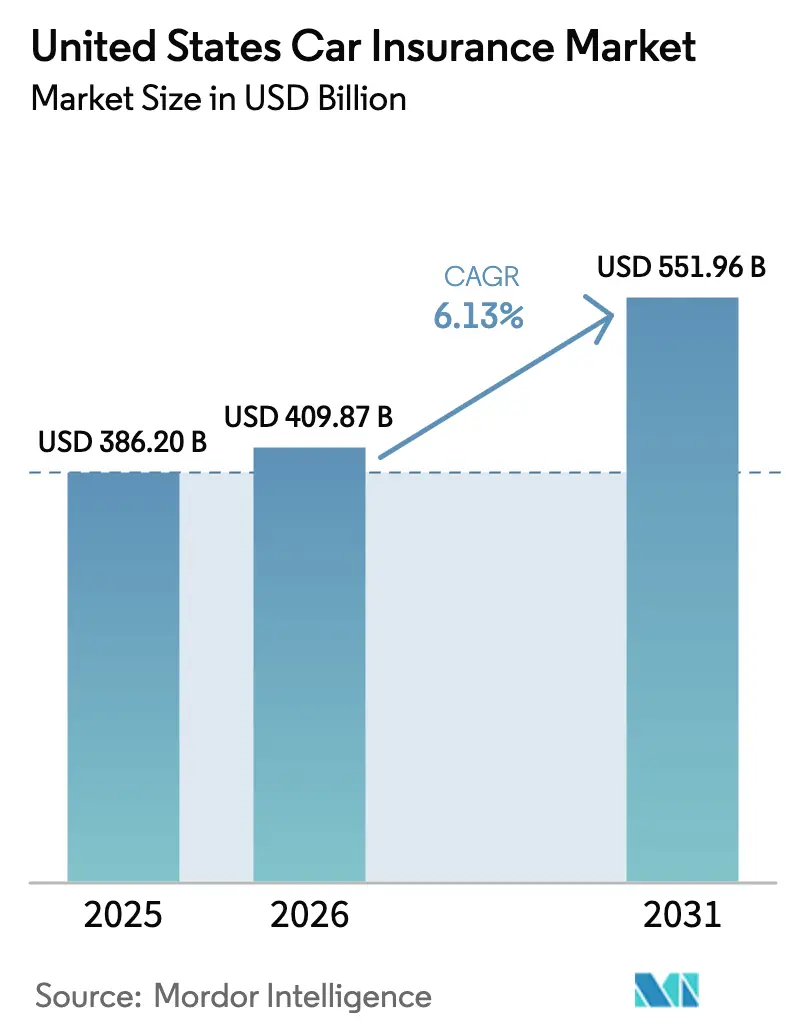
  • The US car insurance market reached $386.20 billion in 2025, showing a strong base for future growth.
  • The market grew to $409.87 billion in 2026, reflecting steady yearly expansion.
  • The industry is projected to hit $551.96 billion by 2031, highlighting long-term growth potential.
  • The market is expected to grow at a CAGR of 6.13% from 2026 to 2031.
  • The increase from $386.20 billion to $551.96 billion shows a major rise in market value over time.
  • Rising demand for auto insurance coverage continues to drive this growth.
United States Car Insurance Market Growth
(Reference: Mordor Intelligence)

Premium and Rate Trends

  • The average US full-coverage car insurance premium is about $2,697 per year, with minimum coverage around $820.​
  • Teen drivers on a family policy pay roughly $5,740–$7,956 per year for full coverage, several times more than middle‑aged drivers.
  • Bundling home and auto can yield discounts of up to 30–40%, depending on the insurer and state.
  • Telematics and usage‑based programs can cut premiums by up to 30% for consistently safe, low‑risk drivers.​
  • Across major US markets, EV insurance averages about 20–50% higher than comparable gas vehicles, with some states seeing gaps above 70%.
  • Advanced safety features and ADAS packages can qualify vehicles for discounts that reduce premiums by up to roughly 25–30%.
Newsletter Img
Don't chase the news. Let us curate it.

You get one weekly briefing with only the stories that matter. If the market is quiet, we skip it.

Read by pros at Visa, Mastercard, Vanguard, and the FDIC.

Average 6-Month Car Insurance Premiums by Age Group​

  • Drivers aged 16–19 pay the highest premiums, averaging $6,164 for 6 months due to inexperience.​
  • The 20–29 age group averages $4,500 for 6-month premiums, a notable drop from teens.​
  • Drivers aged 30–39 see average 6-month rates of $2,844.​
  • The 40–49 range pays around $2,624 on average for six months.​
  • Lowest premiums for the 50–59 group at $2,541 average for 6 months.​
  • 60–69 age group averages $2,455 for 6-month coverage.​
  • 70–79 drivers pay about $2,663 average for six months.​
  • Premiums for 80–85 rise to $2,800 due to age-related risks.

Auto Insurance Satisfaction and Switching Behavior

  • 30% of satisfied customers say they are likely to switch, while 70% say they will stay with their insurer.
  • 24% of neutral customers plan to switch providers, while 76% are not likely to switch.
  • 48% of dissatisfied customers say they are likely to switch, showing strong churn risk.
  • Only 52% of dissatisfied users say they will stay, which is much lower than other groups.
  • Customers who feel dissatisfied are almost twice as likely to switch compared to satisfied users (48% vs 30%).
  • Even among happy customers, nearly 1 in 3 still consider switching providers.
  • The data shows that customer satisfaction strongly affects switching behavior in the auto insurance market.
Auto Insurance Satisfaction And Switching Behavior
(Reference: CivicScience)

Costs and Expenditures

  • US auto insurers paid out roughly $240–$250 billion in personal auto claims, with loss ratios near or above 100% in recent years.
  • Administrative and general expenses typically represent about 10–15% of premium, with some major carriers targeting ratios closer to 9–10% through efficiency programs.​
  • Legal and defense costs tied to auto liability have been rising by roughly 10–12% annually, driven by larger verdicts and broader “social inflation” trends.
  • Auto repair and maintenance costs increased around 7–9% year over year, outpacing general inflation due to higher parts and labor prices.​
  • Typical car accident injury settlements often fall in the $20,000–$30,000 range for moderate cases, with more serious injuries frequently exceeding $100,000.
  • Insurance fraud is estimated to cost the US property-casualty industry about $80 billion annually, with AI fraud tools improving detection rates by over 30%.

Auto Insurance Costs by State

  • Michigan’s average full-coverage premium is about $3,486 per year, remaining among the highest in the country.​
  • Louisiana drivers pay roughly $3,293 per year on average for full coverage, reflecting elevated claim and litigation costs.​
  • Florida’s typical full-coverage premium is approximately $3,884 annually, driven by severe weather risk and dense traffic.​
  • California averages about $3,119 per year for full coverage, with minimum coverage around $916.
  • Vermont remains one of the cheapest states, with average full-coverage premiums near $1,610 per year.
  • Ohio’s average full-coverage premium is about $2,162 annually, while Idaho’s is closer to $1,902, both below the national mean.
  • New York drivers face average full-coverage costs of roughly $2,898–$3,254 per year, with urban high‑risk drivers paying substantially more.
Auto Insurance Costs by State (Full Coverage Premiums)

Claim Frequency and Severity

  • Overall personal auto claim counts fell about 8.5–10.4% year over year despite rising repair complexity and costs.
  • Comprehensive claim frequency reached about 7.8 claims per 100 vehicles as severe weather-related claims increased.
  • Average bodily injury claim severity climbed to roughly $23,500, up about 11% year over year.
  • Total loss frequency rose to about 22.8–23% of all claims, marking a second consecutive record high.
  • Hit-and-run claims totaled around 285,000, representing roughly 4% of all collision claims nationwide.
  • Glass-related and comprehensive claims now account for about 22% of filings, largely driven by theft and weather damage.

Key Market Indicators

  • The auto insurance industry’s total assets reach approximately $4.5 trillion globally.​
  • Direct written premiums for private auto are estimated at $278 billion.​
  • Industry combined ratio expected to stabilize at 99%.​
  • Policy retention rates decline, with 33% likely to switch providers.​
  • Customer satisfaction averages 85% among auto insurance buyers.​
  • Auto liability loss ratio hits 87.6%, highest in 11 years.​
  • Insurer expense ratios have improved by 6 percentage points over the past decade.

Auto Insurance Switching Intent by Provider

  • State Farm policyholders least likely to switch, with only 23% likely to change.​
  • Progressive customers have 29% likely to switch providers in the next 90 days.​
  • Allstate sees 35% of users considering a switch.​
  • GEICO policyholders show 34% intent to change insurers.​
  • Farmers Insurance faces 43% customer turnover risk.​
  • Liberty Mutual has 45% of policyholders likely to switch.​
  • USAA customers exhibit 47% switching likelihood.​
  • Nationwide experiences the highest churn, 53% likely to change.
Top Auto Insurance Companies By Customer Switching Intent

Impact of Technology and Telematics

  • Around 12% of U.S. drivers are enrolled in telematics insurance, while connected telematics penetration is estimated near 55%.
  • AEB and ADAS technologies reduce rear-end crashes by up to 43–50%, while blind-spot monitoring cuts lane-change crashes by about 14–19%.
  • Roughly 70–75% of insurers offer mobile apps or digital portals for claims, making digital-first filing the norm.
  • AI-driven claims tools reduce resolution times by up to 75%, cutting processing from about 30 days to roughly 7.5 days.
  • The global usage-based insurance and telematics market is valued at around $62.6 billion, with a projected 24.8% CAGR over the next decade.
  • Among younger drivers, awareness and favorability for UBI programs exceed 80–90%.
  • Predictive analytics and AI support pricing and claims decisions at roughly 70–80% of major insurers, reducing cost per claim by 30–40%.

Trends in Electric Vehicle Insurance

  • EVs represent 11% of new light-duty vehicle sales in early 2026, showing continued market growth.
  • Insurance premiums for EVs average 20-50% higher than gas-powered cars due to repair costs.​
  • Battery repairs account for 30-40% of an EV claim’s total cost, driving premium increases.
  • Tesla EVs like Model Y cost $5,074 annually to insure, among the priciest brands.​
  • 59% of the U.S. EV market share held by Tesla in Q4 2025, influencing insurance trends.​
  • EV collision repairs average 25-30% more per claim than gas vehicles.​
  • Insurers offer specialized coverage for home charging stations and related damages.​
  • 69% of new European passenger cars were electrified in January 2026, boosting insurance demand.​
  • Discounts for home chargers reduce risks, becoming standard in 2026 policies.

Frequently Asked Questions (FAQs)

What is the average monthly and annual cost of full coverage car insurance in the US in March 2026?

Full coverage car insurance averages $225 per month or $2,697 per year in the US.

What percentage of US auto insurance holders in 2026 say they are likely to switch providers in the next 90 days?

About 33% of US auto insurance customers say they are likely to switch providers in the next 90 days.

How much in net premiums written does State Farm lead US personal auto carriers with?

State Farm leads US personal auto carriers with around $50 billion in net premiums written.

By what percentage are US personal auto premiums forecasted to increase nationally in 2026?

US personal auto premiums are forecasted to increase by around 4% nationally.

Conclusion

The US auto insurance industry today is shaped by advancements in technology, shifting consumer expectations, and a growing emphasis on sustainability. As electric vehicles become more prevalent, insurers must adjust their models to cater to these new demands. Meanwhile, digital innovation is simplifying the insurance process, enhancing customer satisfaction, and improving efficiency.

Consumers benefit from a wide array of options, from telematics-based policies to regional providers, that cater to diverse needs and preferences. With challenges such as climate risks and rising costs, the industry remains dynamic, responding to both regulatory changes and consumer-driven shifts. The future of auto insurance is bright, but insurers must continue adapting to the fast-paced changes ahead.


Definition of Gas Fee. Link to full glossary entry follows the description.Gas Fee

A gas fee is the transaction cost paid to Ethereum validators for the computational effort needed to process and confirm blockchain operations.

Read more

This article has been reviewed and fact-checked by Kathleen Kinder. CoinLaw follows strict Publishing Principles and a documented Fact-Check Policy to ensure accuracy, transparency, and editorial independence across all content. Our statistics are verified using a documented Research Process.

Add CoinLaw as a Preferred Source on Google for instant updates! Follow on Google News
Share ChatGPT Perplexity

References

  • Statista
  • Auto Dealer Today
  • Recharged
  • Carrier Management
Steven Burnett

Steven Burnett

Research Analyst


Steven Burnett has over 15 years of experience across finance, insurance, banking, and compliance-focused industries. Known for his deep research and data analysis skills, Steven transforms complex topics into clear, actionable insights. At CoinLaw, he contributes in-depth articles on financial systems, regulatory trends, and lending practices, helping readers make informed decisions with confidence.

Related Posts

UK Insurance Industry Statistics
Insurance

UK Insurance Industry Statistics 2026: Growth Data

AI in Insurance Industry Statistics 2026: Adoption, Funding and Trust
Insurance

AI in Insurance Industry Statistics 2026: Adoption, Funding and Trust

Insurance Fraud Statistics
Insurance

Insurance Fraud Statistics 2026: Big Insights

Disclaimer: The content published on CoinLaw is intended solely for informational and educational purposes. It does not constitute financial, legal, or investment advice, nor does it reflect the views or recommendations of CoinLaw regarding the buying, selling, or holding of any assets. All investments carry risk, and you should conduct your own research or consult with a qualified advisor before making any financial decisions. You use the information on this website entirely at your own risk.

Reader Interactions

Leave a Comment Cancel reply

Primary Sidebar

Connect With Us

facebook x linkedin google-news telegram pinterest whatsapp email
google-preferred-source-badge Add as a preferred source on Google

You Should Also Read

Auto Insurance Industry Statistics 2026: Growth Secrets
Car Loan Statistics 2026: What You Must Know
Motorcycle Insurance Industry Statistics 2026: Growth Report

Table of Contents

  • Editor’s Choice
  • Recent Developments
  • United States Car Insurance Market Growth
  • Premium and Rate Trends
  • Average 6-Month Car Insurance Premiums by Age Group​
  • Auto Insurance Satisfaction and Switching Behavior
  • Costs and Expenditures
  • Auto Insurance Costs by State
  • Claim Frequency and Severity
  • Key Market Indicators
  • Auto Insurance Switching Intent by Provider
  • Impact of Technology and Telematics
  • Trends in Electric Vehicle Insurance
  • Frequently Asked Questions (FAQs)
  • Conclusion

Weekly stats quiz Week 41

How much of a crypto geek are you?

5 fast questions from this week's verified market data. About a minute.

Play the quiz New every Monday

Footer

CoinLaw Logo

Bringing Finance Closer to You.

Connect With Us

Follow Us on Google News

Editorial & Trust

  • About
  • Publishing Principles
  • Fact-Check Policy
  • Corrections Policy
  • Ethics Policy
  • Disclaimer
  • Cookie Policy

Worth Checking

  • The Crypto Desk
  • Exchange Listings Tracker
  • Crypto Regulation Tracker
  • Retail Options Trading Stats
  • Banking Customer Retention Stats
  • NFT Market Growth Stats
  • DeFi Market Stats
Contact Us
13570 Grove Dr #189,
Maple Grove, MN 55311,
United States
10 a.m. – 6 p.m. | Every day

Copyright © 2024–2026 CoinLaw. All Rights Reserved. Powered by the HODL Force ❤️

  • Privacy Policy
  • Terms
  • Accessibility Statement
Manage your privacy

To provide the best experiences, we and our partners use technologies like cookies to store and/or access device information. Consenting to these technologies will allow us and our partners to process personal data such as browsing behavior or unique IDs on this site and show (non-) personalized ads. Not consenting or withdrawing consent, may adversely affect certain features and functions.

Click below to consent to the above or make granular choices. Your choices will be applied to this site only. You can change your settings at any time, including withdrawing your consent, by using the toggles on the Cookie Policy, or by clicking on the manage consent button at the bottom of the screen.

Functional Always active
The technical storage or access is strictly necessary for the legitimate purpose of enabling the use of a specific service explicitly requested by the subscriber or user, or for the sole purpose of carrying out the transmission of a communication over an electronic communications network.
Preferences
The technical storage or access is necessary for the legitimate purpose of storing preferences that are not requested by the subscriber or user.
Statistics
The technical storage or access that is used exclusively for statistical purposes. The technical storage or access that is used exclusively for anonymous statistical purposes. Without a subpoena, voluntary compliance on the part of your Internet Service Provider, or additional records from a third party, information stored or retrieved for this purpose alone cannot usually be used to identify you.
Marketing
The technical storage or access is required to create user profiles to send advertising, or to track the user on a website or across several websites for similar marketing purposes.
Statistics

Marketing

Features
Always active

Always active
  • Manage options
  • Manage services
  • Manage {vendor_count} vendors
  • Read more about these purposes
Manage options
  • {title}
  • {title}
  • {title}
Manage your privacy
To provide the best experiences, we use technologies like cookies to store and/or access device information. Consenting to these technologies will allow us to process data such as browsing behavior or unique IDs on this site. Not consenting or withdrawing consent, may adversely affect certain features and functions.
Functional Always active
The technical storage or access is strictly necessary for the legitimate purpose of enabling the use of a specific service explicitly requested by the subscriber or user, or for the sole purpose of carrying out the transmission of a communication over an electronic communications network.
Preferences
The technical storage or access is necessary for the legitimate purpose of storing preferences that are not requested by the subscriber or user.
Statistics
The technical storage or access that is used exclusively for statistical purposes. The technical storage or access that is used exclusively for anonymous statistical purposes. Without a subpoena, voluntary compliance on the part of your Internet Service Provider, or additional records from a third party, information stored or retrieved for this purpose alone cannot usually be used to identify you.
Marketing
The technical storage or access is required to create user profiles to send advertising, or to track the user on a website or across several websites for similar marketing purposes.
Statistics

Marketing

Features
Always active

Always active
  • Manage options
  • Manage services
  • Manage {vendor_count} vendors
  • Read more about these purposes
Manage options
  • {title}
  • {title}
  • {title}
Company
  • About Us
  • Our Team
  • Our Mission
  • Core Values
Discover
  • glossary icon
    Glossary
  • Stats
    Stats Research Process
  • Brand Guide Icon
    Brand Assets
Categories
  • Cryptocurrency
  • Payments
  • Investments
  • Banking
  • Finance
Cryptocurrency
Crypto Regulation by Country 2026: Legal Status, Tax and Licensing
Crypto Regulation by Country Statistics 2026: Legal Status, Tax and Licensing
Biggest Crypto Hacks Statistics Ranked by Value Stolen
Biggest Crypto Hacks Statistics 2026: Ranked by Value Stolen
Perpetual Futures Statistics Volume Funding and Leverage
Perpetual Futures Statistics 2026: Volume, Funding and Leverage
Bitcoin Treasury Companies Statistics Holdings and Cost Basis
Bitcoin Treasury Companies Statistics 2026: Holdings and Cost Basis
Prediction Market Statistics Kalshi vs Polymarket Volume
Prediction Market Statistics 2026: Kalshi vs Polymarket Volume
AI Trading Bot Statistics
AI Trading Bot Statistics 2026: Market, Platforms and MEV Data
Payments
Remittances By Country Statistics
Remittances by Country Statistics 2026: Inflows and Cost
Cash App vs Zelle Statistics
Cash App vs Zelle Statistics 2026: Speed, Limits and User Data
Venmo vs. PayPal Statistics
Venmo vs PayPal Statistics 2026: Users, Fees and Volume
Toast Statistics 2026: ARR, GPV, Take Rate and Revenue
Rapyd Statistics 2026: Valuation, Revenue and PayU Deal
Marqeta Statistics
Marqeta Statistics 2026: TPV, Revenue and Customer Mix
Investments
Crypto ETF Statistics Net Assets Fees and Flows by Issuer
Crypto ETF Statistics 2026: Net Assets, Fees and Flows by Issuer
Largest Investment Banks Statistics
Largest Investment Banks Statistics 2026: Revenue, League Tables and Headcount
Public vs Robinhood Statistics
Public vs Robinhood Statistics 2026: Users, Assets, and Fees Compared
Robinhood vs Acorns Statistics
Robinhood vs Acorns Statistics 2026: Users, AUM and Fees
Robinhood vs Fidelity Statistics
Robinhood vs Fidelity Statistics 2026: Accounts, AUM, and Fees Compared
Robinhood vs Schwab Statistics
Robinhood vs Schwab Statistics 2026: Users, Assets, Pricing
Banking
Global Systemically Important Banks Statistics
Global Systemically Important Banks Statistics 2026: Bucket Allocation and Capital Surcharges
Bank Failures Statistics
Bank Failures Statistics 2026: FDIC Data, DIF Costs, and Recent Trends
The 15 Largest Banks in the US
The 15 Largest Banks in the US in 2026: By Assets, Deposits, and Branches
N26 Statistics
N26 Statistics 2026: Customers, Deposits, Revenue and the BaFin Growth Cap
Revolut vs Monzo Statistics
Revolut vs Monzo Statistics 2026: Customers & Profit
Islamic Banking Statistics Assets Growth and Top Markets
Islamic Banking Statistics 2026: Assets, Growth, and Top Markets
Finance
Federal Tax Revenue By State Statistics
Federal Tax Revenue by State Statistics 2026: IRS Gross Collections, Top 10 States, Donor vs Recipient
Tariff Revenue Statistics
Tariff Revenue Statistics 2026: Customs Duties and IEEPA Refunds
Emergency Fund Statistics
Emergency Fund Statistics 2026: How Much Americans Have Saved (and How Much They Should)
Financial Advisor Statistics
Financial Advisor Statistics 2026: Headcount, AUM, and Demographics
Wealth Inequality Statistics
Wealth Inequality Statistics 2026: Hidden Wealth Divide
Blockchain In Supply Chain Finance Statistics
Blockchain in Supply Chain Finance Statistics 2026: Trade Breakthrough
Categories
  • Cryptocurrency
  • Fintech
  • Payments
  • Compliance
  • Investments
Cryptocurrency
Ledger 86m Usd Wallet Hack Reported
Ledger Users Drained of Over $86M in Suspected Exploit
Blockchain And Cftc Application
Blockchain.com Seeks CFTC Nod for Crypto Derivatives Platform
Securitize Tokenized Stocks On Solana
Securitize Unlocks Tokenized Stock Trading on Solana
Samsung Wallet Usdc Payment Support
Samsung Launches USDC Remittances on 82M Galaxy Phones
Ledger Morpho Crypto Btc Loans
Ledger Launches Crypto Loans Through Morpho for Bitcoin Holders
Winklevoss Bros Zcash Etf S 1 Filing
Winklevoss Files S-1 for Zcash ETF at 0.25% Annual Fee
Fintech
Bybit Ceo Ben Zhou Keynote October 13
Bybit CEO Ben Zhou Sets Global Livestream Keynote
Pharos Network Realfi Ai Agent Native Upgrade
Pharos Expands RealFi With Powerful AI Agent Upgrade
Soneium Dayonedream Unveil K Pop Ip Tokenization Deal
Soneium, DayOneDream Unveil K-Pop IP Tokenization Deal
Binanec 100m Circle Stock Purchase
Binance Takes $100M Circle Stake in Strategic USDC Move
World Launches Provekit For Zk Proofs
World Launches ProveKit for On-Device Zero-Knowledge Proofs
Kraken Lseg Tokenized Stocks Deal
LSEG and Kraken Forge Major Deal for Tokenized Shares
Payments
Polygon Tron Usdt Support
Polygon Open Money Stack Adds TRON USDT Support
Circle Foundation Backs UNDP WFP Stablecoin Aid Payments
Circle Foundation Backs UNDP, WFP Stablecoin Aid Payments
Bybit Openpayd Unified Fiat Payments
Bybit’s OpenPayd Deal Brings Fiat Payments Under One Roof
Ecb Launches Pontes Digital Euro
ECB Launches Pontes, Its Wholesale Digital Euro Platform
Moneygram Launches Stablecoin Backed Visa Card In Colombia
MoneyGram Launches Stablecoin-Backed Visa Card in Colombia
Openpayd Sage Capital Partnership
Sage Capital Taps OpenPayd for USD, EUR and GBP Rails
Compliance
Uk Sanctions Crypto Payments To Russia
UK Blacklists 5 Crypto Platforms in Bold Russia Sanctions
New York Sues Polymarket Calls Prediction Markets Illegal Gambling
New York Sues Polymarket, Calls Prediction Markets Illegal Gambling
Ecb Central Banks Drop Stablecoin Deposits Rule Featured 1
ECB Pushes to Drop Mandatory Stablecoin Deposit Rule
Avalanche L1 Uaepass Blockchain Id
Avalanche Powers UAE Identity Vault for 12.5M People
Fca Review Uk Predictions Market
UK Prediction Markets Gain Hope as FCA Reviews Ban
Bitpanda Mica Austria Fine
Bitpanda Fined €70,000 in First Austrian MiCA Penalty
Investments
Okx Investment Ripple Circle Standard Chartered
OKX Raises Strategic Capital at $25 Billion Valuation
Payward And Bny Partnership Crypto Custody
Payward and BNY Explore Strategic Crypto Tie-Up
Strategy Locks Strc Dividend Rate At 12 For October
Strategy Locks STRC Dividend Rate at 12% for October
Cboe S P 500 Options Spx
Cboe and S&P DJI Extend SPX Options Exclusivity to 2051
Ondo Finance Blackrock Tokenized Stock
Ondo Brings BlackRock Portfolios On-Chain in Major Move
Kalshi Eyes 60 Stock Perps
Kalshi Eyes 60 Stock Perps as Leverage Debate Heats Up
Newsletter Img

Too much noise in crypto?

We respect your time. You get one high-impact briefing a week. If the market is quiet, so are we.

Read by pros at Visa, Mastercard, Vanguard, and the FDIC.
Newsletter Img

The Weekly Briefing

We track the market 24/7. You get a 5-minute summary. If it’s quiet, we skip it.

Read by pros at Visa, Mastercard, Vanguard, and the FDIC.