






In recent years, the crypto market has grown from niche to mainstream, capturing the attention of investors, financial institutions, and regulators alike. Amid this expansion, one crucial element defines the market’s functionality: liquidity. Without adequate liquidity, assets become harder to trade efficiently, leading to price volatility and barriers for new investors.
Understanding crypto liquidity can help market participants make smarter decisions, ensuring they navigate this ever-evolving landscape with insight. This article will explore critical statistics around liquidity in the crypto market, from key liquidity metrics to trading volume trends and the role of stablecoins today.
Editor’s Choice
- Bitcoin’s 24-hour trading volume is about $38.8 billion, keeping spot market activity elevated in March 2026.
- Bitcoin accounts for roughly 58.0% of the total crypto market, showing its continued dominance in 2026.
- The DEX-to-CEX spot trading ratio peaked at 24.5% in June 2025, while DEX spot share stood at 13.6% in January 2026.
- Around 560 million people own cryptocurrency worldwide in 2026, equal to about 9.9% of the global connected population.
- U.S. crypto exchange-traded products hold nearly $146 billion in assets across about 140 products in early 2026.
Recent Developments
- Bitcoin traded at about $71,043.14 on March 24, 2026, after rising $443.61 from the prior day.
- XRP changed hands near $1.38 on March 26, 2026, down 2.64% over 24 hours.
- Litecoin traded around $53.84 on March 29, 2026, after closing at $54.29 the previous day.
- Stablecoin market capitalization hit a record $311.3 billion in January 2026.
- Solana’s month-to-date DEX volume reached about $49.46 billion by March 26, 2026.
- Ethereum’s month-to-date DEX volume stood at roughly $37.47 billion over the same period.
- Solana led Ethereum’s March DEX volume by about 32%, extending its lead among major chains.
- Bank of America’s crypto push now reaches 15,000 financial advisors, underscoring wider TradFi integration.
Crypto Market Trends & Key Insights
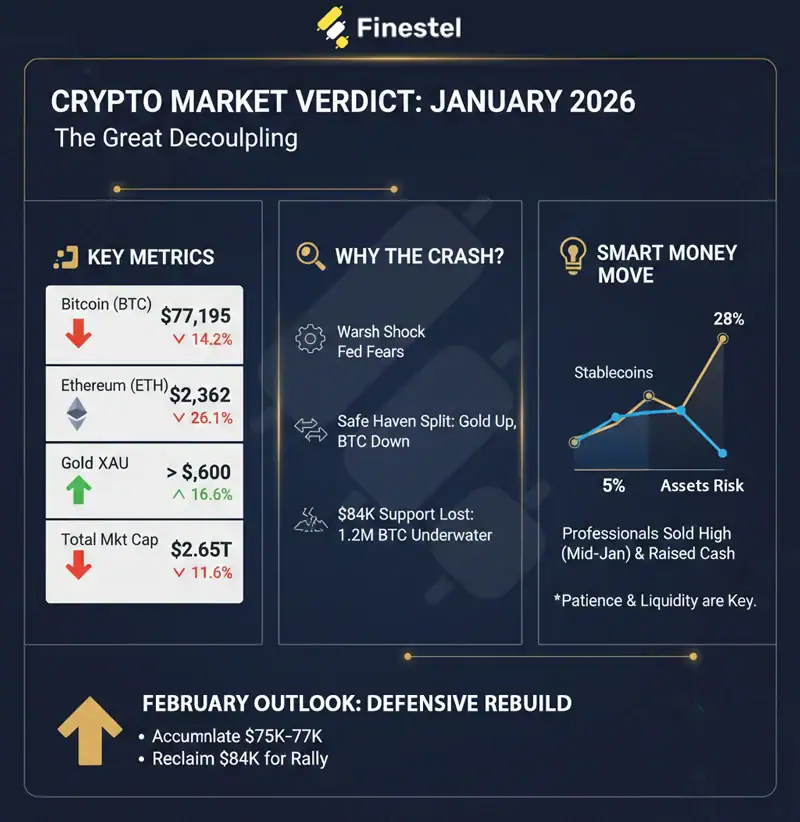
- Bitcoin (BTC) dropped to $77,195, marking a 14.2% decline, signaling short-term bearish pressure.
- Ethereum (ETH) fell sharply to $2,362, recording a deeper 26.1% drop compared to Bitcoin.
- In contrast, Gold (XAU) surged above $6,600, gaining 16.6%, highlighting a strong shift toward safe-haven assets.
- The overall crypto market capitalization declined to $2.65 trillion, reflecting an 11.6% decrease across the market.
- Market volatility was driven by global war concerns and rising Federal Reserve fears, increasing investor uncertainty.
- A clear safe-haven divergence emerged, with gold rising while Bitcoin declined, indicating capital rotation.
- The loss of the $84,000 Bitcoin support level left approximately 1.2 million BTC underwater, intensifying selling pressure.
- Institutional investors significantly increased stablecoin allocations to 28%, prioritizing liquidity and capital preservation.
- Exposure to risk assets dropped to around 5%, showing a defensive market positioning.
- Professional traders sold at mid-January highs and shifted into cash, anticipating further downside or consolidation.
- The key market strategy emphasized patience and liquidity as essential for navigating volatility.
- For February 2026, analysts suggest a defensive accumulation strategy between $75,000 and $77,000.
- A potential bullish recovery depends on reclaiming the $84,000 level, which could trigger renewed upward momentum.
Trading Volume Trends
- Combined centralized exchange trading volume fell to $5.61 trillion in February, with spot volume at $1.5 trillion.
- Binance’s spot market share declined to 22% in February, its lowest level since 2020.
- Across all tokens, Binance’s trading share slipped to 32%, while its Bitcoin spot share fell to 27%.
- Bitcoin recorded $23.11 billion in 24-hour trading volume on March 29, 2026.
- Bitcoin’s 24-hour trading volume reached $73.1 billion during a high-activity session in early March.
- Decentralized exchange spot trading volume dropped to $287 billion in February after a 15.5% monthly decline.
- Ethereum-based DEXs processed about $4.1 billion in daily volume on March 25, equal to 4.2% of total crypto volume.
- Uniswap handled $2.4 billion in 24-hour volume and held 58% of the DEX market share.
- Solana posted $117 billion in DEX volume versus Ethereum’s $52 billion, more than doubling Ethereum’s total.

Stablecoin Supply and Its Impact on Liquidity
- Tether leads the market with roughly $184.1 billion in circulating value and about 58.3% stablecoin dominance.
- USDC’s market capitalization is about $79.1 billion, keeping it the second-largest stablecoin.
- Ethereum led all chains with $1.3 billion in bridge volume by December 2025, reinforcing its role in stablecoin liquidity flows entering 2026.
- BNB Chain stablecoin supply reached $14 billion in March 2026, expanding multi-chain liquidity depth.

Monthly Price Performance of Top 10 Cryptocurrencies
- XRP traded near $1.38 on March 26 after reaching $1.74 on March 5, a swing of about 26.1% from peak to current level.
- Solana fell from $90.10 on March 5 to $80.20 on March 10, a decline of roughly 11.0%.
- Bitcoin traded at about $66,587 on March 10 and climbed to around $71,043.14 by March 24, up about 6.7%.
- Ethereum traded near $1,958 on March 10.
- Cardano rose 3.33% over 24 hours to about $0.2413 on March 26.
- TRON traded around $0.31 on March 27 and was up 0.51% over 24 hours.
- Avalanche was projected to average about $8.84 in March with a monthly high near $8.91.
- Solana processed roughly $108 billion in DEX volume over the past 30 days, supporting continued market relevance despite price weakness.
- The Solana Alpenglow upgrade won approval from 98.27% of stakers, reinforcing network confidence in March.
Exchange Liquidity Analysis
- Binance posted about $4.65 billion in 24-hour volume with an average liquidity score of 881.
- Coinbase Exchange recorded roughly $864.6 million in 24-hour volume and a liquidity score of 772.
- Kraken’s liquidity score stands at 83, ahead of KuCoin’s 71 for active trading liquidity.
- OKX holds a liquidity score of 74 and offers about 683 trading pairs.
- HTX’s annual contract trading volume reached $1.4 trillion, up about 50% year over year.
- HTX’s January trading volume rose 25.6% month over month in early 2026.
- 1inch scans more than 400 liquidity sources across 13+ blockchains for price execution.
- DEX aggregators route over $3.9 billion in weekly volume, with 1inch averaging about $8.6 billion over 30 days.
- Centralized exchanges are projected to retain about 87.4% of the crypto exchange market share in 2026.
Bid-Ask Spread
- BTC bid-ask balance stood at 48% bid versus 52% ask in early 2026.
- ETH showed 52% bid versus 48% ask, indicating slightly stronger buy-side positioning.

- BTC and ETH spreads remain at sub-basis-point levels, with stress signals flagged only if spreads widen above 0.5 bps.
- Solana’s average spread is about 1 bp, roughly 5-8x wider than BTC and ETH.
- BTC order-book depth above $650 million is treated as a sign of stronger institutional liquidity.
- Stablecoin market capitalization is around $300 billion, supporting the tightest spreads in crypto trading.
- In January, some volatile altcoins saw daily swings above 10-20%, consistent with wider spreads in thinner books.
- A $100,000 market buy can move some low-cap altcoins by 5-10% instantly because of shallow liquidity.
- During major crashes, crypto markets can see more than $1 billion in liquidations, a setup that typically widens spreads sharply.
Factors Influencing Liquidity in Crypto Markets
- Bitcoin ETF flows opened in January with a $1.2 billion inflow surge, showing how sentiment shifts can quickly deepen liquidity.
- Total crypto ETF AUM is hovering near $135 billion, underscoring institutional influence on market liquidity.
- BlackRock’s IBIT alone holds about $72 billion, equal to roughly 53% of crypto ETF assets.
- Stablecoins now account for roughly 40% of all crypto trading volume.
- Centralized exchange stablecoin-pair trading volume reached $982 billion by February 23.
- Stablecoin market dominance rose to 13.3% in February from 11.2% in January, signaling greater liquidity buffering.
- Asia-Pacific accounts for about 48% of global crypto derivatives volume, or roughly $41 trillion in 2025 activity entering 2026.
- U.S. spot Bitcoin ETF options notional volume reached $885 million as of March 27.
- Bitcoin’s average 1% market depth fell from over $8 million in 2025 to around $5 million, making liquidity more fragile.
Decentralized Finance (DeFi) Liquidity
- DeFi total value locked stands near $92.8 billion in late March 2026.
- Ethereum and its Layer 2s hold over 60% of all DeFi TVL.
- BNB Chain remains among the top DeFi networks, ranking fourth by TVL behind Ethereum, Tron, and Solana.
- Aave leads DeFi protocols with about $24.6 billion in TVL as of March 2026.
- Lido holds roughly $20.2 billion in TVL across 5 chains.
- Sky, formerly MakerDAO, accounts for about $7.6 billion in TVL in decentralized stablecoin liquidity.
- Morpho has around $6.8 billion in TVL spread across 33 chains.
- Uniswap v3 maintains about $2.29 billion in TVL and roughly $29.52 billion in 30-day DEX volume.
- Aave’s lending stack is estimated at about $40 billion in TVL, highlighting lending’s large share of DeFi liquidity.

How Cryptocurrency Exchanges Manage Liquidity
- Coinbase supports trading across 250+ crypto pairs, helping sustain liquidity across major and secondary assets.
- Binance.US lists 160+ cryptocurrencies and more trading pairs than many U.S. rivals.
- Coinbase keeps about 98% of client crypto in cold storage for operational liquidity control and risk management.
- Coinbase carries up to $255 million in crime insurance for platform-held assets.
- Aave supplies about $36.0 billion in TVL with roughly $23.7 billion borrowed, showing how DeFi pools distribute liquidity management.
- Uniswap v3 holds about $2.29 billion in TVL and processed around $29.52 billion in 30-day volume.
- Curve maintains roughly $2.18 billion in TVL and about $7.34 billion in 30-day DEX volume for stablecoin liquidity.
- On February 5 alone, more than $775 million in positions were liquidated during the market crash, pressuring exchange liquidity systems.
- Some resilient exchanges operated with over-collateralized reserves above 140% during February stress conditions.
Impact of Liquidity on Price Stability and Volatility
- BTC and ETH still trade with spreads below 0.5 bps, supporting stronger price stability than thinner crypto markets.
- Total major-market depth now exceeds $1.33 billion, giving large-cap assets better shock absorption.
- BTC depth above $650 million is viewed as a key threshold for stronger institutional-grade stability.
- Spot trading volumes across major venues remain 25-30% below late-2025 levels, leaving prices more sensitive to large orders.
- Bitcoin has fallen more than 45% from its late-2025 peak, showing how weaker liquidity can amplify volatility.
- Stablecoin transfer volume hit roughly $5.9 trillion through DEX liquidity pools in January alone.
- About 56% of stablecoin transfer volume now comes from DEX liquidity pools, anchoring high-stability trading flows.
- Flash loans reached $1.3 trillion in January, adding to high-frequency DeFi liquidity turnover.
- Some market rebounds in 2026 have still produced 20-30% rallies, highlighting how thin liquidity can magnify both upside and downside moves.
Frequently Asked Questions (FAQs)
About $300 billion after a 49% increase in 2025, making stablecoins the core market infrastructure in 2026.
DEXs processed about $57.15 billion in weekly volume as of March 26, 2026.
The DEX-to-CEX dominance ratio was 14.91% in late March 2026, meaning CEXs still handled roughly 85.09%.
DEX spot market share nearly doubled from 6.9% to 13.6% between January 2025 and February 2026.
Conclusion
Liquidity remains a fundamental aspect of the crypto market, directly affecting trading efficiency, price stability, and accessibility. As the crypto ecosystem evolves, factors like stablecoin growth, DeFi protocols, and regulatory shifts continue to shape liquidity.
Today, innovations like cross-chain interoperability and the adoption of Layer 2 scaling solutions promise to further enhance liquidity, making crypto more resilient and accessible to a broader audience. With increasing institutional and retail interest, the crypto market is set to deepen its liquidity, fostering a more robust financial landscape for years to come.