





Wealth inequality continues to shape economies, influencing everything from housing access in the U.S. to investment flows in global financial markets. For example, rising asset ownership among the top 1% drives stock market gains, while limited savings among lower-income households restrict upward mobility. As policymakers debate taxation and redistribution, understanding the latest data becomes critical. Let’s explore the most recent wealth inequality statistics and what they reveal about today’s global economy.
Editor’s Choice
- The top 10% own about 75% of global wealth, while the bottom 50% hold just 2%.
- The top 1% controls roughly 42% of global wealth.
- Fewer than 60,000 individuals (0.001%) hold more wealth than half of humanity combined.
- The bottom 50% earns less than 10% of global income, highlighting extreme disparity.
- The top 10% receives 53% of global income, while the bottom half earns just 8%.
- Since 2000, the top 1% captured 41% of all new wealth, while the bottom 50% gained only 1%.
Recent Developments
- Billionaire wealth grew by $6.5 trillion since 2015, signaling rapid concentration.
- The wealth of the top 0.001% increased from 4% in 1995 to over 6% today.
- The top 560 billionaires saw wealth grow 8.4% annually over 30 years.
- Capital income now accounts for 47% of global income, up from 39% in 1980.
- The richest 1% increased wealth by $33.9 trillion since 2015.
- Wealth inequality continues to widen despite poverty reduction in Asia, showing uneven gains.
- The top 0.1% alone holds 8.2% of global income, reflecting extreme concentration.
Global Income and Wealth Distribution
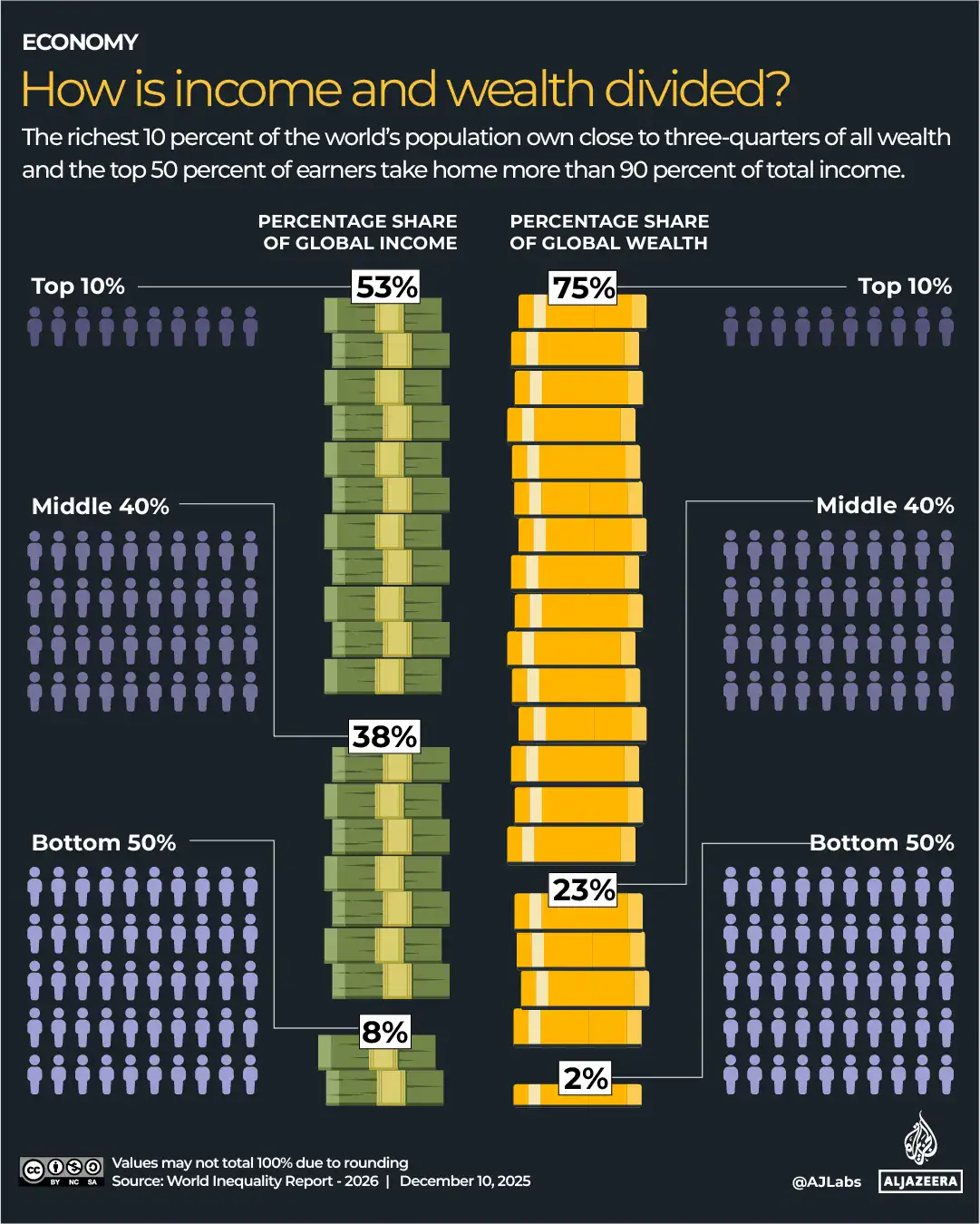
- The top 10% of the global population earn 53% of total global income, highlighting a significant concentration of earnings.
- This same top 10% controls a massive 75% of global wealth, showing wealth is even more unevenly distributed than income.
- The middle 40% account for 38% of global income, representing the largest share of working and middle-class earners.
- However, this group holds only 23% of global wealth, indicating limited asset accumulation compared to top earners.
- The bottom 50% of the population receives just 8% of total global income, reflecting limited earning power.
- Even more striking, the bottom half owns only 2% of global wealth, underscoring extreme wealth inequality.
- Overall, wealth inequality is more pronounced than income inequality, with the richest capturing a disproportionately larger share of assets than earnings.
- The data shows a widening gap where higher-income groups convert earnings into wealth more effectively, while lower-income groups struggle to build assets.
Wealth Inequality by Country
- In the United States, the top 1% holds about 35% of total wealth.
- Mexico’s top 1% controls 37% of national wealth, among the highest globally.
- India’s top 1% holds around 40% of total wealth, showing high concentration.
- In most countries, the top 10% owns more than 50% of the wealth.
- The bottom 50% in many nations own less than 10.4% of wealth.
- In the U.S., the average wealth of the top 1% exceeds $16.4 million per person.
- Developing regions show higher inequality growth rates than developed economies.
- Latin America and the Middle East report the highest within-country inequality levels.

Regional Wealth Disparities
- North America and Oceania hold 338% of the global average wealth per adult.
- These regions also generate 290% of the global average income, leading globally.
- Europe and East Asia remain above global wealth averages, but below North America.
- Sub-Saharan Africa holds significantly below-average wealth levels, highlighting structural gaps.
- South Asia’s per capita wealth remains far below global averages, despite economic growth.
- The Middle East shows high inequality due to oil wealth concentration.
- Regional inequality persists even where GDP growth is strong, indicating uneven distribution.
- Emerging economies experience faster inequality growth than developed regions.
Global Carbon Emissions Inequality by Income Group
- The top 10% of the global population is responsible for 47% of consumption-based emissions, showing a dominant share of everyday carbon output.
- When measured by ownership, this group’s impact rises sharply to 77% of total emissions, highlighting how asset ownership drives emissions inequality.
- The top 1% alone contribute 15% of consumption-based emissions, but their share jumps to a striking 41% of ownership-based emissions, reflecting extreme concentration among the ultra-wealthy.
- The middle 40% generate 43% of consumption emissions, making them a major contributor through daily economic activity.
- However, their ownership-based emissions drop significantly to 20%, indicating lower control over high-emission assets.
- The bottom 50% account for just 10% of consumption-based emissions, showing minimal contribution to global carbon output.
- Their ownership-based emissions are even lower at only 3%, underscoring limited access to emission-intensive assets.
- Overall, emissions inequality is far more pronounced in ownership-based measures, where wealthier groups dominate due to investments, assets, and capital-intensive activities.
- The data highlights a clear pattern where higher-income groups not only consume more but also own assets that generate disproportionately higher emissions.

Top 1% Wealth Share Statistics
- The top 1% globally owns about 38% to 42% of total wealth, depending on methodology.
- Since 2000, the top 1% captured over 40% of wealth growth worldwide.
- The average wealth of the global top 1% exceeds $1 million per adult, compared to under $10,000 for the bottom 50%.
- In Europe, the top 1% controls roughly 25% of wealth, lower than in the U.S. but still rising.
- China’s top 1% wealth share increased to over 30% in 2025, reflecting rapid asset growth.
- The top 1% owns nearly half of the financial assets globally, including stocks and bonds.
- Wealth concentration accelerated after COVID-19, with the top 1% capturing two-thirds of new wealth (2020–2023).
- In Latin America, the top 1% holds over 45% of wealth, among the highest globally.
Top 10% Wealth Share
- The top 10% globally owns about 76% of total wealth, leaving little for the majority.
- In the U.S., the top 10% controls nearly 70% of household wealth.
- Europe’s top 10% holds around 60% of wealth, reflecting more redistribution policies.
- The top 10% share in India exceeds 65% of national wealth, highlighting rising inequality.
- In emerging markets, the top 10% share has grown by 5–10 percentage points since 2000.
- The top 10% owns over 85% of equities globally, driving investment returns concentration.
- In OECD countries, the top 10% wealth share increased steadily post-2008 financial crisis.
- High-income households in the top 10% save over 25% of income, compared to near-zero for lower groups.
Gini Coefficient Rankings
- The global wealth Gini coefficient stands at 0.88, indicating extreme inequality.
- South Africa has one of the highest Gini scores at 0.63 for income inequality.
- Brazil’s Gini coefficient remains high at around 0.53, despite recent improvements.
- The United States has a Gini coefficient of 0.41, among the highest in developed nations.
- Nordic countries maintain lower Gini scores, with Sweden at 0.29, due to redistribution policies.
- China’s Gini coefficient is around 0.47, reflecting rising inequality.
- India’s Gini is estimated at 0.35–0.38, though wealth inequality is higher.
- Latin America remains the most unequal region, with average Gini scores above 0.45.
- Wealth inequality Gini is consistently higher than income inequality Gini across all regions.

Bottom 50% Wealth Share
- The bottom 50% owns just 2% of global wealth, unchanged in recent years.
- In the U.S., the bottom half holds only 2.6% of total wealth, despite representing half the population.
- The average wealth of the bottom 50% globally is under $10,000 per adult.
- Since 2000, the bottom 50% captured just 1% of wealth growth globally.
- In Europe, the bottom 50% owns around 5% of wealth, higher than in the U.S.
- The bottom 50% earns less than 10% of global income, limiting savings capacity.
- Debt levels among the bottom 50% increased significantly, reducing net wealth.
- In developing countries, the bottom 50% often hold less than 5% of national wealth.
- Wage stagnation has kept the bottom 50% wealth growth near zero in real terms since 1990.
Billionaires and Ultra-Rich
- Billionaires collectively hold over $14 trillion in wealth, a record high.
- The top 10 richest individuals own more wealth than the bottom 40% of the U.S. population.
- The number of ultra-high-net-worth individuals (>$50M) increased by over 20% since 2020.
- In the U.S., billionaires pay an effective tax rate below 8%, far lower than that of average workers.
- Tech sector billionaires account for a significant share of new wealth creation, especially in the U.S. and China.
- The top 0.01% owns more than 11% of global wealth, highlighting extreme concentration.
Wealth and Climate Emissions
- The top 10% of earners generate nearly 50% of global emissions, linking wealth to environmental impact.
- The richest 1% emit more than double the emissions of the poorest 50% combined.
- High-income households consume over 70% of global resources, driving emissions.
- The bottom 50% contributes just 12% of global emissions, despite representing half the population.

- Luxury consumption, including aviation, accounts for a disproportionate share of emissions among the wealthy.
- Carbon footprints in North America are more than 10 times higher than in Sub-Saharan Africa.
- Climate change disproportionately impacts low-income populations, despite their minimal contribution.
- Wealth inequality complicates climate policy, as high emitters resist regulation more often.
- Green investments remain concentrated among wealthy nations and individuals, widening climate finance gaps.
Income vs Wealth Inequality Trends
- Global wealth inequality remains far higher than income inequality, with wealth Gini at 0.88 vs income Gini near 0.67.
- Since 1980, the top 1% income share has increased from 16% to over 20% globally.
- Wealth accumulation has accelerated faster than income growth due to rising asset prices and capital returns.
- The bottom 50% saw income growth in Asia, but wealth gains remain limited due to low asset ownership.
- In the U.S., wealth inequality grew twice as fast as income inequality since 1990.
- Capital income now represents nearly 50% of total income globally, reinforcing wealth gaps.
- The top 10% captures over half of all income, while wealth concentration remains even higher.
- Rising housing and stock prices contributed to wealth gains concentrated among high-income households.
- Younger generations hold less wealth relative to income compared to previous generations, widening intergenerational gaps.
Gender Wealth Inequality Statistics
- Women globally earn about 20% less income than men, limiting wealth accumulation.
- Women own less than 40% of global wealth, despite representing half the population.
- In the U.S., single women hold only 55 cents of wealth for every $1 held by single men.
- Women are less likely to own financial assets, including stocks and retirement accounts.
- The global gender pension gap stands at around 30%, affecting long-term wealth.
- Female labor force participation remains below 50% globally, impacting income and savings.
- Women perform over 75% of unpaid care work, limiting earning potential.
- In developing countries, women own less than 20% of land, restricting wealth-building opportunities.
- Closing gender gaps could increase global wealth by over $160 trillion in human capital.
Causes of Wealth Inequality
- Unequal access to education leads to income and wealth gaps across generations, with €200 vs €9,000 spending per child.
- Tax policies favor capital gains, allowing the wealthy to accumulate faster, as the top 10% own 75% global wealth.
- Inheritance accounts for over 50% of wealth in some developed economies, according to recent reports.
- Globalization increases returns to capital, benefiting high-income investors with 8% annual billionaire wealth growth.
- Wage stagnation limits wealth-building as the bottom 50% hold only 2% global wealth.
- Housing market inflation prices out middle/low-income, driven by top income growth outpacing median.
- Financial market access is limited for lower-income individuals, restricting investments amid 77% emissions by the top 10% owners.
- Technological change favors high-skilled, raising wage Gini by 21.5% without automation adjustment.
- Weak labor protections contribute to inequality, with 300 million workers in extreme poverty under $3/day.
- Global finance transfers 1% GDP yearly from poor to rich nations, entrenching wealth gaps.
Impacts of Wealth Inequality
- High inequality reduces economic growth by limiting consumer spending, as the top 10% own 75% global wealth.
- Wealth gaps lower social mobility, with education spending €200 vs €9,000 per child shaping life chances.
- Inequality boosts political polarization as billionaires are 4,000 times more likely to hold office.
- Health worsens in unequal societies with 33-year life expectancy gaps between the richest/poor countries.
- Education gaps widen as top the 10% wealth 200 times that of the bottom 50% enables more private investments.
- High inequality correlates with higher crime as income gaps raise homicide rates in rich nations.
- Wealth concentration limits entrepreneurship with 6.25% inequality drop from more activities.
- Economic shocks hit low-income harder amid 1% GDP annual flow from poor to rich nations.
- Persistent inequality slows poverty reduction, with the bottom 50% holding 2% global wealth.
Frequently Asked Questions (FAQs)
The top 10% owns about 75% of global wealth, while the bottom 50% holds just 2%.
The bottom 50% controls only around 2% of total global wealth.
The top 10% receives approximately 53% of global income, compared to 8% for the bottom half.
The richest 1% captured about 41% of all new wealth created since 2000.
The top 1% in the U.S. holds around 31.7% of total wealth as of 2025, a record high.
Conclusion
Wealth inequality today reflects a deeply uneven global economy, where asset ownership, capital income, and inheritance continue to shape opportunity. While some regions have seen income growth, wealth remains heavily concentrated at the top, creating long-term structural challenges. Policymakers, businesses, and institutions must balance growth with fairness to ensure sustainable economic progress. As the data shows, addressing inequality is not just a social priority; it is essential for economic stability and global resilience.