





GTN and Payward, the parent company of Kraken, partnered to expand the xStocks tokenised equities framework beyond U.S. markets, starting with equities listed in Hong Kong, the companies said in a joint announcement on July 22, 2026.
Key Takeaways
- GTN and Payward will tokenise equities listed in Hong Kong first, then expand to UK-listed, European, and South Korean assets, per Payward.
- The partnership also opens xStocks to tokenised asset classes beyond equities for the first time, per GTN.
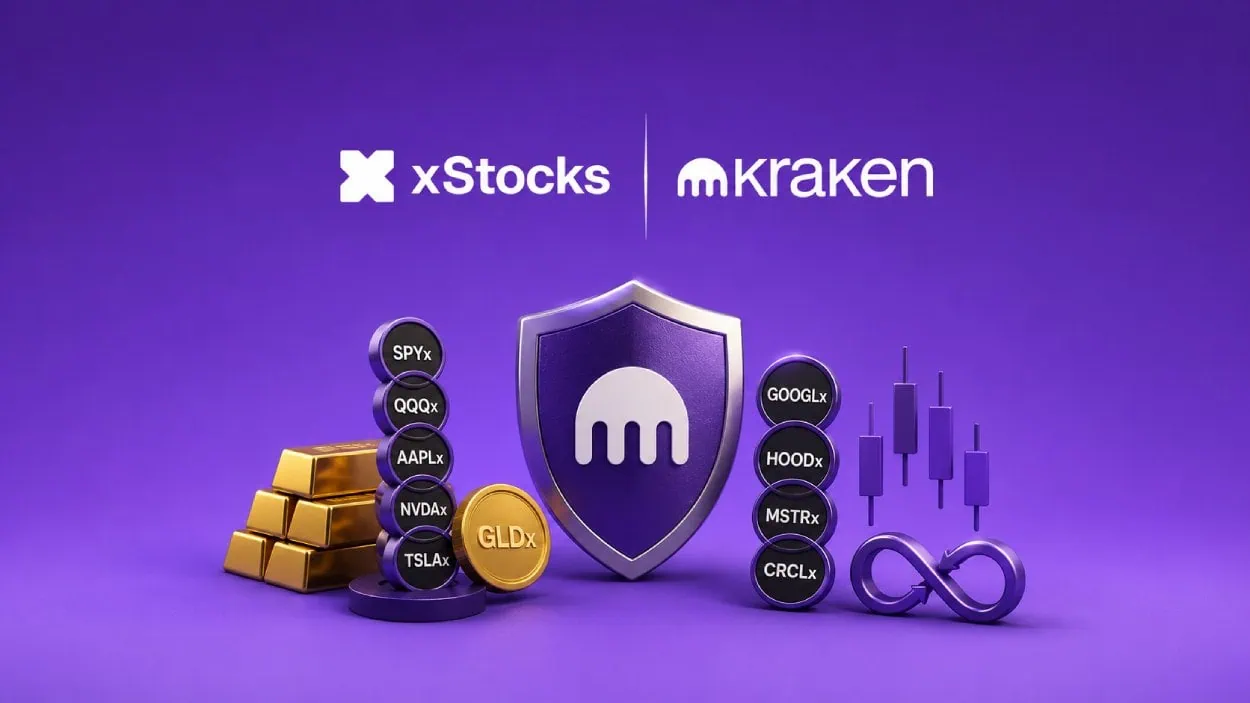
- xStocks has grown to more than 500 tokenised assets and over $35 billion in transaction volume, with nearly 200,000 holders worldwide since launching a year ago.
- GTN will provide execution, custody, and ledgering infrastructure for the underlying assets, and could list xStocks to its own institutional clients once it secures the required licences in each market, per GTN.
- xStocks currently operates through Bermuda- and Cyprus-licensed Payward entities and is not yet available in the United Kingdom, a gap the new markets still have to close.
What Happened?
GTN, a fintech infrastructure provider, and Payward, the parent company of Kraken, have partnered to enhance and accelerate the global expansion of the xStocks offering. GTN provides the global execution and custody for the traditional assets underlying xStocks’ expansion, a role distinct from Payward’s, which built and operates the tokenisation framework itself.
Under the agreement, GTN provides infrastructure to support the ledgering and record keeping of tokenised products, helping token issuers account for the underlying assets. That accounting layer is what lets a foreign listed stock become an onchain token without breaking the link back to the real world share.
We’ve partnered with @PaywardServices to enable @xStocksFi ‘ global expansion; tokenising assets in Hong Kong first, and more to follow.
— GTN (@GTNglobal) July 22, 2026
We provide execution, custody and ledgering behind the assets: https://t.co/MJVgOT38Dz#Tokenisation #DigitalAssets #FinTech pic.twitter.com/CZVv8vtzhx
How GTN Powers the Expansion?
Subject to GTN obtaining the required licences in each market, GTN would also make a range of xStocks available to its institutional clients alongside its existing offering. That clause separates the token-issuance business from the licensed brokerage business: GTN’s own institutional distribution of xStocks does not start until each local regulator signs off.
GTN’s brokerage infrastructure already spans more than 90 markets and 8 asset classes through a single API, the same network Payward is tapping to move xStocks beyond its current lineup of tokenised U.S. equities. Each expansion beyond the U.S., to equities listed in Hong Kong, the UK, Europe and South Korea, and eventually other asset classes, remains subject to regulatory approvals in the relevant market.
Why Licences Set the Real Timeline?
xStocks currently operates through Backed Assets (JE) Limited, a Jersey based issuer, with Payward Digital Solutions Ltd. licensed by the Bermuda Monetary Authority and Payward Europe Digital Solutions (CY) Ltd. authorized under MiFID II in Cyprus. The product is not yet available in the United Kingdom. That licensing stack does not yet cover Hong Kong or South Korea, so the expansion reads as a regulatory build-out rather than a simple product switch-on.
On xStocks’ own platform comparison, tokenised equities settle immediately and trade with 24/7 onchain market access and wallet compatible custody, against T+1 settlement, limited trading hours, and broker controlled custody for a traditional brokerage. That gap, a settlement and custody model that never closes, layered onto shares that today only trade inside local market hours, is the real product GTN is importing into these markets.

CoinLaw’s Takeaway
This deal reads as a market-access problem, not a technology problem. xStocks already proved the token issuance and custody mechanics work at U.S. scale. What Payward lacked was a partner already holding brokerage and capital-markets licences in the exact non-U.S. jurisdictions it wants to enter next, and GTN supplies that licence inventory directly rather than Payward building broker-dealer relationships market by market from nothing.
The regulatory language throughout the announcement explains the sequencing. Every new market is gated on approvals GTN and Payward do not yet hold, so Hong Kong’s early position in the rollout likely reflects where GTN’s existing licence footprint already reaches, not strategic preference. That framing also explains why institutional distribution through GTN reads as conditional rather than immediate: retail style token issuance can move faster than the broker-dealer relationships institutional buyers require, and the two tracks are advancing at different speeds inside the same partnership.