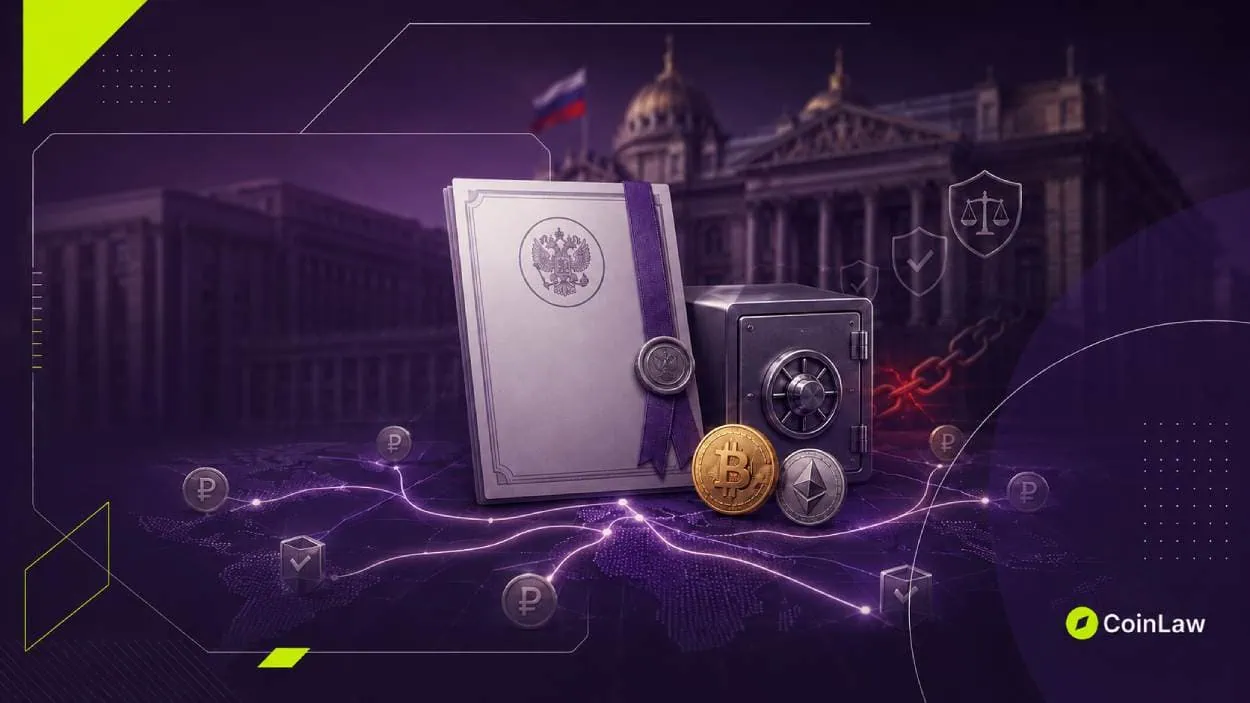






The State Duma passed Russia’s first comprehensive cryptocurrency law on July 21, 2026, creating a licensing regime that takes effect September 1, 2026. The law keeps crypto banned for domestic payments, licenses exchanges and brokers under Bank of Russia oversight, and legalizes cross-border trade settlement.
Key Takeaways
- The State Duma completed the second and third readings of bill No. 1194918-8, clearing it for Federation Council approval and President Putin’s signature.
- Non-qualified retail investors face a 300,000-ruble (about $3,800) annual purchase cap per licensed intermediary, while qualified investors face no such limit.
- Russia’s central bank, the Bank of Russia, will license five categories of crypto firms, including exchanges, brokers, and depositories, once the law takes effect.
- Blockchain-analytics firm TRM Labs found the ruble-pegged A7A5 stablecoin moved more than $72 billion in sanctions-related flows during 2025.
- Sberbank and the Moscow Exchange are already building crypto custody and trading infrastructure ahead of the law’s rollout.
What Happened?
Anatoly Aksakov, chairman of the State Duma Committee on Financial Markets, confirmed the vote a day in advance in remarks to the Russian outlet RBC. Aksakov said the bill was aimed at creating legal conditions for the functioning of cryptocurrencies in our country.
The vote, per TASS, marks the first time Russia has comprehensively regulated the circulation of digital currencies in one law. The State Duma’s own legislative record lists the bill under No. 1194918-8.
Blockchain forensics firms Chainalysis, TRM Labs, and Elliptic have each tracked sanctioned crypto activity connected to Russia, with Elliptic characterizing one Moscow-based network’s business model as sanctions evasion as a service. The new licensing regime is designed to pull that activity inside Bank of Russia oversight, not eliminate it.
The bill still requires Federation Council approval, Russia’s upper parliamentary chamber, and President Putin’s signature, a process expected to take approximately two additional weeks, before it takes legal effect. Firms may keep operating without formal registry listing until a July 1, 2027 deadline, after which only organizations in the special registry may conduct digital currency exchange activity.
🚨 BREAKING: Russia just took another step toward crypto adoption.
— blinq (@blinqfi) July 21, 2026
Crypto is now recognized as property, with state-supervised cross-border trade approved. 🇷🇺 pic.twitter.com/kA02iI5Vzq
What the Law Permits and Restricts?
The law maintains Russia’s ban on using digital currencies as a means of payment domestically and bars advertising that promotes paying for goods or services with cryptocurrency. Exceptions cover settlements under foreign trade contracts between residents and non-residents, cryptocurrency obtained through mining, and transactions involving securities or other digital rights.
Only cryptocurrencies with an average market capitalization above approximately 5 trillion rubles and daily trading volume above 1 trillion rubles qualify for organized exchange trading, a threshold expected to initially limit trading to Bitcoin, Ether, and possibly Solana. Privacy focused cryptocurrencies that conceal transaction data remain prohibited, and an earlier draft requirement to disclose individual wallet addresses was dropped in July revisions.
Banks must refuse transfers when they suspect an unauthorized entity is conducting digital-currency exchange activity. The law also guarantees judicial protection for digital currency holders, regardless of whether the assets were previously declared.
Crypto businesses must register once monthly turnover exceeds roughly 3.5 million rubles, about $38,000, and unregistered operation above that threshold carries criminal liability of up to seven years in prison.
From Gray Market Networks to State Licensed Rails
Garantex, the Russia-based exchange that processed more than $60 billion in crypto for sanctioned entities, operated until US law enforcement shut it down in March 2025. A successor, Grinex, took over Garantex’s role until it suspended operations in April 2026 after an alleged $13.7 million cyberattack its operators attributed to “Western special services“.
The names changed. The function did not.
The ruble pegged A7A5 stablecoin, launched by the Moscow based A7 network to reduce dependence on US-regulated stablecoins, had processed more than $100 billion in total transactions by January 2026. Chainalysis’s 2026 Crypto Crime Report separately put sanctioned-entity crypto receipts across all programs at $104 billion in 2025, a 694% increase year-over-year.
The EU’s 20th sanctions package, which took effect in May 2026, banned Russian established crypto service providers from transacting with EU residents and prohibited both the digital ruble and the RUBx stablecoin. Its 21st package introduced a mechanism letting the EU impose blanket crypto service bans on entire non-EU countries found to host sanctions-evading platforms, a country level tool exchange by exchange designations could not provide.

Implications for Compliance Teams
Under Executive Order 14024, OFAC, the US Treasury’s Office of Foreign Assets Control, can impose secondary sanctions on foreign financial institutions that process transactions for sanctioned Russian entities, regardless of whether the Russian institution itself appears on the SDN list.
Any exchange that onboards Russia’s newly licensed intermediaries as clients, or settles transactions denominated in A7A5 or similar instruments, takes on that secondary-sanctions exposure even though the activity is legal under Russian law. A licensed Russian counterparty is a traceable, named entity, not a background gray-market node. That raises the diligence bar instead of lowering it.
CoinLaw’s Takeaway
This law does not eliminate Russia’s sanctions evasion problem for Western regulators, it relocates it. Garantex and then Grinex operated outside any legal framework, so regulators named each one, sanctioned it, and shut it down. Once the licensing regime takes effect on September 1, 2026, a Bank of Russia-licensed exchange, broker, or depository operates inside Russian law instead, reporting to a domestic regulator that can replace one licensed entity with another rather than rebuilding from scratch.
The bill’s domestic caution, a low retail purchase ceiling, mandatory investor testing, and a ban on privacy coins, sits deliberately next to its international permissiveness for foreign trade settlement. Russia is not opening its economy to crypto, it is building an export facing settlement rail its own citizens cannot easily use at home. For compliance teams outside Russia, the practical test is not whether a counterparty holds a valid license, it is whether that counterparty shows up anywhere near a sanctions list.