





Crypto OTC (over-the-counter) trading has evolved into a core liquidity channel for large-scale digital asset transactions. Institutions now rely on OTC desks to execute multi-million-dollar trades without triggering price swings, while stablecoin issuers use OTC rails for cross-border settlements and treasury management. From hedge funds quietly accumulating Bitcoin to fintech firms settling payments off-exchange, OTC trading shapes how capital flows through crypto markets. Let’s explore the latest statistics driving this rapidly expanding segment.
Editor’s Choice
- The crypto OTC market is estimated to exceed $50–$60 billion in average daily trading volume in 2026.
- Institutional investors now account for over 65% of total crypto trading activity in 2026.
- Stablecoin transactions in OTC markets represent over 70% of settlement volume in 2026.
- OTC desks are expected to process over 115% growth in institutional spot trading volume in 2026.
- Leading market makers report 200%–250% cumulative growth in OTC trading volumes over 2023–2025, with 2024 OTC volumes up 106% and 2025 spot OTC volumes up ~109%.
- OTC trading ecosystems are estimated to surpass $1.5 trillion in daily liquidity access across asset classes in 2026.
Recent Developments
- Institutional OTC activity continues to grow at over 110% annually in 2026, far outpacing exchange growth.
- Stablecoin-based OTC transactions now account for more than 75% of total settlement flows in 2026.
- More than 55% of OTC desks report triple-digit growth in trading activity entering 2026.
- Bitcoin OTC trading volumes are growing steadily at ~10% YoY in 2026, indicating continued accumulation.
- Ethereum OTC trading volumes are expanding at over 90% growth rates in 2026, reflecting diversification.
- Altcoins now represent over 35% of OTC trading volume in 2026, up significantly in recent years.
- OTC markets continue to benefit from institutional inflows linked to ETFs and macroeconomic shifts in 2026.
Crypto OTC Volume Surge
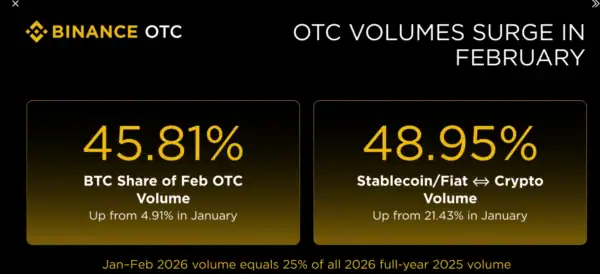
- BTC dominated OTC trading, accounting for 45.81% of February 2026 volume, a sharp rise from just 4.91% in January, highlighting a strong institutional accumulation trend.
- Stablecoin and fiat-to-crypto transactions surged, making up 48.95% of OTC volume in February, compared to 21.43% in January, signaling increased liquidity inflows and settlement activity.
- OTC trading activity accelerated rapidly, with January–February 2026 volume already reaching 25% of the total 2025 full-year volume, indicating explosive early-year growth.
- The data reflects a significant shift toward large block trades, where both Bitcoin and stablecoin corridors dominate institutional OTC execution strategies.
- The sharp month-over-month increases suggest growing reliance on OTC desks for high-value transactions, reducing slippage and market impact compared to exchanges.
Crypto OTC Institutional Adoption
- Institutional investors dominate over 65% of crypto trading volume in 2026, reinforcing OTC reliance.
- OTC desks remain the preferred channel for block trades exceeding $1 million, with usage continuing to grow in 2026.
- Institutional OTC volumes are expanding at triple-digit growth rates in 2026, driven by hedge funds and asset managers.
- Market makers report sustained 2x–4x growth in OTC volumes entering 2026.
- Europe continues to account for ~40% of institutional OTC spot trading volume in 2026.
- US crypto transaction activity has increased by over 55% in 2026, supporting institutional OTC flows.
- Institutions increasingly shift liquidity away from exchanges to OTC platforms for privacy and execution efficiency in 2026.

Key Players
- Leading OTC desks collectively handle over $9 trillion in centralized‑plus‑OTC volume annually in 2026.
- Top desks see monthly OTC inflows in the hundreds of billions of dollars, with spikes around institutional rebalancing windows.
- Binance OTC alone reached 25% of its 2025 full‑year OTC volume within the first two months of 2026.
- Around 60% of OTC market participants forecast a net reduction in active liquidity providers by end‑2026, sharpening concentration among top desks.
- Institutional‑grade OTC platforms now operate across 40+ jurisdictions, up from roughly 25 in 2025.
- More than 800 crypto trading venues fragment spot liquidity, pushing large flows into a shrinking pool of top 20–30 OTC desks.
- Prime‑broker‑backed OTC desks capture roughly 60–70% of institutional block‑trade volume in 2026, according to market‑share estimates.
- OTC‑linked infrastructure hubs now bundle custody and settlement for over $150 billion in daily notional exposures across crypto‑fiat pairs.
Asset Distribution
- Bitcoin accounts for ~45% of total OTC trading volume in 2026, maintaining its dominance.
- Ethereum represents ~25% of OTC volume in 2026, reflecting strong institutional demand.
- Altcoins now make up over 35% of OTC trading volume in 2026, driven by diversification.
- Stablecoins represent over 30% of OTC settlement volume in 2026, especially in cross-border trades.

- Tokenized real-world assets account for ~10% of OTC activity in 2026, showing rapid growth.
- DeFi tokens continue to see over 100% demand growth in OTC markets in 2026.
- NFT-related OTC transactions remain niche but contribute ~3% of specialized desk volume in 2026.
- Institutional portfolios now hold 4–6 major crypto assets on average in 2026, increasing diversification.
- Privacy coins account for less than 2% of OTC trades in 2026, due to compliance constraints.
Top OTC Desks
- The global crypto OTC market is led by desks handling over $1B+ monthly trading volumes in 2026, with top firms dominating institutional flow.
- Leading liquidity providers facilitate multi-billion-dollar daily OTC liquidity during peak periods in 2026.
- Major OTC desks execute trades across 40+ liquidity venues globally in 2026, optimizing pricing.
- OTC desks consistently support block trades exceeding $10 million, especially for hedge funds and family offices in 2026.
- OTC desks now offer 24/7 trading coverage, aligned with global crypto markets in 2026.
- Institutional desks provide same-day or near-instant settlement in over 85% of trades in 2026.
- More than 70% of institutional trades above $1M are executed via OTC desks in 2026.
- OTC desks continue to integrate prime brokerage services, including lending and derivatives, in 2026.
Stablecoin Dominance
- Stablecoin OTC volumes now dominate, accounting for over 75% of settlement flows in 2026.
- USDT and USDC together represent over 85% of stablecoin OTC usage in 2026.
- Stablecoins are used in over 75% of OTC transactions as settlement rails in 2026.
- Cross-border payments via stablecoin OTC channels have increased by over 65% in 2026.
- Stablecoins reduce settlement time by up to 90% compared to traditional banking rails in 2026.
- Over 55% of institutional clients prefer stablecoin settlement in 2026.
- Algorithmic stablecoins contribute less than 5% of OTC volume in 2026, reflecting risk concerns.
- Stablecoin liquidity pools have expanded by over 90% in OTC-linked markets by 2026.
- OTC desks now support multi-currency stablecoin settlements, including EUR and GBP-pegged tokens in 2026.
Regional Breakdown
- Europe accounts for ~40% of institutional OTC crypto trading volume in 2026, maintaining leadership.
- North America contributes approximately 35%–38% of OTC volume in 2026, driven by institutional inflows.
- Asia-Pacific represents nearly 25%–28% of OTC trading activity in 2026, led by Singapore and Hong Kong.

- Latin America continues to see over 45% growth in OTC adoption in 2026, driven by inflation hedging.
- Middle East OTC volumes are expanding at ~35% YoY in 2026, supported by regulatory clarity.
- Africa’s OTC crypto usage is growing by ~25% YoY in 2026, largely tied to remittances.
- The US recorded a ~55% increase in crypto transaction activity in 2026, supporting OTC growth.
- Cross-border OTC trades account for over 60% of total OTC volume globally in 2026.
- Institutional desks increasingly operate in regulated jurisdictions, exceeding 75% compliance coverage in 2026.
Liquidity Provision
- OTC desks provide access to liquidity pools exceeding $120 billion globally in 2026.
- Market makers increased liquidity provision by over 130% leading into 2026, supporting OTC growth.
- OTC trading reduces slippage by up to 70% compared to exchange-based execution in 2026.
- Institutional liquidity providers operate across multiple venues simultaneously in 2026, improving pricing efficiency.
- OTC desks aggregate liquidity from 800+ global exchanges and brokers in 2026, reducing fragmentation.
- Liquidity fragmentation persists, with top exchanges accounting for less than 50% of global volume in 2026.
- OTC desks enable execution of large trades without affecting market depth in 2026.
- Algorithmic execution tools improve OTC pricing efficiency by ~40% in 2026.
- Liquidity providers increasingly combine OTC and derivatives hedging strategies in 2026, reducing volatility exposure.
Comparison with Exchanges
- OTC trading accounts for 35%–50% of total crypto volume for large trades in 2026.
- OTC execution reduces price slippage by up to 70% compared to centralized exchanges in 2026.
- Centralized exchanges continue to process trillions in annual trading volume in 2026, largely retail-driven.
- OTC desks handle most trades above $1 million in 2026, while exchanges dominate smaller trades.
- Exchange volumes are growing at single-digit rates in 2026, compared to strong OTC growth.
- OTC trading offers greater privacy, with transactions not visible on public order books.
- Exchanges provide instant liquidity, while OTC focuses on negotiated pricing for large blocks.
- Institutional investors prefer OTC due to custom pricing and reduced market impact in 2026.
- OTC desks increasingly integrate with exchanges, enabling hybrid execution models in 2026.
Regulatory Impact
- The US accounts for ~25% of global crypto transaction value in 2026, reflecting regulatory influence.
- Over 75% of institutional OTC desks operated under regulatory frameworks in 2026.
- Regulatory clarity has driven a significant increase in institutional OTC participation in 2026.
- Europe’s MiCA framework now covers over 90% of crypto firms in the EU in 2026, improving transparency.
- Compliance costs for OTC desks have increased by ~30% by 2026, due to stricter AML and KYC rules.
- Over 70% of institutional investors cite regulation as a key factor when choosing OTC venues in 2026.

Security and Counterparty Risk Statistics
- Counterparty risk remains a concern, with ~20% of institutional traders citing it as a key challenge in 2026.
- OTC desks use escrow or custody solutions in over 80% of large transactions in 2026.
- Fraud-related OTC incidents have declined by ~25% leading into 2026, reflecting improved safeguards.
- Institutional-grade custody providers manage over $350 billion in crypto assets in 2026, supporting security.
- Multi-signature wallet adoption has increased by over 45% among OTC desks by 2026.
- Around 70% of OTC desks offer insured custody services in 2026, reducing risk exposure.
- Smart contract-based settlement is used in ~20% of OTC transactions in 2026.
- Due diligence processes take 2–4 days on average for new counterparties in 2026.
- Counterparty defaults remain rare, affecting less than 2% of OTC transactions globally in 2026.
Technological Innovations in OTC Trading Platforms
- Algorithmic OTC trading tools improve execution efficiency by ~40% in 2026.
- AI-driven pricing models power over 55% of institutional OTC trades in 2026.
- API-based trading integrations have increased by ~65% YoY, leading into 2026.
- OTC platforms connect to 800+ liquidity sources in 2026, improving aggregation.
- Blockchain-based settlement reduces transaction times by up to 90% in 2026.
- Smart order routing improves execution success rates by ~30% in 2026.
- Tokenization platforms enable OTC trading of real-world assets, growing by over 90% by 2026.
- Custody-tech integration reduces operational errors by ~35% across OTC platforms in 2026.
- Institutional dashboards provide real-time liquidity tracking across venues in 2026, improving decision-making.
Frequently Asked Questions (FAQs)
Around 40% of institutional firms prefer OTC desks, with many routing over 50% of their trading volume off-exchange.
Most OTC platforms require a minimum trade size between $50,000 and $250,000, depending on the provider.
About 60% of OTC market participants expect fewer liquidity providers by the end of 2026.
Roughly 25% predict a significant decrease, while another 37% expect a slight contraction in liquidity providers.
Around 75% of liquidity providers report declining spread margins due to increased competition.
Conclusion
Crypto OTC trading has shifted from a niche service into a critical infrastructure layer for institutional crypto markets. The data shows strong growth in trading volumes, rising institutional dominance, and increasing reliance on stablecoins for settlement. At the same time, regulatory clarity and technological upgrades continue to improve transparency, security, and execution efficiency.
Looking ahead, OTC trading will likely play an even larger role as institutions scale their exposure to digital assets. With better liquidity aggregation, AI-driven execution, and stronger compliance frameworks, OTC desks are positioning themselves as the backbone of large-scale crypto transactions.