

• Skip to primary navigation
  • Skip to main content
  • Skip to primary sidebar
  • Skip to footer
CoinLaw LogoCoinLaw

Bringing Crypto and Finance Closer to You

  • Latest News
  • Statistics
  • About
  • Contact
Subscribe
CoinLaw Logo
  • Latest News
  • Statistics
  • About
  • Contact
Subscribe
Home Β» Cryptocurrency

Stablecoin Statistics 2026: Growth, Adoption, and Regulation

Published on: January 14, 2026
Barry Elad
Written By
Barry Elad
Barry Elad
Founder & Senior Journalist • 560 Articles
Barry Elad is a finance and tech journalist who loves breaking down complex ideas into simple, practical insights. Whether he's exploring fi... See full bio
LATEST POSTS:
How to Understand Crypto Market Cycles 2026: Winning Moves
How to Participate in a Crypto Airdrop Safely 2026: Avoid Scams
Toast Statistics 2026: ARR, GPV & Revenue Data
Kathleen Kinder
Reviewed By
Kathleen Kinder
Kathleen Kinder
Senior Editor • 1,714 Articles
Kathleen Kinder brings over 11 years of experience in the research industry, with deep expertise in finance, cryptocurrency, and insurance. ... See full bio
LATEST POSTS:
Coinbase Sparks New Race With 1:1 Backed Tokenized Stocks
Kraken Rolls Out Regulated Crypto Perps Across the US
MARA Buys 1,000 Bitcoin After Massive $1.5B BTC Selloff
Stablecoin Statistics
As Featured In
Bloomberg LogoForbes LogoFortune LogoCoinDesk LogoCoinMarketCap Logo
Share on LinkedIn ChatGPT Perplexity Share on X Share on Facebook

This report has been updated 2 times. Last updated on January 14, 2026

  • Stablecoin market size was significantly revised upward, with total market capitalization updated from about $251.7 billion (mid-2025) to $307.6 billion, and additional context added around a $317.9 billion peak earlier in the year.
  • Forward-looking market projections were expanded, introducing a clear forecast that the global stablecoin market could exceed $2 trillion by 2026, a projection not present in the earlier version.
  • Transaction volume data was materially updated, replacing figures of $5.7 trillion in 2024 with a much larger $33 trillion in 2025, alongside new quarterly and year-over-year growth comparisons.
  • USDT dominance metrics were refined, shifting from roughly 68% market share with ~$112 billion supply to about 60.8% share with ~$186.8 billion market cap, reflecting supply growth and market diversification.
  • USDC statistics were substantially enhanced, adding detailed transaction volume figures of $18.3 trillion in 2025, stronger institutional adoption signals, and expanded reserve transparency disclosures.
  • Stablecoin usage by purpose was newly quantified, clearly breaking down activity into DeFi and trading (67%), remittances (15%), inflation hedging (10%), merchant payments (5%), and other uses (3%), which was only loosely described before.
  • Regulatory coverage expanded dramatically, growing from around 12 countries with frameworks to 20+ jurisdictions, with new references to MiCA rollout, the US GENIUS Act, Hong Kong licensing, and Canada’s draft legislation.
  • Reserve composition reporting was tightened, moving from mixed exposure including commercial paper to confirmation that USDC reserves are now 100% cash and cash-equivalents, with ~88% in short-dated U.S. Treasuries and repos.
  • Blockchain distribution metrics were revised, shifting Ethereum’s share from ~65–70% to ~56%, while adding clearer dominance data for Tron (β‰ˆ60% of on-chain trading volume) and a combined chain concentration of 75–80%.
  • Emerging market adoption was deepened, with new regional statistics such as 43% of transaction volume in Sub-Saharan Africa, 26% of U.S. adults using stablecoins for remittances, and 5x growth in stablecoin-based remittance platforms.
  • Academic and research coverage was strengthened, including 18% YoY growth in peer-reviewed research, expanded IMF and Federal Reserve references, and broader institutional sentiment toward stablecoins by 2030.

Imagine a world where digital assets provide the stability of traditional currencies yet retain the flexibility of blockchain technology. This is no longer a dream but a rapidly advancing reality. From central banks to startups, the stablecoin ecosystem has grown into a cornerstone of the digital economy. This article dives into the key milestones and cutting-edge developments that define stablecoins, offering a statistical perspective on their impact and future trajectory.

Editor’s Choice

  • The total stablecoin market capitalization stands at $307.6 billion, down slightly from a $310 billion peak in December.
  • Stablecoins recently surpassed $317.94 billion in total market capitalization at the start of the year, underscoring growing on-chain liquidity.
  • Tether (USDT) leads the sector with a market cap of nearly $186.8 billion, representing roughly 60.8% of total stablecoin value.
  • USD Coin (USDC) maintains a strong second place with a market cap of about $75.2 billion, reflecting continued institutional demand.
  • USDT’s circulating supply is roughly 186.84 billion tokens out of a total supply of 190.78 billion, highlighting its deep issuance scale.
  • USDT accounts for about 60.8% of the combined $307.57 billion stablecoin economy, far ahead of rivals in share of market cap.

Recent Developments

  • BlackRock’s tokenized liquidity fund BUIDL surpassed $2 billion in assets and has distributed about $100 million in dividends since launch.​
  • Stablecoin transaction volume rose 83% between July 2024 and July 2025, reaching a record annual run‑rate by August.​
  • Payment giants such as Visa and Mastercard have facilitated more than $120 billion in crypto‑related purchases and spending volume, increasingly leveraging stablecoins.​
  • Business forecasts see stablecoins potentially supporting up to 10–15% of cross‑border B2B payment volumes by 2030.​
  • Retail and e‑commerce leaders, including Amazon and Walmart, are piloting stablecoin payment options as part of strategies in a $648 billion‑revenue retail sector.​
  • Bank and fintech platforms like Fiserv have launched interoperable stablecoins (e.g., FIUSD) designed to connect with PYUSD and USDC for institutional money movement.​
  • India is actively exploring GIFT City stablecoin corridors, with pilots targeting cross‑border trade and remittance costs below 1% versus traditional 5–7% fees.

Stablecoin Market Growth Outlook

  • The global stablecoin market capitalization is projected to exceed $2 trillion by 2026.
  • This forecast highlights the rapid expansion of stablecoins as a core component of the digital financial ecosystem.
  • Reaching $2 trillion would mark a major milestone in institutional adoption and cross-border payment usage.
  • The projected growth reflects rising demand for price-stable digital assets in trading, remittances, and decentralized finance.
Stablecoin Market Growth Outlook
(Reference: Absrbd)

Centralized Stablecoins

  • Tether (USDT) is the leading centralized stablecoin with a market cap of about $186.6–186.8 billion, representing roughly 60% of total stablecoin value.
  • USD Coin (USDC) has a market cap near $75.1–75.3 billion, after 73% growth in 2025 that helped it capture roughly 24–26% of stablecoin capitalization.
  • Together, USDT and USDC account for over two-thirds of the global stablecoin market cap and dominate flows with a combined $31.6 trillion in transaction volume in 2025.
  • Pax Dollar (USDP) maintains a relatively small but stable footprint with circulation around the $1–1.5 billion range among centralized stablecoins.
  • In 2025, global stablecoin transactions reached about $33 trillion, with USDT processing roughly $13.3 trillion and USDC about $18.3 trillion in value.
  • Monthly stablecoin volumes are projected to climb from roughly $739.2 billion in September 2025 to nearly $980 billion by December 2026, driven largely by centralized USD-pegged coins.
Newsletter Img
Don't chase the news. Let us curate it.

You get one weekly briefing with only the stories that matter. If the market is quiet, we skip it.

βœ… Join readers from Visa, Vanguard, and the FDIC.

Decentralized Stablecoins

  • Decentralized stablecoins represent about 20% of total stablecoin capitalization, with centralized designs still holding a roughly 80% share.​
  • DAI’s market capitalization is approximately $4.4–4.6 billion, supported by a circulating supply of nearly 4.5 billion tokens.​
  • Overcollateralization ratios for leading decentralized stablecoins like DAI and LUSD typically range between 150–180%, preserving resilience during market stress.​
  • Liquid staking‑backed stablecoins and LSD‑collateralized models helped lift decentralized stablecoin usage by about 25–30% year over year.​
  • Emerging decentralized stablecoins such as RLUSD reached a circulating supply above $500 million, posting 1,278% year‑to‑date market‑cap growth in 2025.​
  • User adoption of decentralized stablecoins expanded alongside global stablecoin usage, which hit $33 trillion in 2025 transaction value, up 72% year over year.

Stablecoin Interest Rates and Chain Distribution

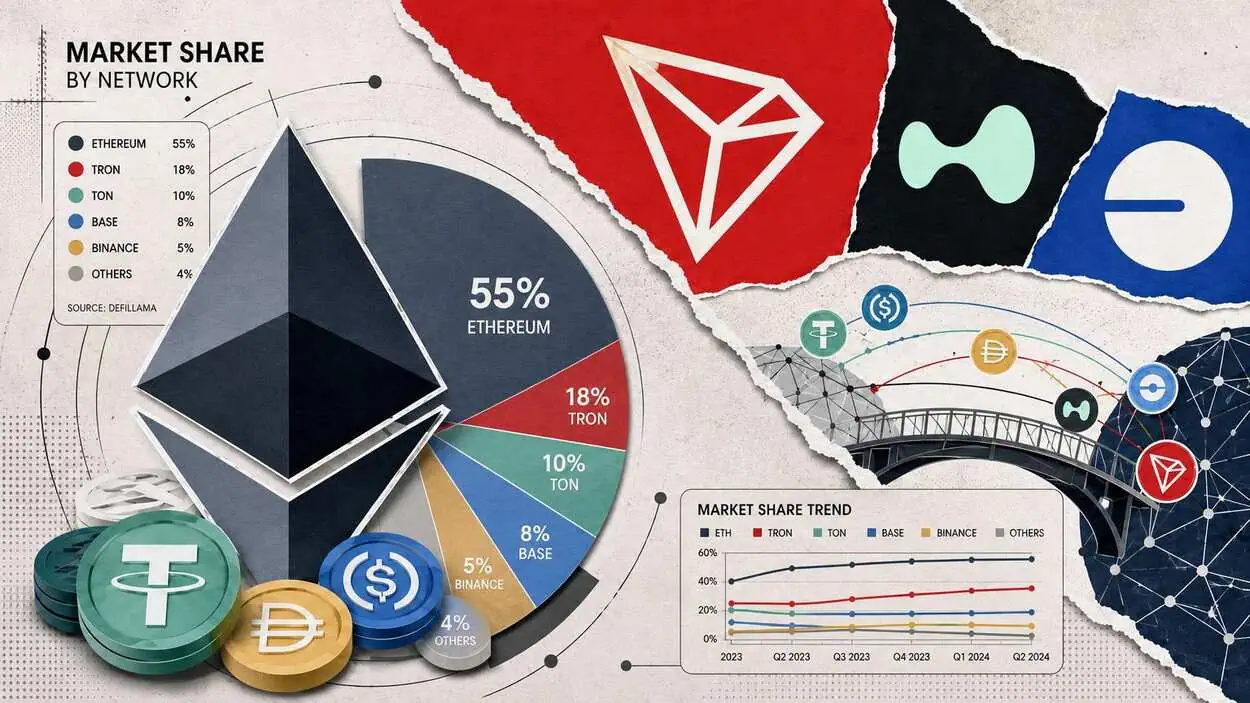
  • Ethereum now hosts about 56% of the total stablecoin supply across major chains.​
  • Tron controls roughly 60% of on-chain stablecoin trade volume, reflecting its dominance in remittance-style payments.​
  • Binance Smart Chain captures around 14–16% of global stablecoin supply, ranking second by chain share.​
  • Ethereum and Tron together account for approximately 75-80% of all stablecoin supply across networks.
Stablecoin Supply And Trading Share By Blockchain
  • Current DeFi lending platforms typically offer stablecoin yields in the 4–8% APY range, depending on borrowing demand.​
  • Around 42% of stablecoin pools offer yields below 5% APY, skewing toward lower-risk strategies.​
  • Approximately 32% of pools deliver between 5–10% APY, forming the most common mid-range yield band.​
  • Roughly 21% of pools provide higher returns between 10–15% APY, while about 5% exceed 15% APY.​

Transaction Volume and User Adoption

  • Stablecoin transactions reached $33 trillion in 2025, up 72% year over year, with Q4 alone hitting about $11 trillion in volume.
  • USDC processed roughly $18.3 trillion in transactions in 2025, while USDT handled about $13.3 trillion, together dominating stablecoin payment flows.
  • Total stablecoin market capitalization climbed about 49% in 2025, rising from roughly $205 billion in January to around $306 billion by November.
  • Stablecoin payment flows are projected to reach about $56 trillion by 2030, more than 1.7x current annual volumes if growth persists.
  • Stablecoin trading volume in Q4 2025 alone reached roughly $11 trillion, compared with about $8.8 trillion in Q3, reflecting accelerating adoption.
  • Around 26% of U.S. adults reported using stablecoins for cross-border remittances in the past year, highlighting mainstream money-movement usage.
  • Stablecoins are involved in about 43% of transaction volume in Sub-Saharan Africa, where users rely on dollar-pegged assets to hedge inflation.
  • Global remittance volumes handled by stablecoin-focused platforms like Aspora grew from $400 million to $2 billion in a year, a 5x increase.

USDC Stablecoin Reserve Breakdown

  • Earlier reserve disclosures showed roughly 23–34% in U.S. Treasuries, 51–63% in repurchase agreements, and about 14% in bank deposits and cash.​
USDC Reserve Composition by Asset Type
  • USDC reserves are now backed 100% by highly liquid cash and cash-equivalent assets, redeemable 1:1 for U.S. dollars.​
  • Approximately 88% of reserves are in short-dated U.S. Treasury securities and overnight Treasury repurchase agreements.​
  • The remaining 12% of USDC reserves are held as cash deposits within the U.S. banking system.​
  • Current policy maintains zero allocation to commercial paper, corporate bonds, municipal bonds, or other risky credit instruments.​
  • The reserve mix implies that over four‑fifths of backing assets are interest‑bearing U.S. government exposures, maximizing safety and liquidity.​
  • Circle’s transparency reports confirm that USDC reserves are fully matched to circulating supply with a small excess buffer of cash and Treasuries.​

Regulatory Developments and Compliance

  • At least 20+ countries now have or are finalizing stablecoin-specific regimes across major jurisdictions, including the US, UK, EU, Singapore, Hong Kong, Brazil, and Canada.
  • The EU’s MiCA framework is rolling out across 27 member states with reserve, disclosure, and supervision rules for stablecoin issuers.
  • The US GENIUS Act, signed in July 2025, created a federal licensing and one-to-one reserve regime, with FDIC implementation proposals released in January 2026.
  • Hong Kong’s Stablecoins Ordinance took effect on 1 August 2025, requiring HKMA licenses for fiat-referenced stablecoin issuers.
  • Canada published a draft stablecoin law in November 2025, mirroring GENIUS-style 1:1 backing and qualified custody requirements.
  • Global reviews show gaps remain, but over 80% of large issuers now align with FATF-style AML/CFT and Travel Rule standards.
  • FATF reported 99 jurisdictions have adopted or are implementing virtual-asset AML rules covering major stablecoin providers.
  • Leading issuers now publish frequent reserve attestations, with top payment stablecoins maintaining 100%+ backing in cash and short-term government securities.

Stablecoin Usage by Purpose

  • DeFi and trading accounts for 67% of total stablecoin transaction volume, confirming their role as the primary use case.​
  • Remittances represent about 15% of stablecoin usage, with cross-border transfers roughly 60% cheaper than traditional money transfers.​
  • Inflation hedging makes up around 10% of stablecoin activity, supporting savings in high‑inflation economies.​
  • Merchant payments capture roughly 5% of stablecoin usage, reflecting gradual adoption in e‑commerce and point‑of‑sale payments.​
  • The remaining 3% of stablecoin volume is attributed to other purposes such as payroll, treasury management, and niche on-chain services.​
  • Overall, payments beyond trading now represent nearly 30% of stablecoin transaction volume, underscoring broadening real‑world utility.
Stablecoin Usage Breakdown By Transaction Purpose

Literature on Stablecoins

  • Academic output on stablecoins grew 18% YoY with 200+ new peer-reviewed papers and policy reports published recently.
  • Survey research shows that about 60% of financial institutions expect 5–10% of global payments to involve stablecoins by 2030.
  • MIT’s Digital Currency Initiative leads global research on Bitcoin and stablecoin use, including a new MIT-UnB course focused on the global south.
  • Central-bank and international-organization research expanded with major stablecoin reports from the IMF, Federal Reserve, and ESRB in 2024–2025.
  • Policy papers suggest stablecoins could reach $2 trillion in market cap by 2030, showing rising importance in digital money debates.

Frequently Asked Questions (FAQs)

How much of the total stablecoin supply does Tether’s USDT hold?

USDT’s dominance of total stablecoin supply stood around 60β€―% in late 2025.

What share of stablecoin supply did USDT and USDC together command?

USDT and USDC together commanded roughly 90β€―% of the total stablecoin supply in 2025.

How much stablecoin supply was held on Ethereum and rollups in 2025?

Ethereum and its rollups held over $170β€―billion in stablecoin supply.

What percentage of financial institutions used or planned to adopt stablecoins?

Stablecoins were used by 13β€―% of financial institutions, with 54β€―% of non‑users expecting adoption within 6–12 months.

Conclusion

The stablecoin market has cemented itself as a cornerstone of the digital economy, bridging the gap between blockchain and traditional finance. From their growing adoption in cross-border payments to their integration in DeFi and institutional finance, stablecoins are no longer niche instruments but vital tools in the global financial infrastructure. As technological advancements and regulatory clarity continue to evolve, stablecoins will undoubtedly remain pivotal in shaping the future of financial ecosystems worldwide.

Definition of Staking. Link to full glossary entry follows the description.Staking

Staking is the process of locking cryptocurrency in a proof-of-stake network to help validate transactions and earn rewards, replacing energy-intensive mining.

Read more

Definition of DeFi. Link to full glossary entry follows the description.DeFi

Decentralized finance leverages blockchain protocols and smart contracts to enable lending, trading, and borrowing without banks or traditional intermediaries.

Read more

Definition of Layer 2. Link to full glossary entry follows the description.Layer 2

A Layer 2 is a secondary blockchain built on top of Ethereum that bundles transactions off-chain and posts compressed data back to the main chain, cutting fees and raising throughput.

Read more

Definition of Stablecoin. Link to full glossary entry follows the description.Stablecoin

A stablecoin is a cryptocurrency tied to a reserve asset like the US dollar, designed to maintain a stable value for trading, payments, and transfers.

Read more

This article has been reviewed and fact-checked by Kathleen Kinder. CoinLaw follows strict Publishing Principles and a documented Fact-Check Policy to ensure accuracy, transparency, and editorial independence across all content. Our statistics are verified using a documented Research Process.

Add CoinLaw as a Preferred Source on Google for instant updates! Follow on Google News
Share ChatGPT Perplexity

References

  • Statista
  • Statista
  • Statista
  • Fireblocks
  • Reuters
  • International Monetary Fund
  • CNN
Barry Elad

Barry Elad

Founder & Senior Journalist


Barry Elad is a finance and tech journalist who loves breaking down complex ideas into simple, practical insights. Whether he's exploring fintech trends or reviewing the latest apps, his goal is to make innovation easy to understand. Outside the digital world, you'll find Barry cooking up healthy recipes, practicing yoga, meditating, or enjoying the outdoors with his child.

Related Posts

Stablecoins Regulations Under MiCA Statistics 2026: Risk & Growth
Cryptocurrency

Stablecoins Regulations Under MiCA Statistics 2026: Risk & Growth

Circle Statistics 2026: Numbers That Tell the Truth
Cryptocurrency

Circle Statistics 2026: Numbers That Tell the Truth

Circle Reports Explosive $2.4 Trillion Stablecoin Surge in Asia-Pacific
Cryptocurrency

Circle Reports Explosive $2.4 Trillion Stablecoin Surge in Asia-Pacific

Disclaimer:Β The content published on CoinLaw is intended solely for informational and educational purposes. It does not constitute financial, legal, or investment advice, nor does it reflect the views or recommendations of CoinLaw regarding the buying, selling, or holding of any assets. All investments carry risk, and you should conduct your own research or consult with a qualified advisor before making any financial decisions. You use the information on this website entirely at your own risk.

Reader Interactions

2 Comments

  1. KKarungi

    February 10, 2026 at 5:33 AM

    I want to know more about stable coins

    Reply
    • Barry EladBarry Elad Post Author

      February 11, 2026 at 5:33 AM

      Hi Karungi, our article covers the latest stats on stablecoin growth, adoption rates, and how regulation is shaping the market. Scroll through the full piece for a comprehensive breakdown. If you have specific questions, feel free to ask.

      Reply

Leave a Comment Cancel reply

Primary Sidebar

Connect With Us

facebook x linkedin google-news telegram pinterest whatsapp email
google-preferred-source-badge Add as a preferred source on Google

You Should Also Read

Decentralized Stablecoins Adoption Statistics 2026: How DeFi, Wallets & Regulation Are Fueling Usage
Algorithmic Stablecoins Statistics 2026: Adoption, Performance, and Challenge
Stablecoin Market Share by Chain Statistics 2026: Ethereum and Tron Dominate

Table of Contents

  • Editor’s Choice
  • Recent Developments
  • Stablecoin Market Growth Outlook
  • Centralized Stablecoins
  • Decentralized Stablecoins
  • Stablecoin Interest Rates and Chain Distribution
  • Transaction Volume and User Adoption
  • USDC Stablecoin Reserve Breakdown
  • Regulatory Developments and Compliance
  • Stablecoin Usage by Purpose
  • Literature on Stablecoins
  • Frequently Asked Questions (FAQs)
  • Conclusion
Connect on Telegram

Footer

CoinLaw Logo

Bringing Finance Closer to You.

Connect With Us

Follow Us on Google News

Editorial & Trust

  • About
  • Publishing Principles
  • Fact-Check Policy
  • Corrections Policy
  • Ethics Policy
  • Disclaimer
  • Cookie Policy

Worth Checking

  • Best Cloud Mining Platforms
  • Millennial vs. Gen Z Banking
  • Ethereum Gas Fees Statistics
  • Binance vs. Coinbase Statistics
  • Zelle vs. Venmo Statistics
  • Traditional Banks vs. Neobanks
  • Crypto Exchange Hack Statistics
Contact Us
13570 Grove Dr #189,
Maple Grove, MN 55311,
United States
10β€―a.m. – 6β€―p.m. | Every day

Copyright Β© 2024–2026 CoinLaw. All Rights Reserved. Powered by the HODL Force ❀️

  • Privacy Policy
  • Terms
Manage your privacy

To provide the best experiences, we and our partners use technologies like cookies to store and/or access device information. Consenting to these technologies will allow us and our partners to process personal data such as browsing behavior or unique IDs on this site and show (non-) personalized ads. Not consenting or withdrawing consent, may adversely affect certain features and functions.

Click below to consent to the above or make granular choices. Your choices will be applied to this site only. You can change your settings at any time, including withdrawing your consent, by using the toggles on the Cookie Policy, or by clicking on the manage consent button at the bottom of the screen.

Functional Always active
The technical storage or access is strictly necessary for the legitimate purpose of enabling the use of a specific service explicitly requested by the subscriber or user, or for the sole purpose of carrying out the transmission of a communication over an electronic communications network.
Preferences
The technical storage or access is necessary for the legitimate purpose of storing preferences that are not requested by the subscriber or user.
Statistics
The technical storage or access that is used exclusively for statistical purposes. The technical storage or access that is used exclusively for anonymous statistical purposes. Without a subpoena, voluntary compliance on the part of your Internet Service Provider, or additional records from a third party, information stored or retrieved for this purpose alone cannot usually be used to identify you.
Marketing
The technical storage or access is required to create user profiles to send advertising, or to track the user on a website or across several websites for similar marketing purposes.
Statistics

Marketing

Features
Always active

Always active
  • Manage options
  • Manage services
  • Manage {vendor_count} vendors
  • Read more about these purposes
Manage options
  • {title}
  • {title}
  • {title}
Manage your privacy
To provide the best experiences, we use technologies like cookies to store and/or access device information. Consenting to these technologies will allow us to process data such as browsing behavior or unique IDs on this site. Not consenting or withdrawing consent, may adversely affect certain features and functions.
Functional Always active
The technical storage or access is strictly necessary for the legitimate purpose of enabling the use of a specific service explicitly requested by the subscriber or user, or for the sole purpose of carrying out the transmission of a communication over an electronic communications network.
Preferences
The technical storage or access is necessary for the legitimate purpose of storing preferences that are not requested by the subscriber or user.
Statistics
The technical storage or access that is used exclusively for statistical purposes. The technical storage or access that is used exclusively for anonymous statistical purposes. Without a subpoena, voluntary compliance on the part of your Internet Service Provider, or additional records from a third party, information stored or retrieved for this purpose alone cannot usually be used to identify you.
Marketing
The technical storage or access is required to create user profiles to send advertising, or to track the user on a website or across several websites for similar marketing purposes.
Statistics

Marketing

Features
Always active

Always active
  • Manage options
  • Manage services
  • Manage {vendor_count} vendors
  • Read more about these purposes
Manage options
  • {title}
  • {title}
  • {title}
Company
  • About Us
  • Our Team
  • Our Mission
  • Core Values
Discover
  • glossary icon
    Glossary
  • Stats
    Stats Research Process
  • Brand Guide Icon
    Brand Assets
Categories
  • Cryptocurrency
  • Payments
  • Finance
  • Banking
  • Insurance
Cryptocurrency
Coinbase vs Kraken Statistics 2026: Volume, Fees, Licenses
Solana vs Ethereum Statistics 2026: TVL, Fees, Validators, ETFs
Uniswap vs PancakeSwap Statistics 2026: Head-to-Head DEX Data
Cryptojacking Statistics 2026: 80+ Cloud, Cost & Threat Numbers
MetaMask vs Phantom Wallet Statistics 2026: Big Growth Data
Crypto Wallet Ecosystem Statistics 2026: Addresses, Security, Adoption
Payments
Toast Statistics 2026: ARR, GPV & Revenue Data
Rapyd Statistics 2026: TPV, Valuation & Licences
Marqeta Statistics 2026: TPV, Revenue and Customer Mix
Digital Payments Statistics 2026: Market Size, Users, and Growth
Cash App vs Venmo vs Zelle Statistics 2026: What You Must Know Now
Worldpay Statistics 2026: Massive Payment Growth
Finance
Emergency Fund Statistics 2026: How Much Americans Have Saved (and How Much They Should)
Financial Advisor Statistics 2026: Headcount, AUM, and Demographics
Wealth Inequality Statistics 2026: Hidden Wealth Divide
Blockchain in Supply Chain Finance Statistics 2026: Trade Breakthrough
Blockchain in Healthcare Finance Statistics 2026: Cost Breakthrough
AI-Powered Robo Trading Statistics 2026: Big Insights
Banking
N26 Statistics 2026: Customers, Deposits, Revenue and the BaFin Growth Cap
Revolut vs Monzo Statistics 2026: Customers & Profit
Islamic Banking Statistics 2026: Assets, Growth, and Top Markets
Credit Union Statistics 2026: Assets, Members, Loans
Banking API Statistics 2026: Market Size, Adoption, and Growth
Citigroup Statistics 2026: Growth Secrets Inside
Insurance
Lemonade Insurance Statistics 2026: Customers, In-Force Premium, Loss Ratio, Pet & Auto Segments
Chubb Statistics 2026: Powerful Data Insights
Virtual Reality In Insurance Statistics 2026: Innovations, Risks, and Opportunities
US Life Insurance Industry Statistics 2026: Growth Facts
US Auto Insurance Industry Statistics 2026: What You Must Know Now
UK Insurance Industry Statistics 2026: Growth Data
Categories
  • Cryptocurrency
  • Investments
  • Compliance
  • Fintech
  • Finance
Cryptocurrency
Inveniam, Docugami Reveal Powerful RWA Data Verification Model
Kraken Rolls Out Regulated Crypto Perps Across the US
MARA Buys 1,000 Bitcoin After Massive $1.5B BTC Selloff
India’s ED Files Case in $20M Coinbase Crypto Heist
Capital B Eyes High Yield Bitcoin Credit Product in Europe
Pyra to Shut Down After Drift Exploit Leaves No Path to Recovery
Investments
Nvidia Unveils Huge $20B Bond Raise to Power AI Growth
Binance SpaceX IPO Offer Attracts Massive $557M Demand
Metaplanet Acquires Siiibo in Major Bitcoin Expansion Move
Morpho Raises $175M at $2B Value as MORPHO Token Jumps
Pyth Launches Groundbreaking 24/7 Stock and Commodity Indices
Nvidia Secures SK Hynix AI Memory Supply Deal
Compliance
Binance Could Lose EU Access After Reported MiCA Rejection
New York Moves to Align Stablecoin Rules With GENIUS Act
Polymarket Faces Major Blow as South Korea Probes Users
FCA Flags Crypto Sponsorship Risks for Premier League Clubs
Polymarket May Enforce KYC as Regulators Tighten Oversight
CFTC and Gemini Ask Court to Undo $5M Settlement
Fintech
Bybit Unveils Powerful Broker API With Ultra Low Latency Access
Bitget and xStocks Bring SpaceX IPO Access Onchain
Bybit Launches IPO Express With Tokenized SpaceX Access
Pred Launches Sports Prediction Markets for FIFA World Cup
JPMorgan, Citi, BofA to Build Blockchain Deposit Network
Moomoo Debuts Kalshi Powered Event Contracts for Retail Traders
Finance
Coinbase Sparks New Race With 1:1 Backed Tokenized Stocks
Bitmine Launches $300M Preferred Stock to Buy More ETH
Coinbase Lists SpaceX Pre IPO Perpetual Futures
Binance Expands Into US Stocks With New bStocks Service
SEC Clears Paxos to Settle U.S. Stocks on Blockchain
Mastercard Expands Stablecoin Strategy With NY BitLicense
Newsletter Img

Too much noise in crypto?

We respect your time. You get one high-impact briefing a week. If the market is quiet, so are we.

βœ… Join readers from Visa, Vanguard, and the FDIC.
Newsletter Img

The Weekly Briefing

We track the market 24/7. You get a 5-minute summary. If it’s quiet, we skip it.

βœ… Read by pros at Visa, Vanguard, and the FDIC.