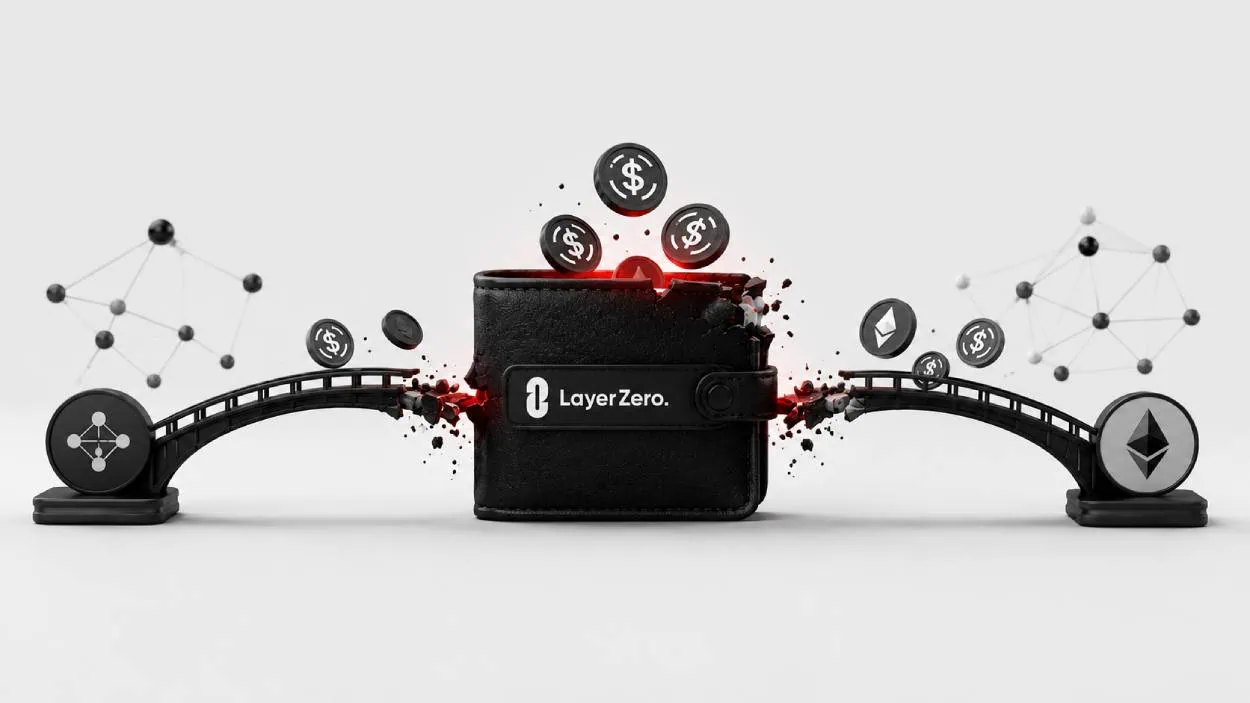






On July 15, 2026, LayerZero’s Executor wallet was drained of roughly $2.1 million across multiple blockchains, according to Specter (@SpecterAnalyst), the on-chain analyst who reported the theft on X. LayerZero has not issued a public statement confirming the incident.
Key Takeaways
- LayerZero’s Executor wallet lost $2.1 million across multiple chains, per Specter, the analyst who first flagged the breach on X.
- The suspected attacker’s address currently holds 955 ETH (about $1.78 million) and 322,000 USDC, separate from the total amount reported stolen.
- Stolen funds were routed to Ethereum through the Stargate and Relay cross-chain bridges, a hop that complicates tracing for investigators.
- An Executor is a permissionless, off-chain service that delivers verified cross-chain messages and pays destination-chain gas, per LayerZero’s own protocol documentation.
- LayerZero previously lost roughly $292 million from the KelpDAO bridge earlier this year after a since-banned verifier misconfiguration, per Chainalysis.
What Happened?
The compromised wallet is an Executor address controlled by the LayerZero team, not a user or protocol treasury account. An Executor is a permissionless, off-chain service that monitors message verification and delivers verified messages to their destination chain once the required decentralized verifier networks (DVNs) have signed off, per LayerZero’s own protocol documentation. Any party can run one, which is why a team operated instance getting compromised reads as an infrastructure problem rather than a routine wallet drain.
Specter’s on-chain trace shows the suspected hacker moved the stolen assets to Ethereum via the Stargate and Relay bridges. The attacker’s Ethereum address currently sits on 955 ETH and 322,000 USDC. Those holdings do not add up to the total amount reported stolen, since Specter’s figures track only the current balance of the flagged address.
LayerZero has said nothing publicly at the time of writing, leaving open whether the team isolated the compromised Executor or identified how the attacker gained control of it.
LayerZero Executor Wallet Drained, Millions Moved to Ethereum
— CoinLaw (@coinlaw_io) July 15, 2026
An on-chain analyst says a @LayerZero_Core Executor wallet lost $2.1 million across chains, with funds bridged to Ethereum via Stargate and Relay. LayerZero has not confirmed the incident.
Bridge-Hopping Raises a Compliance Flag
Moving stolen funds through two separate bridges before they settle on Ethereum is not incidental. Layering assets across multiple cross-chain rails resets the trail an investigator has to reconstruct with every hop. Treasury and OFAC style enforcement increasingly treats that kind of bridge-hopping as a distinct red flag, since it is cheap for an attacker and expensive for a tracing team to unwind.
Cross chain bridges sit outside any single exchange’s KYC perimeter, so the burden of freezing or flagging the funds falls on whichever venue the attacker eventually touches to cash out. That dynamic has pushed exchanges and DeFi market participants to watch wallet clustering alerts more closely once a bridge hop like this one surfaces, even before a regulator opens a formal case.
Implications for Bridge Security
This is not LayerZero’s only recent bridge-security scare. Chainalysis found that a since banned one-of-one verifier configuration let attackers drain roughly $292 million in restaked ether from the KelpDAO bridge earlier in the year, an incident investigators attributed to North Korea’s Lazarus Group. LayerZero made a mistake by allowing that single verifier setup, the project later acknowledged, and it has since joined an industry recovery fund.
No evidence ties the July Executor compromise to that earlier episode or to Lazarus Group, and the attacker behind this smaller theft remains unidentified. Taken together, the two incidents point to the same soft spot: the people and keys operating LayerZero’s infrastructure, not the messaging protocol’s cryptography, which has held up in both cases.

CoinLaw’s Takeaway
An Executor is plumbing, not a bank vault, and that distinction is why the $2.1 million theft matters less for LayerZero’s cryptography and more for its operational hygiene. The wallet’s job is to pay gas and deliver already verified messages, so its compromise does not touch the protocol’s core security model. Until LayerZero explains how the wallet was accessed, the likely read is that a permissioned convenience, letting the team run its own Executor, became the entry point.
The bridge hop through Stargate and Relay is the more durable story. It shows multi-bridge routing has become a routine laundering step, one that forces exchanges and compliance teams to chase a trail that resets with every hop instead of one flagged address. LayerZero’s silence, paired with an unresolved episode that cost far more earlier this year, suggests bridge infrastructure across the industry still needs the same scrutiny that smart-contract code already receives.