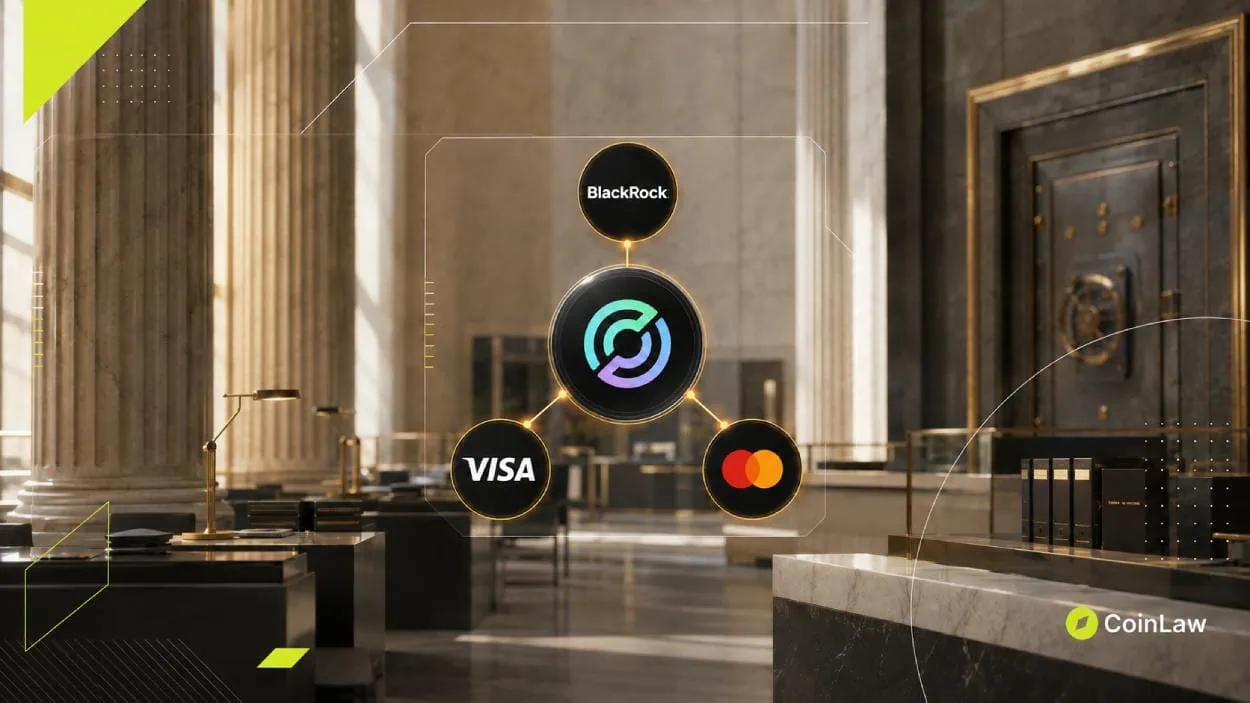






Circle Internet Group (NYSE: CRCL) named the founding validator cohort for Arc, its new layer-1 blockchain network, on August 5, 2026. The cohort includes BlackRock, Visa, Mastercard and DTCC ahead of Arc’s public mainnet launch on September 16.
Key Takeaways
- Circle named 11 founding validators for Arc: BlackRock, DTCC, Galaxy, Global Payments, ICE, Mastercard, MoneyGram, SBI Group, Standard Chartered, Sumitomo Corporation, and Visa, alongside Circle itself.
- Arc is running a private mainnet with more than 100 ecosystem and institutional builders and targets a public mainnet on September 16, 2026.
- BlackRock is expected to deploy BUIDL, its tokenized money-market fund, on Arc using the network’s native USDC integration.
- Circle CEO Jeremy Allaire told CNBC that Arc will initially be run by roughly 10 to 12 major validators, with room to grow to 20 to 40 over time.
- Circle holds 25% of Arc’s initial 10 billion token supply, with 60% reserved for ecosystem builders and 15% for a long-term reserve.
What Happened?
Circle picked 11 named institutions, not anonymous operators, to secure Arc ahead of its public launch. Circle announced Arc’s founding validator cohort alongside a slate of institutional integrations.
The Depository Trust & Clearing Corporation (DTCC, the U.S. clearing house that settles most stock and bond trades), Intercontinental Exchange (ICE, the parent of the New York Stock Exchange), Global Payments, Galaxy, SBI Group and Sumitomo Corporation round out the roster alongside the payments networks and the asset manager.
Circle describes the cohort as a network secured by the institutions building on it, rather than by anonymous, permissionless validators. Arc is built on a simple premise: that the global financial system deserves a blockchain network it can trust, said Jeremy Allaire, Co-Founder, CEO and Chairman of Circle. That named-validator structure is what separates Arc from a typical permissionless blockchain launch.
BlackRock, DTCC, Galaxy, Global Payments, ICE, Mastercard, MoneyGram, SBI Group, Standard Chartered, Sumitomo Corporation, and Visa join Circle as founding validators; major global financial institutions advancing integrations, joining more than 100 ecosystem and institutional…
— Jeremy Allaire – jerallaire.arc (@jerallaire) August 5, 2026
Institutional Integrations Beyond the Validator Seat
BlackRock, BNY, DTCC and Standard Chartered are each exploring integrations spanning tokenized asset settlement, digital asset custody, stablecoin access, and FX and repo infrastructure. The BlackRock and DTCC pieces are the most concrete.
BlackRock is expected to deploy BUIDL, the BlackRock USD Institutional Digital Liquidity Fund, on Arc, leveraging the network’s native USDC integration. CoinLaw’s BlackRock tokenized fund coverage puts BUIDL over $2.5 billion in tokenized assets, the largest RWA product currently on-chain.
Separately, Circle is collaborating with DTCC to tokenize DTC-custodied assets on Arc beginning in the second half of 2027. DTC-tokenized assets will continue to carry the same protections, rights and safeguards investors receive with traditionally held assets, according to the announcement.
Governance, Tokenomics and the Road to Public Mainnet
Allaire framed Arc’s operator base as a starting point, not a ceiling. Arc is being built as a distributed network operated initially by roughly 10 to 12 major players, a number Allaire said could grow to 20 or 40 over time, he told CNBC. Each validator becomes part of a staking structure where ARC token holders will eventually be able to stake and vote on key infrastructure decisions.
Circle’s own stake sets the tone for how that governance is sequenced. Circle holds 25% of Arc’s initial 10 billion token supply, 60% goes to ecosystem participants who build on and use the network, and the remaining 15% funds a long-term reserve. That order, institutions first, echoes CoinLaw’s stablecoin adoption data: 54% of institutions without a stablecoin program plan to launch one by 2026.
Arc’s day-one ecosystem is also taking shape. DeFi protocols including Aave, Uniswap, Morpho, Galaxy and GSR, stablecoin-payments firms Rain, Thunes and Wirex, and wallets and exchanges including Binance Wallet, Kraken, Ledger, MetaMask, Fireblocks and Upbit are expected to be live on Arc at launch. That range extends a stablecoin footprint Circle has already built across Asia-Pacific markets, where on-chain activity is already measured in the trillions.

Implications for Stablecoin Infrastructure
Arc’s validator list reads less like a blockchain launch and more like a settlement-utility filing: a clearing house, a payments-network exchange parent, two card networks and an asset manager validating the same chain. That is a bet that institutions will only route real money through infrastructure they can identify.
Tokenization pilots have historically moved fast in headlines and slowly in production. A named clearing house committing to a specific settlement window gives the market an actual checkpoint to hold Circle to, instead of an open-ended roadmap.
CoinLaw’s Takeaway
This reads as Circle solving a trust problem, not a scaling one. Public blockchains built for retail speculation could not satisfy the institutions Circle just named as validators. Arc inverts that model: known entities run the network first, permissionless apps build on top once that base is secured. The BUIDL and DTCC integrations are the proof points here, real products on dated milestones rather than partnership logos.
The bigger test starts after September 16. A validator cohort and a token split are commitments, not usage. Whether Arc becomes the settlement layer Circle describes depends on how much of that private-mainnet activity turns into live transaction volume, and on whether the DTCC tokenization work ships on schedule.