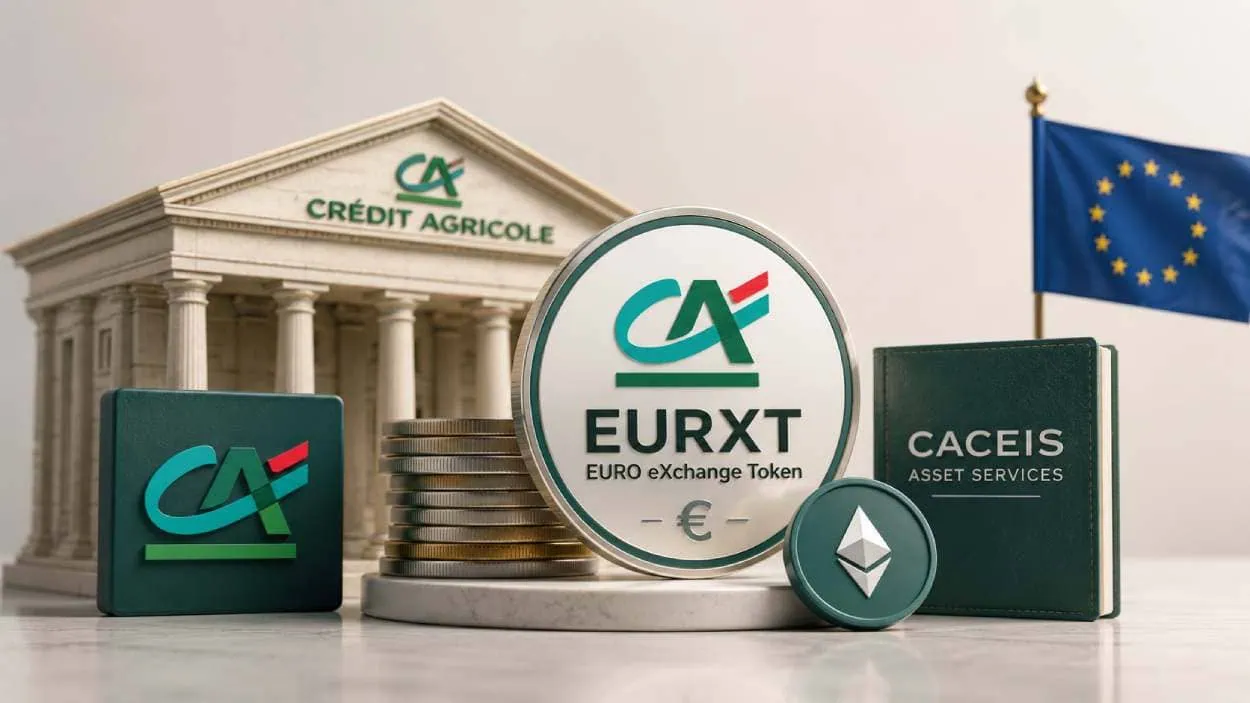






Crédit Agricole S.A. launched EURXT (EURO eXchange Token), its euro-denominated stablecoin, through asset-servicing unit CACEIS, according to CACEIS. It used the token to settle the first subscription into a tokenised Amundi money market fund, per CACEIS.
Key Points
- EURXT is an ERC-20 electronic money token pegged 1:1 to the euro, issued on Ethereum by CACEIS and compliant with the EU’s Markets in Crypto-Assets (MiCA) framework, part of the broader shift toward institutional tokenised settlement in Europe.
- The token is initially limited to institutional investor clients and corporate clients of CACEIS, not retail users, per the CACEIS announcement.
- The first issuance settled a subscription into the Amundi Money Market Fund, according to Amundi, which the release calls the first subscription to a tokenised Luxembourg-domiciled UCITS money market fund settled in euro stablecoin at the European level.
- Around €20 million in EURXT has been issued so far, with a minimum subscription of €10,000, according to LedgerInsights.
- The launch forms part of Crédit Agricole S.A.’s ACT 2028 medium-term plan to accelerate its push into tokenised finance, according to Crédit Agricole S.A.
What Happened?
CACEIS, Crédit Agricole’s asset-servicing arm, issued EURXT on the Ethereum blockchain as an electronic money token backed by fiat euro at 1:1 parity. EURXT’s reserves consist exclusively of cash held on CACEIS Bank’s balance sheet, per the CACEIS announcement.
An initial issuance was used to settle a subscription to the Amundi Money Market Fund, a Luxembourg-domiciled UCITS vehicle that Amundi, Europe’s largest asset manager, had tokenised for the transaction. That settlement sits closer to DeFi infrastructure than to consumer payments.
As said by Olivier Gavalda, Chief Executive Officer of Crédit Agricole S.A., frames EURXT as settlement infrastructure rather than a consumer product. The client restriction to institutional and corporate CACEIS clients reinforces the point: this is a bank building rails for its own fund-servicing business, not chasing retail stablecoin volume.
Reserve Structure: One Claim, Two Readings
CACEIS says EURXT’s reserves consist exclusively of cash held on its own balance sheet, according to the CACEIS press release.
🇫🇷 French banking giant Crédit Agricole has launched EURXT, a euro-backed stablecoin issued by its subsidiary CACEIS on Ethereum.
— TSG | Trend Scout Global (@TSG_Crypt) July 1, 2026
Initially available to institutions and corporate clients, EURXT is designed to support tokenized finance and digital settlement.
The launch comes… pic.twitter.com/hVp5I58b41
The reserves are segregated internally and can include up to 70% in highly liquid securities alongside CACEIS cash, but the segregation is accounting rather than legal. That means token holders would be unsecured creditors if CACEIS were to fail. The two descriptions aren’t necessarily contradictory: “cash on the balance sheet” can still be partly allocated to liquid securities operationally.
The unsecured-creditor detail is the material risk fact a euro-token holder needs, and it does not appear in CACEIS’s own announcement. That gap is exactly the kind of disclosure discrepancy regulators scrutinize under MiCA’s e-money token reserve rules.
Why a Bank-Issued Stablecoin, Now?
EURXT answers a narrower question than most stablecoin launches: not how to move money faster, but how to settle fund subscriptions without a multi-day bank-transfer cycle. Traditional UCITS fund subscriptions can settle over T+2 or longer through correspondent banking. Tying the subscription to an on-chain, 1:1 euro-pegged token issued by a European asset-servicing leader compresses that into near-instant settlement inside the CACEIS-Amundi ecosystem, a use case closer to institutional than to open retail markets.
Tying the launch to Crédit Agricole S.A.’s ACT 2028 medium-term plan signals a multi-year infrastructure commitment, not a one-off pilot.

CoinLaw’s Takeaway
EURXT is less a bid to compete with Circle’s USDC or Tether in open than a bank building private settlement rails for its own asset-servicing pipeline. Around €20 million issued so far, against a €10,000 minimum subscription, points to a controlled, institutional rollout. The MiCA e-money token wrapper gives CACEIS a compliant on-ramp that dollar-pegged stablecoins largely lack in the EU. This is informational reporting on a corporate and regulatory development, not investment guidance.
The reserve-disclosure gap is worth watching. A press release calling the reserves exclusively cash, while a separate report finds up to 70% can sit in liquid securities with only accounting-level segregation, is the kind of detail that determines what happens to institutional clients’ funds if CACEIS ever ran into trouble. As other European banks weigh their own MiCA-compliant tokens, how clearly they disclose reserve composition and legal status at launch will likely shape which projects earn institutional trust.