





What Happened?
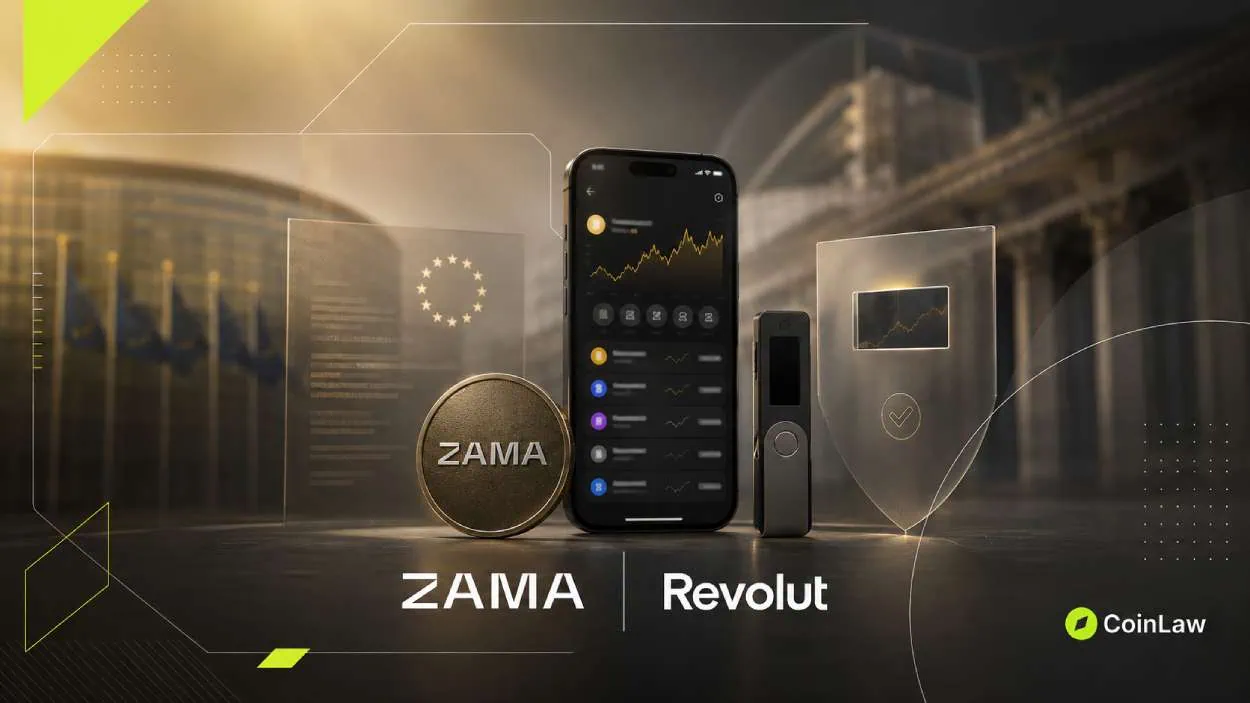
- Zama’s ZAMA token is now tradable inside Revolut across the European Economic Area, an app with more than 70 million customers.
- Revolut users can buy it without opening another account or clearing fresh ID checks, and they can withdraw it to a self-custody wallet.
- EU anti-money-laundering rules bar regulated firms from servicing anonymity-enhancing coins from July 10, 2027. Zama is betting its encryption sits on the safe side of that line.
Zama listed its ZAMA token for trading on Revolut across the European Economic Area on Monday, putting a fully homomorphic encryption project in front of the fintech’s 70 million-plus customers less than a year before EU rules start restricting which privacy assets regulated firms may touch. Zama announced the listing in a post on its own site. The Block first surfaced the listing.
The listing reaches the 15 million-plus Revolut customers who already trade crypto in the app, Zama said. Existing users buy and hold ZAMA without a new account or additional identity checks. Trading fees start at 0 in the main app.
JUST IN:
— Zama (@zama) August 11, 2026
Zama will launch a Learn & Earn campaign inside @Revolut later this year, teaching millions why confidentiality onchain matters for mass adoption.$ZAMA is now live for Revolut’s 70 million users. https://t.co/KoFslgyFyP pic.twitter.com/Z4dsmeZOCD
Revolut supports onchain crypto transfers in the region, so holders can move ZAMA out to a self-custody wallet. The company describes itself as the only banking app in the EEA offering that, and its user and revenue growth has leaned on exactly that kind of add-on. Zama also plans a Learn and Earn campaign inside Revolut later this year.
Rand Hindi, Zama’s co-founder and chief executive said:
A 2027 deadline sits underneath the listing
The calendar is the part nobody put in the announcement. The EU’s anti-money-laundering regulation, Regulation (EU) 2024/1624, applies from July 10, 2027. Its Article 79 bars credit institutions, financial institutions and crypto-asset service providers from keeping anonymous accounts, including crypto-asset accounts that allow transactions to be anonymized, and from providing services in anonymity-enhancing coins.
Revolut is exactly the kind of firm that provision will bind. It holds a MiCA authorization obtained through Cyprus’s securities regulator, CySEC, which lets it passport crypto services across the bloc. CoinLaw has tracked the EU MiCA regulation figures and the widening gap between licensed venues and the rest.
Zama’s design runs alongside that rulebook rather than against it. Its encryption keeps balances and transaction amounts unreadable to onlookers while an issuer or a supervisor can be granted disclosure rights, which separates it from the untraceability model that made Monero and Zcash a delisting problem for European venues. Readers weighing that distinction can compare it against the broader record on privacy coins and regulatory compliance.
What the evidence does not show is a ruling. No EU authority has published a list naming which assets qualify as anonymity-enhancing coins, and none has classified ZAMA either way.
A frozen contract already tested the encryption
In May, a US court order led Circle to freeze a Zama contract holding about $12.5 million in USDC. The order was later lifted and the funds returned to normal operation. Zama accelerated work on controlled-disclosure and compliance tooling afterward.
That episode is the strongest available evidence for the company’s compliance argument and also its clearest boundary. Encrypted balances did not put the assets beyond the reach of a court order, which is the whole pitch and, for anyone who bought the token expecting anonymity, the disappointment.
The deployment record the listing rests on
Zama launched the token in February through a sealed-bid Dutch auction that kept bids encrypted while processing more than $121 million on Ethereum, which the company called the first large-scale production use of FHE on mainnet. It acquired TokenOps to run encrypted token distributions for institutional issuers. It then shipped a confidential yield vault on Ethereum with Morpho and Steakhouse Financial, where deposits reached $23.23 million by mid-July, up from more than $14 million two weeks earlier, ranking eighth among USDC vaults across Morpho V1 and V2 at the snapshot Zama cited.
The market has been less enthusiastic than the deployment log. ZAMA changed hands near $0.046 on Tuesday, a market value around $102 million against a fully diluted $510 million, CoinGecko data shows. The token is down roughly 6% over the past week and trades below its high of $0.06628 set in late July.


What the listing does not settle?
Four questions stay open. Which EEA jurisdictions get the self-custody withdrawal route, and under what Travel Rule terms? When does the Learn and Earn campaign run and how is it funded? Does the confidential transfer layer Zama sells to issuers fall inside Article 79’s scope once a licensed European operator handles it? And does a supervisor treat programmable disclosure as compliance or as a workaround?
Holders who already bought through the app have three things worth checking today: whether onchain withdrawal is switched on in their country, what records their provider retains on those transfers, and whether the confidentiality they have been reading about applies to ZAMA transfers or only to the applications built on Zama’s protocol. It is the second one. Holding the token does not encrypt anything.
Zama has about eleven months of runway before the rulebook that decides which of those answers matter takes effect. The clock started with a listing, not a filing.