





The regulator named the only three crypto assets ordinary Russians may buy on licensed exchanges, then capped retail purchases at about $3,690 a year per intermediary. Roughly 98% of investors sit under that ceiling.
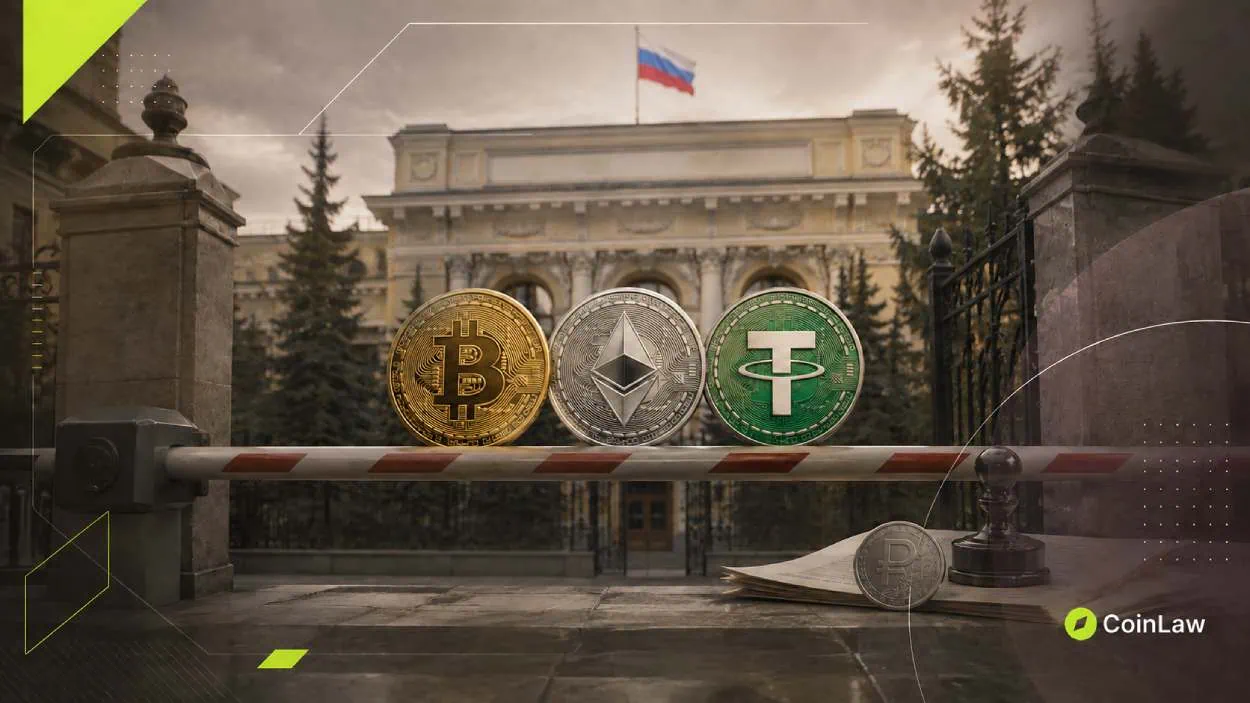
- The Bank of Russia named Bitcoin, Ether and Tether’s USDT as the only crypto assets ordinary Russians may buy on licensed domestic exchanges.
- Retail buyers face a ceiling of 300,000 rubles a year with each intermediary, roughly $3,690, and must pass a test before their first purchase. The regulator puts about 98% of market participants in that tier.
- The document is a draft. Comments close August 24, and the law it implements takes effect September 1.
The Bank of Russia published a draft directive on Tuesday naming Bitcoin, Ether and Tether’s USDT as the only cryptocurrencies ordinary Russians will be allowed to buy on licensed domestic venues, and it capped those purchases at 300,000 rubles a year with each intermediary. That works out to about $3,690. The regulator’s own count places roughly 98% of Russian market participants in the non-qualified tier the ceiling applies to.
Qualified investors escape the cap entirely and may buy any crypto listed on exchange or over-the-counter markets. Everyone else gets three assets and a four-figure annual allowance. Testing binds both groups: all investors, the regulator said in the notice, “regardless of their status will have to pass testing” and review the risks of crypto investing before transacting, a line published in Russian and translated here.
State outlets read the notice as a completed approval. The regulator’s own timetable describes a consultation that closes on August 24.
Russia Proposes $3,645 Annual Crypto Purchase Cap for Retail Investors, Limited to BTC, ETH and USDT
— Wu Blockchain (@WuBlockchain) August 11, 2026
The Bank of Russia has proposed rules that would cap crypto purchases by non-qualified investors at 300,000 rubles, or about $3,645, per year through each broker, crypto exchange… pic.twitter.com/FWy7lvaPLQ
Three names, decided by a threshold nobody else clears
The selection runs off numeric criteria carried into Federal Law No. 282-FZ, the digital currencies and digital rights law President Vladimir Putin signed on August 4. An asset must average a market capitalization above 5 trillion rubles, near $61 billion, across two calendar years. It must average daily turnover of at least 1 trillion rubles. And it must carry five calendar years of published closing prices from licensed foreign platforms whose own average volumes clear 100 billion rubles.
Legal outlet Pravo.ru, summarizing the criteria in March when they still sat in draft legislation, read the thresholds as wide enough to admit Solana alongside Bitcoin and Ether. The board named three. It retains authority to add others later, which makes the list a live document rather than a settled one.
The plumbing this runs through barely exists
Access flows exclusively through licensed intermediaries: exchanges, brokers, asset managers and digital depositories, all supervised by the central bank. That layer is still being built. The regulator’s earlier draft rules set minimum equity for digital depositories at 50 million to 250 million rubles, roughly $600,000 to $3 million, scaled to whether the firm runs post-trade settlement or an open distributed ledger. Certain technical provisions do not bite until the second half of 2027.
Banks may get the shortest path in. Governor Elvira Nabiullina proposed in March, in remarks reported by Interfax, letting banks and brokers pick up crypto exchange permissions through a notification process built on their existing licences, with crypto exposure held to 1% of capital at the start. CoinLaw covered that proposal when Russia drafted the law to let banks run crypto exchanges. Moscow and St. Petersburg had already been lined up for regulated crypto trading on the main stock exchanges.
Moscow approved an asset that freezes Russian wallets
USDT made the list on liquidity and history. Its issuer sits outside Russian jurisdiction and has acted against Russian venues before. Tether said on March 7, 2025 that it helped the US Secret Service freeze $23 million tied to transfers on Garantex, the sanctioned Russian exchange. A Russian retail investor buying Tether’s USDT through a licensed domestic broker holds a claim on a company that has demonstrated it will freeze balances at a foreign law enforcement agency’s request. The draft directive does not address that exposure.
The law keeps crypto out of domestic payments while permitting it in cross-border settlement. Nothing in the directive changes that split.
What the draft leaves open?
Anyone already holding crypto on a foreign platform gets no migration route here. The document names eligible assets and sets buying limits for new purchases through Russian intermediaries. It does not say whether existing offshore balances can be moved in, whether the 300,000-ruble ceiling aggregates across firms or resets with each one, what the mandatory test actually asks, or which intermediaries will hold a licence on day one. Those are the questions worth watching before the window closes.
The evidence here proves the regulator picked three assets and wrote a cap. It does not prove a functioning market appears next month.
Comments close August 24. The framework takes effect on the first of September, the same day large banks and major retailers must begin accepting payments under the digital ruble rollout, which gives Russia two supervised retail money rails starting in the same week. Bitcoin traded near $64,000 as of press time, down about 1.6% on the day, with traders trimming risk ahead of US inflation data. The tape did not notice Moscow at all.