







In recent years, commodities have experienced a groundbreaking transformation in the financial sector. The trend of tokenization, essentially converting tangible assets like gold, oil, or real estate into digital tokens on a blockchain, has opened new doors, making these traditional assets accessible to a broader range of investors. Imagine owning a slice of a gold bar or a portion of an oil reserve. This was previously accessible only to institutional investors or wealthy individuals. Blockchain can improve efficiency and expand access in financial markets by reducing intermediaries, settlement times, and costs, especially in cross-border transactions.
The tokenized commodities market is growing swiftly. It’s essential to understand the data, trends, and potential that define this evolving market. From the current market size to regulatory dynamics and innovative technology, this guide covers all critical statistics and insights into the tokenized commodities market.
Editor’s Choice
- Tokenized RWAs on public blockchains grew to over 24 billion by early 2026.
- Tokenized U.S. Treasuries and money‑market assets hit 12.88 billion in on‑chain value by April 2026.
- Tokenized Treasury products now hold about 11.35 billion in on‑chain AUM tracked in 2026.
- Total value locked in tokenized real‑world assets crossed 23.6 billion on major public chains in 2026.
- Tokenized private credit exposure reached over 5 billion by early 2026.
- Tokenized gold and related precious‑metal products now represent more than 6 billion in value.
Recent Developments
- Venture funding tied to tokenized commodities and related RWA infrastructure helped push the broader RWA market to about $23.6 billion in 2026.
- Gold-backed tokens still dominate the segment, with XAUT at roughly $2.7 billion and PAXG at about $2.4 billion in early April 2026.
- PAXG and XAUT together account for about 74% of the tokenized commodities market in 2026.
- The tokenized gold ecosystem surpassed roughly $5.0 billion-$7.4 billion by April 2026.
- The carbon credit trading platform market value is projected at $235.50 million in 2026, reflecting continued ESG momentum.
- The broader carbon credit market is expected to grow from $642.74 billion in 2025 to $785.35 billion in 2026.
- Tokenized U.S. Treasuries, private credit, commodities, and other RWAs together reached around $23.6 billion in 2026, supporting deeper DeFi collateral use.
- Tokenized commodities now trade in a market operating 24/7, expanding accessibility beyond traditional commodity market hours.
Tokenization Market Growth
- The global tokenization market reached $4.1 billion in 2025, marking the early stage of rapid digital asset adoption.
- In 2026, the market grew to $5.19 billion, reflecting accelerating institutional interest in blockchain-based asset tokenization.
- By 2027, the market will reach approximately $6.5 billion, driven by increased use of tokenized real-world assets (RWAs).
- The market will expand to around $8.2 billion in 2028, supported by broader enterprise adoption and improved regulatory clarity.
- In 2029, the market will hit nearly $10.0 billion, fueled by growing demand for fractional ownership and digital securities.
- By 2030, the market will reach $13.2 billion, highlighting strong long-term growth potential across sectors.
- The industry will grow at a CAGR of 26.3% from 2026 to 2030, indicating sustained high-growth momentum.
- Overall, the market will more than triple from 2025 to 2030, showcasing blockchain’s transformative impact on traditional asset markets.

Technological Advancements
- Tokenized asset markets grew to about $27.6 billion in 2026 as blockchain infrastructure matured for real-world finance.
- Ethereum researchers expect zero-knowledge verification to support up to 10,000 TPS in future scalability phases, versus about 30 TPS on mainnet today.
- Around 10% of Ethereum validators are expected to switch to ZK verification mode by the end of 2026.
- Tokenized assets on public blockchains reached roughly $23.6 billion in 2026, reflecting stronger smart contract and settlement adoption.
- Oracle infrastructure already secures billions of dollars in on-chain value tied to tokenized assets and DeFi markets.
- Stablecoin market size reached approximately $300 billion in 2026, strengthening tokenized asset liquidity rails.
- Bitcoin ETFs and public companies now hold about 12% of the total Bitcoin supply, up from 8.7% at the start of 2025, signaling broader institutional digital asset integration.

Tokenized RWA Market Breakdown
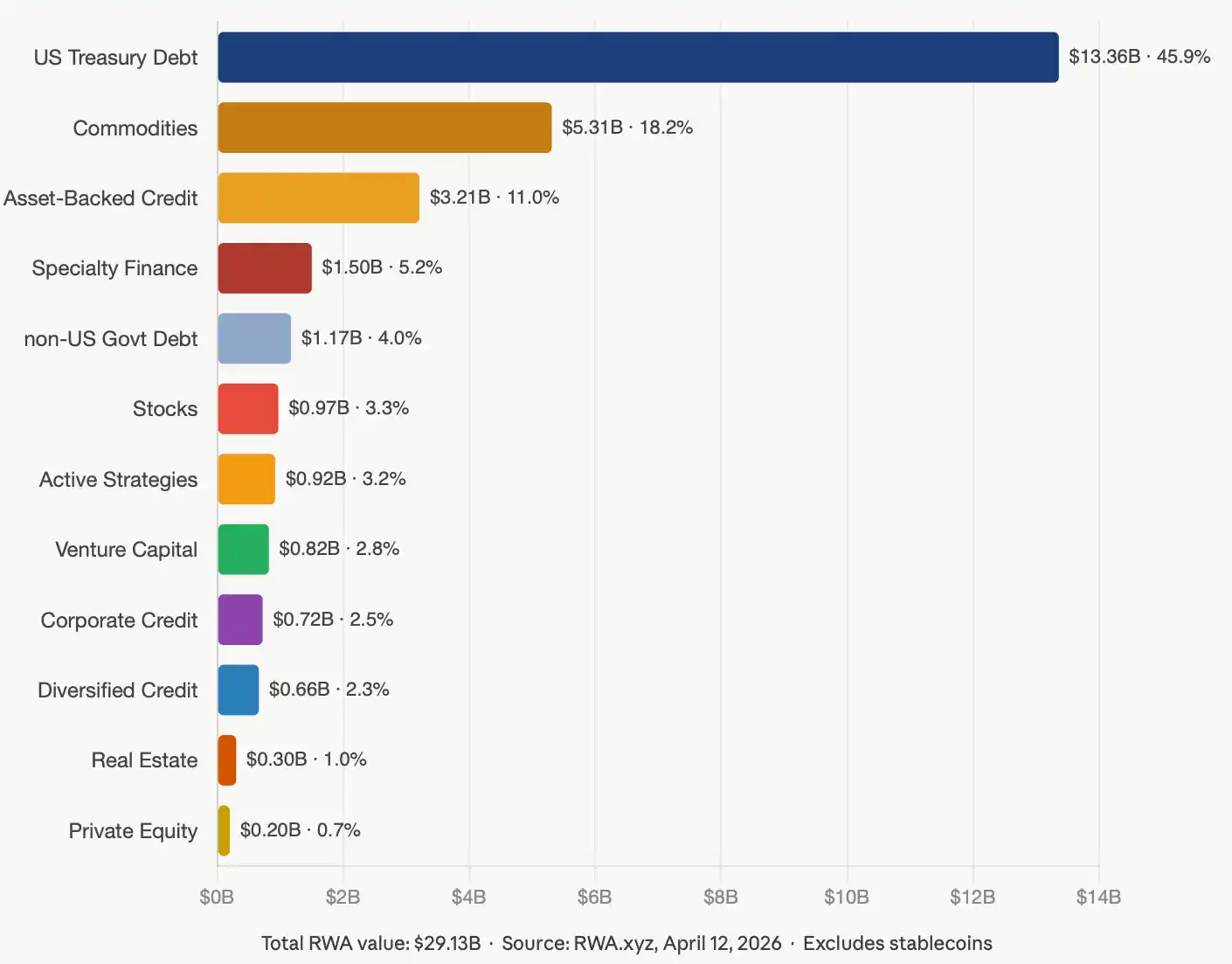
- The total tokenized real-world asset (RWA) market reached $29.13 billion in 2026, highlighting rapid growth in blockchain-based asset adoption.
- U.S. Treasury debt dominates the market at $13.36 billion, accounting for a 45.9% share and leading all tokenized asset classes.
- Commodities rank second at $5.31 billion, representing 18.2% of the market, driven by tokenized gold and resource-backed assets.
- Asset-backed credit reached $3.21 billion, contributing 11.0%, as demand for structured on-chain financial products grows.
- Specialty finance accounts for $1.50 billion (5.2%), reflecting diversification into niche lending and financing markets.
- Non-U.S. government debt totals $1.17 billion, capturing 4.0% and showing global expansion beyond U.S.-based assets.
- Stocks represent $0.97 billion (3.3%), signaling early adoption of tokenized equities.
- Active strategies contribute $0.92 billion (3.2%), highlighting growing interest in managed on-chain investment products.
- Venture capital stands at $0.82 billion (2.8%), showing blockchain’s role in early-stage funding ecosystems.
- Corporate credit totals $0.72 billion (2.5%), as companies increasingly explore tokenized debt issuance.
- Diversified credit holds $0.66 billion (2.3%), supporting portfolio-based credit tokenization strategies.
- Real estate accounts for $0.30 billion (1.0%), indicating early-stage adoption despite strong long-term potential.
- Private equity remains the smallest segment at $0.20 billion (0.7%), reflecting limited but emerging tokenization activity.
- Overall, the market shows strong concentration in fixed-income assets, with government debt and credit products making up the majority of tokenized value.
Regulatory Landscape
- MiCA continues as the EU’s single crypto framework in 2026, with 53 total licenses noted under the regime as of late 2025 and transition periods extending into 2026.
- MiCA rules for tokenized securities and RWAs are scheduled for key implementation milestones by Q2 2026.
- The UAE’s updated 2026 federal crypto framework now covers 8 licensed financial activities.
- UAE minimum capital requirements for regulated crypto activities range from AED500,000 to AED4 million in 2026.
- UAE penalties for certain DeFi compliance failures can reach up to AED1 billion.
- The U.S. House previously passed the CLARITY Act by a vote of 294-134, though broader implementation still depends on the legislative process.
- The CLARITY Act would split oversight across 3 digital asset categories: securities, digital commodities, and stablecoins.
- In the EU, DAC8 crypto-asset tax reporting rules take effect by July 2026.
- Bahrain remains among the Gulf’s more structured digital-asset jurisdictions, with the central bank serving as the sole virtual-asset regulator.
Asset Tokenization Market Trends
- Tokenized real-world assets on public blockchains reached about $23.6 billion in 2026, up roughly 66% year to date.
- RWA tokenization exceeded $24 billion by February 2026 after posting 266% growth in 2025.
- Around 67% of institutional investors and wealth managers now view tokenized assets as a key innovation.
- Nickel surveyed 260 global institutional investors overseeing $14 trillion in assets in early 2026.
- By 2026, institutional investors expect to allocate 5.6% of portfolios to tokenized assets, while HNW investors expect 8.6%.
- Among firms evaluating tokenization partners, 89% rank digital asset custody as a top priority.
- Token servicing and lifecycle management are a priority for 82% of banks evaluating tokenization strategies.
- Primary distribution ranks highly for 80% of asset managers pursuing tokenized asset strategies.
- The tokenized RWA market is now measured in the tens of billions of dollars entering 2026, led by private credit and U.S. Treasuries.
Leading Tokenized Commodities
- PAX Gold held about $942.3 million in market capitalization in April 2026.
- Tether Gold reached roughly $824.5 million in market capitalization in April 2026.
- The tokenized silver market cap rose to around $302 million in 2026.
- Kinesis Silver accounted for about $290.1 million of tokenized silver market value in April 2026.
- XAUT and PAXG together controlled nearly 96.7% of the tokenized gold market in 2026.
- More than 1.2 million ounces of physical gold were backed by on-chain tokenized gold assets in 2026.

Benefits of Commodities Tokenization
- Tokenized commodities market value climbed to about $7.37 billion by early April 2026, showing much deeper liquidity than a year earlier.
- The sector grew from $1.9 billion in early 2025 to $7.13 billion by February 2026, more than 4x in one year.
- Tokenized commodities posted roughly 360% yearly growth, making them one of the fastest-growing RWA segments.
- Gold still represents about 70%-73% of tokenized commodity value, proving strong investor demand for digital precious metals.
- XAUT and PAXG together account for around 74% of the tokenized commodities market in 2026.
- PAXG is backed by more than 510,000 ounces of allocated physical gold, supporting transparency and investor trust.
- Retail access keeps widening as tokenized commodities trade 24/7, unlike most traditional commodity markets.
- Tokenized RWA markets overall surpassed $24 billion by February 2026, helping commodities benefit from stronger on-chain infrastructure and global access.
Institutional Adoption and Infrastructure
- About 63% of institutional investors say they are very interested in tokenized assets in 2026.
- Around 64% of asset managers are interested in tokenizing their own assets.
- More than 350 institutional investors were surveyed globally in the 2026 EY-Parthenon and Coinbase study.
- About 73% of institutional investors plan to increase digital asset allocations in 2026.
- Roughly 61% of institutions expect tokenization to have a significant impact on market structure in the coming years.

- Tokenized fund adoption is scaling, with BlackRock’s USD Institutional Digital Liquidity Fund surpassing $1 billion in AUM.
- Tokenized funds could reach over $600 billion in AUM by 2030, underscoring why infrastructure investment is accelerating now.
- Commodities remain a smaller institutional segment than private credit and Treasuries, while tokenized cash-management products are the most mature RWA category in 2026.
Frequently Asked Questions (FAQs)
Gold-linked products account for roughly 73% of the market, or about $5.3 billion.
XAUT and PAXG together make up about 71% of the entire tokenized commodities market.
The holder count reached 185,690, while monthly active addresses rose to 54,639 by March 2026.
Conclusion
The tokenized commodities market today represents a confluence of technology, regulation, and market demand, transforming traditional commodities investing. By enabling fractional ownership, enhancing liquidity, and attracting institutional investors, tokenized commodities are reshaping access to markets that were once reserved for large-scale players.
Looking ahead, advancements in blockchain scalability, regulatory clarity, and institutional infrastructure will further drive the market, making tokenized commodities an increasingly integral part of diversified investment portfolios. With continued innovation and the backing of major financial institutions, tokenized commodities stand poised to redefine the commodities investment landscape, offering both accessibility and resilience in an ever-evolving financial world.












CEClayton Elliott
Wow thanks for the insight.