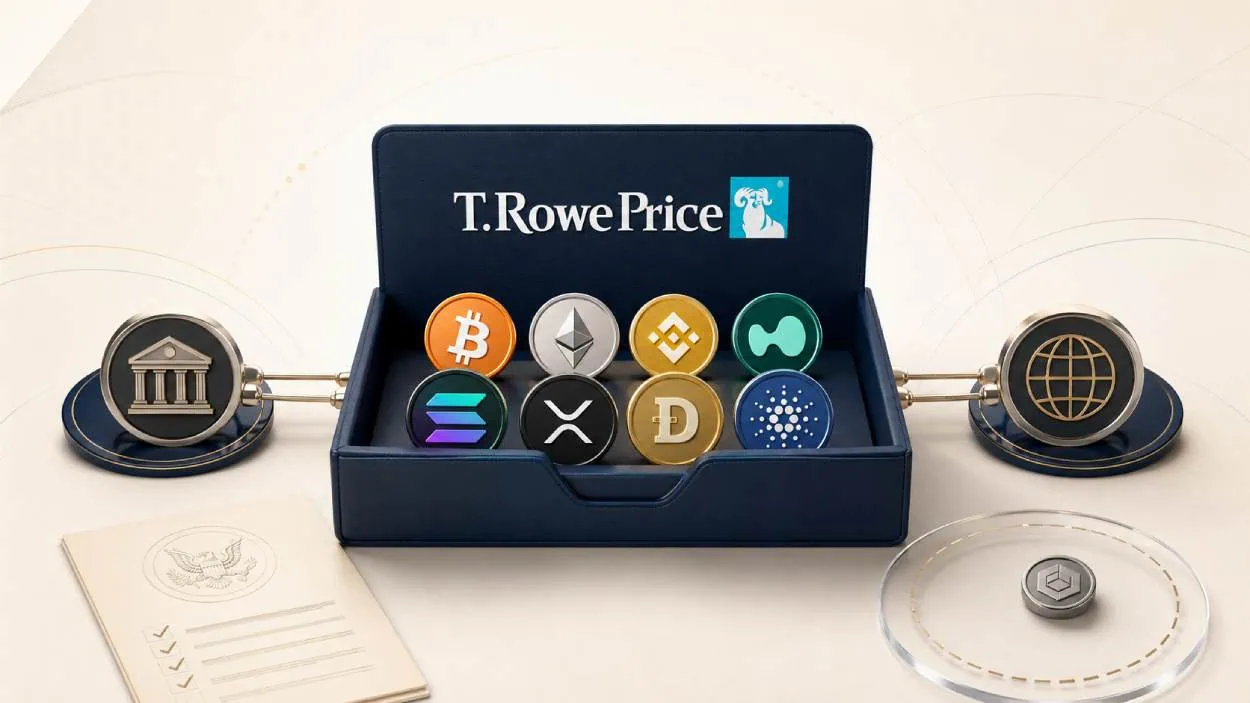






T. Rowe Price disclosed on July 14, 2026, that its Active Crypto ETF (TKNZ) added StoneX Digital LLC and Virtu Financial Singapore as new crypto trading counterparties. The same SEC filing expanded the fund’s Eligible Assets to include tokens such as HYPE and BNB.
Key Takeaways
- T. Rowe Price’s Active Crypto ETF (TKNZ) now lists 17 Eligible Assets, from bitcoin and ether to newer additions like HYPE and BNB.
- StoneX Digital and Virtu Financial Singapore joined as new crypto trading counterparties under agreements the Sponsor disclosed to the SEC alongside the eligible-asset update.
- The fund charges a 0.75% net management fee and holds between 5 and 15 tokens at any given time.
- The fund’s FTSE benchmark index includes Canton Network (CC), a token that is not on the Eligible Assets list T. Rowe Price can actually buy.
- T. Rowe Price can add new Eligible Assets to the fund without prior notice to Shareholders, informing them only through its website or later filings.
What Happened?
T. Rowe Price Sponsor LLC filed a Current Report on Form 8-K disclosing StoneX Digital LLC and Virtu Financial Singapore Pte. Ltd. as new crypto asset trading counterparties for the Fund. A Prospectus Supplement filed the same day carries the identical Eligible Assets update.
Both agreements let the Fund trade crypto assets directly with StoneX and Virtu on a principal-to-principal basis. T. Rowe Price was founded in 1937, and its own Free Writing Prospectus describes TKNZ as the first actively managed multi-token spot ETP available in the U.S.
NEW: T. Rowe Price will soon launch its Active Crypto ETF (TKNZ) on the NYSE Arca, according to Bloomberg Senior ETF Analyst Eric Balchunas.
— The Block (@TheBlockCo) July 15, 2026
“Any day now, I’d guess Thursday,” Balchunas says. pic.twitter.com/wzvOrikUN4
How the New Trading Agreements Split Liability?
Under the StoneX agreement, StoneX carries no liability to the Fund for a third party’s acts, insolvency, delays, or system failures, except where StoneX’s own gross negligence or willful misconduct is to blame. The Fund and StoneX also agreed to indemnify each other for losses tied to a breach of the agreement, a violation of law, or reliance on an instruction reasonably believed to come from the other party.
Virtu’s agreement mirrors that structure: Virtu, the Fund, and the Sponsor each carry no liability for a third party’s acts or for system failures outside systems Virtu itself maintains, with the same mutual indemnification for a breach of the agreement or a violation of law. StoneX’s Digital Asset Trading Agreement with the Sponsor is dated June 12, 2026, and Virtu’s Liquidity Provider Agreement is dated May 15, 2026. Both agreements predate the 8-K by weeks, so the filing formalizes counterparty terms T. Rowe Price had already negotiated.
Eligible Assets vs. the Benchmark Index
The fund’s Eligible Assets now span bitcoin (BTC), ether (ETH), SOL, XRP, ada (ADA), AVAX, litecoin (LTC), DOT, Dogecoin (DOGE), HBAR, Bitcoin Cash (BCH), LINK, lumen (XLM), Shiba Inu (SHIB), sui (SUI), HYPE and BNB. Its benchmark, the FTSE Crypto U.S. Listed Index, includes Bitcoin and Ether alongside eight other constituents, among them Canton Network (CC). Canton Network never appears on the Eligible Assets list, so the fund is benchmarked against a token it cannot currently buy.
| Index Constituent | Weight | On Eligible Assets List |
|---|---|---|
| BTC (Bitcoin) | 39.85% | Yes |
| ETH (Ethereum) | 16.77% | Yes |
| BNB (BNB Chain) | 9.59% | Yes |
| XRP | 9.12% | Yes |
| SOL (Solana) | 8.27% | Yes |
| HYPE (Hyperliquid) | 5.09% | Yes |
| DOGE (Dogecoin) | 3.49% | Yes |
| ADA (Cardano) | 2.79% | Yes |
| XLM (Stellar) | 2.77% | Yes |
| CC (Canton Network) | 2.25% | No |
Source: SEC Form 424B3 Prospectus Supplement, Active Crypto ETF, filed July 14, 2026 (index weights as of July 9, 2026).

Implications for Active Crypto ETFs
Regulatory changes in 2024 enabled institutional custody of crypto tokens, which led to the first spot ETPs and, since then, active multi-token versions like TKNZ. T. Rowe Price frames the pitch around flexibility: fixed-weight crypto indexes are slow to respond to changing markets, while active managers can adjust a portfolio in real time to address risk or seize new opportunities. That framing also explains the discretionary Eligible Assets clause: a fund built to rotate holdings needs room to add newer tokens like HYPE and SUI as the SEC crypto regulation picture keeps developing, without a shareholder vote each time.
CoinLaw’s Takeaway
The counterparty terms matter as much as the ticker count. Capping StoneX’s and Virtu’s liability to their own gross negligence while extending mutual indemnification mirrors how institutional trading desks structure risk in traditional markets, not a crypto specific carve out.
The bigger tell is the benchmark gap. A fund locked to its Eligible Assets list is still measured against an index holding a token it cannot buy, and that gap only closes if T. Rowe Price uses its own discretion to add assets.