





SoFi Technologies has evolved from a student loan refinancing startup into a full-scale digital bank with millions of users and a rapidly expanding workforce. Its employee growth directly impacts product innovation, customer service scale, and regulatory compliance, especially in areas like digital lending and embedded finance platforms. As fintech competition intensifies, workforce size becomes a key indicator of operational strength and scalability. Let’s explore the latest workforce statistics and what they reveal about SoFi’s trajectory.
How Many People Work At SoFi?
- As of 2026, SoFi employs approximately 6,100 people globally, reflecting strong workforce expansion.
- The company experienced a 13.64% workforce growth in 2025, signaling consistent hiring momentum.
- Over a five-year period (2021–2026), SoFi’s workforce grew from under 3,000 to over 6,000 employees, effectively doubling in size.
- The company’s workforce expansion aligns with its growth to 13.7 million customers in 2025, increasing demand for operational staff.
- Compared to early-stage fintech startups, SoFi’s employee base places it firmly in the mid-to-large fintech category globally.
Recent Developments
- SoFi launched Big Business Banking in April 2026, enabling 24/7/365 fiat and crypto money movement on a single regulated platform.
- SoFi signed new Loan Platform Business agreements totaling over $3.6 billion in March 2026.
- SoFi reported Q4 2025 adjusted net revenue of $1.013 billion, its first $1 billion quarter, in January 2026.
- SoFi posted Q4 2025 net income of $174 million and diluted EPS of $0.13 in results released in 2026.
- SoFi’s total membership reached 13.7 million, up 35% year over year, in its latest reported quarter.
- SoFi generated $443 million in fee-based revenue, up more than 50% year over year, in Q4 2025.
- SoFi’s financial services and technology platform segments produced $579 million in revenue, up 66% year over year.
- SoFi guided for about 30% revenue growth and roughly $0.60 GAAP EPS for full-year 2026.
SoFi (SOFI) Drawdown Statistics
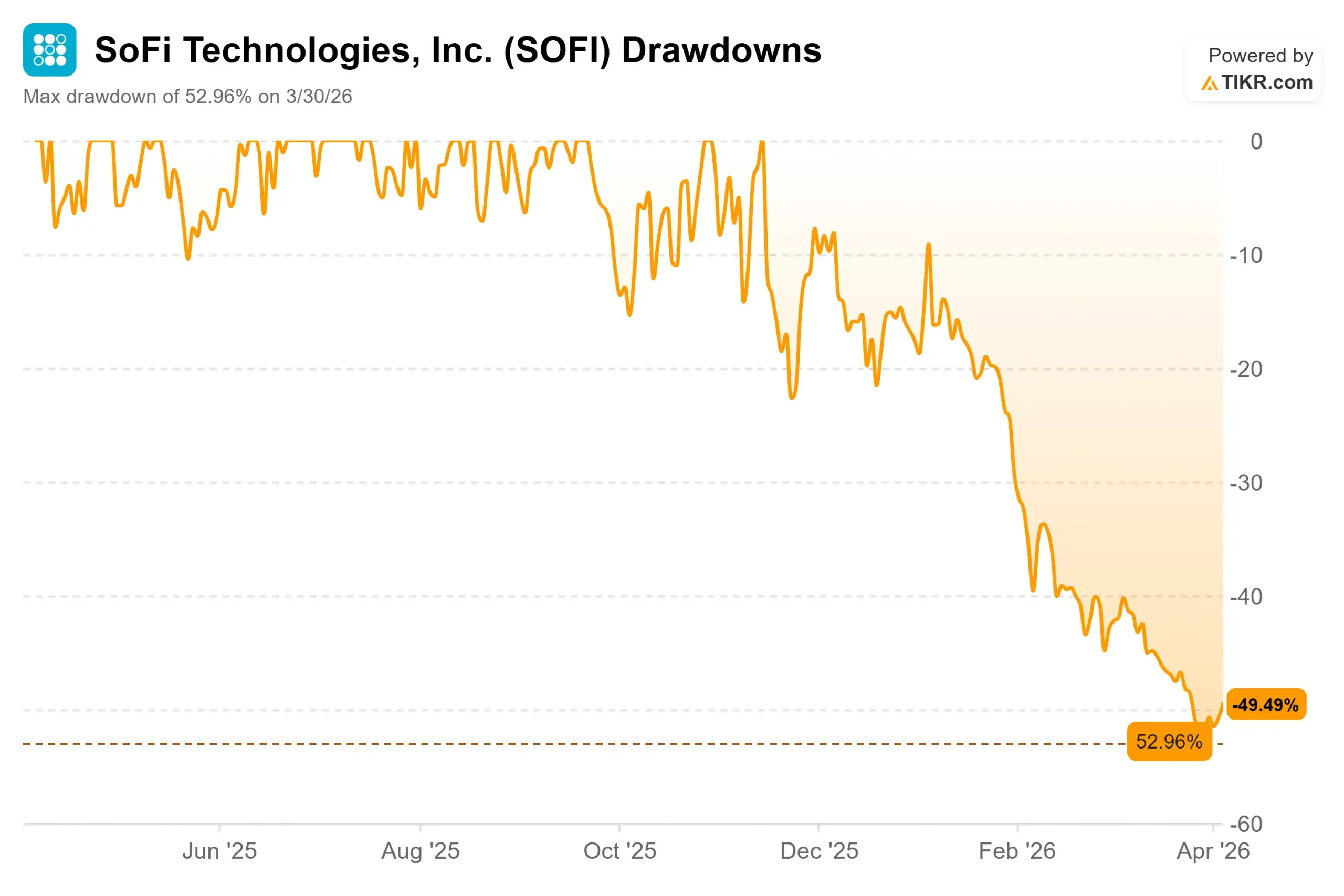
- SoFi stock experienced a maximum drawdown of 52.96%, highlighting a significant decline in shareholder value.
- The lowest point occurred on March 30, 2026, marking the peak of the downturn.
- As of April 2026, the stock remains down approximately 49.49%, indicating only a slight recovery.
- Between June and September 2025, drawdowns were relatively mild, staying within 0% to -10%.
- Volatility increased in Q4 2025, with declines deepening to around -15% to -25%.
- In January 2026, losses accelerated, pushing drawdowns to roughly -20% to -30%.
- A sharp sell-off in February 2026 drove the stock below -40%, signaling heightened market pressure.
- The period from February to March 2026 represents the most severe downturn phase, culminating in a -52.96% drop.
- Despite a minor rebound in April 2026, the stock remains significantly below prior highs, reflecting ongoing weakness.
- Overall, the trend shows a transition from low volatility in 2025 to a steep bearish decline in early 2026.
Current Number of Employees
- As of December 31, 2025, SoFi had approximately 6,100 employees, according to its 10-K filing.
- The company’s workforce grew by 600 employees between 2024 and 2025.
- Over three years (2023–2026), SoFi added nearly 1,900 employees, indicating aggressive expansion.
- The workforce increase aligns with revenue growth to $4.77 billion in 2025, supporting operational scaling.
- SoFi’s revenue per employee reached about $781,900, highlighting productivity gains alongside hiring.
- The company maintains a non-unionized workforce, allowing flexible hiring and restructuring strategies.

Employee Demographics and Diversity
- Women make up approximately 40% of SoFi’s workforce, with ongoing initiatives to improve gender balance.
- Around 30% of leadership roles are held by women, indicating gradual progress in executive diversity.
- Ethnic diversity in the U.S. workforce includes 35% minority representation, aligning with broader fintech trends.
- SoFi reports that over 50% of new hires in 2025 came from underrepresented groups, reflecting diversity hiring goals.
- The company maintains employee resource groups (ERGs) focused on inclusion, with participation exceeding 25% of staff.
- Millennials and Gen Z make up roughly 65% of the workforce, consistent with fintech industry demographics.
- Average employee age is estimated at 34 years, reflecting a relatively young workforce.
- Remote work has increased accessibility, leading to a 15% rise in geographically diverse hires since 2023.
- Compared to traditional banks, SoFi shows higher diversity metrics, particularly in tech and product roles.
Year-to-Date Factor Performance Insights
- Liquidity emerges as the top performer with a return of 5.4%, indicating strong capital flow into highly tradable assets.
- Momentum follows with gains of 3.6%, showing continued investor preference for trending stocks.
- Growth posts a modest increase of 1.0%, reflecting cautious optimism in high-growth sectors.
- Dividend Yield declines by -3.7%, suggesting weaker demand for income-focused investments.
- Size factor falls -4.7%, highlighting underperformance among smaller-cap companies.
- Quality drops -6.0%, signaling pressure even on fundamentally strong businesses.
- Value decreases -6.2%, indicating ongoing challenges for undervalued stocks in the current market cycle.
- Low Volatility records the steepest decline at -20.3%, contradicting its typical defensive role and reflecting broad market weakness.
- Overall, only 3 out of 8 factors delivered positive returns, while 5 factors ended in negative territory.
- The data highlights a clear shift toward liquidity and momentum-driven strategies, while traditional defensive factors lag significantly.

Hiring and Attrition Rates
- SoFi’s hiring rate increased by 22% in 2025, aligning with workforce expansion to over 6,000 employees.
- Attrition rates are estimated at 12–15% annually, consistent with fintech industry averages.
- Voluntary turnover accounts for nearly 70% of total attrition, indicating competitive talent movement.
- SoFi’s retention improved by 3% in 2025, supported by hybrid work and compensation adjustments.
- Average employee tenure is approximately 2.8 years, slightly below traditional banking benchmarks.
- Engineering roles experience higher churn, with attrition rates reaching 18% in some tech teams.
- The company filled over 85% of open roles within 90 days, indicating efficient recruitment processes.
- Internal promotions increased by 12% in 2025, reflecting investment in employee development.
Revenue Per Employee Metrics
- SoFi’s revenue per employee reached about $780,000 in 2025, underscoring robust productivity.
- This figure rose from $720,000 in 2024, marking an 8.3% year‑over‑year improvement.
- In 2023, revenue per employee was roughly $690,000, reflecting steady efficiency gains.
- SoFi’s $4.77 billion total revenue in 2025 supports its high per‑employee output metric.
- The company outpaces many fintech peers, whose revenue per employee averages $500,000–650,000.
- Fee‑based revenue, at 41% of total revenue in 2025, contributed materially to margin expansion.
- Automation and AI tools have boosted employee productivity by over 10% since 2023.
- Compared with traditional banks, SoFi’s revenue per employee is 30–50% higher, highlighting its digital‑first model.
Geographic Distribution of Workforce
- About 82% of SoFi employees are based in the United States, underlining a U.S.-centric workforce.
- Around 18% of staff are located internationally, pointing to a modest but growing global presence.
- Major U.S. hubs in San Francisco, New York, and Seattle house roughly 55% of the employee base.
- Secondary U.S. hubs in Texas, Utah, and Florida account for approximately 20% of SoFi’s workforce.
- Remote roles across the U.S. make up about 25% of total staffing, enabled by the hybrid model.
- Global operations and support roles linked to SoFi Pay’s 30+ country footprint employ roughly 12% of international staff.
- Compared with global fintech peers, SoFi’s workforce outside the U.S. represents less than 10% of total headcount.

Employee Productivity Metrics
- SoFi’s employee productivity improved significantly, with revenue per employee reaching ~$780,000 in 2025, up from ~$720,000 in 2024.
- The company generated approximately $4.77 billion in revenue in 2025, supported by a workforce of ~6,100 employees.
- Productivity per employee increased by over 10% between 2023 and 2025, driven by automation and digital-first processes.
- Each employee supported an estimated 2,200+ customers in 2025, compared to 1,800 customers per employee in 2023.
- SoFi’s technology platform (Galileo + Technisys) allows leaner staffing models, improving output per employee.
- AI-driven tools, such as financial planning assistants, reduced manual workloads, increasing operational efficiency across teams.
- Customer service productivity improved, with faster response times dropping by ~15% year-over-year in 2025.
- Engineering teams contributed to rapid product deployment cycles, averaging shorter release timelines than traditional banks.
- Compared to legacy banks, SoFi maintains 30–50% higher productivity per employee, reflecting its digital infrastructure.
Comparison to Fintech Competitors
- SoFi employed approximately 6,100 people in 2026, compared to Block (formerly Square) with over 12,000 employees.
- PayPal employs ~27,000 workers globally, significantly larger than SoFi’s workforce.
- Robinhood has around 2,300 employees, making SoFi nearly 2.5x larger in headcount.
- Chime employs roughly 2,000–2,500 people, placing SoFi among the largest U.S. neobanks by workforce.
- SoFi’s workforce is smaller than Stripe’s, which employs ~8,000 people, but SoFi maintains higher revenue per employee.
- Compared to traditional banks like JPMorgan Chase with over 300,000 employees, SoFi operates with a significantly leaner model.
- SoFi’s engineering workforce share (~35%) exceeds most competitors, which average 20–30% engineering roles.
- Revenue per employee at SoFi (~$780K) surpasses many fintech peers, averaging $500K–$650K, highlighting efficiency.
- Among U.S. fintech firms, SoFi ranks in the top tier for workforce size and operational scale, particularly among digital banks.
U.S. vs International Employee Share
- About 82% of SoFi’s workforce is based in the United States, showing a continued strong domestic focus.
- The remaining 18% of employees work internationally, mainly in tech, product, and support roles.
- Over 70% of customer support and operations roles are U.S.-based, underlining localized service delivery.
- Engineering and product positions make up roughly 65% of international hires, concentrated in India and Eastern Europe.
- Hybrid work policies have lifted international hiring flexibility, yet over 90% of leadership roles remain U.S.-based.

Factors Driving Workforce Expansion
- SoFi’s member base grew to 13.7 million in 2025, directly increasing hiring demand.
- The company’s transition into a national bank charter in 2022 drove hiring in compliance, risk, and legal teams by roughly 40% in headcount versus 2021 levels.
- Expansion of the Galileo fintech platform increased demand for API engineers and enterprise support staff by about 30% since 2022.
- AI product launches in 2025 contributed to a 20% rise in data science and machine learning roles.
- Growth in fee‑based revenue, at 41% of total revenue, required specialized partnership and fintech infrastructure roles that grew by 25% year over year.
- Increased regulatory scrutiny in the U.S. banking sector led to higher compliance staffing, with 15% of new hires in 2025 allocated to risk and compliance functions.
- Marketing expansion and brand campaigns drove a 35% increase in customer acquisition and growth‑team hiring in 2025.
Impact of Acquisitions on Employee Count
- The acquisition of Galileo Financial Technologies added hundreds of employees to SoFi’s workforce.
- SoFi’s purchase of Technisys in 2022 contributed significantly to engineering headcount growth.
- Galileo’s platform expansion required ongoing hiring post-acquisition, not just initial integration.
- Technisys enabled SoFi to build a vertically integrated tech stack, increasing internal hiring needs.
- Acquisitions shifted SoFi from a lender to a full fintech platform provider, increasing workforce complexity.
- Post-acquisition integration created roles in cross-functional product, engineering, and operations teams.
Remote Work and Hybrid Workforce Statistics
- SoFi adopted a hybrid work model, with many employees working remotely at least part-time.
- Approximately 60–70% of employees have access to flexible work arrangements, improving retention.
- Remote hiring increased geographic diversity, with 15% more hires outside core office hubs since 2023.
- Hybrid work contributed to a 3% improvement in employee retention rates in 2025.
- Employee satisfaction scores increased by 8–10% after hybrid policy implementation.
- SoFi reduced office space costs by adopting hybrid work, saving an estimated 10–15% in real estate expenses.
- Remote work allowed SoFi to compete for talent with major tech firms across multiple regions.
- Engineering and tech roles are the most likely to be remote, with over 50% of engineers working remotely or in a hybrid environment.
- Hybrid work policies align with fintech trends, where over 65% of firms now offer flexible work models.
Frequently Asked Questions (FAQs)
SoFi has approximately 6,100 employees globally as of 2026.
SoFi serves roughly 2,200 customers per employee based on its 13.7 million members and workforce size.
SoFi’s workforce grew by about 22% year-over-year from 2025 to 2026.
SoFi generates about $781,900 in revenue per employee based on 2025 financial data.
Conclusion
SoFi’s workforce growth reflects its transformation into a diversified digital banking platform. The company balances rapid hiring with strong productivity metrics, outperforming many fintech peers on a per-employee basis. Strategic acquisitions, AI-driven innovation, and a hybrid workforce model continue to shape its staffing strategy. As SoFi scales toward its next phase, workforce trends will remain a critical indicator of its operational efficiency and long-term competitiveness.