








In the past few years, cryptocurrency staking has surged in popularity, transforming from a niche activity into a mainstream investment strategy. Unlike traditional mining, staking allows investors to earn rewards by simply holding and “staking” their cryptocurrency in a wallet, contributing to the network’s security and performance.
This new trend offers significant rewards but also presents risks and complexities that investors must understand to maximize their potential. This article delves into the latest staking statistics, exploring key trends, performance metrics, and the factors shaping the staking ecosystem.
Editor’s Choice
- Around 31% of the ETH supply is staked, reflecting strong participation and long‑term network security.
- Roughly 45% of crypto holders participate in staking, with Ethereum, Solana, and Cardano still leading the pack.
- The average annual staking reward across major PoS platforms is about 6.8%, with some altcoins offering up to 12–19%.
- Liquid staking protocols like Lido and Rocket Pool now manage over $58 billion in assets.
- Cardano (ADA) maintains one of the highest participation rates, with roughly 71% of ADA staked.
Recent Developments
- Ethereum’s staking rate has climbed to about 30%–31% of the total ETH supply in 2026, with more than 36 million ETH now staked.
- Ethereum supports over 1.1 million active validators in 2026, with average validator uptime near 99.2%.
- Institutional staking demand is rising, with BlackRock’s staked Ethereum trust reaching about $254 million in AUM in its first week.
- Base ETH staking rewards generally range from 3% to 4%, while restaking incentives can temporarily lift combined yields above 8%–15%.
- Ethereum’s staking ratio hit a record 31.1% in March 2026 as institutional participation continued to expand.
Staking APY Comparison
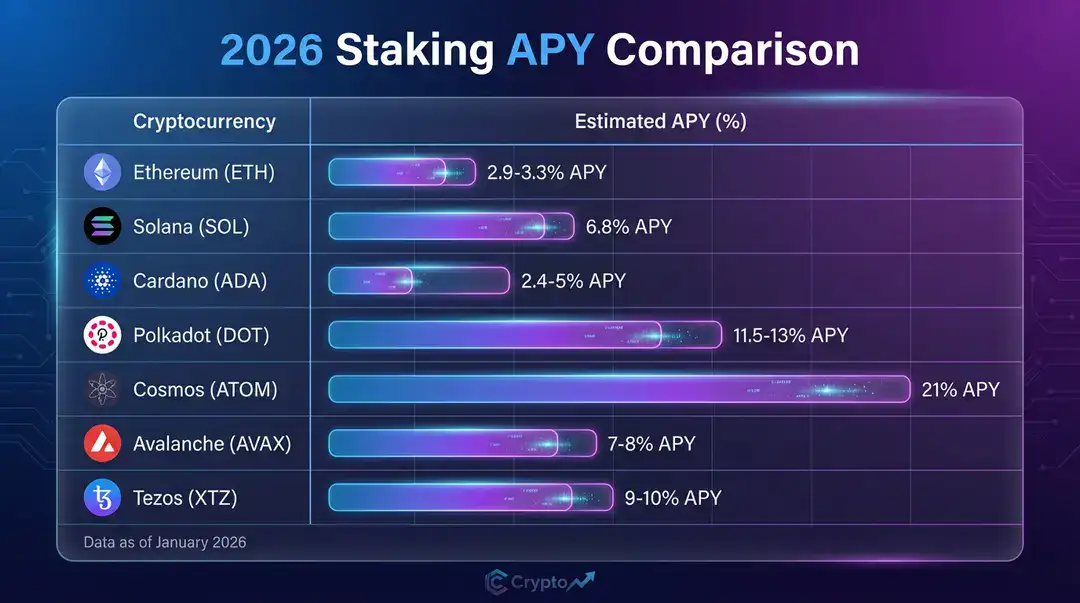
- Cosmos (ATOM) offers the highest staking returns at around 21% APY, making it one of the most lucrative options for yield-focused investors.
- Polkadot (DOT) delivers strong rewards between 11.5% and 13% APY, positioning it among the top high-yield staking assets.
- Tezos (XTZ) provides stable mid-to-high returns ranging from 9% to 10% APY, appealing to long-term stakers seeking consistency.
- Avalanche (AVAX) generates competitive yields of approximately 7% to 8% APY, balancing growth potential with solid staking rewards.
- Solana (SOL) offers a steady 6.8% APY, making it a popular choice for users prioritizing performance and ecosystem growth.
- Cardano (ADA) shows moderate returns between 2.4% and 5% APY, with variability depending on staking pools and network conditions.
- Ethereum (ETH) delivers relatively lower yields at 2.9% to 3.3% APY, reflecting its maturity and lower risk profile in the staking ecosystem.
- Overall, staking yields in 2026 range widely from around 2.4% to 21% APY, highlighting significant differences in risk, inflation models, and network incentives across blockchain ecosystems.
Proof of Stake (PoS) versus Proof of Work (PoW)
- Ethereum’s move to PoS cut its energy use by about 99.95%, making it roughly 2,000x more efficient than its old PoW model.
- PoS networks generally reduce energy use by more than 99% compared with PoW systems.
- Bitcoin’s PoW network consumes roughly 91-150 terawatt-hours of electricity annually, with some estimates reaching 169.7 TWh.
- Cambridge research estimated Bitcoin mining electricity demand at about 138 TWh per year, equal to around 0.5% of global electricity use.
- Ethereum under PoS now uses under 35 Wh per transaction, down from roughly 84,000 Wh under PoW.
- Ethereum’s post-Merge energy usage is estimated at less than 0.1% of Bitcoin’s annual energy footprint.
- A single Bitcoin transaction can consume up to 1,200 kWh, far above the typical PoS transaction energy use.

Leading Staked Cryptocurrencies
- Ethereum (ETH) remains the largest staked asset, with more than 36 million ETH locked and about 30%–31% of the supply staked.
- Cardano (ADA) still posts one of the highest staking participation rates among major networks at roughly 71% of supply.
- Solana (SOL) has about 67%–70% of its supply staked, equal to roughly 393.6 million SOL.
- Polkadot (DOT) keeps about 49%–56% of DOT staked, with annual yields commonly ranging from 11% to 13%.
- Cosmos (ATOM) has around 59%–62% of tokens staked, totaling about 248.8 million ATOM.
- Avalanche (AVAX) shows about 50%–55% of supply staked, or roughly 230–235 million AVAX worth around $2.3–$2.6 billion at recent AVAX prices.
- Tezos (XTZ) records a staking ratio near 68%, with about 699.6 million XTZ staked worth roughly $470.6 million.
- Ethereum, Cardano, Solana, Polkadot, Cosmos, Avalanche, and Tezos all remain among the most actively staked PoS cryptocurrencies in 2026.

The Role of Validators and Delegators in Staking
- Ethereum validators still need to lock 32 ETH to run a full validator in 2026.
- Cardano supports more than 1,200 stake pools, showing broad delegator participation across the network.
- Polkadot validators must now maintain a minimum self-stake of 10,000 DOT after the March 2026 runtime upgrade.
- Polkadot nominators can choose up to 16 validators, expanding delegator diversification across the active set.
- Polkadot nomination pools reduce entry barriers, allowing delegators to start staking with as little as 1 DOT.
- Solana staking is distributed across hundreds of validators through liquid staking protocols like Marinade.
- Polygon delegators can stake either POL or MATIC, though rewards are now paid in POL.
- Polygon governance is considering a model that would route 50% of validator priority fees directly to stakers.
Calculate Your Staking Rewards
- Staking 10 ETH at a 3%–4% yield can earn about 0.3–0.4 ETH per year.
- Staking 10,000 ADA at a 3%–5% yield can generate roughly 300–500 ADA annually.
- Holding 500 SOL at a 6%–8% yield can return about 30–40 SOL per year.
- A 1,000 DOT stake at a 12%–15% yield can earn around 120–150 DOT annually.
- Staking 200 ATOM at a 15%–20% yield can produce about 30–40 ATOM per year.
- Staking 100 AVAX at a 7%–9% yield can return roughly 7–9 AVAX annually.
- Staking 1,000 XTZ at a 4%–5% yield can earn about 40–50 XTZ per year.

The Necessity of an On-Chain Reference Rate for ETH Staking Yield
- CESR emerged in 2026 as a benchmark tracking the mean annualized return of Ethereum validators.
- Ethereum now has more than 36 million ETH staked, creating a large base for standardized yield benchmarking.
- ETH staking yield generally ranges from 3% to 4% APR, making cross-platform comparison increasingly important for institutions.
- CFB reported ETH staking reward rates moving from 2.5611% to 2.4730% in one week in March 2026, underscoring daily benchmark variability.
- The STYETH index is published daily at 4:30 pm London time, giving markets a fixed reference point for ETH staking yield.
- MarketVector’s STKR benchmark recently showed a last close of 2.75, with a 1-year range of 2.49 to 7.61.
- Institutional ETH staking has surpassed 30% network participation, with about $120 billion in staked value needing transparent reference pricing.
- Bit Digital reported an institutional staking yield of about 2.9% on 138,266 ETH, highlighting why common benchmarks matter across providers.
Institutional Demand Trends Impacting Crypto Staking Markets
- In Week 1, Bitcoin ETFs recorded positive inflows of $206 million, while MicroStrategy (MSTR) purchased $116 million, indicating balanced institutional demand.
- Week 2 saw a sharp divergence, with ETF flows turning negative at -$246 million, while MSTR significantly increased its buying to $1.25 billion, highlighting aggressive corporate accumulation despite market outflows.
- Week 3 marked the strongest ETF performance, with inflows reaching $1.19 billion, while MSTR made no purchases, suggesting institutional demand shifted toward ETFs during this period.
- In Week 4, ETF outflows intensified to -$1.11 billion, the largest weekly decline, while MSTR executed massive purchases worth $2.12 billion, reinforcing its role as a major Bitcoin accumulator.
- Across the 4-week period, ETF flows showed high volatility, ranging from +$1.19 billion to -$1.11 billion, reflecting fluctuating investor sentiment.
- In contrast, MSTR purchases remained consistently bullish, totaling over $3.48 billion, signaling strong long-term conviction in Bitcoin.
- Bitcoin’s price fluctuated between approximately $86,000 and $98,000, showing resilience despite significant ETF outflows in later weeks.
- Overall, the data highlights a clear divergence between ETF investor behavior and corporate buying strategies, with MSTR acting as a stabilizing force during periods of ETF selling pressure.

Regulatory Developments in Staking
- The SEC and CFTC issued a joint interpretive release on March 17, 2026, clarifying how U.S. securities laws apply to cryptoassets and related transactions.
- The SEC-CFTC crypto memorandum of understanding was signed on March 11, 2026, creating a coordinated U.S. framework for digital asset oversight.
- MiCA enforcement is accelerating in 2026, with transitional relief ending and stricter compliance deadlines now hitting EU crypto service providers.
- More than 40 countries now enforce stricter crypto reporting rules under OECD-aligned frameworks, increasing scrutiny of staking rewards and offshore holdings.
- Japan continues to tax staking rewards as income, with effective crypto tax rates ranging from 15% to 55% under existing rules.
- South Korea applies crypto tax rates of 20% to 40% as its virtual asset compliance regime expands.
- In Japan, investors must report crypto income once annual gains exceed 200,000 JPY.
Frequently Asked Questions (FAQs)
About 29.6% to 30.1% of the ETH supply is staked, equal to roughly 35.9 million to 36+ million ETH.
Staked ETH is valued at more than $119 billion to $120 billion.
Ethereum has over 1.1 million active validators.
Liquid staking protocols manage more than $25 billion globally, with Ethereum liquid staking alone above $44 billion and some estimates for major protocols above $50 billion.
Conclusion
Cryptocurrency staking has transformed the way users engage with blockchain networks, offering rewards for participation in network security without the need for intensive mining resources. The ecosystem continues to grow with innovations like liquid staking, institutional involvement, and evolving regulatory frameworks. As staking gains traction, it’s reshaping the financial landscape, appealing to a diverse range of participants from retail investors to large institutions. By staying informed about staking metrics, trends, and regulatory changes, investors can make strategic decisions and capitalize on the potential rewards of staking.












APAlex Parker
Hey Barry Elad, thanks for diving into staking milestones and trends. Curious about the average staking yields part. How do these yields compare to traditional savings accounts or stock dividends? Lookin’ for options to beef up my portfolio without crazy risks. Cheers!
Good question, Alex. Staking yields have historically ranged from around 3% to 15% depending on the network, which compares favorably to traditional savings rates on paper. The key difference is that rewards are denominated in the staked asset, so real returns depend heavily on price performance. For someone already comfortable holding crypto long-term it can be a useful addition, though the risk profile is quite different from dividend stocks or savings accounts.
STSam T.
Good luck with that. Crypto’s too volatile for my taste. Traditional dividends are way predictable.
MZMia Zhong
Interesting analysis, particularly the comparison between PoS and PoW. However, it seems like the environmental impact merits deeper discussion. Proof of Stake is undoubtedly less energy-intensive than Proof of Work, offering a more sustainable alternative. Yet, the decentralization level of PoS networks and their security mechanisms against attacks are areas that could have used more scrutiny in your article. Looking forward to a more detailed comparative analysis!
TRTJ Reynolds
Nice rundown on the staking scene! got me thinking about diving deeper into crypto, especially staking. Liquid staking and restaking trends caught my eye. Seems like the crypto world’s always got something new popping up.