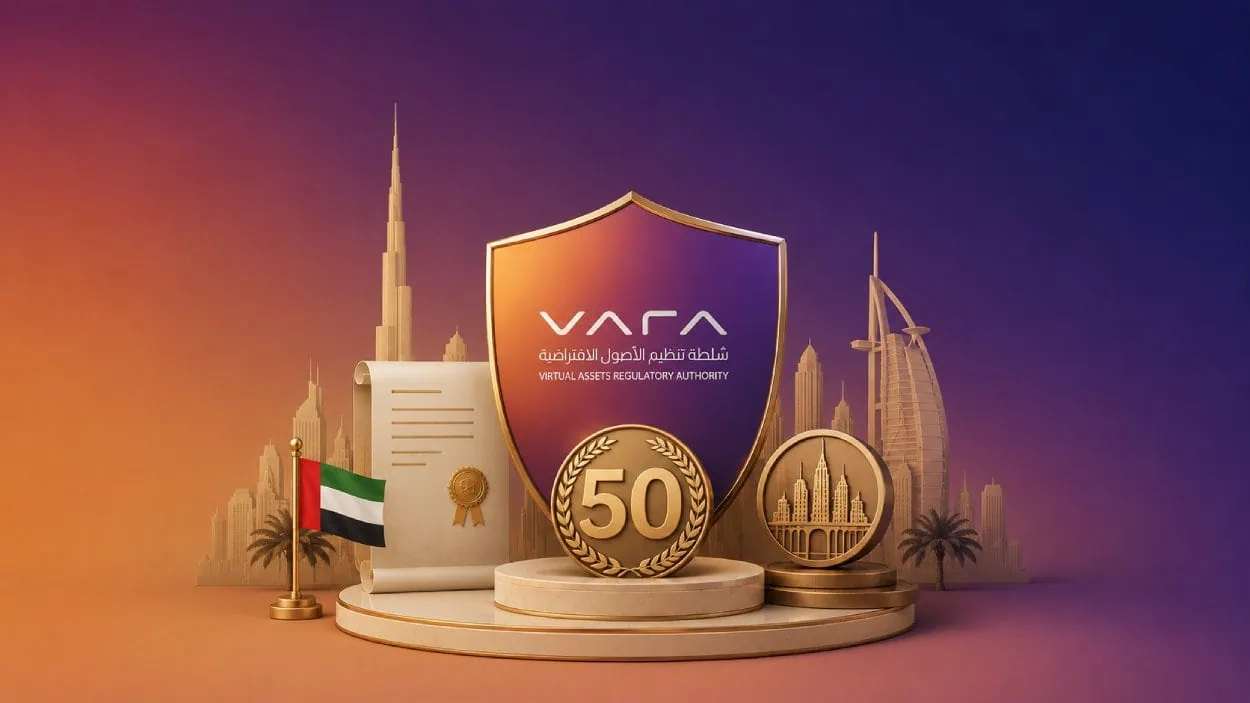






Dubai has issued its 50th crypto license through the Virtual Assets Regulatory Authority, marking another step in the emirate’s effort to become a leading global hub for digital asset businesses.
Key Takeaways
- Dubai’s VARA has granted its 50th Virtual Asset Service Provider license to Tribe Tokenisation FZE.
- The milestone highlights the rapid growth of Dubai’s crypto sector, although not all licensed companies are fully operational.
- VARA says it evaluates market activity using factors beyond license numbers, including transaction volumes and assets under management.
- Dubai’s regulatory framework now covers exchanges, custody providers, broker dealers, token issuers, and emerging sectors such as stablecoins and tokenized assets.
What Happened?
Dubai’s Virtual Assets Regulatory Authority, better known as VARA, has reached an important milestone after issuing its 50th license to a crypto company. The latest approval went to Tribe Tokenisation FZE, a platform focused on tokenized assets.
The new license underlines Dubai’s continued push to attract digital asset companies and build one of the world’s most comprehensive regulatory environments for the crypto industry.
🚨 DUBAI CRYPTO MILESTONE!
— Crypto Aman (@cryptoamanclub) June 29, 2026
Dubai’s regulator VARA has officially granted its 50th crypto license.
This latest license has been given to the tokenized assets platform Tribe Tokenisation.
Dubai’s regulated crypto market is growing even faster! pic.twitter.com/RJSDhx5cHy
Dubai’s Crypto Ecosystem Continues to Expand
VARA was established in March 2022 under Dubai Law No. 4 of 2022, making it one of the first regulators in the world dedicated entirely to virtual assets. Since then, the regulator has steadily expanded its licensing framework and attracted a growing number of international crypto firms.
The regulator’s licensing categories now cover a broad range of activities, including:
- Crypto exchanges.
- Custody services.
- Broker dealer operations.
- Token issuance services.
- Tokenized asset platforms.
- Other virtual asset activities.
The latest milestone also reflects Dubai’s ambition to become a global destination for digital asset innovation by offering companies a dedicated regulatory framework instead of fitting crypto firms into traditional financial regulations.
License Numbers Do Not Tell the Whole Story
Despite reaching 50 licensed firms, VARA has stressed that license numbers alone do not fully represent the size or maturity of Dubai’s crypto market.
A spokesperson for the regulator noted that receiving a license does not necessarily mean a company has launched its commercial operations. Newly approved firms often go through a controlled operationalization process before onboarding customers and offering services.
At the end of 2025, VARA classified only 39 Virtual Asset Service Providers as fully operational. The regulator is currently validating updated figures for 2026.
As of May 2026, VARA’s public register listed 49 active licensed entities, with CoinCorner Virtual Assets Broker and Dealer Services L.L.C. among the latest additions. Other recent approvals include LTP, which received an institutional broker dealer license in April 2026, and Animoca Brands Middle East, which secured its license earlier this year.

Dubai Leads Regional Crypto Growth
Dubai’s total of 50 licensed crypto firms now exceeds the headline numbers reported by other major financial centers such as Singapore and Hong Kong.
However, VARA has pointed out that these figures are not directly comparable because every jurisdiction follows a different licensing model.
Singapore currently lists 37 major payment institutions authorized to offer digital payment token services under its broader payments framework. Meanwhile, Hong Kong has licensed 13 virtual asset trading platforms under a more narrowly focused regime.
According to VARA, measuring the health of the crypto industry requires looking beyond license totals. The regulator also tracks:
- Transaction volumes
- Assets under management
- Employment figures
- Audited financial data
Focus on Compliance and Emerging Sectors
Over the past two years, VARA has introduced new rules targeting anti money laundering compliance and market abuse prevention. The regulator has also intensified enforcement against unlicensed operators.
At the same time, it has expanded its attention to emerging areas of the digital asset economy, including stablecoins, real world asset tokenization, and institutional crypto services.
The approval of Tribe Tokenisation FZE highlights how tokenized assets are becoming an increasingly important part of Dubai’s long term crypto strategy.
CoinLaw’s Takeaway
In my experience, regulatory clarity is still one of the biggest factors determining where crypto companies choose to build. I found Dubai’s approach particularly interesting because it combines strict oversight with a framework specifically designed for digital assets. Reaching 50 licensed firms is an important milestone, but the more significant story is that Dubai continues to attract serious crypto businesses while many jurisdictions are still debating how to regulate the industry.