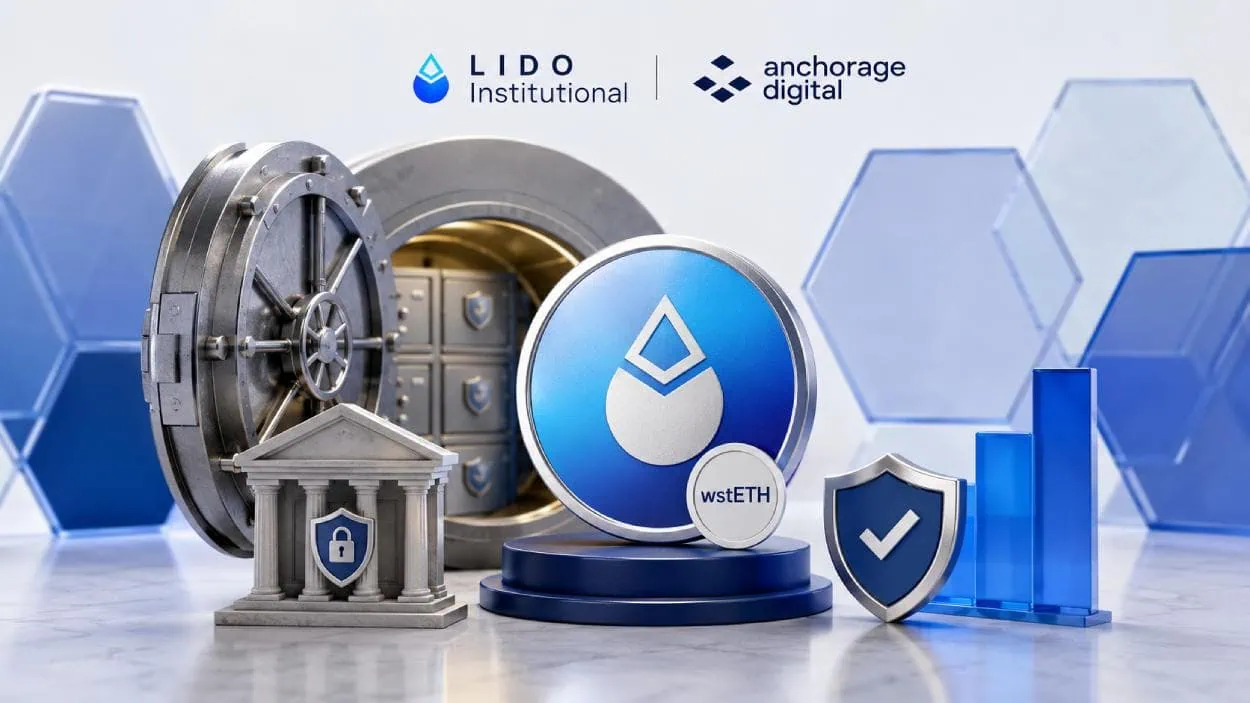






Anchorage Digital, the OCC-chartered crypto bank, integrated Lido on July 2, 2026, giving institutions compliant access to wstETH without leaving the Anchorage Digital platform. Clients now mint and burn wstETH directly, held under Anchorage’s own custody and governance controls inside one federally regulated environment.
Key Takeaways
- Anchorage Digital integrated Lido liquid staking into its institutional platform, giving customers access to wstETH within one of the most established digital asset custody environments in the U.S.
- Institutions connect directly to the Lido dApp from Anchorage Digital to mint and burn wstETH, Lido’s wrapped staked ETH token.
- wstETH is the non-rebasing wrapped form of stETH, with balances that remain fixed while staking rewards accrue through the token’s exchange rate relative to stETH.
- stETH represents ETH staked through the Lido protocol across a distributed set of 900+ node operators and underpins WisdomTree’s 100% staked stETH ETP in Europe, according to Lido.
- Anchorage Digital is home to the first federally chartered crypto bank in the US, and the integration keeps staking, custody, and governance within a single federally regulated environment, per Anchorage’s own account.
What Happened?
Anchorage Digital, home to America’s first federally regulated crypto bank, added support for Lido, the largest liquid staking protocol on Ethereum, on July 2, 2026, with Anchorage and Lido’s own blog publishing matching accounts the same day.
Anchorage’s OCC charter, not a state trust license, is why this integration puts staking access inside a regulated perimeter. That perimeter is built for allocators bound by custody mandates that offshore or unregulated staking venues cannot satisfy.
Clients connect straight to the Lido protocol’s decentralized application from inside Anchorage’s environment, mint or burn wstETH, and hold the resulting position under Anchorage’s existing custody controls instead of opening a separate wallet or venue relationship.
Institutional access to wstETH continues to expand.@Anchorage customers can now access wstETH through the institutional platform they already use for custody, staking, and settlement. pic.twitter.com/FbWxbW6cY3
— Lido (@LidoFinance) July 2, 2026
ETH holders stake through Lido’s protocol and receive wstETH in return, a token that accrues staking rewards while remaining liquid, transferable, and composable across supported onchain ecosystems. That structure answers a specific institutional problem: traditional Ethereum staking forces validators to lock capital, run dedicated infrastructure, and accept long unbonding periods to earn rewards.
Nathan McCauley, Co-Founder & CEO of Anchorage Digital, framed the launch as a maturity step:
Kean Gilbert, Head of Institutional Relations at the Lido Ecosystem Foundation, said the integration “brings wstETH into an important US institutional platform and strengthens the role of stETH and the Lido protocol in institutional Ethereum staking.“
Why the Regulated Wrapper Is the Real News?
The mechanic (wrap ETH, get a liquid token) is not new. What’s new is where it now happens. By accessing Lido through Anchorage Digital, institutions avoid fragmenting operations across multiple platforms or layering on counterparty risk, since staking, custody, and governance sit within a single federally regulated environment.
For allocators bound by custody mandates, that single-environment structure is the actual news, not the yield. It moves liquid staking out of offshore or unregulated venues and into an OCC-chartered bank’s compliance perimeter. For institutions, the benefits are concrete: capital efficiency, simplified operations, and a position that can be managed, used as collateral, or deployed into DeFi strategies without unwinding the underlying stake.
The Non-Rebasing Design Fits Institutional Accounting
wstETH holds a fixed balance while stETH’s balance changes daily, and that single design choice is why Anchorage Digital built this integration around wstETH rather than stETH. Balances remain fixed, with staking rewards reflected through the token’s exchange rate relative to stETH. That structure fits cleanly with institutional custody and accounting workflows, and makes wstETH easier to integrate across DeFi and institutional platforms that do not support rebasing tokens.
A rebasing token like stETH changes an institution’s wallet balance daily as rewards accrue, complicating income recognition on a fixed reporting cycle. A non-rebasing token, where the balance never moves and value shows up in an exchange rate instead, maps directly onto how custodians already track static positions with an accruing value.
The integration lands inside a broader shift. ETF issuers are building products backed by staked ETH, treasury holders are moving from passive ETH balances into staked positions, and custodian support for stETH and wstETH continues to widen across major jurisdictions. wstETH’s fixed-balance design is what lets it slot into that widening custodian and ETF infrastructure without a rebuild.

What the Announcement Doesn’t Address?
Neither party disclosed fees, assets under management, or expected volumes; this is an access-enablement announcement, not a performance report. That omission sidesteps a longer debate: routing more institutional ETH toward the largest liquid staking protocol on Ethereum through a compliant, high-trust gateway could concentrate a larger share of staked ETH under one protocol’s contracts.
Lido’s own framing offers a partial counterpoint, citing a distributed set of 900+ node operators behind stETH rather than one validator entity. The announcement still does not quantify what share of Ethereum’s total staked supply now runs through Lido, or how this deal moves that figure.
CoinLaw’s Takeaway
This integration works as a distribution deal wrapped in compliance language. The underlying yield mechanics of liquid staking have not changed; what changed is that the custody wrapper around them now sits inside a single federally regulated environment at an OCC-chartered bank. That shift, not the staking yield itself, is the actual product for institutions weighing access, since operational and counterparty risk have been the historical blocker for large allocators rather than the economics of staking.
The unresolved question is concentration rather than compliance. Every dollar of institutional ETH that reaches the largest liquid staking protocol on Ethereum through a regulated front door like Anchorage adds to that protocol’s footprint, and neither party’s announcement quantifies how large that footprint already is. A protocol positioned as the default rail for regulated institutional staking draws scrutiny proportional to its role, and Lido’s 900+ node operators argument only partially answers the deeper question of protocol-level dependency.