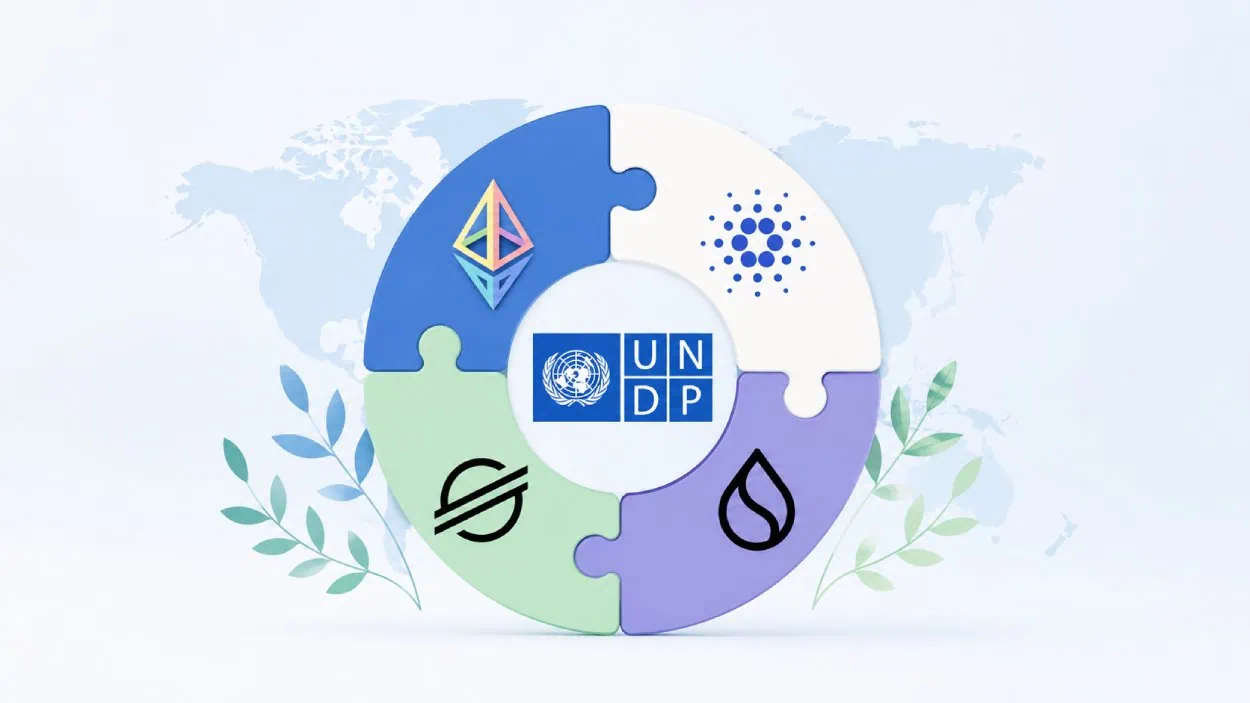






The United Nations Development Programme has launched a new blockchain advisory group that brings together leading blockchain organizations including the Ethereum Foundation, Cardano Foundation, Stellar Development Foundation, and Sui Foundation to explore how the technology can support financial inclusion, digital identity, public services, and climate initiatives.
Key Takeaways
- UNDP launched the Blockchain Advisory Group on June 3 during Proof of Talk 2026 in Paris.
- The group includes 26 organizations from across the blockchain industry, including Ethereum, Cardano, Stellar, Sui, Avalanche, and Algorand.
- Initial discussions focused on financial inclusion, digital finance, and digital identity challenges.
- The advisory group will meet twice each year to explore blockchain applications for public sector development goals.
What Happened?
The United Nations Development Programme (UNDP) has officially launched the Blockchain Advisory Group (BAG), a new initiative designed to connect development organizations with leaders from the blockchain industry. The launch took place on June 3 at Proof of Talk 2026 in Paris and marked a significant step toward exploring practical blockchain applications beyond cryptocurrency markets.
Chaired by UNDP Associate Administrator Haoliang Xu, the group aims to identify how blockchain technology can strengthen public systems, improve transparency, and help address development challenges around the world.
Proud to be part of the UNDP Blockchain Advisory Group. 🌐
— Cardano Foundation (@Cardano_CF) June 8, 2026
Blockchain has a real role to play in sustainable development, from verifiable identity to transparent public systems, and this group is built to put that to work. https://t.co/tNxRt7yWWM
UNDP Shifts Focus Toward Real World Blockchain Applications
While blockchain is often associated with digital assets and token speculation, the new advisory group is focused on public sector use cases that could deliver measurable benefits to governments, institutions, and underserved populations.
The inaugural meeting centered on financial inclusion and digital finance, with participants discussing several barriers that continue to limit access to essential services. These included fragmented payment systems, challenges related to digital identity, interoperability concerns, and institutional readiness for emerging technologies.
Haoliang Xu said:
Major Blockchain Organizations Join the Initiative
The advisory group currently includes 26 organizations representing a broad cross section of the blockchain ecosystem. Members include the Ethereum Foundation, Cardano Foundation, Stellar Development Foundation, Sui Foundation, Avalanche Foundation, Algorand Foundation, Arbitrum Foundation, Filecoin Foundation, Web3 Foundation, Kraken, and several other industry organizations.
The diverse membership gives UNDP access to expertise across blockchain infrastructure, decentralized storage, digital payments, governance systems, and public interest technology initiatives.
Importantly, the initiative does not represent government endorsement of any specific blockchain network or digital asset. Instead, it provides a forum where development experts and blockchain leaders can evaluate where blockchain can create meaningful public value.

Building on Existing Development Programs
The launch builds on UNDP’s growing blockchain work across Africa, Latin America and the Caribbean, Europe and Central Asia, the Middle East, and Asia Pacific.
Existing projects have explored blockchain applications in areas such as:
- Financial inclusion
- Digital payments
- Digital identity
- Climate finance
- Climate accountability
- Public procurement
- Traceability
- Public service delivery
- Digital governance
- Future of work
UNDP says the goal is not to replace existing systems but to determine where blockchain can improve efficiency, increase transparency, and expand access to essential services.
Alongside the advisory group launch, UNDP’s AltFinLab initiative organized a broader series of events under the theme Scaling Blockchain for Public Good. These included the SDG Blockchain Accelerator Impact Showcase, which highlighted blockchain and decentralized AI projects already progressing toward implementation in development programs.
What Comes Next?
Looking ahead, the Blockchain Advisory Group will convene twice annually, with each meeting focusing on a specific development challenge.
Future discussions are expected to cover digital governance, public trust, legal identity, financial inclusion, digital financial services, sustainability, climate accountability, and the future of digital work.
The broader objective is to move beyond discussions and identify practical opportunities for collaboration that can translate blockchain innovation into real world solutions.
For the blockchain industry, the initiative represents an important opportunity to demonstrate how the technology can address longstanding public sector challenges. The next major test will be whether these discussions lead to pilot programs capable of improving identity systems, payment infrastructure, climate reporting, and public service delivery at scale.
CoinLaw’s Takeaway
I believe this initiative stands out because it focuses on utility rather than speculation. For years, many blockchain discussions have revolved around token prices and market cycles. Here, the conversation is centered on solving real problems such as financial access, identity verification, and transparency in public systems. In my experience, blockchain adoption gains the most traction when it addresses practical challenges rather than chasing trends. If the UNDP can successfully turn these discussions into working pilot programs, it could become one of the strongest examples of blockchain delivering measurable public value.