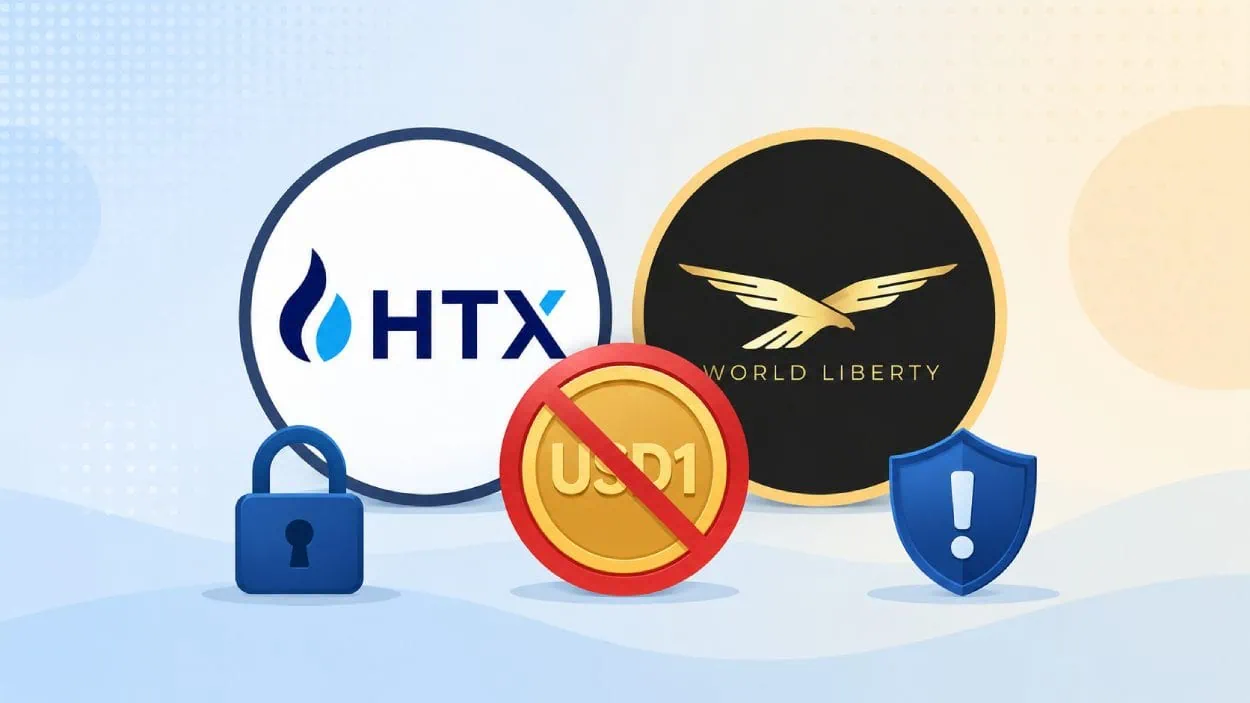






HTX has delisted USD1, the stablecoin issued by World Liberty Financial (WLFI), after accusing the Trump linked crypto project of freezing exchange related wallet addresses without sufficient justification.
Key Takeaways
- HTX delisted USD1 and suspended related trading services after WLFI froze certain exchange linked wallet addresses.
- The exchange will convert eligible USD1 holdings to USDT at a 1:1 ratio.
- HTX claims the freeze lacked proper communication, legal grounds, and due process.
- The dispute adds to an ongoing legal battle between Justin Sun and World Liberty Financial.
What Happened?
Crypto exchange HTX has removed support for USD1, a stablecoin issued by World Liberty Financial, a decentralized finance project linked to U.S. President Donald Trump and members of his family. The move follows a dispute over wallet restrictions that HTX says were imposed by WLFI without adequate notice or justification.
According to HTX, several on chain addresses associated with the exchange were frozen as part of sanctions compliance reviews conducted by WLFI. The exchange argued that the action negatively affected users and restricted the movement of assets connected to those addresses.
Announcement on the Delisting of USD1 (USD1) and Conversion of User Assets to USDT on HTX
— HTX (@HTX_Global) June 6, 2026
As USD1 is an asset issued by the WLFI project team, and in order to mitigate potential risks, safeguard user assets, and maintain a fair trading environment, HTX will delist USD1 at 03:00… https://t.co/pkYx4bT9rl
HTX Ends Support for USD1
HTX announced that it has suspended USD1 deposits, conversion services, and multiple trading pairs involving the stablecoin. Affected pairs include USD1/USDT, BTC/USD1, ETH/USD1, and WLFI/USDT.
The exchange said it would convert eligible user balances from USD1 into Tether’s USDT on a one-to-one basis. Additional details regarding the timing of the conversion are expected to be released separately.
In its statement, HTX said WLFI had “unilaterally imposed a freeze” on specific exchange linked wallet addresses. The platform argued that the restrictions were introduced without sufficient prior communication, a clear legal basis, or a transparent process.
HTX further claimed the freeze limited the circulation of certain WLFI related assets and created unnecessary risks for users. As a result, the exchange said delisting USD1 was necessary to protect customer assets and reduce market uncertainty.
Sanctions Compliance at the Center of the Dispute
The conflict appears to be tied to recent sanctions developments involving a company previously associated with the HTX brand.
On May 26, UK authorities sanctioned Huobi Global S.A., alleging that the entity provided financial services that supported the Russian government. Following those sanctions updates, World Liberty Financial stated on social media that it maintains “risk based sanctions compliance controls.“
While WLFI has not publicly confirmed whether it froze HTX linked addresses, the project’s comments on sanctions compliance have fueled speculation that the restrictions were connected to the sanctions review process.
HTX has rejected any connection between the sanctioned entity and its current operations. The exchange maintains that Huobi Global S.A. is legally separate from the operating HTX platform and that the sanctions should not impact its users or business activities.
The exchange also called on WLFI to reverse the wallet restrictions and warned that it may pursue legal action if the matter is not resolved.

Justin Sun and WLFI Legal Battle Continues
The latest dispute adds another chapter to the growing conflict between Justin Sun and World Liberty Financial.
Sun, who has been closely linked to HTX and previously served on its global advisory board, filed a lawsuit against WLFI in April. He alleged that the project froze tokens he owned and threatened to burn those assets without proper justification.
WLFI later responded with a countersuit, accusing Sun of defamation and claiming he made false statements about the project. The firm also alleged that Sun violated token sale rules through prohibited transactions, including alleged transfers, short selling activities, and straw purchases.
With legal tensions already running high, the USD1 delisting is likely to deepen the divide between the two sides.
Why the USD1 Delisting Matters?
The removal of USD1 highlights the growing influence of compliance measures across the cryptocurrency industry. Actions such as wallet freezes can quickly affect token accessibility, exchange listings, liquidity, and user confidence.
The situation is particularly notable because USD1 is tied to World Liberty Financial, a project associated with Donald Trump, Donald Trump Jr., Eric Trump, and Barron Trump, all of whom have been listed as advisers to the initiative.
For now, USD1 trading remains suspended on HTX while users await further updates regarding the planned conversion of their holdings into USDT.
CoinLaw’s Takeaway
In my experience, this case shows how quickly compliance decisions can ripple across the crypto market. A single wallet freeze was enough to trigger a major exchange delisting, suspend trading pairs, and force a stablecoin conversion program. I found that the bigger story is not just the dispute between HTX and WLFI, but the growing power that compliance controls now have over digital asset ecosystems. As regulators increase scrutiny, exchanges and token issuers will likely face more situations where legal, compliance, and user protection concerns collide.