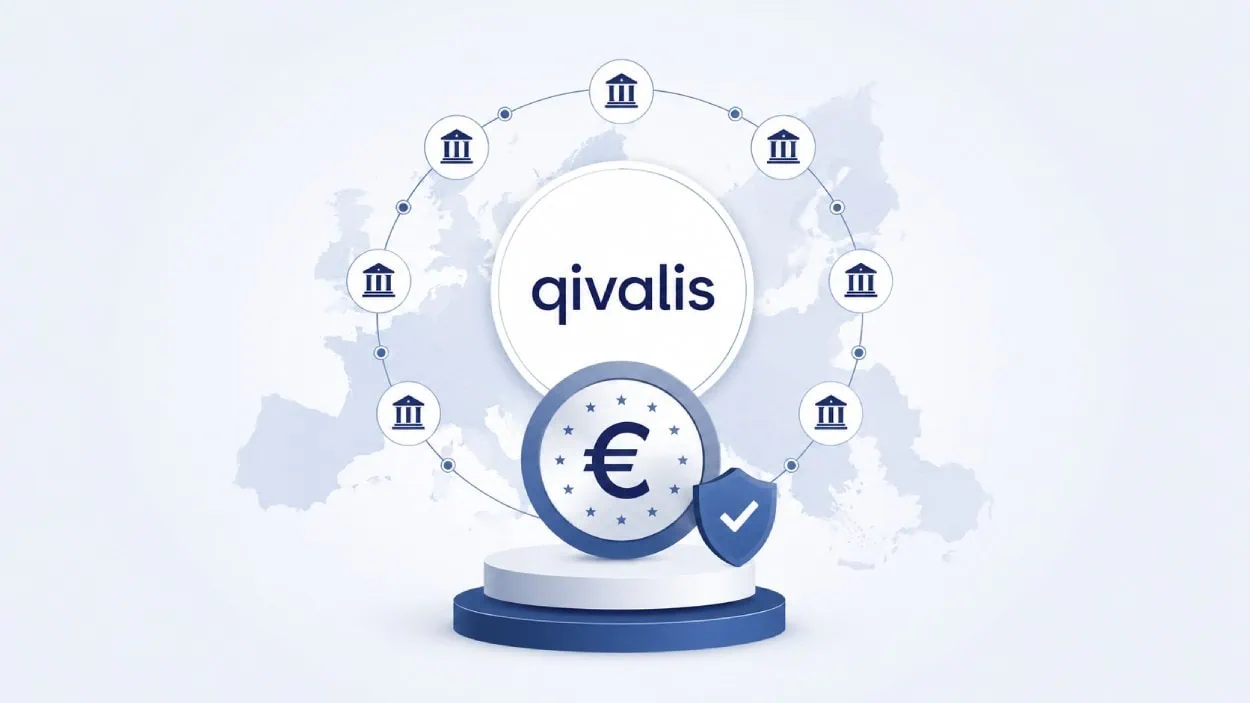






A growing group of European banks has joined forces behind Qivalis as the consortium pushes forward with plans to launch a regulated euro backed stablecoin and blockchain based settlement network.
Key Takeaways
- Qivalis expanded its consortium to 37 banks after adding 25 new financial institutions from across Europe.
- The Amsterdam based project plans to launch a regulated euro stablecoin backed 1:1 with euros and liquid assets.
- Major banks including ABN Amro, Intesa Sanpaolo, Rabobank, Nordea, and Bank of Ireland are now part of the initiative.
- The consortium aims to strengthen Europe’s position in digital finance and reduce dependence on US dominated payment infrastructure.
What Happened?
Qivalis, the European banking consortium developing a euro-linked stablecoin, announced that 25 additional banks have joined the initiative, increasing total membership to 37 institutions across 15 countries.
The project is focused on building a regulated blockchain-based payment and settlement network for Europe. Qivalis is currently seeking authorization from the Dutch central bank to operate as an electronic money institution, with a commercial launch expected in the second half of 2026.
LATEST: 🏦 Qivalis has expanded to 37 member banks after adding 25 institutions across 15 countries, moving closer to a regulated euro stablecoin launch in the second half of 2026. pic.twitter.com/ScZUCH72lZ
— CoinMarketCap (@CoinMarketCap) May 20, 2026
European Banks Deepen Support for Euro Stablecoin Push
The latest expansion marks a significant step for Qivalis as traditional European banks increase their involvement in blockchain-based financial infrastructure.
New consortium members include major institutions such as ABN Amro, Rabobank, Intesa Sanpaolo, Bankinter, Nordea, Handelsbanken, Bank of Ireland, Sabadell, Erste Group, and Swedbank. These banks join existing members including BNP Paribas, ING, UniCredit, BBVA, CaixaBank, Danske Bank, and KBC.
Qivalis was launched in December 2025 and is headquartered in Amsterdam. The company plans to issue a euro pegged stablecoin fully backed by euros and high quality liquid assets held by regulated custodians.
According to the consortium, the goal is not to replace existing European payment systems but to enable faster and more efficient blockchain based settlements, particularly for cross border payments and tokenized financial assets.
In a statement shared by Qivalis, the consortium said:
Qivalis CEO Jan Oliver Sell also emphasized the project’s broader mission for European digital finance. He stated:
Europe Looks to Build Its Own Blockchain Payment Infrastructure
The expansion comes as Europe increasingly explores ways to compete with the growing influence of US based stablecoin issuers and payment companies.
The global stablecoin market remains heavily dominated by dollar backed assets issued by companies such as Tether and Circle. Reports cited in the provided stories noted that Tether has roughly $190 billion in circulation, while Circle manages around $77 billion worth of stablecoins.
By comparison, euro denominated stablecoins remain relatively small. One example is Societe Generale’s crypto division SG FORGE, which launched a euro stablecoin in 2023 but currently has only around 105.6 million euros in circulation.
Despite the smaller market size, European banks appear increasingly interested in blockchain-based settlement systems as tokenization gains momentum across the financial sector. The technology could eventually support the trading and settlement of tokenized assets such as bonds, real estate, and other financial products.
Qivalis believes its stablecoin could help businesses and individuals move money across borders more quickly and at lower cost using banking integrated blockchain solutions.
Jan Oliver Sell told the Financial Times that the consortium is also discussing potential partnerships with non European banks operating in regions with large remittance flows from Europe.

CoinLaw’s Takeaway
In my experience, this is one of the clearest signs yet that traditional European banks no longer see stablecoins as just a crypto experiment. Large financial institutions are now actively building blockchain infrastructure instead of waiting on the sidelines.
I found it especially important that Qivalis is positioning itself around regulation and European control. Europe appears determined to avoid relying entirely on US dollar stablecoins as digital finance expands globally. While demand for euro stablecoins is still limited today, the banking sector clearly believes tokenized finance and blockchain settlement systems will become much more important in the years ahead.