







NFT lending and borrowing have surged into the financial mainstream, transforming digital collectibles from static assets to dynamic financial tools. Imagine owning a rare digital artwork but needing quick liquidity. NFT lending allows you to leverage this asset without selling it. While traditional assets have long enjoyed financing options, the rapid emergence of NFT-backed loans is reshaping the landscape of decentralized finance (DeFi). From innovative financing models to evolving regulatory frameworks, NFT lending is carving out a vital niche, setting new standards in the digital economy.
Editor’s Choice
- GONDI reported more than $100 million in TVL and over $45 million in outstanding debt, with annualized loan volume above $400 million.
- Average NFT loan size dropped to around $4,000, a year-over-year decline of about 71% from $14,000.
- Borrower activity was down roughly 90%, and lender participation fell about 78% versus January 2024 levels.
- NFTfi says it has facilitated over $600 million in total loan volume across 65,000+ loans, with an average loan size of $16,000.
- The NFT lending space comprises around 82 startups, with 53 having raised venture funding.
Recent Developments
- Gondi holds 55% market share in NFT lending, followed by Blend at 29% and NFTfi at 7%.
- Gondi TVL reached a record $34 million after the V3 rollout, with $22 million in V3.
- Gondi reports over $41 million in outstanding NFT loans, including $21 million in USDC.
- Global NFT market projected to reach $18.71 billion, growing at 23.7% CAGR.
- NFT lending platforms use 60-70% loan-to-value ratios for high-value collateral like BAYC.
NFT Market Growth
- The global NFT market is valued at $60.82 billion in 2025, reflecting strong baseline demand for digital assets.
- Market size is projected to reach $86.23 billion in 2026, showing rapid year-over-year expansion.
- By 2027, the NFT market is expected to grow to approximately $122.10 billion, indicating accelerating adoption.
- In 2028, the market is forecasted to hit around $173.00 billion, driven by increased utility and institutional interest.
- The NFT sector is projected to reach nearly $245.00 billion in 2029, highlighting sustained growth momentum.
- By 2030, the global NFT market is expected to surge to $347.46 billion, marking a multi-fold increase within five years.
- The NFT market is anticipated to grow at a compound annual growth rate (CAGR) of 41.7% from 2026 to 2030, underscoring one of the fastest growth rates in the digital asset space.
- Overall, the NFT market is set to expand by nearly 5.7× from 2025 to 2030, demonstrating massive long-term growth potential.

Decoding NFT-Backed Financing
- Interest rates range 10-25%, higher due to NFT volatility compared to traditional loans.
- Loan durations are typically 7-90 days, shorter than multi-year traditional finance terms.
- P2P loans average 15-25% interest rates with 50-60% LTV ratios for risk mitigation.
- Default rates average 8-12%, reflecting short-term structures and market volatility.
- Ethereum is dominant for NFT lending, with Polygon and Solana gaining traction via lower fees.
- Platforms use 60-70% LTV for high-value NFTs like BAYC in stablecoin loans.
- Average loan size $4,000, down 71% year-over-year from $14,000.
- Borrowers repay via lump sums or installments for flexible short-term liquidity.

NFT Revenue Segments, ARPU & Retention
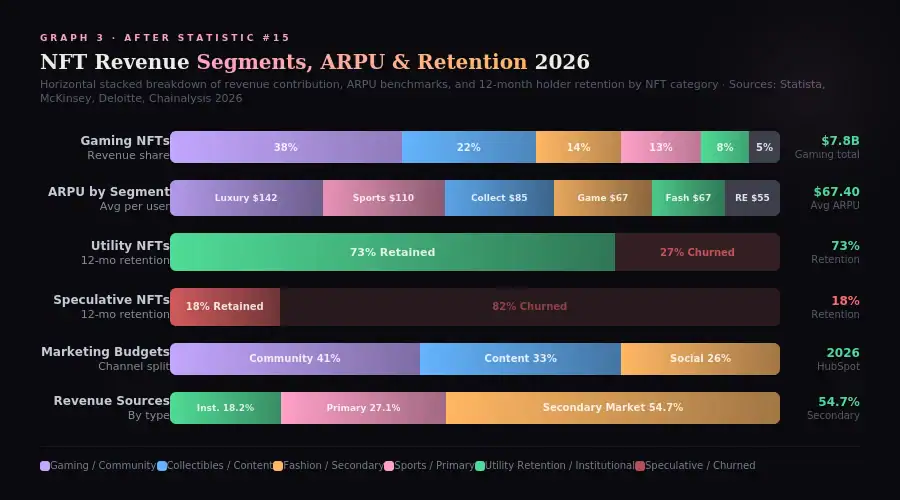
- Gaming NFTs dominate with a 38% revenue share, generating approximately $7.8 billion, making them the largest segment in the NFT ecosystem.
- Collectibles account for 22% of NFT revenue, followed by content (14%) and sports NFTs (13%), showing diversified demand across categories.
- Utility NFTs contribute 8%, while other segments make up 5%, indicating niche but growing use cases.
- Luxury NFTs lead ARPU at $142 per user, significantly outperforming all other segments in monetization.
- Sports NFTs generate $110 ARPU, while collectibles average $85, reflecting strong engagement from mainstream audiences.
- Gaming and fashion NFTs both record $67 ARPU, aligning with the overall average ARPU of $67.40.
- Real estate NFTs have the lowest ARPU at $55, suggesting slower monetization compared to other segments.
- Utility NFTs show strong retention, with 73% of users retained over 12 months, highlighting long-term value and real-world use cases.
- In contrast, speculative NFTs retain only 18% of users, with a high 82% churn rate, indicating short-term, hype-driven participation.
- Community-focused marketing receives the largest budget share at 41%, emphasizing the importance of engagement and loyal user bases.
- Content marketing accounts for 33%, while social channels receive 26%, showing a balanced but community-first strategy.
- Secondary market transactions dominate NFT revenue with a 54.7% share, underscoring the importance of resale activity.
- Primary sales contribute 27.1%, while institutional sources account for 18.2%, reflecting growing interest from larger investors.
Main Platforms
- NFTfi has facilitated over $300 million in NFT loans since its 2020 inception.
- NFTfi recorded $35.88 million lending volume in Q1 2024, up 48.3% QoQ.
- Arcade achieved 2.8% market share with $16.94 million monthly volume.
- Arcade hit a quarterly high of $39.46 million in NFT lending volume, up 37.1% QoQ.
- PawnFi Lending TVL stands at $140,660 with borrowed assets tracked.
- BendDAO holds 0.77% market share in NFT lending volume.
- Yield Guild Games (YGG) 24h trading volume $14.7 million, market cap $27.7 million.
NFT Trading Trends by Age Group
- 25-34 years comprise 38% of NFT owners, the largest group.
- 35-44 years represent 28% of NFT ownership demographics.
- 18-24-year-olds account for 15% of NFT owners.
- 45-54 years make up 12% of NFT ownership.
- 55+ years comprise 7% of NFT owners.
- 63% of NFT owners are male, 35% female.

Types of NFT Lending Protocols
- P2P lending commands 62.3% market share in NFT lending DApps.
- Peer-to-peer protocols account for 60%+ of NFT loan activity volume.
- NFTfi dominates P2P with over $300 million total loan volume.
- NFT lending DApps market is valued at $2.46 billion, with P2P leading.
- Arcade and NFTfi hold a combined 60% P2P NFT lending market share.
- Pool-based lending like Drops offers quick access via aggregated liquidity pools.
- Average NFT loan size $4,000, 71% drop year-over-year.
- Loan durations range from 7 to 90 days for short-term flexibility.
- 73,000 loans issued on NFTfi with $20,000 average size.
Peer-to-Peer Lending and Borrowing
- NFTfi and Arcade hold a combined 60% P2P NFT lending market share.
- P2P lending segment accounts for 62.3% of the NFT lending DApps market.
- NFTfi leads with 15% overall NFT lending DApps market share.
- Arcade supports LTVs up to 70% for high-value NFT collateral.
- NFTs are held in smart contract escrows during the entire P2P loan term.
- NFTfi facilitated over $600 million total P2P loan volume.

Interest Rates and Loan Terms
- Interest rates range 10-25% APR due to NFT volatility.
- P2P loans average 15-25% interest rates for risk premiums.
- Loan durations are typically 7-90 days for a short-term structure.
- Average loan duration shortened to 31 days.
- Short-term loans (<30 days) hold 57% market share.
- Average NFT loan size $4,000, down 71% year-over-year.
- Platforms provide grace periods to reduce default rates by 8-12%.
- Arcade enables customizable terms, including variable rates.
Risks and Challenges in NFT Lending
- Default rates average 8-12% for NFT-backed loans.
- Liquidity risk is high with NFT floor prices down 80%+ from peaks.
- Smart contract vulnerabilities are exploited in $100 million+ DeFi hacks annually.
- Platform insolvency seen in BendDAO $23 million liquidation crisis.
- Valuation challenges with 50%+ NFT price drops year-over-year.
- Legal uncertainty affects cross-jurisdictional NFT loan enforcement.
- LTV ratios are capped at 50-60% to mitigate volatility risks.
Top 10 NFT Collections by Trading Volume
- Doginal Dogs leads with $1 billion+ lifetime volume on Dogecoin.
- Bored Ape Yacht Club floor $10,700, market cap $107 million.
- Milady Maker floor $5,100, driven by cultural resonance.
- Mad Lads 24h volume $27,309, floor 36.15 SOL.
- Chromie Squiggle market cap $210 million, floor 5.50 ETH.
- CryptoDickbutts 24h volume $54,715, floor 1.69 ETH.
- Quantum Cats 24h volume $55,464, floor 0.040 BTC.
- VeeFriends market cap $64.6 million, floor 1.65 ETH.
- Cool Cats market cap $21.6 million, floor 0.57 ETH.
- DeGods floor 0.38 ETH, 24h volume $16,850.
Regulatory Landscape
- 70% of major jurisdictions proposed digital-asset regulations affecting NFT lending.
- 28% of DeFi platforms adopted KYC procedures amid regulatory pressure.
- AML/KYC compliance boosted NFT lending volumes by 28% on platforms.
- 32% rise in AML compliance with real-time transaction monitoring.
- Cross-border compliance costs surged 35% for multi-jurisdictional protocols.
- 70% of users prefer KYC-compliant platforms for high-volume transactions.
- SEC clarifies federal securities laws for crypto assets, including NFTs.
- MiCA exempts most NFTs but requires assessment for large collections.
- NFT gifts over $19,000 per person trigger US tax reporting.
Frequently Asked Questions (FAQs)
Average NFT loans are $4,000, down 71% year-over-year.
Default rates average 8-12% due to short-term structures and volatility.
GONDI reported $100 million TVL with $45 million outstanding debt.
NFT lending space comprises 82 startups, with 53 venture-funded.
Conclusion
NFT lending has swiftly transformed the digital asset landscape, unlocking unprecedented opportunities for collectors and investors to capitalize on their digital holdings. As the market matures, platforms are innovating with new protocols, advanced valuation tools, and multi-chain capabilities to cater to growing demand.
However, the challenges of volatility, regulatory uncertainty, and valuation complexity remain significant obstacles. Continued security, regulation, and platform functionality advancements will be essential for sustainable growth in the NFT lending space. This sector, marked by rapid evolution and increasing mainstream interest, holds immense potential as part of the broader decentralized finance ecosystem.












AKAlex K.
Hey Barry, nice piece on NFT lending. How does the interest rate compare to traditional loans? Got curious.
NFT loan rates vary considerably by platform and collateral type, Alex, but they tend to run higher than traditional secured loans given the volatility and liquidity risk of the underlying assets. Some platforms let the market set rates through a bidding mechanism rather than using a fixed rate. The article covers how Blend structures its lending specifically if you want the detail.
MMaggieSue
All this buzz about NFT-backed financing but won’t the bubble burst like everything else? Seen too many get burned.
That skepticism is fair, MaggieSue. NFT markets have gone through significant booms and corrections, and lending platforms built on volatile collateral carry real structural risk. The piece tries to present both the potential and the risks so readers can weigh them on their own terms.
TTJ
The rapid growth of Blend as mentioned by Barry is impressive. It’s platforms like these that are truly innovating in the NFT space. I’ve been keeping an eye on it, and the blend of technology and finance is fascinating. Diversification in the crypto world is key, and NFT lending platforms are paving the way.
Well observed, TJ. The trajectory of Blend has been one of the more interesting data points in the NFT space precisely because it combines real utility with DeFi mechanics. The diversification angle is worth taking seriously as the sector develops.
RRonny
so what’s NFT lending exactly? sounds cool but confusing.
In short, Ronny, NFT lending lets you use an NFT you own as collateral to borrow crypto without selling it. The article covers how platforms like Blend handle this in detail if you want the full breakdown. The core concept is straightforward even if the mechanics get complex.
EGElise Granger
Ronny, NFT lending lets you use your digital assets as collateral for a loan. It’s a great way to get liquidity without selling off your NFTs.
DLDerrick L.
interesting read about nft lending. didn’t know this was a thing until now. not sure how I feel about it though.
Understandable, Derrick. NFT lending sits at an unusual intersection of digital art, DeFi, and credit markets, so uncertainty is a natural response. The risk profile is genuinely different from traditional secured lending and worth weighing carefully before getting involved.
SShellyAnn
Loving the idea of NFT-backed financing. As an artist, this could open so many doors! Thanks for the insights, Barry.
Glad the piece was useful, ShellyAnn. For artists specifically, NFT-backed financing could change the economics of creative work significantly, giving access to liquidity without having to sell the underlying asset. Worth watching closely as the platforms mature.
KJKen J
While the article talks about the growth and potential of NFT lending platforms, I believe we’re neglecting to address the elephant in the room: the volatility of the NFT market. Yes, platforms like Blend show promise, but without addressing market stability, aren’t we risking too much? It’s essential to discuss not just the potential but also the pitfalls in a rapidly changing landscape.
You make a strong point, Ken. NFT market volatility is perhaps the biggest unresolved risk for lending platforms in this space. Without reliable, liquid price discovery for collateral, liquidation events can happen fast and hit lenders hard. Platforms like Blend have made strides on the mechanics side, but the underlying market stability question you raise remains largely open.