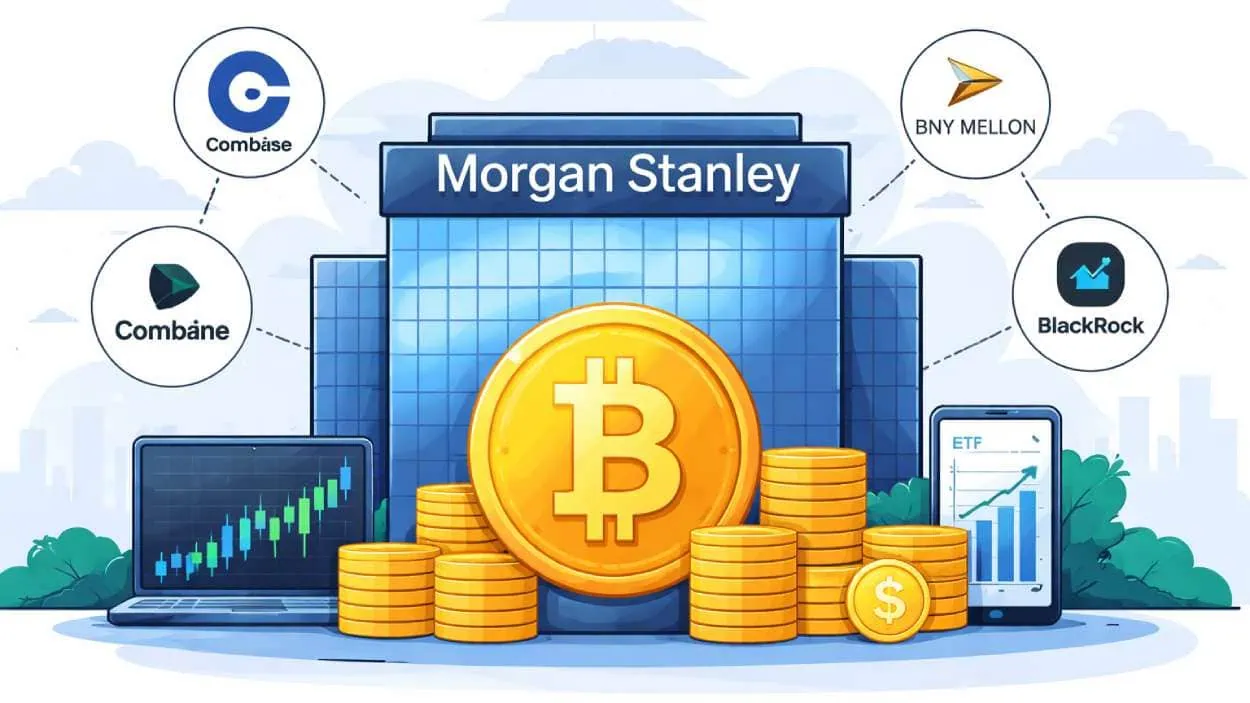






Morgan Stanley filed amended S-1/A registration statements for its proposed spot ether and solana exchange-traded funds on July 14, 2026, naming Coinbase Custody Trust Company as a custodian and staking facilitator alongside The Bank of New York Mellon.
Key Takeaways
- Morgan Stanley filed a third round of amended filings for its ether and solana ETFs since its January debut, with Coinbase named as custodian.
- Both proposed funds carry an annualized 0.14% sponsor fee, undercutting Grayscale’s 0.15% ether product as the ETF fee war intensifies.
- The filings permit staking 50% to 80% of the ether trust’s holdings and up to 100% of the solana trust’s SOL.
- Staking providers and custodians would share 5% of rewards, with 95% accruing to each trust, per the filings.
- Morgan Stanley’s Bitcoin Trust (MSBT) drew $300.7 million in inflows after its April 2025 launch, the same low-fee playbook now extended to ether and solana.
What Happened?
Morgan Stanley’s amended filings mark a third round of revisions since the bank’s January debut filings, following a second amendment round on June 18 that set the current fee structure. Coinbase Custody Trust Company will serve as custodian for both the ether and solana trusts alongside The Bank of New York Mellon, with Coinbase also facilitating the staking programs built into each fund.
Morgan Stanley’s Form S-1/A for the ether trust lists the shares for trading under the ticker MSSE, and the companion Form S-1/A for the solana trust lists its shares under the ticker MSOL, expected on NYSE Arca. Neither product is approved or trading yet, and the SEC has not committed to a timeline for approval.
Morgan Stanley Picks Coinbase to Custody Its New Ether, Solana ETFs
— CoinLaw (@coinlaw_io) July 15, 2026
Morgan Stanley amended its SEC filings for proposed ether and solana ETFs on July 14, 2026, naming Coinbase Custody Trust Company as custodian and staking facilitator alongside BNY Mellon.$MS $COIN pic.twitter.com/O7oVCczgG3
The Custody and Staking Structure
Figment Inc., Galaxy Blockchain Infrastructure and Coinbase Canada serve as the staking providers named in the ether trust’s filing, working alongside the dual custodians on each fund. Coinbase now sits on both sides of the ledger: it is named custodian for both trusts and, through its Canadian unit, a staking counterparty on the same products, a concentration of roles inside one corporate family that sits alongside Coinbase’s position in Crypto Exchange market as one of the largest regulated venues for institutional crypto flows.
Staking providers and custodians take a minority share of the rewards, with the remainder accruing to each trust, the same split disclosed for both products above. The design lets Morgan Stanley advertise a staking-enabled ether or solana fund without locking up every token: a portion always stays liquid to meet redemptions.
A Fee War With a Track Record
The fee that undercuts Grayscale’s ether product already worked once. Morgan Stanley’s Bitcoin Trust launched in April 2025 with the same low-fee approach, and the bank is applying the identical playbook to ether and solana as competition on price intensifies across issuers.
Approval would let Morgan Stanley bring staking-enabled ether and solana funds to its 19,000 advisers, the distribution network that determines whether a fee undercut actually converts into asset flows.

Implications for Crypto ETF Approvals
Three rounds of amendments since the January debut signal active back and forth with the SEC rather than a stalled application, where successive filings usually precede a formal decision window. A bank the size of Morgan Stanley returning to the SEC with amendment after amendment reads as active drafting with agency staff, not a shelved application.
The SEC has not set a review timeline, and Morgan Stanley has not said when a next amendment might arrive. Nothing here confirms a launch date, and a staking enabled ether or solana ETF from Wall Street’s biggest wealth manager remains a proposal, not an approved product, until the agency signs off.
CoinLaw’s Takeaway
The custody structure matters more than the headline fee. Staking most of a trust’s ether or solana while keeping some liquid is how a registered fund can pay out yield without freezing investor redemptions, and splitting custody between Coinbase and an independent bank is the compromise regulators have pushed issuers toward. The open question is concentration: Coinbase is both custodian and, through its Canadian unit, a staking provider on the same filings, and that overlap is exactly what a full SEC review is built to catch.
The fee undercut is the more predictable variable. Morgan Stanley already pulled meaningful assets into its Bitcoin fund with the same low-price approach, and a repeat performance in ether and solana would pressure Grayscale and other issuers to cut again rather than compete on service. None of that changes the fact that both products remain unapproved filings: the amendments show a bank preparing to launch, not a launch that has happened.