






Cryptocurrency has transformed the global financial landscape, offering innovation and high stakes. Yet, behind its promise lies a darker reality that impacts investors, exchanges, and even national economies. As digital currency grows, so does the risk of cybersecurity threats targeting this volatile asset.
From high-profile exchange breaches to sophisticated ransomware targeting crypto wallets, this year has already marked itself as a pivotal year for understanding and defending against these threats. This article delves into the statistics and trends surrounding cybersecurity in cryptocurrency, providing a clear picture of where we stand and where vulnerabilities remain.
Editor’s Choice
- Impersonation scams surged roughly 1,400% year over year in the latest 2026 crime reporting.
- January 2026 crypto losses hit $370.3 million, the highest monthly total in 11 months.
- Phishing alone accounted for $311.3 million of January 2026 crypto losses.
- A single social-engineering scam caused $284 million in losses during January 2026.
- PeckShield tracked 16 crypto hacks in January 2026, with direct hack losses of about $86 million.
Recent Developments
- Coinbase published new digital safety guidance for 2026, highlighting stronger scam prevention as AI-enabled fraud keeps rising across crypto.
- Binance also delivered more than 160 training sessions to support investigators tackling crypto-related threats.
- Ethereum’s 2026 roadmap centers on the Glamsterdam upgrade, with gas limits targeted toward and beyond 100 million.
- Post-quantum security became a formal Ethereum priority in 2026, with a dedicated new research team announced in January.
- Smart contract audit pricing in 2026 ranges from $5,000 for simple tokens to over $500,000 for complex protocols.
- Average DeFi smart contract audits now cost about $50,000 to $100,000 per engagement.
- January 2026 crypto losses reached $370.3 million across 40 documented incidents, reinforcing demand for real-time monitoring.
- A single phishing incident accounted for about 71% of January crypto losses, showing why exchanges keep tightening fraud detection.
Cyber Risk Trends and Threat Escalation
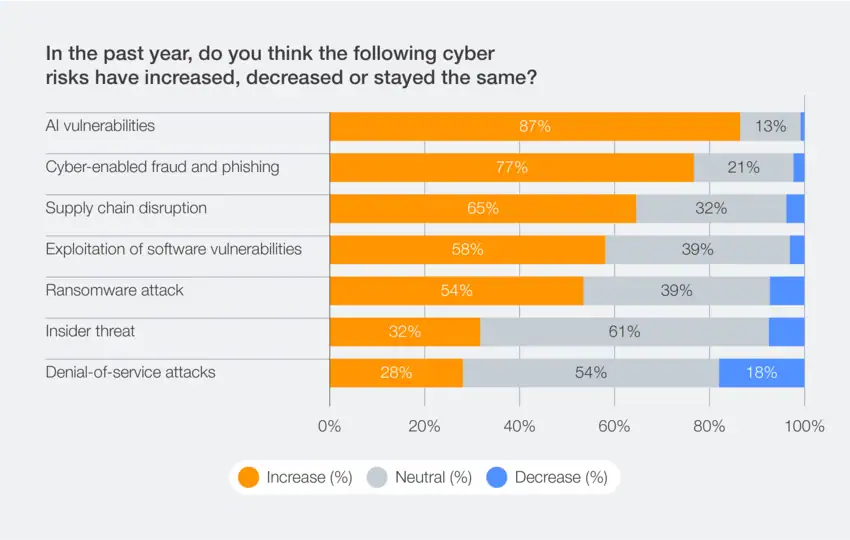
- AI vulnerabilities surged the most, with 87% of respondents reporting an increase, highlighting growing risks from generative AI and automation tools.
- Cyber-enabled fraud and phishing attacks rose sharply, as 77% observed an increase, reinforcing their position as one of the most common cyber threats.
- Supply chain disruptions continue to escalate, with 65% indicating an increase, reflecting vulnerabilities in third-party and vendor ecosystems.
- Exploitation of software vulnerabilities increased for 58%, showing that unpatched systems and zero-day exploits remain a critical concern.
- Ransomware attacks grew for 54% of organizations, signaling persistent threats despite improved defensive measures.
- Insider threats showed mixed trends, with only 32% reporting an increase, while a majority 61% observed no change, suggesting stable but ongoing internal risks.
- Denial-of-service (DoS) attacks had the lowest growth, with 28% reporting an increase, while a notable 18% saw a decrease, indicating some improvement in mitigation strategies.
Financial Impact of Crypto Cybercrime
- Sanctioned entities accounted for $104 billion of that illicit volume after a 694% annual surge.
- Ransomware actors received about $820 million in 2025, with Chainalysis saying the final figure could reach $900 million.
- Crypto scams received at least $14 billion on-chain in 2025 and may exceed $17 billion as more illicit wallets are identified.
- The Bybit breach remained the largest crypto heist ever, at about $1.5 billion stolen in February 2025.
- The Nobitex hack drained more than $90 million from Iran’s largest crypto exchange in June 2025.
- Chinese money laundering networks moved an estimated $16.1 billion in illicit crypto flows during 2025.
- Global cybercrime damages are still widely projected at about $10.5 trillion annually, showing the broader financial backdrop around crypto-enabled crime.

How Confident Are Regions in Cyber Incident Preparedness?
- Middle East & North Africa lead in confidence, with a striking 84% of respondents feeling confident, while only 4% report a lack of confidence, indicating strong regional preparedness.
- East Asia & Pacific shows moderate confidence, with 47% confident, but a notable 26% not confident, highlighting mixed readiness levels.
- Europe & Central Asia remains balanced, as 40% are confident and 35% neutral, suggesting steady but cautious preparedness across the region.
- South Asia reflects uncertainty, with an equal 40% confident and 40% neutral, while 19% remain not confident, indicating uneven resilience.
- North America displays divided sentiment, with 38% confident versus 32% not confident, pointing to concerns despite advanced infrastructure.
- Sub-Saharan Africa faces confidence challenges, where only 37% feel confident, and a higher 39% are not confident, signaling gaps in cyber readiness.
- Latin America & the Caribbean ranks lowest in confidence, with just 13% confident and a significant 49% not confident, revealing major preparedness concerns.

Growth of Cryptocurrency-Related Cyber Threats
- January 2026 crypto losses reached $370.3 million across more than 40 major security incidents.
- DeFi protocols accounted for roughly 78% of January losses, with about $42 million stolen across 6 major incidents.
- Early 2026 DeFi hacks topped $137 million across 15 protocols, with only $9 million recovered.
- Centralized exchanges represented 79% of all breaches in recent industry tracking, showing attacks remain heavily concentrated on trading platforms.
- DeFi attacks rose 44% in the latest security data, driven largely by smart contract vulnerabilities.
- Cross-chain bridge exploits have now caused more than $3.2 billion in cumulative losses.
- Alternative bridge-loss tracking puts cumulative cross-chain exploit losses at about $2.89 billion since 2016.
- Cryptojacking incidents surged to $6.5 million in early 2026, according to recent cybersecurity tracking.
Common Attack Vectors in the Crypto Space
- January 2026 crypto losses reached $370.3 million, with phishing and social engineering alone causing $311.3 million.
- One social-engineering scam accounted for $284 million in January, showing how dominant phishing-style attacks remain.
- Wallet compromises surged to 158,000 incidents affecting 80,000 unique victims in 2025.
- Individual wallet compromises stole $713 million in 2025, representing about 37% of total stolen value absent the Bybit outlier.
- Malicious browser extensions have siphoned at least $1,006,610 into attacker-controlled wallets in documented academic tracking.
- Researchers identified 186 malicious crypto-themed browser extensions, including 166 targeting cryptocurrencies and 72 targeting wallets.
- More than 40 malicious Firefox extensions targeting wallet secrets were uncovered in an active campaign during 2025.
- Wallet drainers embedded in malicious browser extensions caused over $40 million in thefts by June 2025.
Regulatory Responses and Compliance Measures
- The SEC’s Cyber and Emerging Technologies Unit launched with about 30 fraud specialists and attorneys focused on cyber and crypto misconduct.
- KuCoin agreed to pay nearly $300 million in penalties, including $112.9 million in criminal fines and $184.5 million in forfeitures.
- FinCEN reported 10,956 crypto-kiosk fraud complaints with victim losses of about $246.7 million.
- Those crypto-kiosk complaints marked a 99% increase year over year, while reported losses rose 31%.
- Stablecoins accounted for 84% of illicit transaction volume in the latest 2026 reporting.
- SafeMoon CEO Braden Karony was sentenced to 8 years in prison after the fraud case tied to the project.

Ransomware and Malware Attack Statistics in Cryptocurrency
- Total on-chain ransomware payments fell about 8% to $820 million in 2025, with the final figure likely reaching or exceeding $900 million.
- Claimed ransomware attacks still rose 50% even as total crypto-linked payments declined.
- The median ransom payment jumped 368% year over year from $12,738 to $59,556.
- Cryptojacking incidents surged to $6.5 million in early 2026 across the broader cyber threat landscape.
- Microsoft observed cryptojacking cases generating over $300,000 in compute fees for targeted organizations.
- Weekly cyberattacks reached an average of 1,968 per organization in early 2026, up 18% year over year.
- Global data breaches increased by up to 40% in 2026, reinforcing the malware-heavy threat environment facing crypto users.
Phishing Attack Statistics Related to Cryptocurrency
- Blockchain address poisoning campaigns generated over 270 million attempts across major chains.
- Around 17 million unique victim addresses were targeted by poisoning attempts across Ethereum and BSC.
- Only 6,633 poisoning attempts resulted in confirmed transfers, equal to about 0.04% of targeted victims.
- Confirmed address-poisoning losses reached at least $83.8 million across major campaigns.
- Ethereum alone saw about 17 million address-poisoning attempts targeting 1.3 million users.
- Those Ethereum poisoning attacks led to at least $79.3 million in confirmed losses.
How Crypto Funds Were Stolen
- Private key compromises account for 35% of crypto hacks, remaining the top attack vector.
- Infrastructure attacks (keys, wallets, access control) drive about 76% of total stolen funds.
- Smart contract exploits contribute roughly 12.1% of total losses despite frequent incidents.
- Oracle manipulation and data feed attacks make up around 20% of crypto exploits.
- Device and endpoint compromises also represent about 20% of attack entry points.
- Social engineering attacks account for nearly 10% of breaches, but are rising in impact.
- Human-related vectors (key compromise + social engineering) combine for 45% of total attacks.

Industry-Specific Cybersecurity Statistics: Finance and Cryptocurrency
- Illicit actors stole $2.87 billion across nearly 150 crypto hacks and exploits in 2025.
- The Bybit breach alone accounted for $1.46 billion, or about 51% of all hack losses that year.
- Pyramid and Ponzi schemes received about $6.1 billion in victim funds, up 49% year over year.
- The global crypto insurance market is estimated at $13.75 billion in 2026, up from $9.49 billion in 2025.
- Only 11% of cryptocurrency holders currently have insurance coverage, despite strong market demand.
- Annual global cybercrime losses are projected at roughly $10.5 trillion to $10.8 trillion in 2026.
Technological Advancements and the Potential of Blockchain in Security
- Illicit crypto tracking now covers at least $154 billion in identified 2025 flows, underscoring how central blockchain analytics has become for investigators.
- Better blockchain analytics is explicitly listed as one of 5 major crypto policy trends shaping 2026 compliance efforts.
- Global blockchain users reached about 283 million in 2026, reflecting broader infrastructure adoption across security-sensitive applications.
- The blockchain decentralized identity market is projected to grow at a 4% CAGR from 2026 to 2033.
- North America is expected to hold about 40% of the decentralized identity market, with Europe at roughly 30%.
- Enterprise-grade multisignature wallets reached 9 million in-use deployments in 2025, up 47% year over year.
- The multisignature wallet market hit $1.27 billion in 2024 and is projected to reach $4.37 billion by 2033.
- About 35% of crypto wallet users cite security as their top concern, helping drive adoption of stronger wallet controls.
- Wallets protected by MFA show a 62% lower incidence of compromise than wallets without it.
Frequently Asked Questions (FAQs)
The Bybit breach reached about $1.46 billion to $1.5 billion in stolen funds.
Impersonation scam inflows surged about 1,400% year over year.
About 16% of crypto owners and 14% of all respondents said potential cyberattacks are their biggest concern.
Conclusion
The ever-evolving cryptocurrency landscape offers exciting possibilities but also significant challenges. With cyber threats becoming more sophisticated, individuals and organizations involved in cryptocurrency must remain vigilant and adopt the latest security measures. From advanced blockchain technologies to stricter regulatory responses, the push for secure transactions and safe platforms has never been stronger. As the market matures, cybersecurity will play an even more crucial role, making it essential for stakeholders to stay informed and proactive against potential risks.