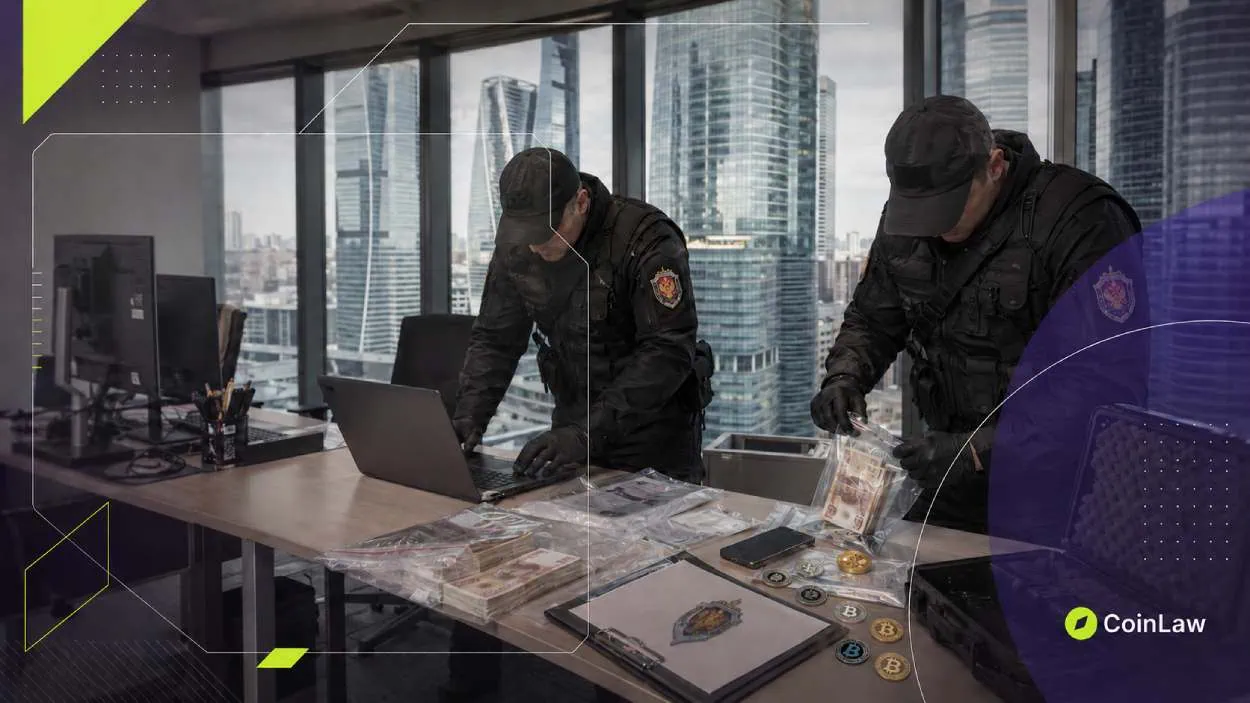






Russia’s Federal Security Service said on August 7, 2026, it detained more than 20 people running nine unregistered crypto exchange desks in Moscow City’s Federation Vostok tower. The agency alleges the desks converted phone scam proceeds into cryptocurrency and moved the money abroad.
Key Takeaways
- The FSB and Russia’s Interior Ministry raided crypto exchange offices operating inside the Federation Vostok tower, one of Moscow City’s best-known skyscrapers.
- Authorities say the desks turned rubles stolen through phone scams into cryptocurrency that left the country.
- One victim lost 144 million rubles, about $2 million, to scammers who posed as FSB agents.
- The agency named no exchanges or coins and gave no evidence for its claim that Ukrainian call centers ran the scheme.
- A new law passed by the State Duma requires every Russian crypto exchange to join a state registry, with a phased rollout into 2027.
What Happened?
The FSB said in a statement that it worked with the Interior Ministry to shut what it described as channels for moving stolen funds abroad through cryptocurrency. The raided offices operated alongside legitimate businesses in the tower, and officers detained the suspects on site.
The agency also described how the desks found staff. The FSB said:
Inside the Alleged Fraud Pipeline
Investigators say the scheme started in call centers that phoned Russians directly, including pensioners. Callers posed as bank employees, police officers, and FSB agents, kept victims on the line, and told them step by step how to proceed.
Victims were then sent to the exchange offices to buy cryptocurrency and transfer it to accounts the suspects controlled. In one case investigators cited, a victim moved 144 million rubles through a single crypto platform after callers impersonated FSB officers.
The FSB claimed Ukraine-based scam call centers used gray-market exchange offices in Moscow City to convert stolen cash into cryptocurrency and funnel it out of Russia.https://t.co/e2m5JsiwKl
— The Moscow Times (@MoscowTimes) August 7, 2026
What the FSB Left Out?
The agency’s statement leaves the core of the case unverified. Officials did not disclose:
- Which exchanges the desks worked through?
- Which cryptocurrencies carried the funds?
- How much money moved through the operations in total?
- What evidence supports the claim of Ukrainian coordination?
The case record so far rests on the FSB’s own account, and the agency released no supporting evidence for the Ukraine attribution. That attribution follows a pattern. Russia declared WhiteBit, a Ukrainian-founded crypto exchange, an undesirable organization earlier this year, accusing firms like it of funding Ukraine’s war effort.

A Registry Law Tightens the Net
Legislation passed by the State Duma in July 2026 requires every crypto exchange operating in Russia to enter a special government registry. The law phases in through 2027, giving compliant operators time to register. This week’s raids show what awaits desks that stay outside it.
The crackdown fits a wider repositioning of crypto inside Russia’s financial system. The state moved from banning most crypto payments to legalizing Bitcoin mining and permitting certain cross-border crypto transactions for sanctioned trade. A separate decree bans crypto mining in the Moscow region from August 15, 2026.
State-approved channels keep expanding at the same time. Russia has pressed ahead with its digital ruble September rollout, and major lenders are testing retail crypto access through Sberbank’s crypto wallet launch. Anyone holding funds with a Russian over-the-counter crypto desk can ask the operator for proof of registry status before transacting, since unregistered platforms are now the focus of enforcement.
CoinLaw’s Takeaway
The raid reads as enforcement arriving ahead of the rulebook. The registry law is still phasing in, yet security services are already treating unregistered conversion desks as criminal infrastructure. That sequencing tells operators the registration window works as a compliance deadline in practice, whatever the formal timeline allows.
The unproven Ukraine attribution matters as much as the arrests. By folding a fraud case into the war narrative, the agency placed unlicensed crypto conversion under a national security lens, which hands enforcement to the security services rather than financial regulators. Operators weighing registration are, in effect, choosing which of those two tracks they answer to. Registered, state-visible channels are getting room to grow, while street level desks in office towers are getting raided.