





Bitcoin infrastructure company Breez has launched a new feature that allows users to send USDC and USDT across more than 30 blockchain networks directly from their Bitcoin balances, removing the need to first convert funds or hold stablecoins.
Key Takeaways
- Breez now lets users send USDC and USDT from Bitcoin balances across more than 30 blockchains.
- The feature uses the Lightning Network and automated conversion through liquidity providers like Flashnet and Boltz.
- Users keep holding Bitcoin until a payment is initiated, while recipients receive stablecoins on their preferred blockchain.
- The launch expands Bitcoin’s role in cross chain payments and remittance applications.
What Happened?
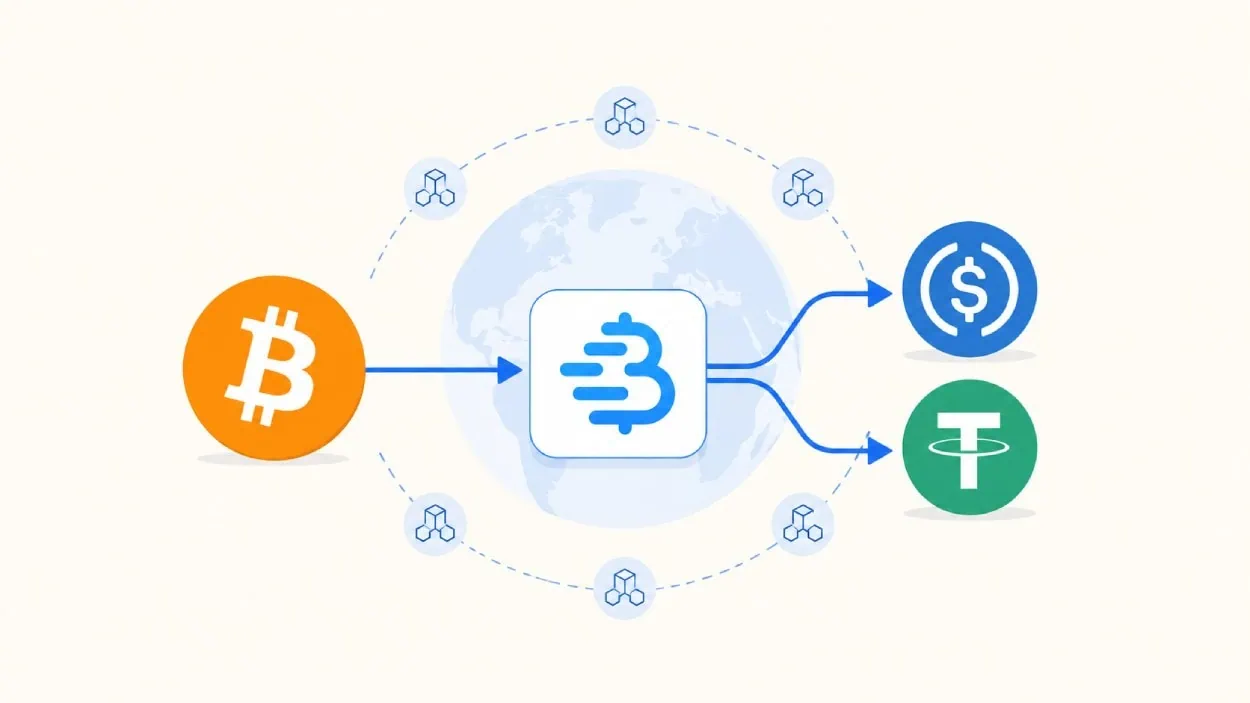
Breez has added a stablecoin payment feature to its developer toolkit that enables Bitcoin users to pay recipients in USDC or USDT without managing separate stablecoin wallets. The new capability works across more than 30 blockchain networks and is designed to simplify cross-chain transactions for developers and end users.
The company says the feature is non custodial and currently supports outbound stablecoin payments, with inbound stablecoin functionality expected in a future release.
Introducing Send USDT/USDC for the Breez SDK 🔥
— Breez ⚡ (@Breez_Tech) June 29, 2026
Bitcoin can now reach anyone. Even the people who live on dollars.
Any app or service can send dollars across 30+ networks, instantly, straight from a bitcoin balance.
One balance, no second network to manage. Bitcoin goes out,… https://t.co/wQRMqmryk7 pic.twitter.com/dXogsWcTyk
How the New Payment System Works?
The feature is integrated into the Breez SDK, the company’s toolkit for building Lightning powered applications. When a sender enters a recipient’s wallet address, the software automatically identifies the destination blockchain, calculates the conversion route, and displays the transaction amount, network, and fees before the payment is confirmed.
Once approved, the payment is routed through liquidity providers including Flashnet and Boltz. These providers convert the sender’s Bitcoin into either USDC or USDT and deliver the funds on the blockchain selected by the recipient.
According to Breez Chief Executive Officer Roy Sheinfeld, the process does not require USDC or USDT to be issued on the Lightning Network itself. Instead, the system relies on interoperability that allows users to spend directly from their Bitcoin balances while recipients receive stablecoins on supported blockchain networks.
The company said users continue to hold Bitcoin until the moment they initiate a payment, removing the need to keep separate stablecoin balances.
A Simpler Experience for Developers
The new feature is aimed at developers building wallets, social applications, and remittance platforms. By handling the blockchain routing and asset conversion behind the scenes, developers can offer stablecoin payments without integrating dozens of different networks individually.
Breez also noted that users can maintain a stable balance denominated in a US dollar equivalent. This approach helps reduce exposure to Bitcoin’s price swings without requiring users to convert their holdings into stablecoins.
The company already has a significant user base for the product. More than 75 applications, including Deblock and Cake Wallet, have integrated the Breez SDK, giving the stablecoin payment feature immediate distribution.
Supporting more than 30 blockchains could also prove valuable for remittance companies, where different regions often rely on different networks because of local exchange support and transaction costs.

Bitcoin Payment Infrastructure Continues to Grow
The launch comes as companies increasingly expand Bitcoin and the Lightning Network into new financial applications.
In February, Secure Digital Markets completed a $1 million Bitcoin payment to Kraken through the Lightning Network in less than half a second, highlighting the network’s potential for large value transfers.
During the same month, Voltage introduced a US dollar settled revolving credit line that integrates business credit into Lightning payment flows. The product allows companies to repay loans using either US dollars or Bitcoin.
Elsewhere, event platform Satlantis launched a Bitcoin-native ticketing platform with embedded Lightning wallets, allowing organizers to sell tickets and accept Bitcoin payments alongside traditional payment methods.
In March, Tether-backed startup Ark Labs raised $5.2 million to develop technology supporting stablecoin issuance, transfers, and settlements on Bitcoin.
Lightning adoption has also accelerated in recent years. A report from River estimated that the network surpassed $1 billion in monthly transaction volume in late 2025, a major increase from approximately $12 million in 2021.
CoinLaw’s Takeaway
I think this launch is another sign that Bitcoin’s utility is moving far beyond simple peer to peer payments. In my experience, one of the biggest barriers to using crypto for everyday transactions has been the need to manage multiple wallets and assets. Breez is trying to remove that complexity by making stablecoin payments feel like native Bitcoin transactions.
I found the cross-chain approach particularly interesting because it addresses a real problem for remittances and global payments. If developers can offer stablecoin transfers across dozens of networks while users only need to hold Bitcoin, it could make digital payments significantly easier for mainstream users.