





Imagine a world where paying for your coffee or grocery run is as simple as waving your wrist. That’s the promise of wearable payments technology, an innovation that merges convenience and cutting-edge tech. From smartwatches to fitness trackers, these devices are transforming how we think about payments, blending style, security, and utility. Let’s explore the latest statistics and trends shaping this dynamic market.
Editor’s Choice
- Smartwatch users who use mobile payment services on their devices now account for 37%.
- NFC technology accounted for 57.44% of the wearable payment devices market in 2025, showing its dominance in transaction enablement.
- Retail and grocery stores captured 45.62% of the wearable payment device market revenue in 2025.
- Indirect sales channels made up 63.25% of the wearable payment devices market in 2025.
- Asia-Pacific will expand at a 19.88% CAGR through 2031, making it the fastest-growing regional market.
- Contactless payments are supported on approximately 85% of wearable devices, reflecting broad ecosystem adoption.
Recent Developments
- Apple ended Apple Pay Later, while CaixaBank now offers Apple Pay instalments in Spain with plans from 2 to 12 months.
- The wearable payment devices market is projected to reach $82.16 billion in 2026 after growing from $69.95 billion in 2025.
- Apple holds about 20% of the wearable payment device market, keeping its lead among major players.
- Samsung accounts for about 15% of the wearable payment device market among the top companies.
- Fitness trackers represent roughly 25% of the wearable payment device market by device type.
- Smartwatches make up around 40% of the market, remaining the largest wearable payment device segment.
- NFC technology holds about 50% of the market, sustaining its lead in wearable payment transactions.
- North America accounts for approximately 35% of the global wearable payment device market.
- Asia-Pacific holds around 28% of the market and remains a major growth region for wearable payments.
Wearable Payments Market Growth
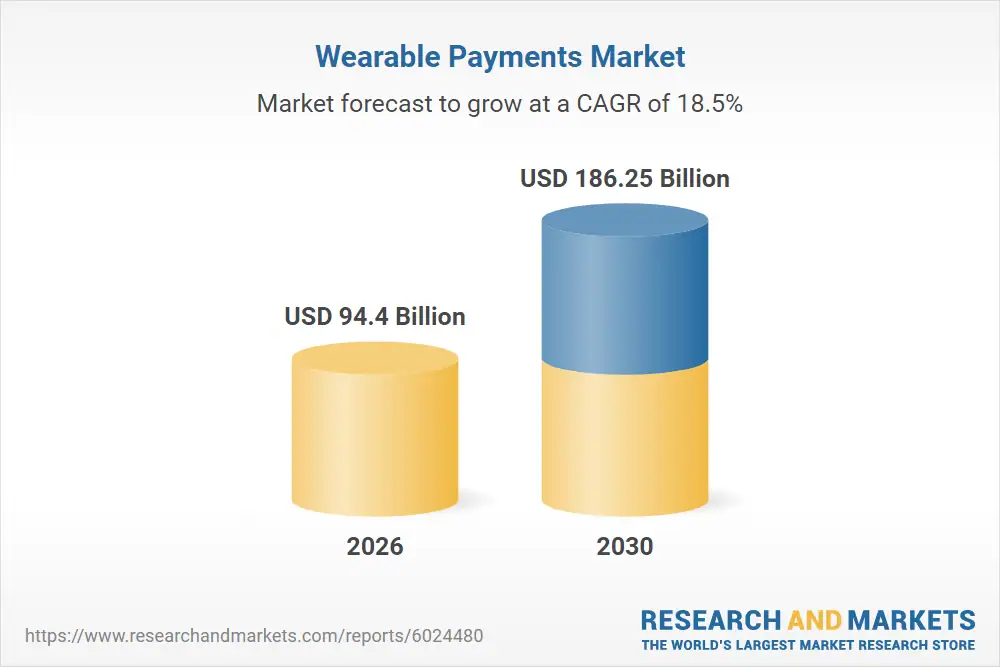
- The global wearable payments market will grow at a strong CAGR of 18.5%, highlighting rapid adoption and technological advancement.
- In 2026, the market will reach an estimated $94.4 billion, driven by increasing use of smartwatches and contactless payment devices.
- By 2030, the market will nearly double to approximately $186.25 billion, reflecting significant expansion in digital payment ecosystems.
- The growth from 2026 to 2030 reflects rising consumer demand for convenient, secure, and fast payment solutions through wearable technology.
Adoption Rates and User Demographics
- Gen Z and Millennials account for about 67% of wearable payment users.
- Smartwatch users who use mobile payment services on their devices now total 37%.
- Mobile payment usage on smartwatches is expected to increase by 44% over the next two years.
- Adults aged 35-44 show the highest wearable fitness technology adoption rate at 49%.
- Younger adults aged 18-24 use wearable payment devices at least weekly at a rate of 16%.
- Older adults aged 55+ use wearable payment devices at least weekly, at just 4%.
- Among Britons, smartwatch ownership reaches 46% for ages 18-24 and 47% for ages 25-34.
- About 34% of U.S. smartwatch owners use mobile payments on their devices weekly.
- Men account for about 55% of wearable technology users, compared with 45% for women.

Adoption of Wearable Technology by Education
- Adults with graduate degrees are 2.23x more likely to own wearables than those without advanced degrees.
- Advanced degree holders account for 31.4% of wearable device owners versus 13.5% of nonowners.
- People with college degrees show 60% wearable ownership, compared with 41% among those with only high school degrees.
- Americans with a college education make up 27% of smartwatch and fitness tracker users.
- People with a high school education or less represent just 15% of smartwatch and fitness tracker users.
- Overall wearable ownership reached 44.5% across 23,974 surveyed U.S. respondents.

Technology and Device Insights
- Biometric authentication is projected to power 68% of wearable payment transactions.
- The wearable payment devices market is expected to reach $82.16 billion in 2026.
- NFC held 57.44% of the wearable payment device market in 2025 and remains the core payment technology entering 2026.
- Another industry forecast values the wearable payments market at $94.4 billion in 2026.
- Contactless and NFC technology is expected to hold 40.2% of the broader payment devices market in 2026.
- Voice-enabled payments are projected to grow by about 30% in global adoption.
- Around 60% of wearable payment devices now use AI-driven personalization for spending controls and loyalty features.
- Multi-factor authentication support has reached about 20% of wearable payment devices.
- Wearable payment devices can now deliver up to 7 days of average battery life.
Wearable Payment Device Market Share by Technology
- Near-field communication held 57.44% of the wearable payment devices market in 2025.
- RFID represents about 15% of the wearable payment device market.
- QR and barcode-based wearable payment devices account for around 20% of the market.
- NFC-enabled devices remain the dominant technology across smartwatches, fitness trackers, and payment wristbands.

Application Insights
- Retail and grocery stores accounted for 45.62% of wearable payment device application revenue in 2025.
- Transportation and ticketing are projected to grow at a 22.05% CAGR through 2031, making it the fastest-growing application segment.
- Contactless payments made up more than 75% of transactions on Mastercard’s network in 2025, supporting broader wearable payment use cases.
Key Market Dynamics and Challenges
- Security concerns remain a barrier, with 64% of consumers citing data breach risks.
- About 35% of non-users avoid wearable payments due to hacking or unauthorized access fears.
- Device cost deters approximately 30% of potential users in budget-conscious segments.
- Biometric security is now featured in about 80% of wearable payment devices.
- End-to-end encryption is standard on about 90% of new wearable payment devices.
- Around 62% of consumers trust wearable payments because of authentication features like multi-factor authentication.
- Compliance with data privacy regulations improved by approximately 20% among manufacturers.
Leading Devices and Manufacturers
- Apple led global smartwatch shipments with a 32% market share in Q4 2025.
- Xiaomi ranked second in global wearables with 11.2% market share in 2025.
- Huawei captured 7.8% of the global wearable device market in 2025.
- Samsung accounted for 7.7% of the global wearable device market in 2025.
- Xiaomi recorded 13.2% annual growth in wearable shipments in 2025.
- Contactless payment compatibility is available on about 90% of new wearable devices.

Security and Privacy Considerations
- Approximately 80% of wearable payment devices now include biometric security features.
- Biometric authentication powers an estimated 68% of wearable payment transactions.
- About 90% of new wearable payment devices use end-to-end encryption as a standard feature.
- 62% of consumers trust wearable payments because of authentication features, such as multi-factor authentication.
- Around 35% of non-users avoid wearable payments due to fears of hacking or unauthorized access.
- About 92% of users still cite biometric authentication as a key trust factor.
Frequently Asked Questions (FAQs)
Retail and grocery stores captured 45.62% of application revenue in 2025.
Around 37% of smartwatch users now use mobile payment services.
North America commanded 29.96% of the global wearable payment devices market in 2025.
Conclusion
The evolution of wearable payment technology underscores the shift toward seamless, secure, and integrated payment solutions. Security innovations, user-friendly features, and expanding global adoption highlight this sector’s potential to redefine consumer transactions.
As wearables become essential accessories, the combination of biometric security, AI-driven personalization, and IoT integration positions these devices as indispensable tools in modern life. Despite challenges like device costs and data privacy concerns, continuous innovation and global collaborations signal a promising future. For consumers and businesses alike, wearable payments represent not just convenience, but the next step in the evolution of digital commerce.