





OKX has enabled institutional clients to use BlackRock’s BUIDL fund as trading collateral, linking tokenized Treasury assets with regulated banking custody.
Key Takeaways
- OKX now allows BUIDL to be used as trading collateral for institutional and VIP clients.
- Standard Chartered provides custody, keeping assets off exchange in a regulated structure.
- BUIDL generates yield while being used as margin, solving idle capital issues.
- Tokenized Treasury funds are becoming key infrastructure in crypto trading.
What Happened?
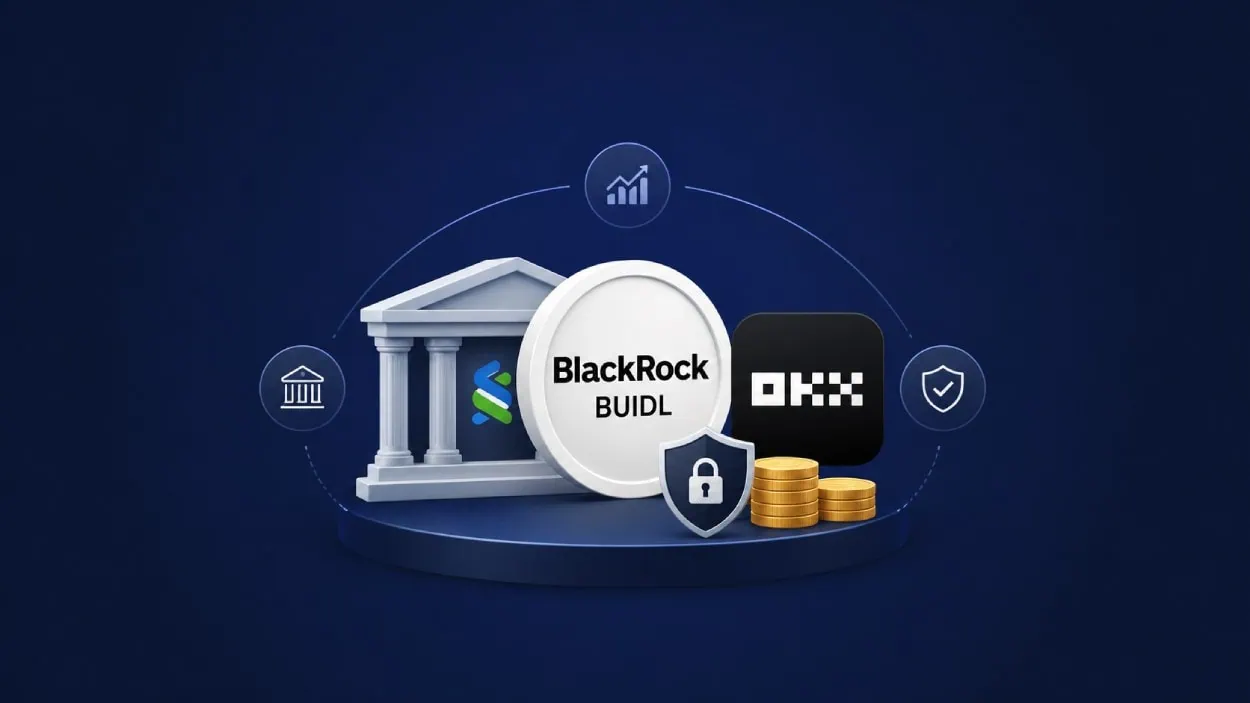
OKX has integrated BlackRock’s tokenized Treasury fund BUIDL into its collateral framework, allowing institutional clients to use it as margin for trading. The setup works with Standard Chartered as a regulated custodian, giving clients the option to hold assets off exchange while still accessing liquidity on OKX.
The move reflects a growing trend where tokenized real world assets are being actively used in trading systems instead of sitting idle.
Your collateral shouldn’t sit idle.
— OKX (@okx) April 28, 2026
BlackRock’s BUIDL is now live as yield-bearing collateral on OKX — safeguarded in Tier 1 custody with Standard Chartered.
Together, the world’s largest asset manager, a G-SIB, and global digital market infrastructure set a new blueprint for… pic.twitter.com/GvesinW4co
OKX Brings Tokenized Treasury Assets Into Active Trading
Crypto exchange OKX has introduced a new way for institutions to use capital more efficiently by enabling BUIDL as trading collateral. The fund, which is backed by cash, US Treasury bills, and repurchase agreements, is tokenized by Securitize and distributes yield onchain.
Under the new framework, institutional and VIP clients can either:
- Hold BUIDL in custody with Standard Chartered while trading on OKX.
- Deposit BUIDL directly onto the exchange for margin use.
This dual structure gives flexibility based on risk preferences and operational needs, something that has become increasingly important after past market events pushed institutions toward safer custody models.
Solving Crypto’s Idle Capital Problem
One of the biggest inefficiencies in crypto trading has been idle collateral. Traditionally, cash or stablecoins used as margin would sit unused, earning little or no return.
With BUIDL, that changes. The fund allows institutions to:
- Earn yield from Treasury backed assets while using them as collateral.
- Maintain exposure to low risk, short term government securities.
- Improve capital efficiency without sacrificing liquidity.
Rifad Mahasneh, CEO of OKX Middle East and North Africa and Commonwealth of Independent States said:

Standard Chartered Adds Regulated Custody Layer
A key part of the structure is the role of Standard Chartered, which acts as an independent custodian. Client assets are held separately from OKX’s balance sheet, aligning the framework more closely with traditional finance standards.
The system also builds on an earlier collateral mirroring program launched in 2025 under Dubai’s regulatory framework. That program initially included Franklin Templeton’s BENJI fund, with BUIDL now expanding the list of supported tokenized assets.
OKX continues to handle real time margining and liquidation processes, while custody remains with the bank. This separation is designed to reduce counterparty risk and increase trust among institutional participants.
Growing Adoption of Tokenized Treasury Funds
The integration of BUIDL into OKX is part of a broader shift toward using tokenized Treasury products across crypto markets. Other major platforms like Binance, Crypto.com, and Deribit have also added similar assets to their collateral systems.
Since its launch in 2024, BUIDL has grown into one of the largest tokenized funds, reaching around $2.5 billion in assets. It is available only to qualified investors and has been steadily expanding across both centralized exchanges and decentralized finance platforms.
Data suggests that a significant portion of tokenized Treasury assets are now actively used as collateral, rather than sitting idle, signaling a shift toward more integrated financial systems.
Regulatory Outlook and Market Risks
While adoption is increasing, concerns remain. The International Monetary Fund has warned that blockchain based financial systems could accelerate market stress during crises due to faster transaction speeds and interconnected platforms.
This highlights the need for strong regulatory oversight as tokenized assets become more deeply embedded in both crypto and traditional financial systems.
CoinLaw’s Takeaway
I see this move as a clear signal that crypto markets are maturing fast. In my experience, one of the biggest concerns for institutions has always been how to use capital efficiently without taking on unnecessary risk. This setup directly addresses that.
What stands out to me is the combination of yield generation, regulated custody, and trading utility all in one structure. That is exactly the kind of bridge needed between traditional finance and crypto.
I believe this is not just about OKX or BlackRock. It is about how tokenized real world assets are becoming the backbone of next generation financial infrastructure.