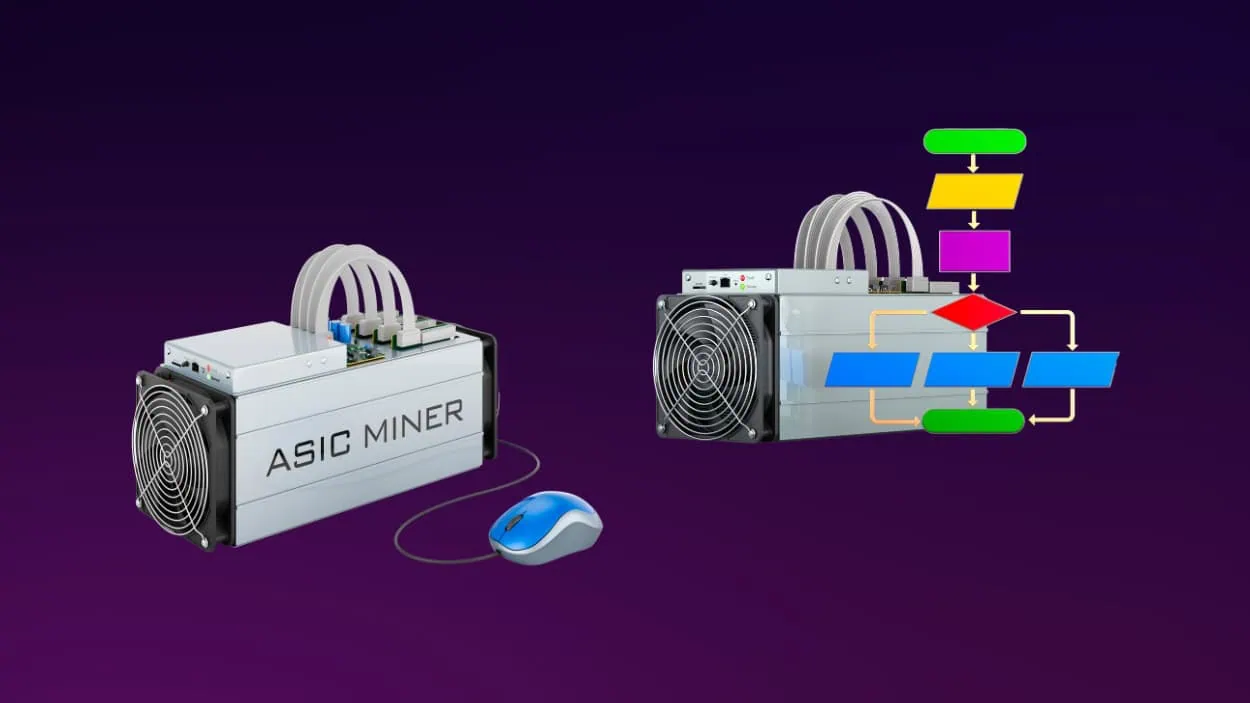
ASIC mining uses chips purpose-built to run one cryptographic algorithm. SHA-256 is the variant that powers Bitcoin. Every transistor is dedicated to that single operation, reaching 17.5 J/TH on the Antminer S21 per Bitmain spec sheets, a figure general-purpose CPUs or GPUs cannot approach. The term ASIC stands for Application-Specific Integrated Circuit. These machines do one thing at an industrial scale and nothing else.
Bitcoin’s entire security model now rests on silicon that would be useless for any other computing task. The shift from general-purpose hardware to purpose-built chips is why the network has grown from a hobbyist curiosity into infrastructure driving cryptocurrency adoption and consuming roughly half a percent of global electricity, according to Cambridge Centre for Alternative Finance estimates.
Key Takeaways
- The Antminer S21, according to Bitmain, delivers 200 TH/s at 17.5 J/TH on 3,500 watts at the wall, setting the 2024-era air-cooled benchmark.
- Bitcoin’s network hashrate reached 1,096 EH/s as of April 15, 2026, per Hashrate Index tracking, an order of magnitude above early-2023 levels.
- Sustainable energy’s share of Bitcoin mining, according to Cambridge Centre data, climbed to about 52.4% (including 9.8% nuclear and 42.6% renewables) per the Cambridge Centre for Alternative Finance.
- Coal’s share, per Cambridge CCAF research, collapsed to about 8.9%, down from 36.6% in 2022, as older rigs unplugged first.
- Bitmain, MicroBT, and Canaan together manufacture the vast majority of SHA-256 miners, led by Bitmain’s flagship S21 family.
How Does ASIC Mining Work?
ASIC mining solves a narrow math problem very fast. The Bitcoin network sets a target hash value. Miners race to find an input whose double SHA-256 hash falls below that target. This process, per Nakamoto’s original whitepaper, works like so: The proof-of-work involves scanning for a value that, when hashed, such as with SHA-256, the hash begins with a number of zero bits. An ASIC is the chip designed to scan that space as fast as physics and silicon geometry allow.
| Miner | Released | Hashrate (TH/s) | Power (W) | Efficiency (J/TH) |
| Antminer S19 XP | Jul 2022 | 140 | 3,010 | 21.5 |
| Antminer S21 | Oct 2023 | 200 | 3,500 | 17.5 |
| WhatsMiner M60S | Feb 2024 | approximately 186 | approximately 3,441 | approximately 18.5 |
| Avalon A1466 | Sep 2023 | 150 | 3,230 | 21.5 |
Sources: Bitmain Support; WhatsMiner by MicroBT; Canaan AvalonMiner product documentation
1. The Chip Is Designed for One Algorithm
A SHA-256 ASIC bakes the entire hashing pipeline into the silicon. There is no floating-point unit, no cache hierarchy built for generic code, and no graphics pipeline. Every square millimetre of die area computes SHA-256 rounds. The Antminer S21 runs the SHA-256 algorithm and supports BTC, BCH, and BSV, which all share the same hash function. Switch the algorithm, and the chip becomes electronic scrap.
2. The Miner Computes Trillions of Hashes Per Cycle
A modern rig iterates through candidate block headers at terahash (trillion-hash) speeds. The Antminer S21 reaches 200 TH/s of SHA-256 throughput, with the chip varying a 32-bit nonce and parts of the Merkle root to generate new inputs. At that pace, the network collectively processes well above a zetahash (10^21 hashes) per second.


3. The Network Compares Hashes Against a Difficulty Target
Each block, the protocol publishes a difficulty target. A hash only counts as a valid block if its numeric value is below that target. The average work required is exponential in the number of zero bits required and can be verified by executing a single hash. Difficulty retargets every 2,016 blocks (about two weeks), keeping block times near 10 minutes as total hashrate changes.
4. Pools Aggregate Hashrate and Split Rewards
Individual miners rarely solve a block alone at today’s scale. Mining pools combine the hashrate from thousands of rigs and pay members proportionally to the shares they submit. With the network above 1,000 EH/s across major crypto exchanges and mining operations, a single S21 produces a vanishingly small share of global hashrate, which pools translate into small, steady payouts instead of unpredictable block wins.
Why Does ASIC Mining Matter?
ASIC mining matters because it concentrates Bitcoin’s security budget into purpose-built hardware that cannot easily be repurposed. The Cambridge Digital Mining Industry Report estimated Bitcoin’s annualized electricity consumption at about 0.5% of global demand, with network-wide emissions reported in megatons of CO2 equivalent. That spending (mostly on power and capital depreciation) is what makes a 51% attack on the network economically irrational.
Geography changed dramatically after China imposed its 2021 mining ban. The U.S. share of Bitcoin mining rose from about 3.4% in January of 2020, reaching 37.8% by January of 2022, per the U.S. Energy Information Administration, citing Cambridge CBECI data. By 2025, the United States accounted for about 75.4% of reported Bitcoin mining activity, followed by Canada at 7.1%. North America now hosts the bulk of ASIC capacity. Most new rigs plug into grids chosen for baseload availability rather than marginal cost alone.
Our coverage of 80-plus mining and adoption statistics tells a story price charts don’t: network security has compounded through four halvings and multiple bear markets, even when the spot price fell 70 percent. That is the pattern that matters for Bitcoin’s long-term credibility as a settlement infrastructure, and it is the pattern ASICs quietly underwrite. For readers tracking the dollar side of the ledger, our full Bitcoin mining energy consumption breakdown tracks the cost per TH alongside grid mix.

Pros, Cons, and Risks
Advantages
- Extreme efficiency: Modern SHA-256 ASICs operate in the 17-22 J/TH range, a figure general-purpose silicon cannot approach.
- Mature supply chain: Bitmain, MicroBT, and Canaan manufacture the vast majority of SHA-256 ASIC hardware, with known firmware, warranty pathways, and resale markets.
- Predictable thermals: Purpose-built heatsinks and fan curves make large-fleet deployment easier than bespoke GPU rigs.
- High resale liquidity: Major models trade on public secondary markets with transparent price history.
Trade-offs and Risks
- Single-algorithm lock-in: A SHA-256 ASIC cannot pivot to another coin if Bitcoin mining economics collapse. Resale value depends entirely on BTC’s ongoing network.
- Obsolescence pressure: The efficiency step from the S19 XP at 21.5 J/TH (2022) to the S21 at 17.5 J/TH (2023) in roughly one year turns older fleets into stranded assets once power prices rise.
- Concentration risk: Manufacturer concentration means supply shocks (tariffs, export controls, U.S. investigations into Chinese hardware) can jolt the market. Our reporting on the Bitmain statistics dossier captures recent shipment swings.
- Capital intensity: New-generation ASICs typically list in the low-thousands-of-dollars range per unit before power contracts, hosting, and ancillary electrical work.
- Noise and heat: Air-cooled ASICs run at 75+ dB, ruling out most residential deployments without containment.
ASIC Mining vs GPU Mining
ASIC mining and GPU mining solve the same nominal problem with radically different silicon. An ASIC strips every circuit not needed for SHA-256. A GPU retains floating-point units, shaders, and memory controllers built for games and machine learning. On Bitcoin, that gap proves decisive.
| Dimension | SHA-256 ASIC | High-End GPU |
| Best-case Bitcoin efficiency | 17.5 J/TH (Antminer S21) | Multiple orders of magnitude worse |
| Peak hashrate per unit | S21 rated at 200 TH/s at 3,500 W | Sub-gigahash at practical power |
| Bitcoin mining viability | Only viable option at network scale | Not competitive since ~2013 |
| Algorithm flexibility | SHA-256 only | Many algorithms (Kaspa, Ergo, ETC-style coins) |
| Upfront cost (2026) | $3,000-$5,000 new | $500-$2,000 per consumer card |
| Secondary use | Near-zero outside mining | AI workloads, gaming, rendering |
| Noise profile | 75+ dB under load | 30-50 dB typical |
Sources: Bitmain Support; WhatsMiner by MicroBT; Canaan product documentation; Bitcoin whitepaper by Satoshi Nakamoto for the SHA-256 specification
The Bitcoin whitepaper defines proof-of-work as scanning for hashes that begin with a number of zero bits. That operation is trivially parallel and deeply simple. Custom silicon crushes general-purpose chips on it. GPUs keep a role in mining economies for altcoins whose communities deliberately resist ASIC adoption. Bitcoin stopped being a GPU coin over a decade ago and will not come back. The history of Bitcoin traces this hardware evolution from CPUs through GPUs to today’s ASIC-dominated landscape.
Real-World Applications
ASIC mining rigs run in three broadly different settings today. Each trades noise, capital, and power access differently.
Industrial Bitcoin Mining Farms
Publicly listed operators host tens of thousands of ASICs in purpose-built facilities. These sites choose locations for long-duration power contracts, cooling (air, immersion, or hydro), and grid-services revenue. North America, led by the United States at about 75.4% of reported activity, hosts most of today’s industrial ASIC fleet. Readers tracking listed operators can cross-reference our cryptocurrency mining statistics hub.
Home and Small-Business Hosted Mining
A shrinking but persistent segment runs a few units at home. Owners often route them through a hosted facility for thermal and power reasons. Low-noise variants and hydro-loop kits keep small miners viable. Margins compress quickly whenever global hashrate grows faster than block reward.
Scenario: How an S21 Earns a Share in a Pool
Picture an Antminer S21 plugged in at a small commercial site. The pool sends the rig a block template plus a numeric difficulty target lower than the network target. The S21 hashes the template at its rated 200 TH/s, varying the nonce. When a hash beats the pool’s internal target, the rig submits a share over Stratum. The pool credits the share and batches thousands of shares from many miners. When one of those shares also beats the network target, the pool claims the block reward and distributes it pro rata. At 1,096 EH/s of network hashrate, a single S21 earns fractional payouts daily instead of waiting years for a solo block.
Frequently Asked Questions (FAQs)
ASIC stands for Application-Specific Integrated Circuit. In crypto, the term refers to a chip whose circuitry runs one hashing algorithm. SHA-256 is the Bitcoin variant. The Bitcoin whitepaper defines the proof-of-work scan that ASICs are built to accelerate. An ASIC cannot be reprogrammed for other workloads the way a CPU or GPU can.
New mid-to-top-tier SHA-256 ASICs list in the low thousands of dollars per unit, depending on efficiency class and air versus hydro cooling. Used prior-generation rigs, such as the Antminer S19 XP, trade on secondary markets for a fraction of that price. Thinner margins per watt mean power prices matter far more than purchase price.
Technically, yes; practically no. With the network above 1,000 EH/s, a CPU or GPU contributes a rounding error of hashrate and will likely never solve a block, even over years. Home-scale solo mining with non-ASIC hardware is a lottery ticket, not a strategy. Every serious Bitcoin miner runs ASICs.
The Cambridge Centre for Alternative Finance estimates annual electricity consumption at about 0.5% of global demand in terawatt-hours. The U.S. Energy Information Administration, citing the CBECI, reported a 2023 point estimate of about 120 in terawatt-hours, with a lower bound of 67 and an upper bound of 240. Ranges vary because machine efficiency, grid mix, and price-driven on-off behaviour all shift the number.
Conclusion
ASIC mining is the quiet infrastructure layer behind Bitcoin. Every block is found by silicon designed for nothing else, with air-cooled 2023-era rigs reaching 17.5 J/TH on the Antminer S21 at 3,500 W per unit. The efficiency curve is why the network can carry more than 1,000 EH/s of hashrate, while the Cambridge Centre for Alternative Finance measures about 52.4% of that energy coming from sustainable sources.
Our coverage has tracked four halvings and two deep bear markets. The pattern is consistent: each cycle’s efficiency step-change retires the previous fleet, coal gives up more ground, and the network keeps adding security faster than observers expect. If the pattern holds, the next generation of miners will push efficiency lower still, and the share of renewables plus nuclear will keep rising. The ASIC arms race is not slowing down, and Bitcoin’s energy economics keep shifting with it.