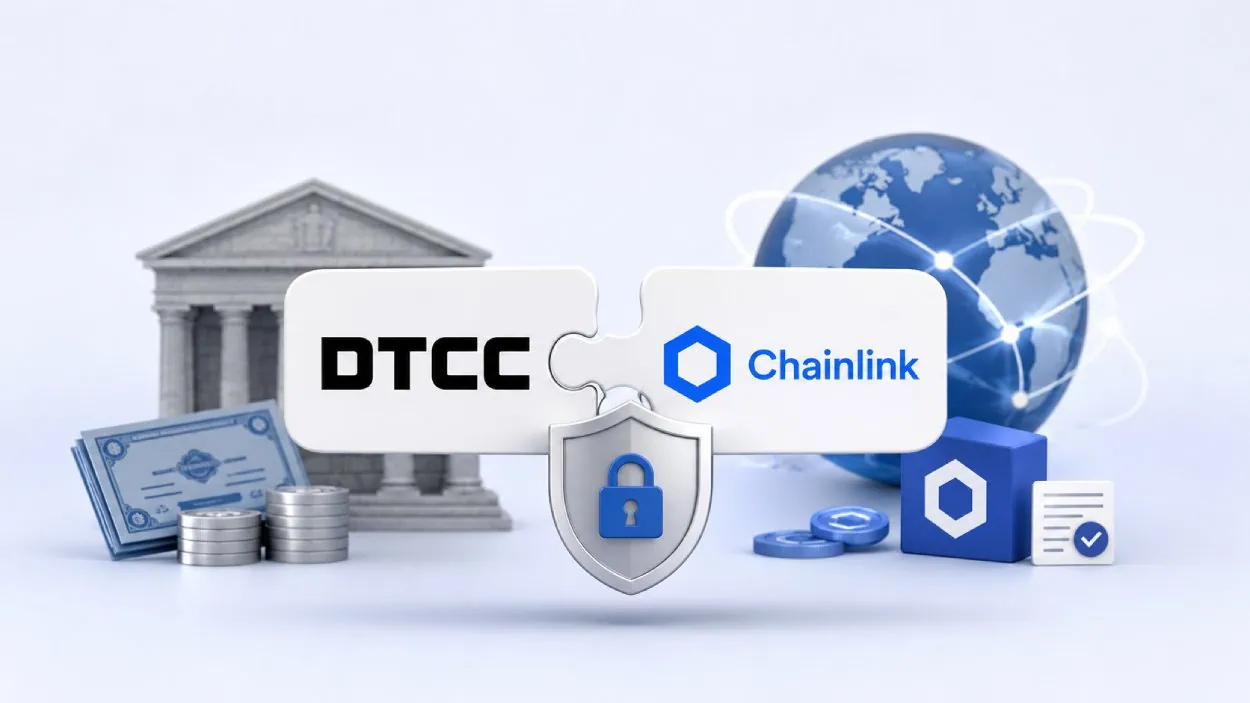






DTCC is integrating Chainlink technology into its blockchain based collateral platform as the financial giant pushes toward real time tokenized asset management across global markets.
Key Takeaways
- DTCC will use Chainlink’s Runtime Environment for its Collateral AppChain platform.
- The blockchain based system aims to enable 24 hour near real time collateral movement.
- The platform is expected to launch in Q4 2026.
- DTCC processed $4.7 quadrillion in securities transactions during 2025.
What Happened?
The Depository Trust and Clearing Corporation, better known as DTCC, announced that it will integrate Chainlink infrastructure into its tokenized collateral management platform called Collateral AppChain. The platform is being developed to modernize how collateral moves across financial institutions and blockchain networks.
The integration will allow DTCC to automate key collateral functions including pricing, valuation, margining, settlement, and collateral optimization using blockchain technology and smart contracts.
Today we announced progress toward our goal of advancing 24/7 collateral mobility. DTCC’s Collateral AppChain, a shared infrastructure platform for collateral, will leverage the Chainlink Runtime Environment (CRE) and @chainlink data standard to enable near real-time collateral… pic.twitter.com/pJxBBmVWAr
— DTCC (@The_DTCC) May 12, 2026
DTCC Pushes Further Into Blockchain Infrastructure
DTCC’s Collateral AppChain is designed as a shared blockchain infrastructure for institutional finance participants. The system aims to support collateral providers, custodians, triparty agents, collateral managers, and financial venues through one interoperable network.
The platform is built on Besu blockchain technology and focuses on tokenizing collateral assets so they can move more efficiently across markets. DTCC said the current collateral system often suffers from delays and fragmentation because assets remain locked across institutions, jurisdictions, and time zones.
By tokenizing collateral and automating workflows with smart contracts, DTCC wants to enable near real time collateral transfers around the clock.
Nadine Chakar, DTCC Managing Director and Global Head of Digital Assets, said:
Chainlink’s Role in the Platform
Chainlink will provide its Runtime Environment, also known as CRE, alongside its data standard technology for the project. According to DTCC, the infrastructure will help orchestrate data access, automation, compliance, and collateral related workflows.
The integration is expected to handle:
- Eligibility checks
- Asset valuation
- Margin calculations
- Collateral optimization
- Settlement instructions
- Cross chain interoperability
Rather than creating separate integrations for every asset class or data source, DTCC selected Chainlink’s reusable framework to simplify scaling over time.
Chainlink Co-founder Sergey Nazarov described collateral management as one of blockchain technology’s strongest use cases for traditional finance.
Nazarov said:

Tokenization Efforts Continue to Expand
The latest move builds on earlier collaboration between DTCC and Chainlink. In 2024, both firms worked together on the Smart NAV pilot project, which tested bringing mutual fund net asset value data onto blockchains.
Major institutions including JPMorgan, Franklin Templeton, and BNY Mellon participated in that initiative, focusing on fund tokenization across multiple blockchain networks.
DTCC has also continued expanding its broader tokenization strategy. Earlier this month, the company revealed that more than 50 firms joined a working group connected to The Depository Trust Company’s tokenization service. Limited production trades are expected to begin in July before a broader launch planned for October.
The collateral initiative also involves onboarding multiple forms of tokenized assets including tokenized money market funds, stablecoins, tokenized deposits, and other cash equivalents.
Why This Matters for Traditional Finance?
DTCC remains one of the most important pieces of global financial infrastructure. Its subsidiaries processed approximately $4.7 quadrillion in securities transactions during 2025 while providing custody and asset servicing for securities valued at $114 trillion.
That scale makes the Collateral AppChain one of the largest blockchain based infrastructure projects currently under development in traditional finance.
The project also signals how major financial institutions are increasingly moving beyond blockchain experiments and into production level systems focused on efficiency and automation.
CoinLaw’s Takeaway
In my experience, collateral management has always been one of the least visible but most critical parts of global finance. What stands out here is not just the use of blockchain, but the fact that DTCC is applying it to a core financial workflow that touches trillions of dollars daily.
I found the choice of Chainlink especially important because institutional players care deeply about secure data, compliance, and interoperability. If this platform launches successfully in 2026, it could become one of the strongest examples yet of blockchain technology solving a real world infrastructure problem for Wall Street.