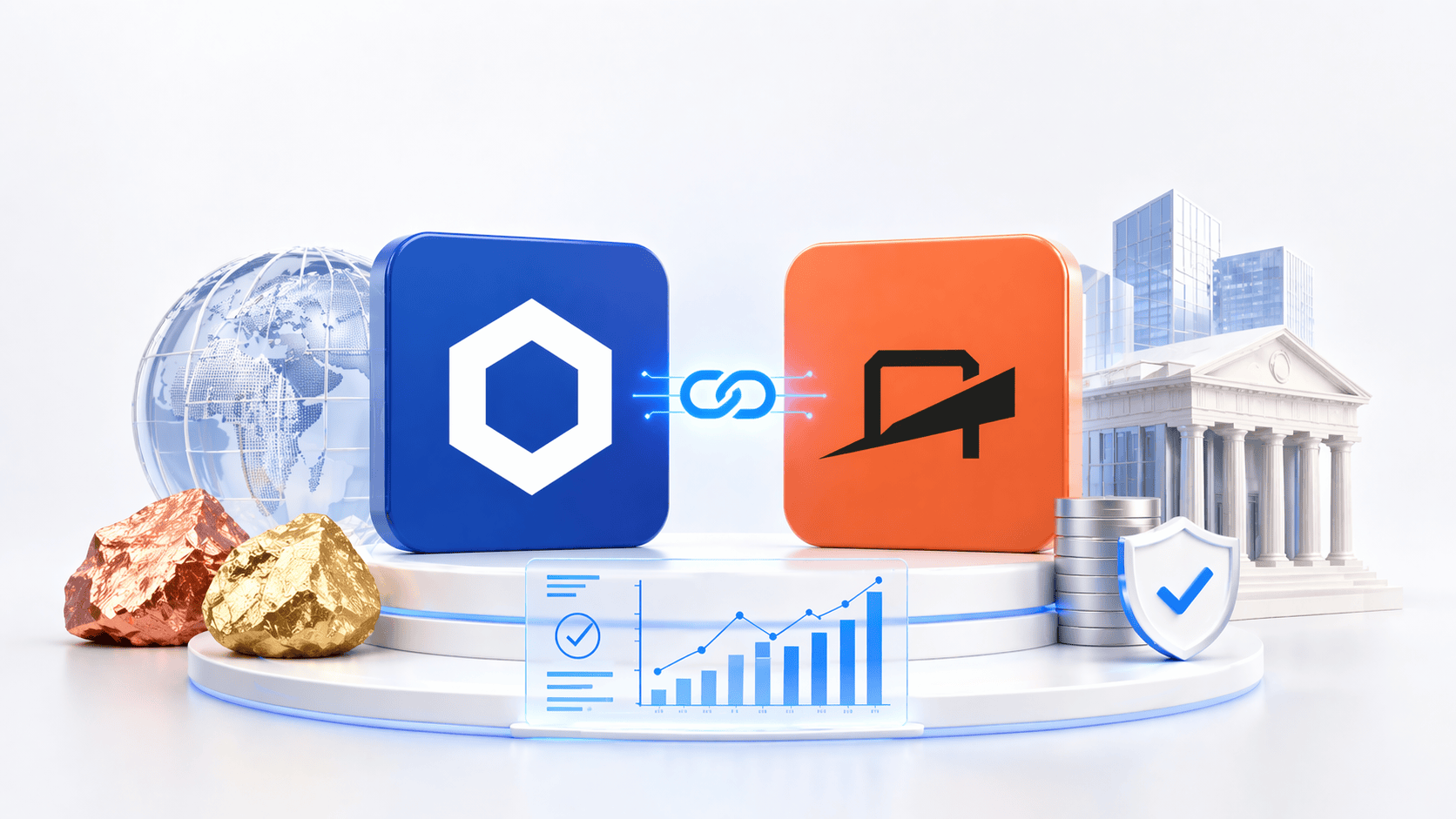






Chainlink and Bridgetower have launched a live deployment to tokenize an $11 billion copper gold project, marking a major step in bringing real world assets onchain.
Key Takeaways
- Bridgetower is tokenizing an $11 billion DOM X copper gold project using Chainlink infrastructure.
- The platform supports full lifecycle management including data, compliance, and cross chain connectivity.
- Institutional features like KYC, AML, and Proof of Reserve are built directly into the system.
- The move signals growing momentum for real world asset tokenization across global markets.
What Happened?
Bridgetower has partnered with Chainlink to bring the DOM X Arizona Copper Gold Project onchain, representing over $11 billion in tokenized securities. The deployment also supports a broader pipeline of more than $25 billion in natural resources, energy, and metals.
The integration uses Chainlink’s full technology stack to enable institutional grade issuance, compliance, and distribution of tokenized assets across blockchain networks.
NOW: Bridgetower adopts Chainlink to tokenize $11B+ in securities from the DOM X Arizona Copper-Gold Project.
— Chainlink (@chainlink) April 23, 2026
By integrating the full Chainlink stack into its tokenization platform, BridgeTower is unlocking the issuance and distribution of tokenized securities at scale. pic.twitter.com/wnucctQ3IP
Bridgetower Moves Into Full Scale Tokenization
The latest deployment marks a transition from early experimentation to live production infrastructure for tokenized assets. Bridgetower is now using Chainlink’s tools to manage the complete lifecycle of tokenization, including:
- Cross chain connectivity through CCIP to access regulated DeFi and secondary markets.
- Proof of Reserve for asset verification and transparency.
- NAVLink for real time valuation data onchain.
- Runtime Environment to automate compliance, settlement, and reporting.
According to Bridgetower CEO Cory Pugh:
This setup allows investors to participate using both fiat and stablecoin payment rails, supported by Iron, a MoonPay company, while maintaining strict compliance standards.
Why This Matters for Real World Assets?
Tokenizing commodities like copper and gold could fundamentally change how these assets are traded. Instead of traditional markets, these assets can now be fractionalized, digitized, and traded globally through blockchain infrastructure.
Johann Eid, Chief Business Officer at Chainlink Labs, said:
Major institutions such as BlackRock and JPMorgan Chase are already exploring tokenization, signaling a broader shift across financial markets.

Privacy and Compliance Take Center Stage
A key feature of this deployment is its focus on privacy preserving tokenization. Bridgetower is working with Chainlink to ensure that investor identities and ownership details remain confidential while still meeting regulatory requirements.
The platform embeds:
- KYC and KYB verification.
- AML compliance controls.
- Confidential ownership structures with verifiable data.
This combination of privacy and compliance is critical for attracting institutional investors who require both transparency and discretion.
Chainlink Price Outlook After the Announcement
Following the announcement, Chainlink’s native token has shown mixed short term performance. The price hovered around $9.30 after testing resistance near $9.50, reflecting broader market pressure.

Key technical levels include:
- Support between $8.70 and $9.00.
- Resistance between $9.50 and $10.50.
- Potential upside toward $14 to $15 if bullish momentum returns.
Indicators suggest a neutral outlook, with the RSI near mid levels and MACD showing slowing momentum. Broader crypto market trends, especially movements in Bitcoin, could influence the next price direction.
Institutional Momentum Continues to Build
Chainlink’s role in real world asset tokenization continues to expand. The network has already helped secure over $100 billion in assets, and this latest deployment adds further credibility.
The integration highlights how blockchain infrastructure is evolving beyond experimentation into real financial systems used by institutions. Platforms like Coinbase and Binance could eventually play a role in distributing these tokenized assets at scale, while networks like Ethereum stand to benefit from increased activity.
CoinLaw’s Takeaway
In my experience, this is one of the clearest signals yet that tokenization is no longer just a concept but a working system. I found this development especially important because it shows real assets, not just digital tokens, being brought into blockchain infrastructure at scale.
What stands out to me is the shift toward institutional readiness. This is not a pilot or a test. It is a live deployment backed by compliance, liquidity pathways, and real economic value.
If this trend continues, I believe we are looking at a future where traditional assets like commodities, real estate, and securities become as easy to trade as cryptocurrencies. That could completely reshape global finance.