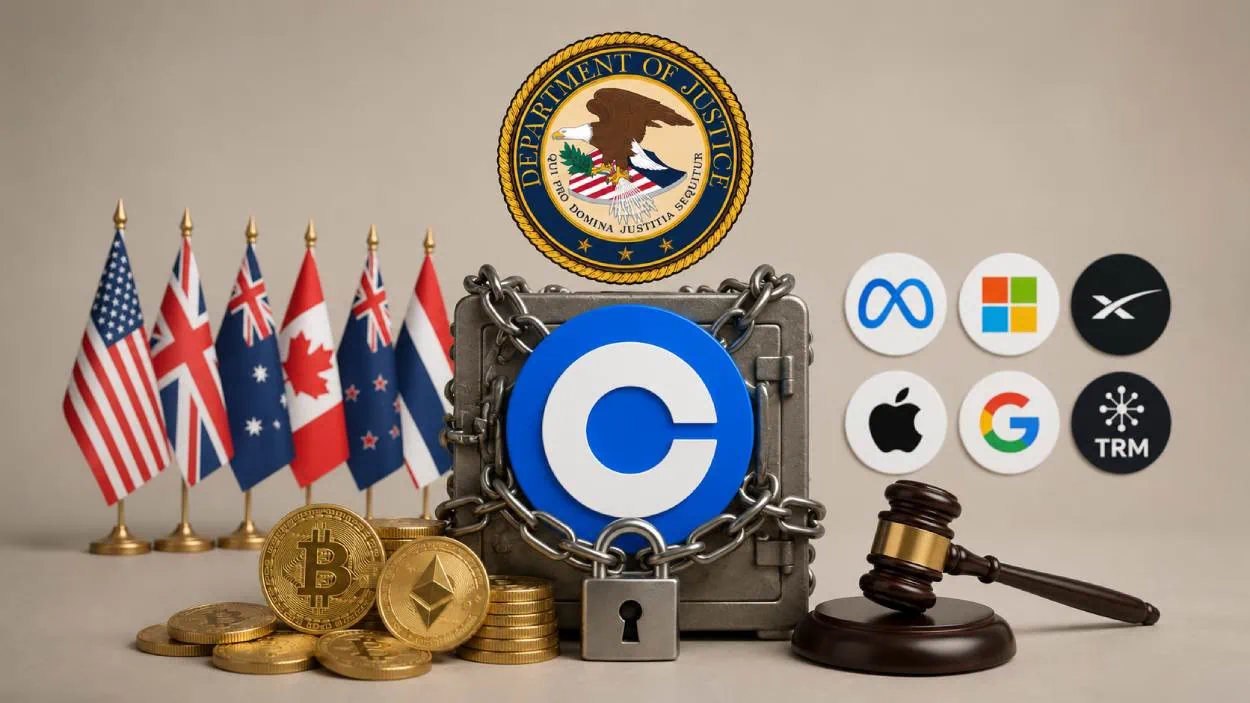






Coinbase has frozen more than $3 million in cryptocurrency linked to Southeast Asian scam networks as part of a coordinated international operation led by the U.S. Department of Justice.
Key Takeaways
- Coinbase froze over $3 million in cryptocurrency connected to Southeast Asian fraud organizations.
- The action was part of the DOJ’s Disruption Week initiative led by the Scam Center Strike Force.
- Authorities and technology companies disrupted more than 1.4 million social media and email accounts used by scammers.
- The operation involved global law enforcement agencies and major technology firms working together to combat crypto investment fraud.
What Happened?
Coinbase has taken action against cryptocurrency wallets linked to Southeast Asian scam networks, freezing more than $3 million in digital assets. The move was carried out during a large scale international enforcement effort known as Disruption Week, organized by the U.S. Department of Justice’s Scam Center Strike Force.
The operation brought together government agencies, technology companies, and international law enforcement partners to target the infrastructure behind crypto-related investment scams that have cost victims billions of dollars worldwide.
🚨 TODAY: Coinbase froze over $3 million in crypto tied to criminal fraud networks as a global crackdown on Southeast Asian scam operations led to 63 arrests.
— Coin Edition: Your Crypto News Edge ️ (@CoinEdition) June 4, 2026
The operation involved the FBI, DOJ, Meta, Microsoft, Coinbase, and international law enforcement agencies.
More… pic.twitter.com/wJjr4iSIIJ
DOJ and Tech Giants Join Forces Against Fraud Networks
According to the Department of Justice, the operation involved cooperation between the FBI, U.S. Secret Service, and law enforcement agencies from the United Kingdom, Australia, Canada, New Zealand, and Thailand.
Several major technology firms also participated, including Apple, Google, Meta, Microsoft, SpaceX, Starlink, and TRM Labs. Together, these organizations worked to identify and disrupt the digital tools used by criminal groups operating scam compounds across Southeast Asia.
As part of the coordinated effort, more than 1.4 million social media and email accounts believed to be linked to fraudulent activity were blocked or disrupted. Authorities said these accounts were used to contact victims, promote fake investment opportunities, and facilitate fraudulent transactions.
Thai law enforcement also took action on the ground. Reports indicate that police arrested multiple suspects connected to the scam operations and launched additional investigations into related criminal activity.
Coinbase Freezes Millions in Crypto Assets
Coinbase played a significant role in the operation by freezing more than $3 million in cryptocurrency assets associated with the scam networks.
The exchange highlighted the advantages of blockchain technology in combating financial crime. Because blockchain transactions are recorded on public ledgers, investigators can trace the movement of funds and identify suspicious patterns more effectively than in some traditional financial systems.
Coinbase said:
The statement emphasized the importance of collaboration between public and private organizations in disrupting sophisticated criminal enterprises.

Authorities Warn About Growing Crypto Investment Scams
The DOJ described cyber enabled investment fraud as one of the most damaging forms of financial crime affecting Americans today.
U.S. Attorney Jeanine Pirro stated:
Many of these operations are associated with so called pig butchering schemes, where scammers build trust with victims over time before convincing them to invest in fraudulent cryptocurrency platforms. These scams often rely heavily on social media platforms, messaging services, and email accounts to recruit and manipulate targets.
Previous Enforcement Actions Show Broader Crackdown
The latest operation follows earlier enforcement efforts by the Scam Center Strike Force. In April, authorities charged two Chinese nationals accused of operating a crypto fraud scheme in Burma and attempting to rebuild operations in Cambodia.
Officials also revealed that they had previously restrained more than $700 million in cryptocurrency connected to scam related money laundering activities.
The latest asset freeze signals that regulators, law enforcement agencies, and crypto companies are increasingly willing to work together to track, seize, and disrupt criminal proceeds moving through digital asset networks.
CoinLaw’s Takeaway
In my experience, one of the biggest misconceptions about cryptocurrency is that it is impossible to track. Cases like this show the opposite. Blockchain transparency can become a powerful tool for investigators when exchanges, analytics firms, and law enforcement agencies cooperate. I found the scale of this operation particularly notable because it targeted not only the money but also the communication channels and infrastructure that keep these scam networks running. That broader approach may prove far more effective than simply chasing stolen funds after they have already moved across borders.