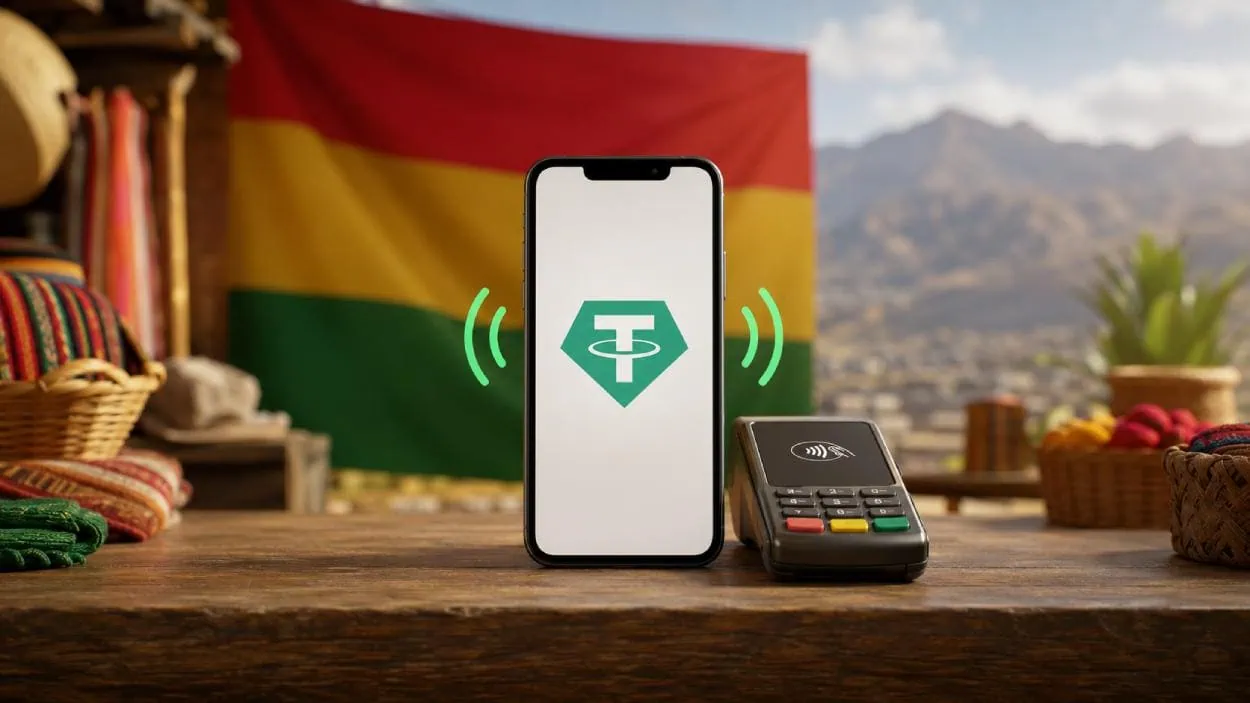






Bolivia’s Economy and Public Finance Minister José Gabriel Espinoza said on Friday, July 10, 2026, that the government is technically evaluating whether Tether’s USDT stablecoin can circulate in the national payment system alongside the US dollar and the boliviano, Bolivia’s currency.
Key Takeaways
- The government, according to Espinoza, is technically studying USDT’s integration into the national payment system, so it circulates like the dollar or the boliviano.
- USDT’s market capitalization has surpassed $184 billion, and Bolivia removed its blanket restrictions on crypto in 2024.
- State-owned Banco Unión added USDT to its Yasta digital wallet on April 29, 2026, and Banco FIE launched a competing crypto account product that same month.
- Espinoza said full adoption still needs a comprehensive regulatory framework, since Bolivia remains on the FATF grey list, per Espinoza’s own framing of the hurdle.
- The plan sits, per Bolivia’s wider strategy under President Rodrigo Paz Pereira, inside a push for banks to eventually offer crypto-based savings accounts, credit cards, and loans.
What Happened?
The notable part isn’t just what Espinoza proposed, but the order: Bolivia is formalizing a privately issued, dollar-pegged stablecoin already used in its economy rather than build a state digital currency first, reversing how sovereigns typically sequence digital money.
Espinoza said the government is working on and technically evaluating the possibility of including USDT in Bolivia’s payment system, so it circulates as another currency, like the dollar, like the boliviano. He made the statement during a public declaration and noted that the country currently only has the lifting of the crypto prohibition, but still lacks a clear and thorough set of rules. Espinoza made the remarks in a video statement posted by El Deber, the original record behind the coverage cited here.
That distinction matters. Digital assets are no longer prohibited in Bolivia, but Espinoza said formal adoption still requires comprehensive regulation before USDT can function as a recognized means of payment rather than a tolerated one. Bolivia’s gap between a lifted ban and a working rulebook.
🇧🇴 LATEST: Bolivia is considering integrating Tether’s USDT into its national payment system as it grapples with ongoing U.S. dollar shortages. pic.twitter.com/5liOEP8Brs
— Cointelegraph (@Cointelegraph) July 13, 2026
Why Bolivia Is Turning to a Dollar-Pegged Token?
USDT use has grown sharply in Bolivia since 2024, when limited access to US dollars pushed more of the economy toward the stablecoin, including for fuel imports and commercial transactions. Espinoza’s proposal follows that pattern rather than starting it, formalizing a channel that already exists instead of building a state alternative from scratch.
That sequencing carries practical stakes. Officials say bringing USDT into the payment system would also help mitigate shortages of foreign currency and improve access to global digital financial markets, alongside everyday payments, cross-border trade, and remittances.
Two banks already sell the token through retail apps. State-owned Banco Unión added USDT to its Yasta electronic wallet on April 29, 2026, and Banco FIE launched its own crypto account product that same month, letting customers buy and sell USDT from its mobile app. Formal integration would put a legal wrapper around a channel banks already operate, since products routinely outrun the rules meant to govern them.
The FATF Grey List Hurdle
Espinoza’s own framing is the caveat. The government said implementation depends on a comprehensive regulatory framework that satisfies international financial supervision requirements, particularly because Bolivia remains on the FATF grey list. FATF (the global anti-money-laundering watchdog) grey-lists countries with acknowledged gaps in tracking illicit finance, and that status invites closer scrutiny of exactly the kind of borderless, pseudonymous-adjacent asset USDT is.
The grey-list status cuts both ways: it is why Bolivia wants a tighter framework, and the same audit burden that will slow how fast supervisors accept it. Building rules that satisfy the FATF while still letting USDT circulate freely is a narrower path than lifting a ban, and it depends heavily on who is actually using the token day to day.

Implications for Bolivia’s Financial System
The initiative forms part of a wider strategy under President Rodrigo Paz Pereira to integrate digital assets into the formal banking sector, beginning with stablecoins, with banks eventually offering crypto-based savings accounts, credit cards, and loans. That order, stablecoins first, credit later, mirrors how dollar-scarce economies re-dollarize: the most liquid instrument first.
A more telling comparison sits outside Bolivia. El Salvador gave Bitcoin legal-tender status in 2021 and later walked the mandate back once volatility made it unworkable for everyday commerce. Bolivia’s dollar-pegged route sidesteps that failure mode, but inherits a different one: dependency on Tether’s own reserve backing, an issuer risk a sovereign currency does not carry.
CoinLaw’s Takeaway
This reads as a dollar shortage economy choosing the path of least resistance: formalizing an already-common workaround gives the state a way to track and tax activity it previously could not fully see, arguably as much a monitoring upgrade as a payments one.
The FATF grey list is the real constraint to watch, not the technology. A government can lift a ban in an afternoon. Building a framework that satisfies international anti-money-laundering standards, while keeping USDT useful enough to solve the dollar shortage it is meant to fix, is a multi-year project, and Bolivia’s timeline for it remains unstated.