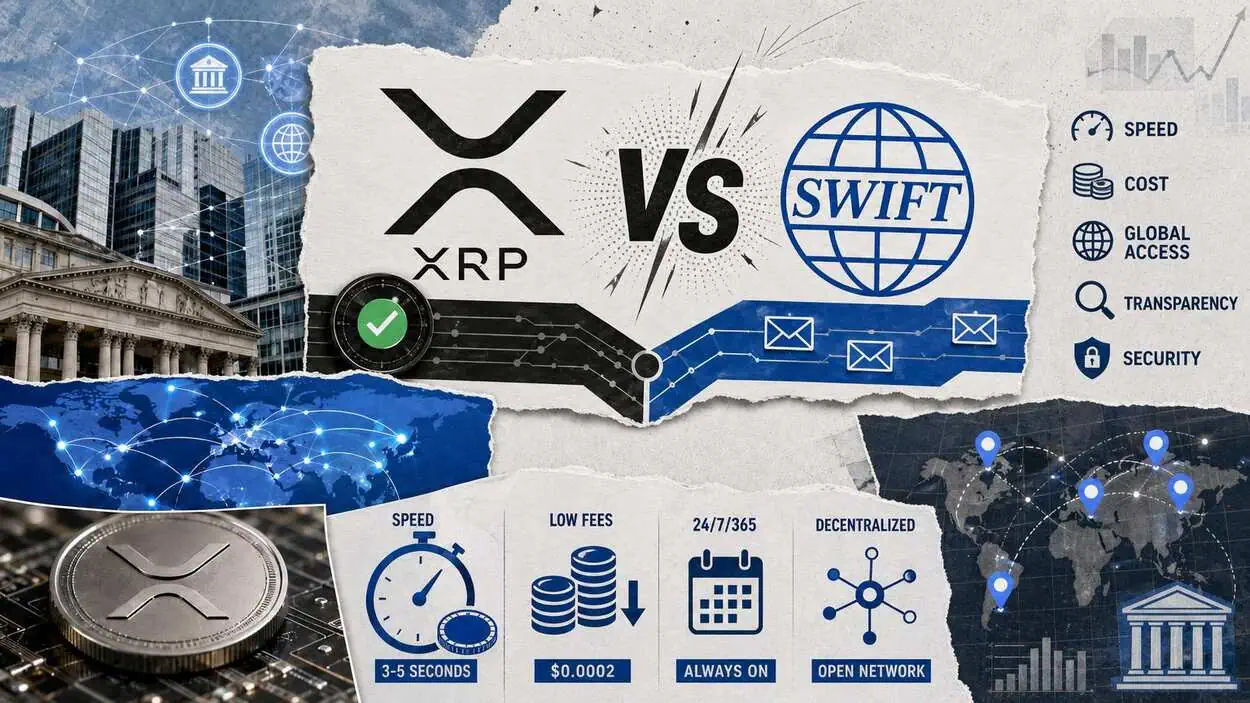






SWIFT carried a total of 15.1 billion messages over its network in 2025, an average of 59.8 million a day. XRPL validators, running an entirely separate system, reach agreement on the order and outcome of XRP transactions every three to five seconds, at a minimum cost of 10 drops for a standard transaction. Most XRP vs. SWIFT statistics stop at that contrast.
Those two numbers measure different layers of the same problem. SWIFT is a messaging network that instructs banks to move money, while XRP is a settlement asset that moves value on a public ledger. A table that skips the distinction manufactures a comparison rather than reporting one, so useful XRP vs. SWIFT statistics hold each metric to the layer it belongs to.
Key Takeaways
- The domestic last mile accounts for 80% of the total processing time in cross-border transactions, which places the delay outside the messaging layer entirely.
- Sending remittances costs a global average of 6.36% of the amount sent, an end-user price rather than a network fee.
- The minimum transaction cost on the XRP Ledger is 10 drops, and 1 million drops equals 1 XRP.
- Swift began design and build work on a blockchain-based shared ledger with more than 30 financial institutions.
- Securities messaging accounted for 7,785 million of Swift’s 2025 FIN traffic against 6,573 million for payments.
- 75% of Swift payments reach destination banks within 10 minutes.
- A $125,035,150 civil penalty against Ripple Labs remains in effect.
Editor’s Choice
- Swift FIN traffic: 15.1 billion messages in 2025, an average of 59.8 million a day.
- Swift connected institutions: over 11,500, spanning more than 200 countries and territories.
- Swift payment routes: over 40,000 active routes reaching over 4 billion accounts.
- XRP Ledger consensus: a new ledger every 4-6 seconds, requiring agreement from 80% of validators.
- XRP genesis supply: 100 billion XRP at creation, with 55 billion placed in escrow in 2017.
- Ripple payout reach: more than 60 markets and over $100 billion in cumulative payments volume, both vendor-reported.
Swift Network Scale
- Over 11,500 institutions connect to the network.
- Coverage spans more than 200 countries and territories.
- The network carries over 40,000 active payment routes.
- Those routes reach over 4 billion accounts.
- Over 235 market infrastructures are connected.
- The equivalent of the world’s GDP flows over SWIFT roughly every three days.
- Total traffic reached 15.1 billion messages in 2025.
- Daily volume averaged 59.8 million messages.
| Swift network measure | 2025 value |
|---|---|
| Institutions connected | over 11,500 |
| Countries and territories | over 200 |
| Active payment routes | over 40,000 |
| Accounts reachable | over 4 billion |
| Market infrastructures connected | over 235 |
| FIN messages sent | over 15.1 billion |
| Average daily FIN messages | 59.8 million |
Source: Swift Annual Review 2025
About This Data
The XRP vs. SWIFT statistics here are compiled from 16 captured primary and official sources. That set is 7 tier-one regulator, network, and court documents and 8 tier-two protocol references. One vendor-reported disclosure is labelled as such wherever it appears.
The publication window spans August 2025 to September 2026, and only primary or official publications qualified. Figures are reviewed on a rolling basis and updated when the underlying sources publish new editions.
Scale is the incumbent’s strongest argument and its weakest one at once. A network of that reach has little reason to swap its settlement layer. It has every reason to defend the routing relationships behind those figures.

Swift FIN Message Volume by Business Segment
- Securities messaging accounted for 7,785 million messages in 2025.
- Payments accounted for 6,573 million messages.
- Treasury traffic reached 698 million messages.
- Trade messaging totalled 28 million.
- System messages totalled 22 million.
- FIN figures include InterAct payment messages resulting from the migration from FIN to ISO 20022.
Payments are a minority of SWIFT traffic by message count, which reframes the replacement question. A settlement asset that handles payments well leaves the larger securities book untouched. That book is the part of the network least exposed to a payments-only competitor.
Recent Developments
- July 2026: SWIFT announced that its blockchain-based ledger is ready for initial use, enabling early adopter financial institutions to support 24/7 cross-border payments with tokenised deposits.
- July 2026: Seventeen banks from six continents are preparing to pilot live transactions on the ledger.
- July 2026: SWIFT designed and built the ledger with feedback from international financial institutions in just nine months.
- September 2025: SWIFT began work with more than 30 financial institutions globally to design and build the shared ledger.
- August 2025: The Securities and Exchange Commission filed a Joint Stipulation of Dismissal resolving its civil enforcement action against Ripple Labs, Bradley Garlinghouse and Christian A. Larsen.
- 2025: The coexistence period between MT and ISO 20022 format messages for cross-border payments ended, with over 97% of messages over the SWIFT network now sent in the ISO 20022 format.
XRP vs. SWIFT Statistics: Settlement Speed and Payment Delivery
- XRPL validators reach agreement on the order and outcome of XRP transactions every three to five seconds.
- The consensus process takes 4-6 seconds and starts a new ledger once 80% of validators agree on a set of transactions.
- Over 120 validators are active on the ledger, operated by universities, exchanges, businesses, and individuals.
- 75% of SWIFT payments reach destination banks within 10 minutes.
- 86% of all SWIFT payments are conducted directly or with a single intermediary.
- Any transaction that follows the protocol is confirmed right away, with every server applying the same rules.
| Measure | XRP Ledger | Swift |
|---|---|---|
| Settlement or delivery interval | Agreement every three to five seconds | 75% reach destination banks within 10 minutes |
| Ledger close cycle | 4-6 seconds | not applicable |
| Agreement threshold | 80% of validators | not applicable |
| Routing hops | single shared ledger | 86% direct or one intermediary |
Source: XRP Ledger documentation 2026, Swift Annual Review 2025
The two intervals do not measure the same event. A ledger close is finality on one network. A Swift payment reaching the destination bank still leaves a domestic credit leg outstanding. The ledger-level XRP activity data is where that gap shows up.
Cross-Border Payment Costs Against the G20 Targets
- Sending remittances costs a global average of 6.36% of the amount sent.
- The retail target sets a global average cost of no more than 1%, with no corridors above 3% by end-2027.
- The remittance target reaffirms the UN SDG goal of no more than 3% on a $200 transfer by 2030, with no corridors above 5%.
- No cost target is set for wholesale cross-border payments.
- 75% of cross-border wholesale payments are to be credited within one hour of payment initiation by end-2027.
- Cutting prices by at least 5 percentage points can save up to $16 billion a year.
- The domestic last mile accounts for 80% of the total processing time in cross-border transactions.
By the numbers: The global average cost of sending a remittance is 6.36% of the amount sent, against a remittance target of no more than 3% on a $200 transfer by 2030. The observed average runs more than twice the remittance target.
Neither network is normally scored against these thresholds, which is what makes them useful. The observed average is a retail price built from foreign exchange margin, payout, and compliance work.
XRP Ledger Transaction Cost Mechanics
- The current minimum transaction cost required by the network for a standard transaction is 10 drops.
- XRP is specified as an integer number of drops, where 1 million drops equals 1 XRP.
- Each transaction must destroy a small amount of XRP to protect the ledger from spam and denial-of-service attacks.
- The transaction cost is designed to increase along with the load on the network.
- The cost sometimes increases due to higher-than-usual load.
- Only certain protocol fields accept XRP specifically, including the Fee field that carries the transaction cost.
| Cost mechanic | XRP Ledger behaviour |
|---|---|
| Minimum cost, standard transaction | 10 drops |
| Drop-to-XRP ratio | 1 million drops equals 1 XRP |
| Fee handling | destroyed by the transaction |
| Behaviour under load | increases along with network load |
Source: XRP Ledger documentation 2026
A burned anti-spam fee and a remittance price are different objects. Setting the 10-drop minimum beside the 6.36% average is the most repeated error in this comparison. One is what a network charges to accept an instruction. The other is what a customer pays to move money and have cash handed over at the far end.
Swift’s Blockchain Shared Ledger Programme
- Swift announced on 29 September 2025 that it will add a blockchain-based shared ledger to its technology infrastructure.
- More than 30 financial institutions globally began design and build work on the ledger.
- The first use case is real-time 24/7 cross-border payments, starting with a conceptual prototype by ConsenSys.
- Financial institutions from 16 countries are providing Swift feedback on the design of the ledger.
- The ledger will record, sequence, and validate transactions and enforce rules through smart contracts.
| Programme attribute | Detail |
|---|---|
| Announced | 29 September 2025 |
| Institutions designing and building | more than 30 |
| Countries providing design feedback | 16 |
| Prototype partner | Consensys |
| First use case | real-time 24/7 cross-border payments |
| Ready for initial use | 9 July 2026 |
| Banks preparing to pilot live transactions | Seventeen, across six continents |
| Design and build duration | nine months |
Source: Swift press releases, September 2025 and July 2026
Why it matters: Seventeen banks from six continents are preparing to pilot live transactions on Swift’s blockchain-based ledger, which the network says is ready for initial use. The design moves record-keeping onto a distributed ledger without adopting an outside settlement asset. That answers the displacement question from the incumbent’s own side, not a vendor’s.
Absorbing a technology is a different outcome from being replaced by it. The programme keeps the routing relationships, compliance perimeter and institution list intact while moving the record onto a ledger. Most blockchain-based payment rollouts inside regulated institutions have followed that pattern.
With our new ledger capability, we’re extending the trust and stability of established finance into the frontiers of digital money.
Thierry Chilosi, Chief Business Officer at Swift
Swift Traffic Growth Rates by Segment
- Swift traffic volume experienced record growth of 12% in 2025.
- Payments volume recorded an 8.9% increase in both instructions and reporting flows.
- Securities recorded double-digit growth of 14.7%.
- Payments growth is driven by improving macro trends, in particular international trade growth, as well as business gains.
- Historical figures have been adjusted to keep the FIN comparison like-for-like after the ISO 20022 migration.
Growth concentrates in the part of the network a payments-focused settlement asset does not touch. That widens the functional distance between the two systems rather than narrowing it, whatever happens to payment volumes next.
Swift Delivery Speed and Standards Performance
- 75% of SWIFT payments reach destination banks within 10 minutes.
- 86% of all SWIFT payments are conducted directly or with a single intermediary.
- Over 97% of messages over the SWIFT network are now sent in the ISO 20022 format.
- The coexistence period between MT and ISO 20022 format messages for cross-border payments has ended.
- Over 580 business continuity exercises were completed successfully.
- The domestic last mile accounts for 80% of the total processing time in cross-border transactions.
That single figure is the ceiling on the whole delivery picture. The table below breaks the same 2025 window into the four throughput and standards measures behind it.
| Swift performance measure | 2025 result |
|---|---|
| Payments reaching destination banks within 10 minutes | 75% |
| Payments routed directly or via a single intermediary | 86% |
| Messages sent in the ISO 20022 format | over 97% |
| Business continuity exercises completed successfully | over 580 |
Source: Swift Annual Review 2025
Structured data and single-hop routing are messaging-layer wins, and the network has largely banked them. What remains is a domestic settlement problem outside the perimeter of any messaging standard. Compliance regimes such as the FATF travel-rule framework shape corridor timing more than transport speed does.
World Bank Remittance Corridor Coverage
- The remittance price series covers 367 country corridors worldwide.
- Coverage starts from 48 remittance sending countries.
- Those corridors terminate in 105 receiving countries.
- The data covers the cost of sending and receiving relatively small amounts of money from one country to another.
- The 6.36% global average is used to monitor progress of the global effort for reduction of remittance prices.
- Cutting prices by at least 5 percentage points can save up to $16 billion a year.
Corridor count is the scale any settlement asset would have to match before displacement becomes a serious proposition. The tracked set is not the whole market, but it is the reference series most global remittance volume data is benchmarked against.
The corridor spread also explains why a single average misleads. A single headline figure hides the corridors where cost sits far above the mean. Those are the routes a cheaper rail would change first.
XRP Supply and Escrow Milestones
- The XRP Ledger was built from 2011 to early 2012 by Jed McCaleb, Arthur Britto and David Schwartz.
- At the time of its creation, there were 100 billion XRP.
- In September 2012, Jed and Arthur, along with Chris Larsen, formed Ripple and decided to gift 80 billion XRP to the company in exchange for developing on the XRP Ledger.
- In 2017, the company placed 55 billion XRP in escrow.
- The company has regularly sold XRP, used it to strengthen XRP markets and improve network liquidity, and incentivized development of the greater ecosystem.
Supply structure is the axis on which XRP diverges most sharply from the other large-cap public networks tracked in the Bitcoin and Ethereum datasets. A fixed genesis allocation held partly in escrow raises governance questions a messaging cooperative never has to answer. Those questions shape institutional appetite more than throughput does.
Network Reach by Country, Market Infrastructure and Payout Market
- Swift coverage spans more than 200 countries and territories.
- Over 235 market infrastructures connect to the network.
- Over 11,500 institutions are connected.
- Ripple Payments reports last-mile rails across more than 60 markets.
- The same network has processed over $100 billion in payments volume, according to the company’s own product page.
- Ripple Payments executes first-party and third-party payouts in fiat or stablecoin through a single integration.
| Reach measure | Swift | Ripple Payments |
|---|---|---|
| Countries or markets | over 200 countries and territories | more than 60 payout markets |
| Connected institutions | over 11,500 | not disclosed |
| Market infrastructures | over 235 | not applicable |
| Cumulative payments volume | not disclosed | over $100 billion, vendor-reported |
Source: Swift Annual Review 2025, Ripple product page 2026
Worth noting: The payout-market count and the cumulative volume figure both come from Ripple’s own product page. Neither is audited, broken out by corridor, or backed by a published methodology. They belong in a different evidentiary tier from a network’s annual review.
The two reach figures are not held to the same standard. Swift’s counts come from a published annual review. The payout and volume numbers are vendor claims of the kind common across the DeFi and payments-infrastructure sectors.
Are Banks Using XRP or Ripple?
More than 30 financial institutions are working with SWIFT on the design and build of its blockchain-based shared ledger, while Ripple Payments reports last-mile rails across more than 60 markets without naming counterparties. Bank participation is named and documented on one side and self-reported on the other, so the two counts are not comparable evidence of adoption.
Ripple’s Regulatory Position After the SEC Case
- Litigation Release No. 26369 is dated Aug. 7, 2025.
- The Securities and Exchange Commission filed a Joint Stipulation of Dismissal with Ripple Labs, Bradley Garlinghouse, and Christian A. Larsen.
- The stipulation dismisses the Commission’s appeal and Ripple’s cross-appeal pending in the United States Court of Appeals for the Second Circuit.
- The district court’s final judgment imposed a $125,035,150 civil penalty against Ripple.
- The judgment includes an injunction prohibiting Ripple from violating the registration provisions of the Securities Act of 1933.
- Following the dismissal of the cross-appeals, that final judgment will remain in effect.
- The case was filed in S.D.N.Y. on Dec. 22, 2020 as Case No. 1:20-cv-10832.
| Case outcome | Detail |
|---|---|
| Litigation release | 26369, dated August 7 2025 |
| Case filed | December 22 2020, S.D.N.Y., case 1:20-cv-10832 |
| Civil penalty | $125,035,150 |
| Appeals | Commission appeal and Ripple cross-appeal dismissed |
| Injunction | remains in effect under the Securities Act of 1933 |
Source: SEC Litigation Release 26369, August 2025
Legal certainty removes a blocker without creating demand. The penalty and the injunction both survive the dismissal, which is why the open question for Ripple is now commercial rather than existential.
Cross-Border Settlement Timeline: XRP Ledger and Swift
- The XRP Ledger was built from 2011 to early 2012, and Ripple was formed in September 2012 with 80 billion XRP allocated to the company.
- In 2017, the company placed 55 billion XRP in escrow.
- The Securities and Exchange Commission filed its civil enforcement action against Ripple Labs on Dec. 22, 2020.
- Swift announced its blockchain-based shared ledger on 29 September 2025.
- Swift announced on 9 July 2026 that the ledger is ready for initial use, with seventeen banks preparing to pilot live transactions.
The chronology explains why the comparison keeps resetting. One side spent the middle of that decade resolving its legal position. The other spent the end of it rebuilding its rails, so the two have never been measured against each other in a settled state.
How Likely Is XRP to Replace Swift?
Replacement is not the shape the evidence takes. The domestic last mile accounts for 80% of the total processing time in cross-border transactions, a result of factors such as regulatory requirements, capital controls and industry processing practices. None of those constraints change when the settlement asset changes, because they sit inside national clearing systems rather than in the message that instructs them.
Swift traffic recorded growth of 12% to a total of 15.1 billion messages in 2025, and the network has started design work on a blockchain-based shared ledger with more than 30 financial institutions. A network growing and rebuilding at the same time is not one being displaced, though it is clearly one being pushed to change.
Will Swift Use XRP?
Swift’s focus is on the infrastructure, and the types of tokens that will be exchanged on the ledger are the territory of commercial and central banks. Swift will work with those banks on how to complement and make use of the new infrastructure. No public statement in the announcement names any specific asset, so token selection has been deferred to the institutions that issue them.
That framing narrows the realistic candidates. Tokenised deposits and CBDC pilots already sit inside the regulated perimeter the design assumes. That is a lower hurdle than admitting an externally issued asset.
Conclusion
Swift moved a total of 15.1 billion messages at an average of 59.8 million a day, while XRPL validators reached agreement on the order and outcome of XRP transactions every three to five seconds. The XRP vs. SWIFT statistics above are each accurate, and neither settles the comparison. They describe a messaging layer and a settlement layer that no single table can honestly merge.
The measure that does travel between them is where the time goes. With 80% of total cross-border processing time sitting in the domestic last mile, the binding constraint is national clearing infrastructure rather than the rail carrying the instruction. Institutions weighing either system will find the decision turns on regulatory perimeter and payout reach, not on seconds saved in transit.