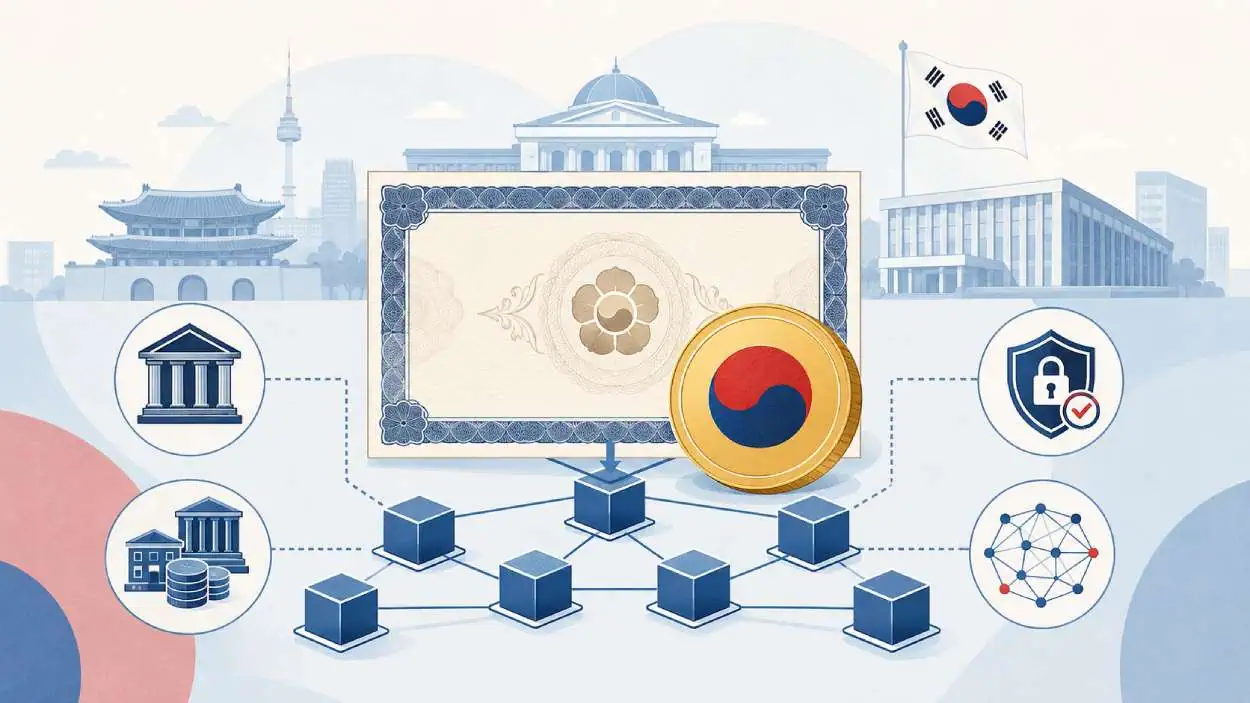






South Korea’s government detailed a 2027 pilot to test tokenized government bonds on the Bank of Korea’s wholesale central bank digital currency (CBDC) platform, part of a growth strategy unveiled July 14, 2026.
Key Takeaways
- South Korea’s government scheduled a 2027 pilot testing tokenized government bonds on the Bank of Korea’s wholesale CBDC platform.
- The Bank of Korea will study interoperability between its CBDC infrastructure and external blockchain networks, though officials have not named participants or scale.
- Distributed ledgers will become official securities registries starting in February 2027, according to South Korea’s Ministry of Economy and Finance, permitting regulated tokenized stocks, bonds, and money-market products.
- The pending Digital Asset Basic Act will set legal standards for won-backed stablecoins and cross-border digital asset transactions.
- The Ministry of Economy and Finance will separately test tokenized bank deposits for government spending in Sejong during the fourth quarter of 2026.
What Happened?
South Korea’s Ministry of Economy and Finance built the bond tokenization pilot into its 2026 Economic Growth Strategy for the Second Half, the same package that raised the country’s 2026 growth forecast from 2% to 3% on a semiconductor export boom. The pilot targets the Bank of Korea’s wholesale central bank digital currency (CBDC) platform, a permissioned rail distinct from the public Decentralized Finance markets built for retail trading, per Bank of Korea.
Authorities will, per Seoul’s growth strategy, study interoperability between the Bank of Korea’s CBDC infrastructure and external blockchain networks worldwide. Officials have not identified which government bonds, participating institutions, or blockchain platforms the trial will use, and have not said whether it covers issuance, secondary trading, or settlement alone.
BREAKING: South Korea will test tokenized government bonds linked to the Bank of Korea’s wholesale CBDC system in 2027.
— MSB Intel (@MSBIntel) July 14, 2026
The pilot will launch as token securities rules take effect in February 2027. pic.twitter.com/Ww4bWe0hX0
The Blockchain Reform Package Behind the Pilot
Regulators are separately finishing the Digital Asset Basic Act, legislation that will establish legal standards for digital asset businesses and Korean won-backed stablecoins while preparing rules for cross-border stablecoin transactions. The same reform push recognizes distributed ledgers as official securities registries from February 2027, the change that lets the government permit regulated issuance and circulation of tokenized stocks, bonds, and money market products well beyond the bond pilot itself.
The Ministry of Economy and Finance also plans a fourth quarter pilot spending tokenized bank deposits in Sejong, a smaller test that runs on ordinary commercial bank money rather than a central bank liability. Running both trials at once lets Seoul compare a state money settlement rail against a bank money one before it commits either to the bond market at scale.
We cannot afford to be complacent about the current upswing, said Koo Yun-cheol, Deputy Prime Minister and Finance Minister of South Korea, describing the same semiconductor driven expansion the tokenization pilot rides alongside. The bond pilot reads as one line inside a much larger industrial bet, not a standalone crypto initiative.
The Legal Stakes of Tokenizing Sovereign Debt
The February 2027 securities registry change is the real legal hinge, not the pilot itself. It lets exchanges, custodians, and issuers treat a blockchain record as the authoritative ownership record for a security, the function a central securities depository performs today. That is what turns a “tokenized bond” from a marketing label into a legally enforceable claim, and it is why the registry amendment will outlast any single 2027 trial.
South Korea is also running two legal tracks toward the same settlement layer. The Digital Asset Basic Act will set legal standards for Korean won-backed stablecoins, a privately issued liability, while the bond pilot runs on the Bank of Korea’s wholesale CBDC, a direct central bank liability. Settling a government bond against stablecoin money and settling it against central bank digital currency carry different finality guarantees, and writing both rulebooks at once suggests regulators have not yet picked one architecture over the other.
Bank of Korea Governor Hyun Song Shin has called government bonds the “big prize” for tokenization and proposed placing tokenized bonds, wholesale central bank money, and tokenized commercial bank deposits on a single ledger as an extension of Project Hangang.
The central bank has separately warned that faster continuous settlement could transmit market stress more quickly and create risks tied to smart contracts, liquidity management, and reliance on data oracles, and noted that the Project Hangang ledger and the current payment system do not yet operate together in real time. Those settlement finality questions sit on top of the ownership question the registry rule settles separately, and they echo the same debate playing out wherever a government studies putting its own sovereign debt on a ledger.

CoinLaw’s Takeaway
The real story is the timetable, not the pilot’s size. South Korea turned sovereign debt tokenization from a research idea into a dated government commitment, paired with the legal change that actually makes a tokenized bond enforceable: the securities-registry rule due in February 2027. Without that legal backing, the 2027 test would be a mere technology demo instead of a dry run for a market structure regulators plan to make permanent.
The bigger open question is architecture, not timing. Running the bond pilot on central bank money while separate legislation builds out won-backed stablecoins leaves unresolved which liability actually settles a regulated tokenized security, and the Bank of Korea’s own flagged risks, settlement stress, smart contracts, oracle reliance, read like a checklist other central banks will study first. South Korea’s single 2027 timetable for CBDC, stablecoins, and tokenized securities is still more legally coherent than the fragmented, agency-by-agency path United States regulators have taken.