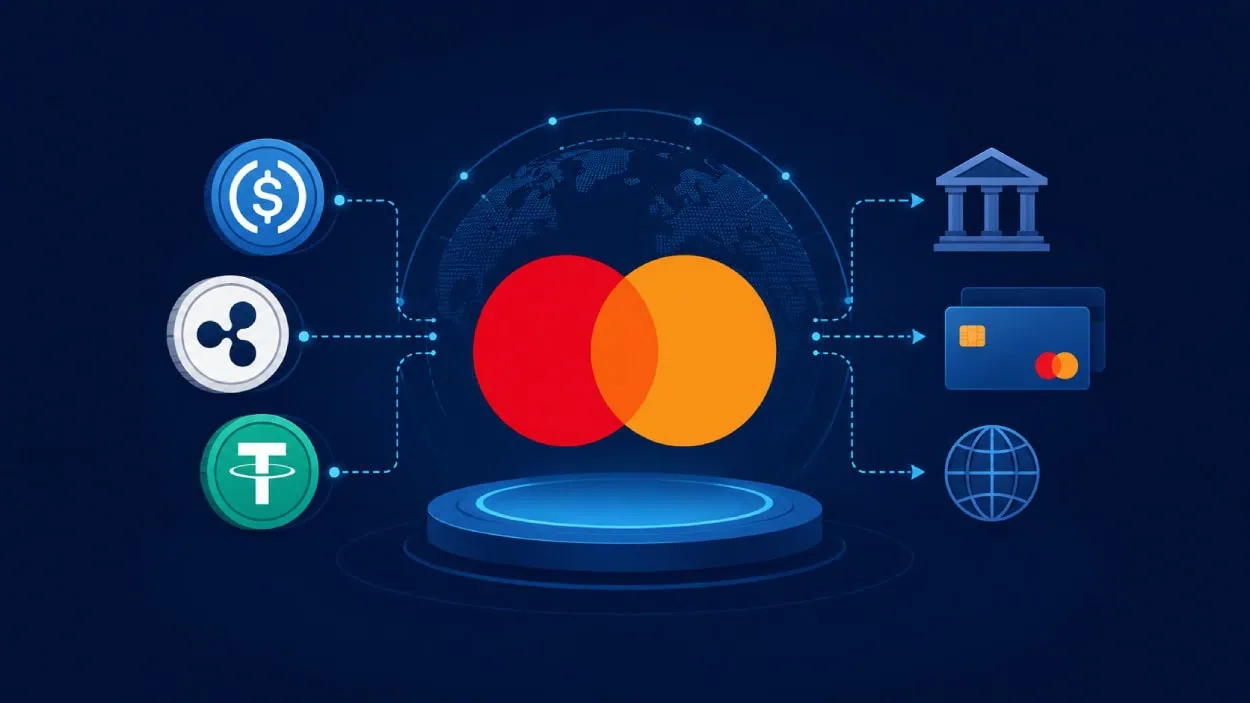






Mastercard is expanding its settlement infrastructure to support regulated stablecoins, allowing partners to settle transactions using digital assets such as USDC and RLUSD alongside traditional payment methods.
Key Takeaways
- Mastercard is adding support for settlement using regulated stablecoins including USDC, RLUSD, PYUSD, USDG, USDP, and SoFiUSD.
- The company is introducing intraday, weekend, and holiday settlement capabilities across its network.
- Initial support will be available through partners in the United States and Latin America, with broader expansion planned through 2026.
- The move is designed to improve liquidity management, cross border payments, treasury operations, and global payouts.
What Happened?
Mastercard announced an expansion of its global settlement capabilities, enabling issuers and acquirers to settle transactions using regulated stablecoins across supported blockchain networks. The initiative builds on the company’s earlier stablecoin pilots and live deployments and marks another step in bringing digital assets into mainstream payment infrastructure.
The payments giant said the enhanced settlement options will operate alongside existing fiat based processes, giving partners greater flexibility in managing liquidity and settlement timing in an increasingly digital and always on economy.
NEW: @Mastercard expands settlement to support regulated stablecoins including $USDC, $RLUSD and $PYUSD across Ethereum, Solana, Base, Arbitrum and XRPL. pic.twitter.com/2kYqCRcziK
— CoinDesk (@CoinDesk) June 3, 2026
Mastercard Expands Stablecoin Settlement Options
As part of the rollout, Mastercard will support settlement using several regulated stablecoins. These include Circle’s USDC, Ripple’s RLUSD, PayPal’s PYUSD, as well as USDG, USDP, and SoFiUSD.
The stablecoins will be supported across multiple blockchain networks, including Ethereum, Solana, Polygon, Arbitrum, Base, Canton, Tempo, and XRPL.
According to Mastercard, the expansion is intended to provide institutions with additional flexibility while preserving the security standards, fraud protections, and dispute resolution processes already built into its global payments network.
New Settlement Windows Aim to Improve Liquidity
A major component of the announcement is the introduction of intraday, weekend, and holiday settlement capabilities.
Traditionally, many settlement processes are tied to banking hours and business days. By extending settlement availability, Mastercard aims to help partners move funds more efficiently and manage liquidity in real time.
The company said the new capabilities are particularly relevant for:
- Cross-border payments
- Treasury operations
- Global payouts
- Liquidity management
- Always on payment services
Raj Dhamodharan, executive vice president, Blockchain & Digital Assets at Mastercard, said:

Initial Partners and Expansion Plans
Mastercard said ARQ, formerly known as DolarApp, along with CBW Bank, Cross River, Lead Bank, and Nuvei, are expected to be among the first organizations supporting stablecoin settlement options.
The initial rollout will focus on the United States and Latin America, with additional regions, partners, and regulated stablecoins expected to join the network over time, subject to regulatory approvals.
Circle Chief Commercial Officer Kash Razzaghi highlighted growing demand for payment infrastructure that can function beyond traditional banking hours. Razzaghi said:
Mastercard Deepens Its Stablecoin Strategy
The latest announcement further strengthens Mastercard’s broader push into blockchain and digital assets.
The settlement expansion follows the company’s earlier stablecoin pilots involving USDC and comes shortly after Mastercard’s reported $1.8 billion acquisition of stablecoin infrastructure provider BVNK. Industry observers have also pointed to Mastercard’s recent BitLicense approval from the New York State Department of Financial Services, which could provide greater flexibility in supporting multiple regulated stablecoins directly.
By allowing traditional and blockchain-based settlement to operate through the same infrastructure, Mastercard is positioning itself to support both conventional finance and emerging digital asset ecosystems without requiring partners to overhaul existing systems.
CoinLaw’s Takeaway
In my experience, one of the biggest obstacles preventing stablecoins from moving beyond speculation has been the lack of real payment infrastructure supporting them at scale. I found Mastercard’s latest move significant because it focuses on a practical use case that financial institutions care about: settlement.
Supporting major stablecoins such as USDC and RLUSD while enabling weekend and intraday settlement shows that blockchain technology is increasingly being integrated into existing financial systems rather than competing against them. If adoption continues to grow, this could become one of the most meaningful real world uses of stablecoins in global payments.