

• Skip to primary navigation
  • Skip to main content
  • Skip to primary sidebar
  • Skip to footer
CoinLaw LogoCoinLaw

Bringing Crypto and Finance Closer to You

  • Latest News
  • Statistics
  • About
  • Contact
Subscribe
CoinLaw Logo
  • Latest News
  • Statistics
  • About
  • Contact
Subscribe
Home » Cryptocurrency

Market Timing vs. DCA: Choosing Your Bitcoin Entry Strategy

Published on: December 2025 • Last Updated: January 29, 2026
Kathleen Kinder
Written By
Kathleen Kinder
Kathleen Kinder
Senior Editor • 1,705 Articles
Kathleen Kinder brings over 11 years of experience in the research industry, with deep expertise in finance, cryptocurrency, and insurance. ... See full bio
LATEST POSTS:
Best Solana Token Distribution Platform in 2026: Streamflow Review
Morpho Raises $175M at $2B Value as MORPHO Token Jumps
South Korea Taps Chainalysis to Tackle Crypto Crime
Market Timing Vs Dca 1
As Featured In
FortuneYahoo! FinanceCoinDeskSeeking AlphaCoin Market Cap
Share on LinkedIn ChatGPT Perplexity Share on X Share on Facebook

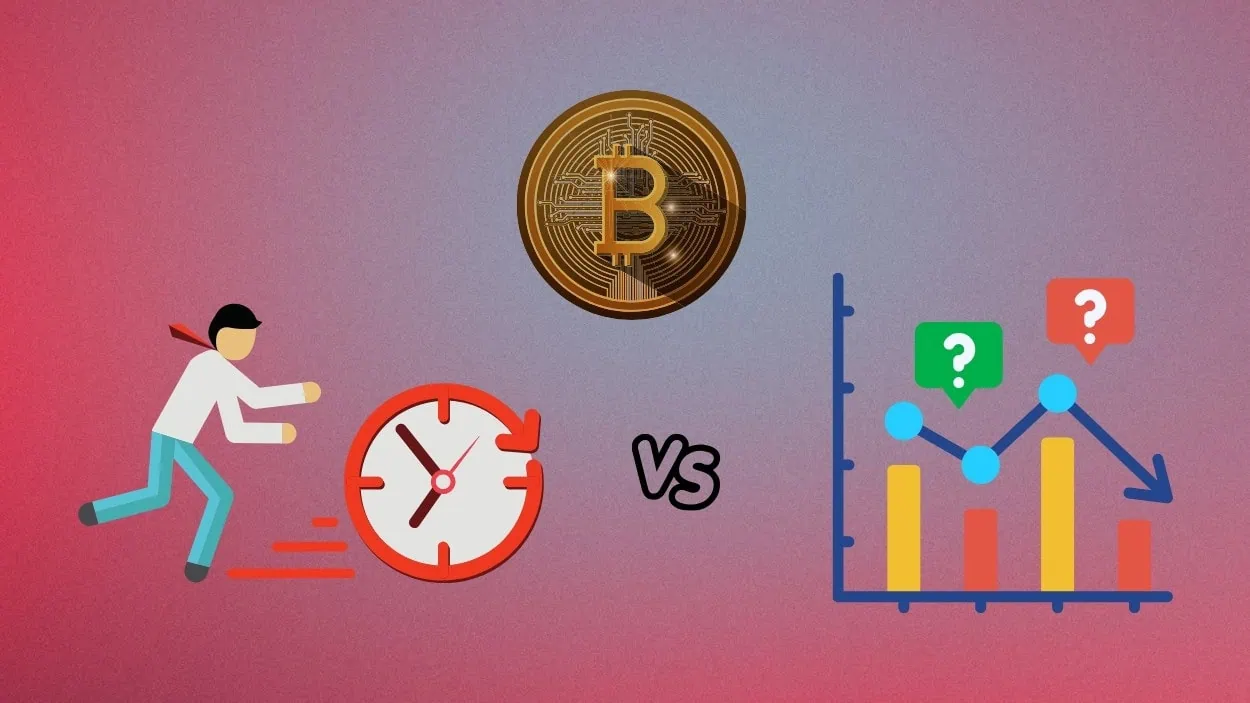
DCA fits most busy investors; timing works only when you have an edge, a plan, and the stomach for swings. For many people, adding Bitcoin to their portfolio begins with understanding these two approaches and deciding which one matches their schedule, temperament, and risk tolerance, not just which one looks best in hindsight.

What they are:

  • Timing: deploying a lump sum when you believe the price is favorable, such as buying BTC after macro events, CPI prints, or major protocol upgrades.
  • DCA (dollar-cost averaging): investing a fixed amount on a recurring schedule (e.g., $100/week on Coinbase or Cash App), regardless of current price.

Why DCA often shines:

  • Volatility is unforgiving: Bitcoin has seen four drawdowns greater than 70% (2011, 2014, 2018, 2022). Ethereum once fell by 94%. DCA spreads entries and reduces emotional regret.
  • Time generally beats precision: Vanguard found that lump sum outperforms DCA 66% of the time in equities, but Bitcoin’s higher volatility (often 60–80% annualized) increases the risk of entering at the worst moments.
  • Example: $100/week into BTC from Jan 2019 to Dec 2023 ($26k invested) results in 1.3 BTC. At $42k (12/31/23), that’s $54k, about +108%, without needing to “call” a bottom.

When timing can shine:

  • Major catalysts or structural shifts: ETF approvals, The Merge, or central bank pivots.
  • Clear rules: position sizing, stop-losses, tax planning (harvesting losses, using IRAs).
  • Ability to act decisively, not reactively.

If you work long weeks, have life responsibilities, or simply don’t enjoy market-watching, DCA provides psychological freedom. It compounds steadily into Bitcoin, Ethereum, Solana, or broader web3 exposure, without relying on luck, panic, or perfect calls.

Bitcoin’s Return/Drawdown Profile You’re Actually Betting On

The bet is asymmetric upside paired with deep, recurring drawdowns. Since 2015, Bitcoin rose from $250 to $65k–$70k (roughly 70–80% CAGR), yet has experienced multiple crashes of −77% to −85%. Short-term volatility commonly sits around 60–100%. The question is not just whether you believe long-term growth continues, it’s whether your budget and nerves can tolerate long periods of pain along the way.

Even with the volatility, risk-adjusted returns have often surpassed the S&P 500 and gold, though correlations with tech stocks can spike during market stress. Bitcoin diversifies until the macro tide forces everything to move together. Supply is fixed and predictable: the April 2024 halving reduced issuance to 0.8% annual inflation, lower than gold. Demand has institutional support, with U.S. spot ETFs (IBIT, FBTC) pulling in tens of billions since launch.

The sustainable approach is small sizing (1–5%), rules-based rebalancing, and a multi-year horizon that expects occasional −50% drawdowns. Survivability is the real edge. Mining’s renewable share is rising, but environmental debates remain and should be taken seriously.

Newsletter Img
Don't chase the news. Let us curate it.

You get one weekly briefing with only the stories that matter. If the market is quiet, we skip it.

✅ Join readers from Visa, Vanguard, and the FDIC.

Evidence Check: Backtests and Real-World ROI

Backtests and live results point to a clear takeaway: a small, rules-based crypto slice can lift portfolio returns without blowing up risk, if you size it right and rebalance.

  • Numbers first. Bitcoin’s 10-year CAGR since 2015 sits near 70%, but with brutal drawdowns of −80%+. Ethereum’s lifetime CAGR is higher, with 90%+ drawdowns. Solana ran from <$1 (2020) to $150 (2025), yet fell −95% in 2022. Volatility is the toll.
  • Portfolio math. A 60/40 portfolio with a 5% Bitcoin sleeve (rebalanced quarterly, 2014–2024) improved annualized returns from roughly 6–7% to 8–9% and lifted the Sharpe ratio from 0.5 to 0.7, with max drawdown near unchanged (≈−32% to −34%), per Bitwise and NYDIG backtests. Small slice. Big impact.
  • Real-world ROI. Post-spot Bitcoin ETF approvals (BlackRock iShares IBIT, Fidelity FBTC) in Jan 2024, BTC roughly doubled into 2025, while fees compressed to 0.20–0.25%. Lower friction. Higher access via Coinbase and Robinhood, think adding BTC like you add a new streaming bundle.
  • Dollar-cost averaging? If you’d DCA’d $50/week into BTC since 2020, you’d be solidly positive by 2025 despite the 2022 crash, yet your path would include multi-month drawdowns >50%. Can your budget handle that?
  • Skeptic’s corner. Backtests are not destiny. Reg shifts, smart-contract bugs (DeFi, NFTs), and chain outages (Solana 2022) are real. Energy? The Bitcoin Mining Council estimates a 59% sustainable power mix in 2023, improving, but contested.
  • Freedom lens: a 1–5% crypto sleeve is an optionality bet, like testing a new app feature, not rewriting your entire financial stack.
Backtests And Real World Roi

Behavioral Traps That Derail Either Strategy

Most investors lose more to their own reactions than to market conditions or strategy choice. FOMO drives chasing hype, especially when social feeds pump memes or microcaps. But crypto regularly experiences 30–60% pullbacks, and Bitcoin has fallen 77% (2022) and 83% (2018). If you can’t hold through a weekend dip, chasing green candles almost guarantees buying high and selling low.

Overtrading is another trap. The dopamine loop of alerts and group chats encourages constant tinkering. Research shows frequent traders underperform due to slippage, taxes, and poor timing, even when fees seem low.

Loss aversion makes declines feel twice as painful as gains. Anchoring to the last all-time high leads to freezing, refusing to rebalance, or abandoning a plan entirely when timing goes wrong, especially with lump-sum entries. Leverage magnifies everything. With 50–100x perpetuals, a 1% move can liquidate positions instantly; crypto has seen multi-billion dollar wipeouts in single days. Borrowing for “freedom” often ends in forced exits.

Finally, scattered accounts create hidden risk. Managing positions across multiple exchanges and wallets without a single view makes exposure hard to control. Discipline comes from one consolidated dashboard and the rules you actually follow.

Building a DCA Plan Around Your Cash Flow

Set your DCA to match your paycheck rhythm and fixed bills, automate buys right after essentials are covered, and cap crypto to a % you can ignore in a bad month.

  1. Start with a cash map: Fixed costs (rent, loans, transit, insurance, groceries, subscriptions) usually run 50–60% for many 25–34-year-olds, per BLS spending data. Aim to keep DCA within 5–15% of take-home after building a 3–6 month emergency fund. No cushion? Go 1–3% to start.
  2. Tie DCA to payroll: Paid biweekly? Schedule recurring buys the same day via Coinbase Recurring, Cash App Auto Invest, or Fidelity Crypto. Small, steady tickets, $25–$150 per cycle, beat heroic lump sums when life happens.
  3. Audit the “app drip”: Cancel 2–3 low-value subs (that $9.99 cloud, duplicate streaming, and an unused game pass). Freeing $30/month funds an extra $360/year in DCA.
  4. Side income: flex DCA. Got DoorDash weekends, TikTok UGC, or freelance? Route 10–20% of variable income to a “bonus DCA” bucket only after taxes are set aside (IRS safe harbor: 90% of current-year tax or 100–110% of last year).
  5. Control friction: Fees compound: Cash App 0.5–1.75%, Coinbase 0.6% maker/taker on Advanced Trade, Binance.US 0–0.4%. Prefer lower-fee tiers and batch fewer, slightly larger buys.
  6. Reduce anxiety: Volatility is real, BTC has posted 30–80% drawdowns; DCA historically cuts timing risk and variance (Morningstar notes DCA reduces regret, though not expected return).
  7. Values check: Want greener exposure? Ethereum’s post-Merge energy use fell 99.95% (Ethereum Foundation).

Timing Frameworks That Aren’t Just Guesswork

Use simple, observable signals instead of gut feelings. Start with the macro calendar. CPI, FOMC, and payrolls are scheduled for volatility. When markets expect easing, high-beta assets (BTC, SOL, smaller DeFi) often bid; when inflation runs hot, tighten exposure.

  • Check liquidity: Expanding stablecoin supply and positive global M2 growth have historically aligned with crypto uptrends. Contracting liquidity usually means headwinds.
  • Watch on-chain momentum: Rising 30-day active addresses, fees, and unique senders often precede short-term strength. Tools like Nansen or Messari help. MVRV extremes highlight overheated or washed-out conditions. Track flows. Spot BTC ETF net inflows are a straightforward tailwind; persistent outflows mean caution.
  • Monitor positioning: Elevated perp funding and high open interest relative to market size signal froth; rich futures basis suggests taking profits or hedging.

Finally, look at real usage. Sustained Uniswap volume, growing Solana transactions with low fees, or improving app store rankings point to active demand. But sudden Google Trends spikes often indicate late-cycle hype. The goal isn’t calling tops, it’s avoiding exit liquidity.

Hybrid Approaches That Balance Discipline and Opportunity

Blend a rules-based core with a small, high-conviction satellite to capture upside without losing sleep. 

  • Core: 70–85% in BTC and ETH (together 70% of crypto market cap; BTC dominance 50–55%, ETH 16–18%). Dollar‑cost average weekly. ETH’s switch to proof‑of‑stake cut energy use by 99.95% (Ethereum Foundation), if sustainability matters. 
  • Satellite: 15–30% in themes with catalysts, Solana (high‑throughput apps), EigenLayer/restaking, DeFi blue chips (Aave, Lido), gaming (Immutable, Ronin), or real‑world assets (Ondo’s USDY, BlackRock’s BUIDL). Set position sizes (1–3% each). Missed the last SOL run? This keeps the optionality for the next.

Automate discipline, leave room for shots. Use Coinbase Advanced or Kraken Pro for recurring buys, plus limit orders around events (CPI, Fed meetings) when crypto’s 24/7 volatility spikes; BTC’s annualized vol often 50–70%, ETH higher. Rebalance quarterly back to targets; it forces you to sell winners, buy laggards.

Keep dry powder in a low‑risk yield. Tokenized T‑bill funds yield 4.5–5.5% in today’s rate regime; stablecoin lending on Aave typically yields 3–6% APY. Smart‑contract and depeg risks are real; size accordingly, avoid chasing double‑digit APYs that blow up. Use downside rules. Cap single‑name loss at −25 to 35%, or trail stops on satellites only. Core stays untraded.

Harvest volatility for taxes. In the U.S., crypto currently isn’t under wash‑sale rules; tax‑loss harvesting can add 1–2% annual after‑tax alpha. Sounds boring? That’s freedom: disciplined base, optionality for upside, so you can focus on your career, not babysitting charts.

Balance Discipline And Opportunity

Risk Management You’ll Actually Use

Protect downside first. Size small, automate, secure custody, and follow preset rules.

  • Position sizing: Keep any single coin to 1–3% of net worth, total crypto 5–15% depending on risk. Bitcoin and ETH have seen drawdowns of 80%+, so you can hold through them.
  • Automate entries: Weekly or biweekly DCA reduces regret and timing errors. Historically, steady DCA into BTC outperformed buying tops and waiting to recover.
  • Custody matters: Store long-term holdings on hardware wallets (Ledger, Trezor) and keep only spending amounts in hot wallets. Exchange failures and stablecoin stress events still happen.
  • Diversify sanely: A BTC/ETH core plus cash-like reserves (T-Bills or reputable stablecoins) smooths volatility. Avoid chasing high APYs with unclear risk.
  • Set rules in advance: Predefine trim targets, use alerts, and hedge if needed. Don’t rely on willpower mid-volatility.
  • Acknowledge protocol risk: Staking and DeFi introduce smart contract and concentration risks, use audited protocols and sensible limits.
  • Track taxes: Tools like CoinTracker or Koinly help avoid surprises; regulations can change.

Freedom is keeping control of keys, cash flow, and emotions.

Definition of Smart Contract. Link to full glossary entry follows the description.Smart Contract

A smart contract is a self-executing program stored on a blockchain that automatically enforces agreement terms when predefined conditions are met, without intermediaries.

Read more

Definition of Staking. Link to full glossary entry follows the description.Staking

Staking is the process of locking cryptocurrency in a proof-of-stake network to help validate transactions and earn rewards, replacing energy-intensive mining.

Read more

Definition of DeFi. Link to full glossary entry follows the description.DeFi

Decentralized finance leverages blockchain protocols and smart contracts to enable lending, trading, and borrowing without banks or traditional intermediaries.

Read more

Definition of Crypto ETF. Link to full glossary entry follows the description.Crypto ETF

A crypto ETF is an exchange-traded fund that holds cryptocurrency directly or via futures, letting investors access digital assets through brokerage accounts.

Read more

CoinLaw follows strict Publishing Principles and a documented Fact-Check Policy to ensure accuracy, transparency, and editorial independence across all content.

Add CoinLaw as a Preferred Source on Google for instant updates! Follow on Google News
Share ChatGPT Perplexity
Kathleen Kinder

Kathleen Kinder

Senior Editor


Kathleen Kinder brings over 11 years of experience in the research industry, with deep expertise in finance, cryptocurrency, and insurance. At CoinLaw, she writes timely, reader-focused news articles and also serves as a senior editorial reviewer. Drawing on her background in B2B research, consumer insights, and executive interviews, she ensures every piece delivers clarity, accuracy, and real-world relevance.

Related Posts

Bank of America Endorses Crypto Allocation of Up to 4 Percent for Wealth Clients
Investments

Bank of America Endorses Crypto Allocation of Up to 4 Percent for Wealth Clients

Strategy Buys 390 More Bitcoin as Treasury Surges Past 640K BTC
Cryptocurrency

Strategy Buys 390 More Bitcoin as Treasury Surges Past 640K BTC

Inflationary vs deflationary features in cryptocurrency
Cryptocurrency

Inflationary vs deflationary features in cryptocurrency

Disclaimer: The content published on CoinLaw is intended solely for informational and educational purposes. It does not constitute financial, legal, or investment advice, nor does it reflect the views or recommendations of CoinLaw regarding the buying, selling, or holding of any assets. All investments carry risk, and you should conduct your own research or consult with a qualified advisor before making any financial decisions. You use the information on this website entirely at your own risk.

Reader Interactions

Leave a Comment Cancel reply

Primary Sidebar

Connect With Us

facebook x linkedin google-news telegram pinterest whatsapp email
google-preferred-source-badge Add as a preferred source on Google

You Should Also Read

Cryptocurrency in Investment Portfolios Statistics 2026: Smart Money Moves Now
How to Understand Crypto Market Cycles 2026: Winning Moves
Fear Not the “Fear” Signal: Why Negative Sentiment Can Be an Opportunity

Table of Contents

  • What they are:
  • Why DCA often shines:
  • When timing can shine:
  • Bitcoin’s Return/Drawdown Profile You’re Actually Betting On
  • Evidence Check: Backtests and Real-World ROI
  • Behavioral Traps That Derail Either Strategy
  • Building a DCA Plan Around Your Cash Flow
  • Timing Frameworks That Aren’t Just Guesswork
  • Hybrid Approaches That Balance Discipline and Opportunity
  • Risk Management You’ll Actually Use
Connect on Telegram

Footer

CoinLaw Logo

Bringing Finance Closer to You.

Connect With Us

Follow Us on Google News

Editorial & Trust

  • About
  • Publishing Principles
  • Fact-Check Policy
  • Corrections Policy
  • Ethics Policy
  • Disclaimer

Worth Checking

  • Ethereum Gas Fees Statistics
  • Zelle vs. Venmo Statistics
  • Millennial vs. Gen Z Banking
  • Binance vs. Coinbase Statistics
  • Traditional Banks vs. Neobanks
Contact Us
13570 Grove Dr #189,
Maple Grove, MN 55311,
United States
10 a.m. – 6 p.m. | Every day

Copyright © 2024–2026 CoinLaw. All Rights Reserved. Powered by the HODL Force ❤️

  • Privacy Policy
  • Terms
Company
  • About Us
  • Our Team
  • Our Mission
  • Core Values
Discover
  • glossary icon
    Glossary
  • Stats
    Stats Research Process
  • Brand Guide Icon
    Brand Assets
Categories
  • Cryptocurrency
  • Payments
  • Finance
  • Banking
  • Insurance
Cryptocurrency
Coinbase vs Kraken Statistics 2026: Volume, Fees, Licenses
Solana vs Ethereum Statistics 2026: TVL, Fees, Validators, ETFs
Uniswap vs PancakeSwap Statistics 2026: Head-to-Head DEX Data
Cryptojacking Statistics 2026: 80+ Cloud, Cost & Threat Numbers
MetaMask vs Phantom Wallet Statistics 2026: Big Growth Data
Crypto Wallet Ecosystem Statistics 2026: Addresses, Security, Adoption
Payments
Toast Statistics 2026: ARR, GPV & Revenue Data
Rapyd Statistics 2026: TPV, Valuation & Licences
Marqeta Statistics 2026: TPV, Revenue and Customer Mix
Digital Payments Statistics 2026: Market Size, Users, and Growth
Cash App vs Venmo vs Zelle Statistics 2026: What You Must Know Now
Worldpay Statistics 2026: Massive Payment Growth
Finance
Emergency Fund Statistics 2026: How Much Americans Have Saved (and How Much They Should)
Financial Advisor Statistics 2026: Headcount, AUM, and Demographics
Wealth Inequality Statistics 2026: Hidden Wealth Divide
Blockchain in Supply Chain Finance Statistics 2026: Trade Breakthrough
Blockchain in Healthcare Finance Statistics 2026: Cost Breakthrough
AI-Powered Robo Trading Statistics 2026: Big Insights
Banking
N26 Statistics 2026: Customers, Deposits, Revenue and the BaFin Growth Cap
Revolut vs Monzo Statistics 2026: Customers & Profit
Islamic Banking Statistics 2026: Assets, Growth, and Top Markets
Credit Union Statistics 2026: Assets, Members, Loans
Banking API Statistics 2026: Market Size, Adoption, and Growth
Citigroup Statistics 2026: Growth Secrets Inside
Insurance
Lemonade Insurance Statistics 2026: Customers, In-Force Premium, Loss Ratio, Pet & Auto Segments
Chubb Statistics 2026: Powerful Data Insights
Virtual Reality In Insurance Statistics 2026: Innovations, Risks, and Opportunities
US Life Insurance Industry Statistics 2026: Growth Facts
US Auto Insurance Industry Statistics 2026: What You Must Know Now
UK Insurance Industry Statistics 2026: Growth Data
Categories
  • Cryptocurrency
  • Investments
  • Compliance
  • Fintech
  • Finance
Cryptocurrency
Sam Bankman Fried’s Final Appeal Fails in $8 Billion FTX Fraud
Securitize Unveils STAC on Solana With $250M Ethena Backing
Circle Sends $4.4B USDC to Coinbase in Historic Transfer
Tether Blocks $72M USDT After Massive Monero Purchases
Bitget Wins Argentina Crypto License as Adoption Surges
South Korea Taps Chainalysis to Tackle Crypto Crime
Investments
Binance SpaceX IPO Offer Attracts Massive $557M Demand
Metaplanet Acquires Siiibo in Major Bitcoin Expansion Move
Morpho Raises $175M at $2B Value as MORPHO Token Jumps
Pyth Launches Groundbreaking 24/7 Stock and Commodity Indices
Nvidia Secures SK Hynix AI Memory Supply Deal
Goldman Sachs Backs Blockchain Real Estate Fund
Compliance
New York Moves to Align Stablecoin Rules With GENIUS Act
Polymarket Faces Major Blow as South Korea Probes Users
FCA Flags Crypto Sponsorship Risks for Premier League Clubs
Polymarket May Enforce KYC as Regulators Tighten Oversight
CFTC and Gemini Ask Court to Undo $5M Settlement
Kenya Proposes New Crypto Taxes Under Finance Bill 2026
Fintech
Bybit Unveils Powerful Broker API With Ultra Low Latency Access
Bitget and xStocks Bring SpaceX IPO Access Onchain
Bybit Launches IPO Express With Tokenized SpaceX Access
Pred Launches Sports Prediction Markets for FIFA World Cup
JPMorgan, Citi, BofA to Build Blockchain Deposit Network
Moomoo Debuts Kalshi Powered Event Contracts for Retail Traders
Finance
Bitmine Launches $300M Preferred Stock to Buy More ETH
Coinbase Lists SpaceX Pre IPO Perpetual Futures
Binance Expands Into US Stocks With New bStocks Service
SEC Clears Paxos to Settle U.S. Stocks on Blockchain
Mastercard Expands Stablecoin Strategy With NY BitLicense
Russia Plans Full Exit of Visa and Mastercard From Market
Newsletter Img

Too much noise in crypto?

We respect your time. You get one high-impact briefing a week. If the market is quiet, so are we.

✅ Join readers from Visa, Vanguard, and the FDIC.
Newsletter Img

The Weekly Briefing

We track the market 24/7. You get a 5-minute summary. If it’s quiet, we skip it.

✅ Read by pros at Visa, Vanguard, and the FDIC.