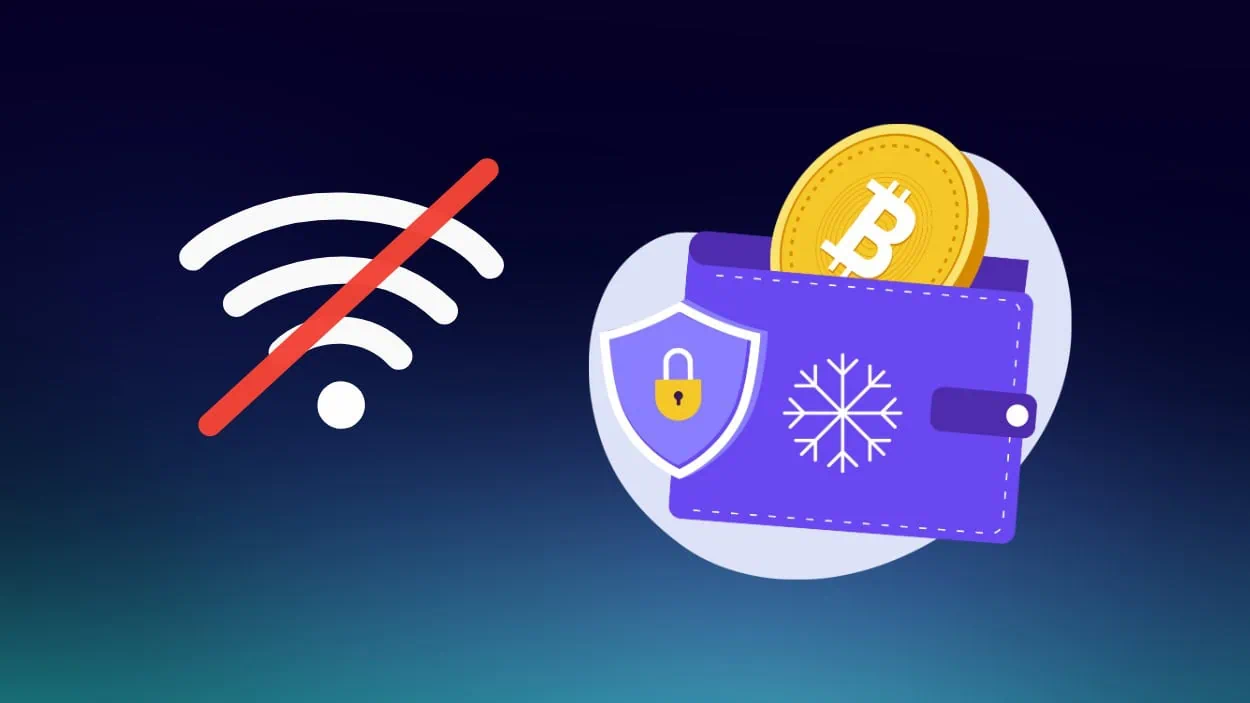
A cold wallet is an offline cryptocurrency storage device that keeps private keys completely disconnected from the internet, protecting digital assets from remote hacking, malware, and unauthorized access.
Key Takeaways
- Cold wallets store private keys offline, making them immune to remote cyberattacks, phishing, and malware that target internet-connected devices.
- Hardware wallets from manufacturers like Ledger and Trezor are the most popular cold storage solution, with Ledger reporting over 6 million devices sold.
- Cold storage secures an estimated 70-80% of all Bitcoin held by exchanges, according to Chainalysis’s on-chain analysis.
- The trade-off for security is convenience: cold wallet transactions require physical access to the device and take longer to execute than hot wallet transfers.
- Losing a cold wallet without a backup of the recovery seed phrase means permanent, irreversible loss of all stored assets.
How Does a Cold Wallet Work?
1. Private Keys Never Touch the Internet
Think of a cold wallet as a bank vault buried underground with no phone line, no Wi-Fi, and no connection to the outside world. A hot wallet, by comparison, is a cash register sitting on a shop counter. Both hold money, but the vault is unreachable to anyone who is not physically present.
Cold wallets generate and store private keys on a device that never connects to the internet. When you need to send cryptocurrency, the transaction is constructed on an internet-connected computer, transferred to the cold wallet (via USB or QR code), signed offline using the private key, and then the signed transaction is transferred back to the connected device for broadcasting to the blockchain.

2. Hardware Wallets Sign Transactions in Isolation
Hardware wallets like the Ledger Nano X and Trezor Model T contain a secure element chip that performs cryptographic signing in an isolated environment. Even if the computer connected to the hardware wallet is infected with malware, the private key never leaves the device. The malware can see the transaction details but cannot extract the key needed to authorize transfers.

3. Recovery Seeds Provide Backup Access
During setup, every cold wallet generates a recovery seed phrase (typically 12 or 24 words) using the BIP-39 standard. This phrase is a human-readable backup of the private key. If the hardware device is lost, damaged, or stolen, the seed phrase can restore full access on a new device. The seed phrase is the single most critical piece of information in cold storage security, and it must be stored offline, ideally on metal backup plates rather than paper.
| Cold Storage Method | Security Level | Cost | Best For |
| Hardware wallet (Ledger, Trezor) | Very high | $60-$250 | Individual holders with significant crypto positions |
| Air-gapped computer | Extremely high | $200-$500+ | Advanced users, institutional custody |
| Paper wallet | High (if generated securely) | Free | Long-term storage with no transaction needs |
| Metal seed backup | Very high (disaster-resistant) | $20-$80 | Seed phrase protection against fire, water, corrosion |
| Multi-signature setup | Highest | Multiple devices needed | Seed phrase protection against fire, water, and corrosion |
Source: Ledger, Trezor product documentation
Why Do Cold Wallets Matter?
The history of cryptocurrency is punctuated by exchange hacks that wiped out user funds held in hot wallets. Mt. Gox lost 850,000 BTC in 2014. FTX lost billions in customer deposits in 2022. In every major exchange failure, cold storage was the dividing line between recovered and lost funds.
The pattern of our self-custody wallet coverage documents is clear: after each major exchange failure, the rate of Bitcoin leaving exchanges for self-custody wallets accelerates. Glassnode data shows exchange-held Bitcoin has been declining since 2020, with the sharpest outflows following the FTX collapse. Cold wallets are the practical tool enabling this structural shift toward self-custody.
Pros, Cons, and Risks
Advantages
- Maximum security: Private keys never touch the internet, eliminating remote attack vectors entirely.
- Self-custody: You own your keys with no reliance on exchanges, custodians, or third parties.
- Malware immunity: Even on a compromised computer, the hardware wallet’s secure element protects the private key.
- Multi-asset support: Modern hardware wallets support thousands of cryptocurrencies and tokens.
- Portability: Hardware wallets are small enough to carry or store in a safe deposit box.
Trade-offs and Risks
- Inconvenience: Every transaction requires physical access to the device, making frequent trading impractical.
- Seed phrase vulnerability: If someone gains access to your recovery seed, they can steal all funds without needing the physical device.
- Loss risk: Losing both the device and the seed phrase means permanent, irrecoverable loss of assets.
- Supply chain attacks: Purchasing hardware wallets from unofficial sellers risks receiving tampered devices.
- Learning curve: Setting up and using cold storage correctly requires more technical knowledge than exchange-based custody.
Cold Wallet vs Hot Wallet
The choice between cold and hot storage is not binary. Most experienced users combine both, keeping daily-use funds in a hot wallet and long-term holdings in cold storage.

| Feature | Cold Wallet | Hot Wallet |
| Internet Connection | Never connected | Always connected |
| Security Level | Highest (offline keys) | Lower (exposed to network attacks) |
| Transaction Speed | Slower (requires device access) | Instant (keys readily available) |
| Convenience | Low (physical steps required) | High (app-based, always accessible) |
| Best For | Long-term storage, large holdings | Daily transactions, DeFi interaction |
| Cost | $60-$250 for hardware wallet | Free (software wallets) |
| Recovery | Seed phrase + new device | Seed phrase or account recovery |
| Example | Ledger Nano X, Trezor Safe 3 | $60-$250 for a hardware wallet |
Real-World Applications
Individual Long-Term Storage
Bitcoin holders who plan to hold for years (“hodlers”) use cold wallets to remove their assets from exchange risk entirely. After purchasing Bitcoin on an exchange, they transfer it to a hardware wallet and store the device and seed phrase backup in separate secure locations. The Bitcoin remains accessible only to the holder, regardless of what happens to any exchange or online service.
Institutional Custody
Cryptocurrency exchanges and custodians use multi-signature cold storage setups to protect customer funds. Coinbase, for example, stores approximately 98% of customer assets in geographically distributed cold storage vaults. Accessing these funds requires multiple authorized signers using separate hardware devices, preventing any single employee from moving funds unilaterally.
Scenario: Setting Up Cold Storage for the First Time
David buys a Ledger Nano X directly from the manufacturer’s website (never from third-party resellers). He unboxes it, connects it to his computer via USB, and follows the setup wizard in the Ledger Live app. The device generates a 24-word recovery seed phrase, which David writes down on the included recovery sheet and then stamps onto a stainless steel backup plate. He stores the steel plate in a fireproof safe at a different location than the Ledger device itself. David then creates accounts for Bitcoin and Ethereum on the device, transfers his holdings from Coinbase to the Ledger addresses, and verifies the receiving address on the Ledger’s physical screen before confirming. His crypto is now in cold storage, accessible only with the physical device or the seed phrase.
Frequently Asked Questions (FAQs)
If you have your recovery seed phrase backed up, you can restore full access on a new hardware wallet from the same or a different manufacturer (seed phrases follow the BIP-39 standard and are cross-compatible). If you lose both the device and the seed phrase, the funds are permanently inaccessible. This is why storing the seed phrase separately from the device is critical.
Hardware wallets cost $60-$250. For holdings under a few hundred dollars, the cost may not justify the security benefit, and a reputable hot wallet with strong security practices may be sufficient. As holdings grow, the risk of keeping assets on an exchange or in a hot wallet increases proportionally, making cold storage increasingly worthwhile.
Cold wallets are immune to remote hacking because private keys never connect to the internet. Physical attacks are theoretically possible (side-channel attacks on the secure element chip) but require advanced equipment, physical possession of the device, and expertise. The most common attack vector is social engineering: tricking the user into revealing their seed phrase through phishing.
No. Always purchase hardware wallets directly from the manufacturer or an authorized reseller. Used or third-party devices may have been tampered with (pre-loaded seed phrases, modified firmware) to steal funds after you deposit crypto. Legitimate hardware wallets arrive sealed and generate a fresh seed phrase during your initial setup.
The Bottom Line
Cold wallets remain the gold standard for cryptocurrency security. The principle is simple: if your private keys never touch the internet, they cannot be stolen remotely. For anyone holding cryptocurrency as a long-term investment rather than for daily trading, cold storage eliminates the single largest category of risk.
The self-custody trend continues to accelerate. Each exchange failure reinforces the same lesson that early Bitcoin adopters learned over a decade ago: “not your keys, not your coins.” Cold wallets are a practical tool that makes that principle actionable, giving individuals the same level of custody security that institutions have used for years.