

• Skip to primary navigation
  • Skip to main content
  • Skip to primary sidebar
  • Skip to footer
CoinLaw LogoCoinLaw

Bringing Crypto and Finance Closer to You

  • Latest News
  • Statistics
  • About
  • Contact
Subscribe
CoinLaw Logo
  • Latest News
  • Statistics
  • About
  • Contact
Subscribe
Home » Finance

DeFi vs. Traditional Banking Statistics 2026: Market Battle Now

Published on: July 2025 • Last Updated: April 4, 2026
Steven Burnett
Written By
Steven Burnett
Steven Burnett
Research Analyst • 241 Articles
Steven Burnett has over 15 years of experience across finance, insurance, banking, and compliance-focused industries. Known for his deep res... See full bio
LATEST POSTS:
NFT Regulatory Framework 2026: Global Status and Compliance Map
DeFi Regulation Status by Country 2026: A Global Compliance Map
What Is MiCA Regulation? The EU Crypto Rulebook Explained
Kathleen Kinder
Reviewed By
Kathleen Kinder
Kathleen Kinder
Senior Editor • 1,682 Articles
Kathleen Kinder brings over 11 years of experience in the research industry, with deep expertise in finance, cryptocurrency, and insurance. ... See full bio
LATEST POSTS:
Winklevoss Twins Move $67.5M BTC Amid Sell Fears
Revolut Eyes U.S. Bank Launch With FDIC Insured Accounts
Visa, Mastercard and Stripe Plan New Stablecoin Platform
DeFi vs. Traditional Banking Statistics
As Featured In
FortuneYahoo! FinanceCoinDeskSeeking AlphaCoin Market Cap
Share on LinkedIn ChatGPT Perplexity Share on X Share on Facebook

Imagine stepping into a bank branch in the early 2000s, pen in hand, filling out paperwork for a simple wire transfer. Fast forward today, and a 20-year-old in Nairobi can earn, lend, and stake digital assets, all from a smartphone app connected to a decentralized finance (DeFi) protocol.

This transformation from traditional banking to DeFi isn’t just a shift in tools; it’s a reshaping of trust, access, and efficiency in financial ecosystems. As we dive into the numbers, you’ll see how DeFi is challenging legacy banking, not just ideologically, but statistically.

Key Takeaways

  • 1$247 billion in DeFi total value locked (TVL) in Q2 2025, up 31% year-over-year.
  • 25.4 billion people globally remain unbanked or underbanked, many now reached via DeFi.
  • 3$19.7 trillion in total assets held by the five largest U.S. banks.
  • 457% of Millennials and Gen Z prefer DeFi apps over mobile banking platforms in 2025.

Largest DeFi Lending Protocols

  • AAVE V2 led the market with a lending volume of $4.1 billion, making it the top DeFi lending protocol.
  • JustLend followed with a substantial $3.39 billion in lending, securing the second spot in the rankings.
  • Venus recorded $878.25 million in lending volume, placing it third among major DeFi lending platforms.
Largest Defi Lending Protocols
(References: vpnAlert)

Global Market Size Comparison of DeFi and Traditional Banking

  • $247 billion is the DeFi market size as of May 2025.
  • $370 trillion represents the total global traditional banking assets.
  • 9.4% compound annual growth rate (CAGR) for DeFi, projected to hit $540 billion by 2027.
  • $1.9 trillion in DeFi transactions per quarter this year.
  • $32 billion in annual revenue generated by DeFi platforms.
  • $1.5 trillion global fintech market in 2025, with DeFi accounting for nearly 16% of it.
  • 72% market share in consumer lending held by traditional banks; DeFi accounts for 6.8%.
  • $13 billion collected in gas fees across Layer-2 DeFi platforms.
  • 3.5x growth in DeFi user funds since 2023.

User Growth and Adoption Rates

  • 312 million active DeFi users globally in Q2 2025.
  • 6.9% annual increase in traditional bank account holders.
  • 61% of DeFi users are under 35 years old.
  • 47 million monthly active users on Ethereum-based DeFi apps.
  • 39% year-over-year increase in first-time DeFi users accessing via mobile wallets.
  • 84% of traditional bank users rely on centralized apps, but only 26% trust them for investing.
  • 88 countries report active DeFi usage.
  • 25 million new users onboarded via Layer-2 platforms like Arbitrum and Base.
  • 14.3% DeFi user retention rate, versus 7.1% in traditional retail banking apps.
  • 3x higher account reactivation rate among DeFi users.
Newsletter Img
Don't chase the news. Let us curate it.

You get one weekly briefing with only the stories that matter. If the market is quiet, we skip it.

✅ Join readers from Visa, Vanguard, and the FDIC.

Projected Growth of the DeFi Market

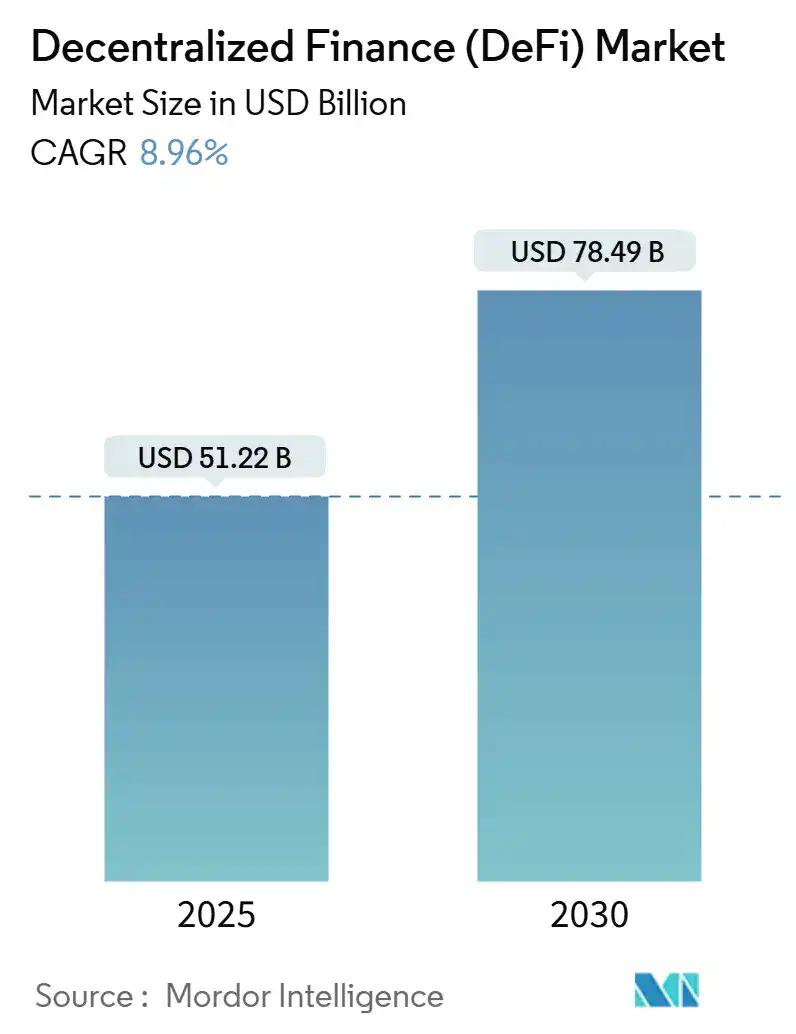
  • The DeFi market size is projected to reach $51.22 billion in 2025.
  • By 2030, the market is expected to grow to $78.49 billion.
  • This expansion reflects a CAGR of 8.96%, indicating steady and sustainable growth in the decentralized finance space.
Projected Growth of the DeFi Market
(References: Mordor Intelligence)

Transaction Volume and Value

  • $1.9 trillion in quarterly DeFi transaction volume in Q1 2025.
  • $405 trillion in transaction volume handled by the global banking system.
  • $1.07 is the average DeFi transaction fee on Layer-2s.
  • 72 million average daily DeFi transactions.
  • 3.6 seconds average time to finalize a DeFi transaction; traditional international wire transfers average 28 hours.
  • $34 billion in quarterly decentralized exchange (DEX) volume.
  • 16.2% rise in institutional DeFi trading activity.
  • 4.1x increase in DeFi collateralization of NFTs.
  • $108 billion in synthetic assets traded through DeFi, including tokenized stocks and forex.
  • $12.6 billion in flash loan activity for 2025.

Geographic Distribution of DeFi vs. Traditional Banking Usage

  • 33% of DeFi users in 2025 are based in Asia, with Vietnam, India, and the Philippines among the top adopters.
  • 21% of DeFi adoption comes from Latin America, led by Brazil, Argentina, and Colombia.
  • 19% of active DeFi users are in Sub-Saharan Africa, particularly Nigeria and Kenya, where mobile finance is dominant.
  • 47% of global banked individuals live in North America and Europe, but only 14% of global DeFi adoption occurs there.
  • 78% of traditional banking institutions still require in-person identity verification in emerging markets.
  • 86 countries now support on-ramp access to DeFi via local fiat currencies.
  • 12% of U.S. households used at least one DeFi application in 2025.
  • 53% of new wallet creations in 2025 are from mobile-first regions in Southeast Asia and Africa.
  • 16.4% of DeFi adoption growth comes from MENA (Middle East and North Africa) in 2025.
  • 91% of traditional banking infrastructure investment is concentrated in G20 countries.

How Users Perform Different Banking Activities Across Channels

  • 48% of users inquire about a product through traditional banking, while only 37% use online banking and 15% use mobile apps.
  • For international money transfers, 53% prefer online banking, 24% use mobile apps, and 23% rely on traditional methods.
  • When updating account details, 47% use online banking, followed by 26% on mobile apps, and 27% through traditional banking.
  • Paying bills is most common via mobile apps (41%), closely followed by online banking (44%), and only 15% use traditional banking.
  • 48% of users transfer money to others using mobile apps, compared to 38% via online banking and just 14% traditionally.
  • Similarly, account-to-account transfers are done by 48% through mobile apps, 38% online, and 14% via traditional channels.
  • For balance inquiries, 56% turn to mobile apps, while 29% use online banking, and 15% still go the traditional route.
How Users Perform Different Banking Activities Across Channels
(References: ElectroIQ)

Interest Rates and Yield Comparison

  • 8.2% average yield for DeFi staking and lending platforms in 2025.
  • 2.1% is the average global savings interest rate offered by traditional banks this year.
  • 14% yield is offered on select DeFi protocols for stablecoin lending.
  • 1.9% average rate for 1-year fixed deposits in U.S. banks in 2025.
  • 6.5% is the return from DeFi yield farming on Layer-2 ecosystems such as Optimism and Arbitrum.
  • 0.01%–0.50% is the yield range still offered by traditional savings accounts in major retail banks.
  • 9.8% average APY on DeFi liquidity pools pairing stablecoins with blue-chip crypto assets.
  • 7.4% returns from staking native assets such as ETH and SOL on-chain.
  • 0.9% is the effective interest earned by U.S. consumers after adjusting for inflation in traditional accounts.
  • 2.5x is the average multiple by which DeFi rates outpace traditional high-yield bank products.

Security Incidents and Fraud Rates

  • $1.1 billion in reported DeFi exploits and protocol hacks in the first half of 2025.
  • $2.8 billion in traditional banking fraud losses in the U.S. alone during the same period.
  • 52% of DeFi-related breaches occurred due to smart contract vulnerabilities.
  • 38% of DeFi hacks were mitigated within 24 hours due to community alerts and circuit breakers.
  • 97% of banking fraud involved account takeovers or unauthorized transactions.
  • 11 million phishing attacks targeted traditional bank users in Q1 2025.
  • 19% of total DeFi security incidents involved rug pulls.
  • 87% of DeFi protocols were audited in 2025.
  • 0.18% of the total DeFi value locked was lost to hacks in 2025.
  • $418 million in frozen funds were successfully recovered by white hat hackers and bounty programs in DeFi.

Generational Concerns About Banks Collecting Personal Data

  • 21% of Gen Z Brits are most concerned about online banking and data collection.
  • 19% of Millennials express high wariness over banks collecting their personal data.
  • 10% of Gen X are cautious about data use in online banking.
  • Only 5% of Baby Boomers show concern over data collection practices.
  • The Silent Generation is the least worried, with just 4% expressing concern.
Generational Concerns About Banks Collecting Personal Data
(References: Finder Survey)

Operational Costs and Efficiency Metrics

  • 60–70% lower operational overhead for DeFi platforms compared to legacy banks.
  • $0.06 is the median cost per DeFi transaction on Layer-2 networks.
  • $9.40 is the estimated cost for processing a bank wire transfer, including human capital and compliance.
  • 5.4x faster average settlement time in DeFi protocols than in SWIFT-based systems.
  • 93% of DeFi smart contract deployments in 2025 are automated with no human intervention post-launch.
  • 23 minutes average resolution time for user-side issues in decentralized exchanges.
  • $1.2 billion saved globally in remittance fees by using DeFi-based channels over traditional banking.
  • 81% of DeFi operating costs are allocated to infrastructure and audits, with minimal spend on human resources.
  • 42% reduction in overhead observed in hybrid financial institutions that adopted on-chain operations.
  • 4.7 million transactions per day processed through DeFi rails with less than 0.3% error rate.

Regulatory Impact and Compliance

  • 43 countries have established specific DeFi regulatory sandboxes or frameworks in 2025.
  • 31% of global DeFi volume now comes from jurisdictions with clear legal recognition of DAO structures.
  • $2.5 billion in DeFi platform revenue was subject to compliance-based disclosures in 2025.
  • 61% of traditional banks increased regulatory costs due to enhanced KYC and AML requirements.
  • $820 million in fines levied on banks globally for compliance failures in H1 2025.
  • 16 DeFi protocols voluntarily adopted on-chain KYC modules without compromising decentralization.
  • 24.6% of users now prefer protocols that comply with travel rule regulations.
  • 11% reduction in regulatory delays reported by DeFi projects operating under proactive legal advisory.
  • $173 million in grants issued by global fintech regulators to study DeFi governance models.
  • 7 countries are piloting CBDC-DeFi interoperability projects in collaboration with blockchain foundations.

Top Factors People Consider When Choosing a Bank

  • 43% of respondents prioritize convenience when selecting a bank.
  • 35% consider bank charges as a key deciding factor.
  • 15% focus on getting a favorable interest rate.
  • Only 5% value the location of the bank.
  • A minor 2% choose based on other reasons.
Top Factors People Consider When Choosing A Bank
(References: ResearchGate)

Customer Trust and Satisfaction Levels

  • 63% of DeFi users report higher satisfaction with transparency compared to traditional banking.
  • 29% of U.S. adults in 2025 trust decentralized apps more than banks with investment-related transactions.
  • 71% of DeFi platforms offer real-time asset verification and open audit trails.
  • 19% of traditional banking customers feel confident that their institution operates in their best interest.
  • 47% of Gen Z consumers say they would rather lose access to a bank account than their crypto wallet.
  • 89% of surveyed DeFi users cite control over funds as their main reason for preference.
  • 12% of DeFi users experienced platform failures or withdrawal delays in the last year, versus 6% for online banks.
  • 91% of DeFi apps display protocol fees and rules up front; only 34% of banks do the same for service fees.
  • 38% of new users say social proof and community reviews influenced their trust in DeFi protocols.
  • 58% of DeFi platforms now include native dispute resolution tools to improve user confidence.

Cross-Border Payment

  • $1.2 trillion in global cross-border DeFi transactions processed in the first half of 2025.
  • 3.6 seconds is the average time to finalize a DeFi-based international payment.
  • $46 billion saved globally in remittance fees by switching from traditional payment rails to DeFi.
  • $14.7 is the average fee per cross-border transfer via traditional banks in 2025.
  • 96% of DeFi cross-border payments use stablecoins like USDC and DAI.
  • 71 countries have seen stablecoin volumes exceed their local banking corridors.
  • 4.3x faster settlement speed in DeFi systems compared to bank-based cross-border SWIFT transfers.
  • $387 million processed daily through decentralized remittance platforms like Celo and Stellar in 2025.
  • $2.9 billion in total value moved across refugee and aid networks through DeFi in regions with failed banking access.

DeFi Semi-Annual Revenue Breakdown by Segment

  • Total DeFi revenue reached $1.5 billion on a semi-annualized basis.
  • Exchanges dominated the sector, generating $1.2 billion, or 80% of total revenue.
  • Lending protocols contributed $0.3 billion, accounting for 20% of the total.
  • Asset management platforms brought in a minimal $0.04 billion, showing a limited revenue share.
DeFi Annual Revenue Breakdown by Segment
(References: Grayscale Research)

Mobile and Digital Access Penetration

  • 92% of DeFi users in emerging markets access platforms via mobile apps.
  • 4.8 billion people globally now have mobile internet access, fueling DeFi’s grassroots growth.
  • 61% of DeFi usage happens on mobile-first platforms with wallet-native apps.
  • 82% of users under age 30 prefer managing their DeFi assets on mobile wallets.
  • 27% of banking apps in low-income regions are still inaccessible due to outdated tech stacks.
  • 43 million active monthly users on MetaMask Mobile, with 19 million on Trust Wallet in 2025.
  • 11% of all DeFi activity now comes from decentralized social apps with embedded financial tools.
  • 6.3x growth in DeFi users via mobile onboarding flows since 2020.
  • 72% of DeFi users say ease of mobile access was their top reason for adoption.

DeFi Lending vs. Traditional Loan

  • $97 billion in total value issued through DeFi lending protocols in H1 2025.
  • $4.1 trillion in total global consumer loans issued by traditional banks in the same period.
  • 9.1% is the average annual interest rate on unsecured DeFi loans.
  • 4.6% is the average interest rate offered by U.S. traditional lenders for personal loans.
  • 0.08 seconds is the average loan approval time in DeFi, versus 1–3 days for traditional banks.
  • 72% of DeFi loans are overcollateralized with digital assets, ensuring lower credit risk without intermediaries.
  • 32% of users borrow in DeFi to access capital in underbanked economies.
  • 18% of DeFi borrowers are repeat users with positive repayment histories.
  • 14% of U.S. small businesses used DeFi to secure capital in 2025.
  • 3.3x higher capital efficiency for DeFi loan protocols than legacy systems, thanks to smart contract automation.

Recent Developments

  • April 2025: Ethereum’s Dencun upgrade improved Layer-2 throughput by 3.7x, reducing costs and congestion.
  • $1.6 billion: Total market cap of tokenized U.S. Treasury products on DeFi platforms like Ondo and Maple.
  • 9.4 million new wallets onboarded via AI-driven DeFi onboarding tools in Q1 2025.
  • 51% of DAOs now use zero-knowledge governance frameworks for private voting.
  • $418 million in DeFi ecosystem investments announced by major fintech VCs in 2025 alone.
  • 1.5 million users interacted with DeFi via Telegram-integrated bots and embedded mini-apps.
  • April 2025: Uniswap v4 launched hooks and custom LP pools, increasing platform volume by 38% in 3 weeks.
  • $280 million in grants allocated by the Ethereum Foundation for DeFi protocol R&D in 2025.
  • 7 central banks are piloting interoperability standards with DeFi bridges and CBDC contracts.
  • 89% of DeFi teams now use embedded AI tools for fraud detection, pricing models, and user support automation.

Conclusion

DeFi is no longer a fringe experiment; it’s a parallel financial ecosystem growing with exponential sophistication. While traditional banking continues to dominate in volume, DeFi is rapidly gaining ground in user engagement, transparency, and efficiency.

From lending protocols issuing loans in seconds to cross-border payments settled instantly, decentralized finance is reshaping what users expect from financial services. Traditional institutions must adapt or risk becoming obsolete in a landscape where code, not clerks, powers finance.


Definition of CBDC. Link to full glossary entry follows the description.CBDC

A central bank digital currency (CBDC) is digital money issued as a direct liability of a central bank, available in retail or wholesale forms.

Read more

Definition of Smart Contract. Link to full glossary entry follows the description.Smart Contract

A smart contract is a self-executing program stored on a blockchain that automatically enforces agreement terms when predefined conditions are met, without intermediaries.

Read more

Definition of Staking. Link to full glossary entry follows the description.Staking

Staking is the process of locking cryptocurrency in a proof-of-stake network to help validate transactions and earn rewards, replacing energy-intensive mining.

Read more

Definition of DeFi. Link to full glossary entry follows the description.DeFi

Decentralized finance leverages blockchain protocols and smart contracts to enable lending, trading, and borrowing without banks or traditional intermediaries.

Read more

Definition of Cross-Chain. Link to full glossary entry follows the description.Cross-Chain

Cross-chain is the ability to move data or assets between separate blockchains via bridges, messaging protocols, or interoperability networks.

Read more

Definition of Gas Fee. Link to full glossary entry follows the description.Gas Fee

A gas fee is the transaction cost paid to Ethereum validators for the computational effort needed to process and confirm blockchain operations.

Read more

This article has been reviewed and fact-checked by Kathleen Kinder. CoinLaw follows strict Publishing Principles and a documented Fact-Check Policy to ensure accuracy, transparency, and editorial independence across all content. Our statistics are verified using a documented Research Process.

Add CoinLaw as a Preferred Source on Google for instant updates! Follow on Google News
Share ChatGPT Perplexity

References

  • Statista
  • IJFMR
  • SSRN
  • Sygnum Bank
  • International Journal of Social Impact
  • ResearchGate
  • Anaptyss Inc.
Steven Burnett

Steven Burnett

Research Analyst


Steven Burnett has over 15 years of experience across finance, insurance, banking, and compliance-focused industries. Known for his deep research and data analysis skills, Steven transforms complex topics into clear, actionable insights. At CoinLaw, he contributes in-depth articles on financial systems, regulatory trends, and lending practices, helping readers make informed decisions with confidence.

Related Posts

Crypto Lending and Borrowing Statistics 2026: Big Money Moves
Lending

Crypto Lending and Borrowing Statistics 2026: Big Money Moves

Decentralized Exchange vs. Centralized Exchange Statistics 2026: What Traders Need to Know Now
Cryptocurrency

Decentralized Exchange vs. Centralized Exchange Statistics 2026: What Traders Need to Know Now

Digital Banking Statistics 2026: What’s Surging Now
Banking

Digital Banking Statistics 2026: What’s Surging Now

Disclaimer: The content published on CoinLaw is intended solely for informational and educational purposes. It does not constitute financial, legal, or investment advice, nor does it reflect the views or recommendations of CoinLaw regarding the buying, selling, or holding of any assets. All investments carry risk, and you should conduct your own research or consult with a qualified advisor before making any financial decisions. You use the information on this website entirely at your own risk.

Reader Interactions

Leave a Comment Cancel reply

Primary Sidebar

Connect With Us

facebook x linkedin google-news telegram pinterest whatsapp email
google-preferred-source-badge Add as a preferred source on Google

You Should Also Read

Decentralized Finance (DeFi) Market Statistics 2026: Must-Know Insights Now
Traditional Banks vs. Neobanks Statistics 2026: How Digital Is Winning
Banking Statistics 2026: What You Must Know Now

Table of Contents

  • Key Takeaways
  • Largest DeFi Lending Protocols
  • Global Market Size Comparison of DeFi and Traditional Banking
  • User Growth and Adoption Rates
  • Projected Growth of the DeFi Market
  • Transaction Volume and Value
  • Geographic Distribution of DeFi vs. Traditional Banking Usage
  • How Users Perform Different Banking Activities Across Channels
  • Interest Rates and Yield Comparison
  • Security Incidents and Fraud Rates
  • Generational Concerns About Banks Collecting Personal Data
  • Operational Costs and Efficiency Metrics
  • Regulatory Impact and Compliance
  • Top Factors People Consider When Choosing a Bank
  • Customer Trust and Satisfaction Levels
  • Cross-Border Payment
  • DeFi Semi-Annual Revenue Breakdown by Segment
  • Mobile and Digital Access Penetration
  • DeFi Lending vs. Traditional Loan
  • Recent Developments
  • Conclusion
Connect on Telegram

Footer

CoinLaw Logo

Bringing Finance Closer to You.

Connect With Us

Follow Us on Google News

Editorial & Trust

  • About
  • Publishing Principles
  • Fact-Check Policy
  • Corrections Policy
  • Ethics Policy
  • Disclaimer

Worth Checking

  • Ethereum Gas Fees Statistics
  • Zelle vs. Venmo Statistics
  • Millennial vs. Gen Z Banking
  • Binance vs. Coinbase Statistics
  • Traditional Banks vs. Neobanks
Contact Us
13570 Grove Dr #189,
Maple Grove, MN 55311,
United States
10 a.m. – 6 p.m. | Every day

Copyright © 2024–2026 CoinLaw. All Rights Reserved. Powered by the HODL Force ❤️

  • Privacy Policy
  • Terms
Company
  • About Us
  • Our Team
  • Our Mission
  • Core Values
Discover
  • glossary icon
    Glossary
  • Stats
    Stats Research Process
  • Brand Guide Icon
    Brand Assets
Categories
  • Cryptocurrency
  • Payments
  • Finance
  • Banking
  • Insurance
Cryptocurrency
Coinbase vs Kraken Statistics 2026: Volume, Fees, Licenses
Solana vs Ethereum Statistics 2026: TVL, Fees, Validators, ETFs
Uniswap vs PancakeSwap Statistics 2026: Head-to-Head DEX Data
Cryptojacking Statistics 2026: 80+ Cloud, Cost & Threat Numbers
MetaMask vs Phantom Wallet Statistics 2026: Big Growth Data
Crypto Wallet Ecosystem Statistics 2026: Addresses, Security, Adoption
Payments
Toast Statistics 2026: ARR, GPV & Revenue Data
Rapyd Statistics 2026: TPV, Valuation & Licences
Marqeta Statistics 2026: TPV, Revenue and Customer Mix
Digital Payments Statistics 2026: Market Size, Users, and Growth
Cash App vs Venmo vs Zelle Statistics 2026: What You Must Know Now
Worldpay Statistics 2026: Massive Payment Growth
Finance
Emergency Fund Statistics 2026: How Much Americans Have Saved (and How Much They Should)
Financial Advisor Statistics 2026: Headcount, AUM, and Demographics
Wealth Inequality Statistics 2026: Hidden Wealth Divide
Blockchain in Supply Chain Finance Statistics 2026: Trade Breakthrough
Blockchain in Healthcare Finance Statistics 2026: Cost Breakthrough
AI-Powered Robo Trading Statistics 2026: Big Insights
Banking
N26 Statistics 2026: Customers, Deposits, Revenue and the BaFin Growth Cap
Revolut vs Monzo Statistics 2026: Customers & Profit
Islamic Banking Statistics 2026: Assets, Growth, and Top Markets
Credit Union Statistics 2026: Assets, Members, Loans
Banking API Statistics 2026: Market Size, Adoption, and Growth
Citigroup Statistics 2026: Growth Secrets Inside
Insurance
Lemonade Insurance Statistics 2026: Customers, In-Force Premium, Loss Ratio, Pet & Auto Segments
Chubb Statistics 2026: Powerful Data Insights
Virtual Reality In Insurance Statistics 2026: Innovations, Risks, and Opportunities
US Life Insurance Industry Statistics 2026: Growth Facts
US Auto Insurance Industry Statistics 2026: What You Must Know Now
UK Insurance Industry Statistics 2026: Growth Data
Categories
  • Cryptocurrency
  • Investments
  • Compliance
  • Fintech
  • Finance
Cryptocurrency
FG Nexus Moves 10,000 ETH as Ethereum Losses Exceed $85M
Arthur Hayes Shocks Hyperliquid Holders With $18M HYPE Exit
Coinbase Freezes $3M Linked to Southeast Asia Scams
Mt. Gox Moves $8M BTC to Bitstamp as Bitcoin Falls
Winklevoss Twins Move $67.5M BTC Amid Sell Fears
Visa, Mastercard and Stripe Plan New Stablecoin Platform
Investments
Goldman Sachs Backs Blockchain Real Estate Fund
Keyrock to Buy Bankrupt Crypto Lender BlockFills for $3.25M
OKX Buys 19.6% of Coinone in $53M Korea Crypto Deal
Samsung Buys $408M Stake in Upbit Parent Dunamu
Nvidia to Invest $150 Billion a Year in Taiwan AI Expansion
Binance Launches SpaceX Pre-IPO Futures for Retail Traders
Compliance
FCA Flags Crypto Sponsorship Risks for Premier League Clubs
Polymarket May Enforce KYC as Regulators Tighten Oversight
CFTC and Gemini Ask Court to Undo $5M Settlement
Kenya Proposes New Crypto Taxes Under Finance Bill 2026
Poland Passes MiCA Crypto Bill Amid Zondacrypto Probe
Bitget Secures Mexico Crypto Approval for LatAm Expansion
Fintech
Moomoo Debuts Kalshi Powered Event Contracts for Retail Traders
Shinhan Financial Joins Canton Network for Tokenized Assets
Tether Launches First Gold Backed Visa Card With Fasset
OpenPayd Targets Nasdaq Listing With $1.145B Deal
Sui Identifies Bugs Behind Three Mainnet Network Outages
OKX X Layer Introduces Exchange OS for Onchain Markets
Finance
Bitmine Launches $300M Preferred Stock to Buy More ETH
Coinbase Lists SpaceX Pre IPO Perpetual Futures
Binance Expands Into US Stocks With New bStocks Service
SEC Clears Paxos to Settle U.S. Stocks on Blockchain
Mastercard Expands Stablecoin Strategy With NY BitLicense
Russia Plans Full Exit of Visa and Mastercard From Market
Newsletter Img

Too much noise in crypto?

We respect your time. You get one high-impact briefing a week. If the market is quiet, so are we.

✅ Join readers from Visa, Vanguard, and the FDIC.
Newsletter Img

The Weekly Briefing

We track the market 24/7. You get a 5-minute summary. If it’s quiet, we skip it.

✅ Read by pros at Visa, Vanguard, and the FDIC.