

• Skip to primary navigation
  • Skip to main content
  • Skip to primary sidebar
  • Skip to footer
CoinLaw LogoCoinLaw

Bringing Crypto and Finance Closer to You

  • Latest News
  • Statistics
  • About
  • Contact
Subscribe
CoinLaw Logo
  • Latest News
  • Statistics
  • About
  • Contact
Subscribe
Home » Cryptocurrency

Cryptocurrency in Investment Portfolios Statistics 2026: Smart Money Moves Now

Published on: August 2025 • Last Updated: February 26, 2026
Barry Elad
Written By
Barry Elad
Barry Elad
Founder & Senior Journalist • 577 Articles
Barry Elad is a finance and tech journalist who loves breaking down complex ideas into simple, practical insights. Whether he's exploring fi... See full bio
LATEST POSTS:
How Many People Use Cryptocurrency Worldwide 2026: Global User Count by Year and Region
Stablecoin Market Cap Statistics 2026: Issuer Share and Growth
Venmo Business vs Personal Account 2026: Fees, Limits, and Tax Rules
Kathleen Kinder
Reviewed By
Kathleen Kinder
Kathleen Kinder
Senior Editor • 1,774 Articles
Kathleen Kinder brings over 11 years of experience in the research industry, with deep expertise in finance, cryptocurrency, and insurance. ... See full bio
LATEST POSTS:
Anchorage Digital Adds Lido’s wstETH for Institutions
Standard Chartered Becomes First G-SIB to Offer USDC Minting
Solana Launches Onchain Governance for Validators
Cryptocurrency In Investment Portfolios Statistics
As Featured In
Bloomberg LogoForbes LogoFortune LogoCoinDesk LogoCoinMarketCap Logo
Share on LinkedIn ChatGPT Perplexity Share on X Share on Facebook

More U.S. adults are adding cryptocurrency to their portfolios, with ownership rising. Globally, the world’s population now holds digital assets. In sectors from tech startups to wealth management, crypto’s inclusion in investment strategies is becoming strategic, not speculative. Explore how this shift is shaping financial decisions worldwide.

Editor’s Choice

  • 28% of American adults, about 65 million people, own cryptocurrency in 2025, almost doubling since 2021.
  • Global crypto ownership stands at 562 million individuals, or 6.8% of the world population.
  • U.S. adoption rose from 21% in 2024 to 24% in 2025.
  • Institutional interest grows; 59% of investors plan to allocate over 5% of AUM to crypto in 2025.
  • Q1 2025 institutional crypto investments totaled $21.6 billion.
  • Some hedge funds reduced Bitcoin ETF exposure in early 2025, though overall institutional demand remains mixed across different firms and strategies.
  • Global crypto market cap surged to $4 trillion by mid‑2025.

Recent Developments

  • The global crypto market cap hit $4 trillion by July 2025.
  • BlackRock-managed funds, including Bitcoin ETFs, reportedly surpassed $100 billion in total AUM across crypto-related products by mid-2025, primarily due to Bitcoin ETF inflows.
  • Crypto hedge funds, such as Tephra Digital, delivered up to 23% YTD gains, helped by a $700 billion market rally and $30 billion inflows into crypto products.
  • Crypto companies like Circle ($35B valuation) and Bullish completed high-profile IPOs amid regulatory clarity.
  • Surveys suggest around 30–35% of U.S. retail crypto investors made their first purchase in memecoins like Dogecoin or Shiba Inu, serving as entry points into the market.
  • Proposed stablecoin regulations, such as the Genius Act, and other reforms are catalyzing institutional demand.

Global Crypto Ownership and Market Size

  • Across major nations, crypto ownership grew from 2024 to 2025: U.S. 20% → 22%, UK 18% → 24%, France 18% → 21%, and Singapore 26% → 28%.
Crypto Ownership Growth By Country
  • Approximately 562 million individuals globally own cryptocurrency, representing 6.8% of the global population.
  • The number of crypto owners has climbed 33% since 2023.
  • In 2025, 28% of U.S. adults (≈ 65 million people) own crypto, up from 27% in 2024.
  • Memecoins act as entry points; 30–35% of U.S. crypto owners first bought memecoins.
  • Crypto ETFs are gaining traction; 39% of U.S. crypto holders now own ETFs, up from 37%.
  • Ownership skews 67% male, 33% female, and the median owner age is 45.

Cryptocurrency Allocation in Investment Portfolios

  • In 2025, 59% of institutional investors plan to allocate over 5% of AUM to crypto.
  • 35% of institutions currently allocate 1–5% of portfolios to digital assets, 60% allocate more than 1%, and only 3% allocate above 20%.
  • Q1 2025 institutional crypto investments reached $21.6 billion.
  • Roughly 40–45% of private equity firms have some exposure to blockchain or digital assets as of 2025
  • An estimated 15–20% of real estate investment companies are engaging in crypto through tokenized property or accepting crypto as payment, particularly in niche markets.
  • Registered investment advisors and wealth managers hold a significant portion, approaching 50%, of Bitcoin ETF assets, as reported in early 2025.
  • Retail investors dominate spot Bitcoin ETF flows, while institutional allocations remain below 10%, according to 13F filings and ETF analytics platforms.
Newsletter Img
Don't chase the news. Let us curate it.

You get one weekly briefing with only the stories that matter. If the market is quiet, we skip it.

✅ Join readers from Visa, Vanguard, and the FDIC.

Volatility and Risk Metrics of Crypto Portfolios

  • Crypto markets remain highly volatile, evidenced by Bitcoin’s sharp price swings, such as rallies to nearly $112,000, then fluctuations.
  • Institutional strategies are shifting, and hedge funds are reducing exposure, signaling responses to short-term volatility.
  • Strategic allocations by advisors suggest a more risk-managed, long-term view of crypto assets.
  • Regulatory clarity, such as ETFs and a stablecoin framework, is reducing perceived risk and boosting institutional comfort.
  • Overall, crypto volatility is high, but evolving institutional frameworks aim to mitigate risk through structured allocation.

Public Perception of Cryptocurrency as an Investment

  • 42.6% of respondents somewhat agree that cryptocurrency is a legitimate investment.
  • 23.8% strongly agree, showing solid confidence in crypto’s legitimacy.
  • 16.8% neither agree nor disagree, reflecting uncertainty in the market.
  • 9.9% somewhat disagree, expressing moderate skepticism.
  • 6.9% strongly disagree, rejecting crypto as a valid investment.
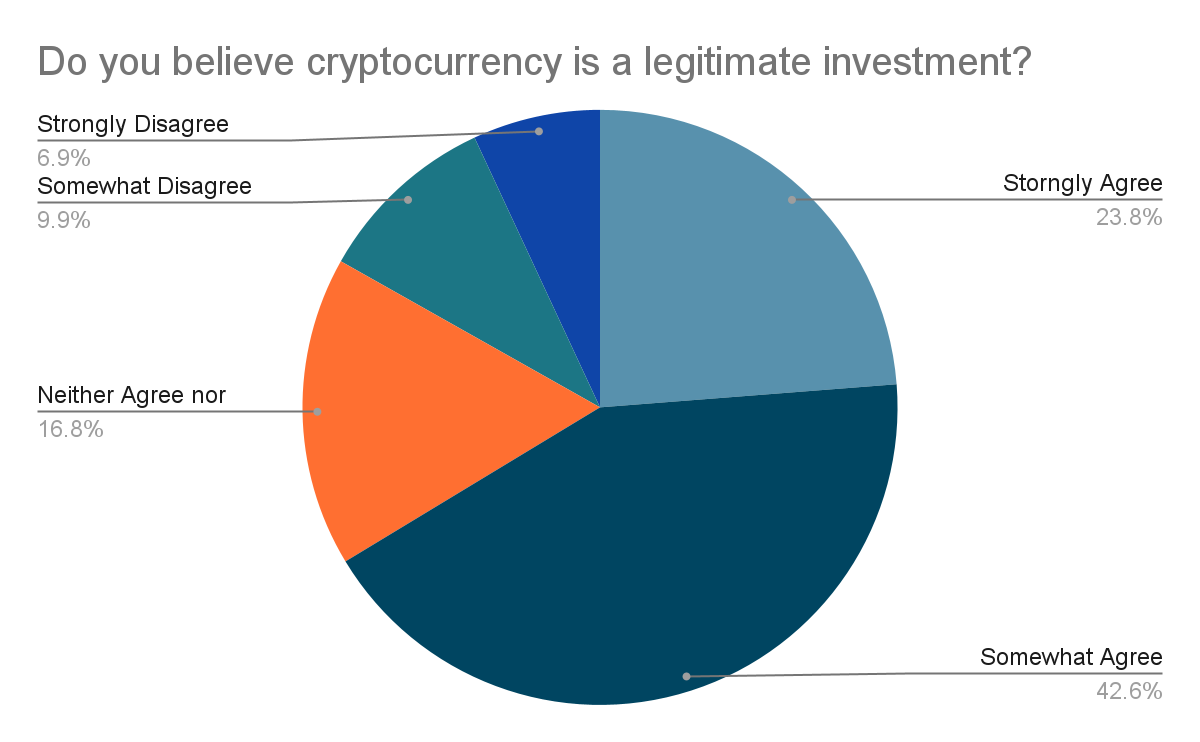
Public Perception Of Cryptocurrency As An Investment
(Reference: Forbes)

Risk-Adjusted Returns of Crypto-Integrated Portfolios

  • Adding 1% Bitcoin to a traditional portfolio boosts Sharpe and Sortino ratios measurably, and even minimal exposure improves risk-adjusted returns.
  • A model portfolio with 5% Bitcoin delivered a 26.33% cumulative return and a Sharpe ratio of 0.30, versus 18.38% and 0.17 without crypto.
  • Bitcoin’s 10-year annualized return reached 77.65% with a volatility of 70.43%.
  • Over the past 12 months, Bitcoin’s Sharpe ratio of 2.42 ranks it among the top 100 global assets, well above large-cap tech averages (~1.0).
  • Some models show Sharpe ratios surpassing 4.0 during strong bull runs, underscoring exceptional risk-adjusted performance.
  • Dynamic rebalancing strategies outperform static ones, enhancing both return and volatility control.
  • Institutional adoption of Bitcoin improves overall portfolio risk-adjusted metrics, particularly when reallocating from equities.

Correlation Between Cryptocurrencies and Equity Markets

  • Bitcoin’s five-year average correlation with the S&P 500 is approximately 0.38, rising to 0.70 during market turmoil like early 2025.
  • Daily correlations from 2014 to April 2025 sit around 0.20, but increased through ~0.50 during 2020–2022, recently around 0.48.
  • Corporate Bitcoin adoption correlates more closely with equities, studies find peaks up to 0.87 in 2024.
  • Rolling correlations often spike during stressed markets, such as the early 2020 COVID sell-off, the Ukraine war in 2022, and early-2025 drawdowns.
  • Bitcoin’s standard deviation remains 2–4× that of equities, yet correlations rise during turmoil, reducing diversification benefits.
  • Coinbase’s inclusion in the S&P 500 (~0.11% weight) strengthens its ties to equities and may marginally increase crypto’s exposure in index funds.
  • While crypto began as a hedge, increasing correlation suggests its role as a diversifier has weakened over time.

Ideal Age to Start Saving for Retirement

  • 41.2% believe people should begin saving for retirement under 18.
  • 20.6% think the ideal age is 18–25.
  • 12.4% suggest starting between 26–35.
  • Only 6.8% recommend beginning at 36 or later.
  • 18.9% are unsure about when to start saving.
Ideal Age To Start Saving For Retirement
(Reference: Bitget)

Portfolio Performance Statistics with Cryptocurrency

  • A crypto-focused portfolio yielded 26.46% YTD and 76.25% annualized return over 10 years as of August 17, 2025.
  • In comparison, the S&P 500 returned 9.66% YTD and 11.89% annualized over 10 years, spotlighting crypto’s superior growth.
  • Crypto portfolios significantly outperform balanced allocations, but such returns come with higher volatility, requiring careful risk alignment.
  • Hedge funds like Tephra Digital posted 10% YTD, and Edge Capital logged 7.3% YTD amid volatile markets.
  • Even during volatility spikes, some quantitative strategies, such as long/short, achieved 6% YTD gains, demonstrating tactical resilience.
  • Models incorporating hierarchical risk parity or GARCH‑Copula portfolio optimization outperform traditional allocations.
  • Agent-based, dynamic allocation strategies deliver stronger out-of-sample Sharpe and Sortino ratios than static weighting.

Contribution of Bitcoin and Ethereum to Portfolio Performance

  • Bitcoin often contributes more to risk-adjusted returns given its liquidity and deep markets, especially when comprising 1–5% of portfolio weight.
  • Ethereum (and other altcoins) can enhance upside but bring more volatility and structural risk; allocations tend to be lower.
  • During bull cycles, Ethereum may outperform on raw return but lags Bitcoin in Sharpe due to higher drawdowns.
  • When Bitcoin and Ethereum move in tandem, combined exposure raises overall portfolio correlation, builders allocate diversely to soften overlap.

Diversified Crypto Portfolio Example

  • Bitcoin (BTC) holds the largest share at 25% of the portfolio.
  • Ethereum (ETH) makes up 17%, reinforcing its role as a strong secondary asset.
  • Fasttoken (FTN) is allocated 15%, giving it a notable presence.
  • Solana (SOL) accounts for 10%, showing confidence in high-performance blockchains.
  • Cardano (ADA) represents 8%, adding balance with its long-term growth focus.
  • Avalanche (AVAX), Cosmos (ATOM), Polkadot (DOT), Chainlink (LINK), and Uniswap (UNI) each hold 5%, providing diversification across multiple projects.
Diversified Crypto Portfolio Example
(Reference: Genspark)

Stablecoins’ Role in Portfolio Structure

  • The global stablecoin market reached approximately $255 billion by June 2025, with nearly 99% pegged to the U.S. dollar.
  • Major fiat‑backed stablecoins include USDT, USDC, and BUSD; these dominate the stablecoin landscape.
  • Stablecoins simplify crypto trading, letting investors conveniently switch into a stable asset during market volatility.
  • Used heavily for cross-border payments, especially in emerging markets, stablecoins offer speed and cost advantages.
  • U.S. legislation, the GENIUS Act, now requires stablecoins to be backed 1:1 by high-quality assets.
  • In the EU, MiCA provides a legal framework for stablecoins; Hong Kong and the UAE have also adopted formal regulations.
  • The DWS CEO describes stablecoins as a “gigantic market” unfolding in institutional workflows.

Altcoins’ Share in Portfolio Allocations

  • Bitcoin dominance dropped from 65% in May 2025 to 59% in August, as altcoin capitalization surpassed $1.4 trillion.
  • Retail allocators show interest shifting, altcoin season index remains low (~40s), but broader capital rotation is underway.
  • Institutional portfolios allocate ~67% to BTC and ETH combined, versus 37% for retail investors.
  • The search for yield and diversification is pushing interest toward altcoins with utility, such as AI and infrastructure-focused.
  • Ethereum recently rallied nearly 42% year-to-date, closing in on record highs, highlighting investor interest in altcoins.
  • ETF interest in Ether is rising alongside Bitcoin, enhancing its relevance in institutions’ altcoin exposure.

Institutional vs. Retail Allocation to Crypto Assets

  • 75% of institutional investors plan to increase crypto allocations in 2025, marking a shift from speculative to strategic use.
  • A survey of 352 institutional investors shows 83% plan to expand crypto exposure in 2025, 59% already targeting over 5% AUM.
  • Institutions often concentrate portfolios in BTC and ETH (67%) compared with retail (37%).
  • 35% of institutions currently allocate 1–5% to digital assets, 60% allocate more than 1%.
  • Only 3% of investors allocate more than 20% of their portfolios to digital assets.
  • Smaller institutions (AUM <$1B) tend to allocate more (>1%) than larger institutions (> $500B).

Dynamic Allocation Strategies Involving Cryptocurrencies

  • Including a 10% crypto allocation (BTC + ETH) in a combined portfolio significantly boosts return and Sharpe ratio, with marginal volatility or drawdown increases.
  • Dynamic dilution (DD90/10) portfolios using EWMA or GARCH models achieved ~10.1–10.4% returns, Sharpe ratios of ~1.04–1.06 vs. baseline Sharpe of 1.00.
  • Multi-agent AI strategies (static vs. rolling-window optimization) yield stronger risk-adjusted returns, especially during volatile markets.
  • Markowitz + GARCH-Copula optimization combining crypto with traditional assets yields portfolios with higher Sharpe ratios and more stable performance.
  • Optimization using network analysis, price forecasting, and portfolio theory helps identify profitable crypto portfolios under uncertainty.

Sharpe Ratio Analysis Including Crypto Assets

  • Adding Bitcoin to a 60/40 portfolio steadily raises the Sharpe Ratio up to a 5% weight, after which gains plateau.
  • An ideal 71.4% BTC and 28.6% ETH crypto-only mix yields a Sharpe of 1.43, outperforming 100% Bitcoin (1.16) or 100% Ether (0.83).
  • 10–20% BTC allocation for individual investors consistently improves returns and Sharpe Ratio across both lump sum and rolling portfolios.

Standard Deviation and Value-at-Risk in Crypto Portfolios

  • Crypto portfolios typically display a standard deviation 2–4× that of equities, reflecting extreme volatility.
  • In the DD90/10 dynamic portfolios, volatility remained similar (~9.7–9.8%) compared to the traditional 8.2% baseline, while return and Sharpe improved.
  • GARCH‑Copula optimized portfolios consistently show lower tail risk (VaR) and more stable performance than crypto-only or traditional portfolios.

Strategic Approaches to Crypto Risk Management

  • Static caps (e.g., ≤10% crypto exposure) provide a simple yet effective risk control strategy.
  • Dynamic rebalancing using tools like EWMA or GARCH models enables volatility-controlled exposure adjustments.
  • Agentic AI strategies offer scalable, auditable, and adaptive portfolio allocation, especially valuable in fast-moving crypto markets.
  • Incorporating clean or ESG-focused cryptocurrencies may boost portfolio resilience while addressing environmental and regulatory expectations.
  • Tailored models, like GARCH-Copula or network analysis, help manage tail risk and correlation shifts effectively.

Long-Term vs. Short-Term Portfolio Statistics with Crypto

  • Long-term allocations (5–10 years) feature crypto outperforming traditional benchmarks in both raw return (~76% annualized) and risk-adjusted terms (Sharpe >1).
  • Short-term dynamic strategies and rebalancing help navigate volatility and improve performance in turbulent episodes.
  • Strategic allocations under 10% via long-term investing yield boosted returns with manageable risk profiles.

Regulatory Trends Affecting Portfolio Crypto Allocations

  • The U.S. enacted the GENIUS Act in July 2025, solidifying stablecoin regulatory frameworks.
  • MiCA continues as the EU’s foundational crypto regulation, with Hong Kong and the UAE advancing stablecoin licensing and oversight.
  • Major banks, like Citigroup, are entering stablecoin custody and payment services, expanding institutional infrastructure.
  • Regulatory clarity underpins surging institutional flows and ETF growth in both Bitcoin and Ethereum markets.

Conclusion

Cryptocurrency continues to reshape the world of investment portfolios. A modest crypto allocation (1–10%), particularly in BTC and ETH, often yields superior risk-adjusted returns, enhanced portfolio performance, and added diversification. Dynamic optimization models, AI-led strategies, and thoughtful risk management frameworks further refine these benefits, especially in turbulent markets.

Stablecoins offer strategic liquidity and regulatory appeal, while altcoins present growth opportunities amid shifting market cycles. Growing institutional adoption, backed by evolving regulatory clarity, solidifies crypto’s place in portfolios. For U.S. investors and global market participants alike, integrating crypto demands a balance of strategy and prudence.


Definition of Crypto ETF. Link to full glossary entry follows the description.Crypto ETF

A crypto ETF is an exchange-traded fund that holds cryptocurrency directly or via futures, letting investors access digital assets through brokerage accounts.

Read more

This article has been reviewed and fact-checked by Kathleen Kinder. CoinLaw follows strict Publishing Principles and a documented Fact-Check Policy to ensure accuracy, transparency, and editorial independence across all content. Our statistics are verified using a documented Research Process.

Add CoinLaw as a Preferred Source on Google for instant updates! Follow on Google News
Share ChatGPT Perplexity

References

  • Statista
  • EY
  • Morningstar
  • Statista
  • MDPI
  • CNBC
  • Statista
Barry Elad

Barry Elad

Founder & Senior Journalist


Barry Elad is a finance and tech journalist who loves breaking down complex ideas into simple, practical insights. Whether he's exploring fintech trends or reviewing the latest apps, his goal is to make innovation easy to understand. Outside the digital world, you'll find Barry cooking up healthy recipes, practicing yoga, meditating, or enjoying the outdoors with his child.

Related Posts

Institutional Crypto Risk Management Statistics
Cryptocurrency

Institutional Crypto Risk Management Statistics 2026: What Top Firms Don’t Want You to Know

Crypto HODLing Statistics
Cryptocurrency

Crypto HODLing Statistics 2026: Secrets of Smart Investors

Cryptocurrency Adoption Statistics
Cryptocurrency

Cryptocurrency Adoption Statistics 2026: Key Global Shifts Now

Disclaimer: The content published on CoinLaw is intended solely for informational and educational purposes. It does not constitute financial, legal, or investment advice, nor does it reflect the views or recommendations of CoinLaw regarding the buying, selling, or holding of any assets. All investments carry risk, and you should conduct your own research or consult with a qualified advisor before making any financial decisions. You use the information on this website entirely at your own risk.

Reader Interactions

Leave a Comment Cancel reply

Primary Sidebar

Connect With Us

facebook x linkedin google-news telegram pinterest whatsapp email
google-preferred-source-badge Add as a preferred source on Google

You Should Also Read

Cryptocurrency Adoption by Institutional Investors Statistics 2026: Real Insights Now
Cryptocurrency Statistics 2026: Growth, Trends, and Market Analysis
Cryptocurrency Wallet Adoption Statistics 2026: Shocking Growth Trends

Table of Contents

  • Editor’s Choice
  • Recent Developments
  • Global Crypto Ownership and Market Size
  • Cryptocurrency Allocation in Investment Portfolios
  • Volatility and Risk Metrics of Crypto Portfolios
  • Public Perception of Cryptocurrency as an Investment
  • Risk-Adjusted Returns of Crypto-Integrated Portfolios
  • Correlation Between Cryptocurrencies and Equity Markets
  • Ideal Age to Start Saving for Retirement
  • Portfolio Performance Statistics with Cryptocurrency
  • Contribution of Bitcoin and Ethereum to Portfolio Performance
  • Diversified Crypto Portfolio Example
  • Stablecoins’ Role in Portfolio Structure
  • Altcoins’ Share in Portfolio Allocations
  • Institutional vs. Retail Allocation to Crypto Assets
  • Dynamic Allocation Strategies Involving Cryptocurrencies
  • Sharpe Ratio Analysis Including Crypto Assets
  • Standard Deviation and Value-at-Risk in Crypto Portfolios
  • Strategic Approaches to Crypto Risk Management
  • Long-Term vs. Short-Term Portfolio Statistics with Crypto
  • Regulatory Trends Affecting Portfolio Crypto Allocations
  • Conclusion
Connect on Telegram

Footer

CoinLaw Logo

Bringing Finance Closer to You.

Connect With Us

Follow Us on Google News

Editorial & Trust

  • About
  • Publishing Principles
  • Fact-Check Policy
  • Corrections Policy
  • Ethics Policy
  • Disclaimer
  • Cookie Policy

Worth Checking

  • Best Cloud Mining Platforms
  • Millennial vs. Gen Z Banking
  • Ethereum Gas Fees Statistics
  • Binance vs. Coinbase Statistics
  • Zelle vs. Venmo Statistics
  • Traditional Banks vs. Neobanks
  • Crypto Exchange Hack Statistics
Contact Us
13570 Grove Dr #189,
Maple Grove, MN 55311,
United States
10 a.m. – 6 p.m. | Every day

Copyright © 2024–2026 CoinLaw. All Rights Reserved. Powered by the HODL Force ❤️

  • Privacy Policy
  • Terms
  • Accessibility Statement
Manage your privacy

To provide the best experiences, we and our partners use technologies like cookies to store and/or access device information. Consenting to these technologies will allow us and our partners to process personal data such as browsing behavior or unique IDs on this site and show (non-) personalized ads. Not consenting or withdrawing consent, may adversely affect certain features and functions.

Click below to consent to the above or make granular choices. Your choices will be applied to this site only. You can change your settings at any time, including withdrawing your consent, by using the toggles on the Cookie Policy, or by clicking on the manage consent button at the bottom of the screen.

Functional Always active
The technical storage or access is strictly necessary for the legitimate purpose of enabling the use of a specific service explicitly requested by the subscriber or user, or for the sole purpose of carrying out the transmission of a communication over an electronic communications network.
Preferences
The technical storage or access is necessary for the legitimate purpose of storing preferences that are not requested by the subscriber or user.
Statistics
The technical storage or access that is used exclusively for statistical purposes. The technical storage or access that is used exclusively for anonymous statistical purposes. Without a subpoena, voluntary compliance on the part of your Internet Service Provider, or additional records from a third party, information stored or retrieved for this purpose alone cannot usually be used to identify you.
Marketing
The technical storage or access is required to create user profiles to send advertising, or to track the user on a website or across several websites for similar marketing purposes.
Statistics

Marketing

Features
Always active

Always active
  • Manage options
  • Manage services
  • Manage {vendor_count} vendors
  • Read more about these purposes
Manage options
  • {title}
  • {title}
  • {title}
Manage your privacy
To provide the best experiences, we use technologies like cookies to store and/or access device information. Consenting to these technologies will allow us to process data such as browsing behavior or unique IDs on this site. Not consenting or withdrawing consent, may adversely affect certain features and functions.
Functional Always active
The technical storage or access is strictly necessary for the legitimate purpose of enabling the use of a specific service explicitly requested by the subscriber or user, or for the sole purpose of carrying out the transmission of a communication over an electronic communications network.
Preferences
The technical storage or access is necessary for the legitimate purpose of storing preferences that are not requested by the subscriber or user.
Statistics
The technical storage or access that is used exclusively for statistical purposes. The technical storage or access that is used exclusively for anonymous statistical purposes. Without a subpoena, voluntary compliance on the part of your Internet Service Provider, or additional records from a third party, information stored or retrieved for this purpose alone cannot usually be used to identify you.
Marketing
The technical storage or access is required to create user profiles to send advertising, or to track the user on a website or across several websites for similar marketing purposes.
Statistics

Marketing

Features
Always active

Always active
  • Manage options
  • Manage services
  • Manage {vendor_count} vendors
  • Read more about these purposes
Manage options
  • {title}
  • {title}
  • {title}
Company
  • About Us
  • Our Team
  • Our Mission
  • Core Values
Discover
  • glossary icon
    Glossary
  • Stats
    Stats Research Process
  • Brand Guide Icon
    Brand Assets
Categories
  • Cryptocurrency
  • Payments
  • Banking
  • Finance
  • Insurance
Cryptocurrency
How Many People Use Cryptocurrency Worldwide
How Many People Use Cryptocurrency Worldwide 2026: Global User Count by Year and Region
Stablecoin Market Cap Statistics
Stablecoin Market Cap Statistics 2026: Issuer Share and Growth
Coinbase vs Kraken Statistics
Coinbase vs Kraken Statistics 2026: Volume, Fees, Licenses
Solana vs Ethereum Statistics
Solana vs Ethereum Statistics 2026: TVL, Fees, Validators, ETFs
Uniswap vs PancakeSwap Statistics
Uniswap vs PancakeSwap Statistics 2026: Head-to-Head DEX Data
Cryptojacking Statistics
Cryptojacking Statistics 2026: 80+ Cloud, Cost & Threat Numbers
Payments
Cash App vs Zelle Statistics
Cash App vs Zelle Statistics 2026: Speed, Limits and User Data
Venmo vs. PayPal Statistics
Venmo vs PayPal Statistics 2026: Users, Fees and Volume
Toast Statistics
Toast Statistics 2026: ARR, GPV & Revenue Data
Rapyd Statistics
Rapyd Statistics 2026: TPV, Valuation & Licences
Marqeta Statistics
Marqeta Statistics 2026: TPV, Revenue and Customer Mix
Digital Payments Statistics
Digital Payments Statistics 2026: Market Size, Users, and Growth
Banking
N26 Statistics
N26 Statistics 2026: Customers, Deposits, Revenue and the BaFin Growth Cap
Revolut vs Monzo Statistics
Revolut vs Monzo Statistics 2026: Customers & Profit
Islamic Banking Statistics
Islamic Banking Statistics 2026: Assets, Growth, and Top Markets
Credit Union Statistics
Credit Union Statistics 2026: Assets, Members, Loans
Banking API Statistics
Banking API Statistics 2026: Market Size, Adoption, and Growth
Citigroup Statistics
Citigroup Statistics 2026: Growth Secrets Inside
Finance
Emergency Fund Statistics
Emergency Fund Statistics 2026: How Much Americans Have Saved (and How Much They Should)
Financial Advisor Statistics
Financial Advisor Statistics 2026: Headcount, AUM, and Demographics
Wealth Inequality Statistics
Wealth Inequality Statistics 2026: Hidden Wealth Divide
Blockchain In Supply Chain Finance Statistics
Blockchain in Supply Chain Finance Statistics 2026: Trade Breakthrough
Blockchain In Healthcare Finance Statistics
Blockchain in Healthcare Finance Statistics 2026: Cost Breakthrough
AI-Powered Robo Trading Statistics
AI-Powered Robo Trading Statistics 2026: Big Insights
Insurance
Lemonade Insurance Statistics
Lemonade Insurance Statistics 2026: Customers, In-Force Premium, Loss Ratio, Pet & Auto Segments
Chubb Statistics
Chubb Statistics 2026: Powerful Data Insights
Virtual Reality In Insurance Statistics
Virtual Reality In Insurance Statistics 2026: Innovations, Risks, and Opportunities
US Life Insurance Industry Statistics
US Life Insurance Industry Statistics 2026: Growth Facts
US Auto Insurance Industry Statistics
US Auto Insurance Industry Statistics 2026: What You Must Know Now
UK Insurance Industry Statistics
UK Insurance Industry Statistics 2026: Growth Data
Categories
  • Cryptocurrency
  • Investments
  • Fintech
  • Compliance
  • Finance
Cryptocurrency
Etoro Leads 12 5m Round In Extended Exchange
eToro Leads $12.5M Round in Extended Exchange
Circle Sells 20 25m More Arc Tokens At 3b Valuation
Circle Sells $20.25M More ARC Tokens at $3B Valuation
Ondo Finance Tokenizes Blackrock Etf Micron Shares
Ondo Finance Tokenizes BlackRock ETF, Micron Shares
Anchorage Digital Adds Lido Staking Support
Anchorage Digital Adds Lido’s wstETH for Institutions
Standard Chartered Becomes First G Sib To Offer Usdc Minting
Standard Chartered Becomes First G-SIB to Offer USDC Minting
Sbi Crypto To Shut Down Btc Mining Pools On 31st July
SBI Crypto to Shut Down Bitcoin Mining Pool
Investments
Binance Reportedly Set To Lead Mesh S 2b Round
Binance Reportedly Set to Lead Mesh’s $2B Round
Kiwoom Chases Bithumb Stake South Korea
Kiwoom Chases Bithumb Stake as South Korea Crypto Expands
Sbi Seals 288m Bitbank Acquisition
SBI Seals $288M Bitbank Acquisition to Expand in Japan
Kraken Plans 72m Investment In Aave For A Stake
Kraken Eyes Major Aave Deal With $71M Investment Plan
Bybit Launches Pwm 2 0 For Vip2 Wealth Investors
Bybit Launches PWM 2.0 for VIP2+ Wealth Investors
Kalshi Eyes 40b Valuation For Next Round
Kalshi Eyes $40B Valuation as Funding Talks Heat Up
Fintech
Bitgo Slashes 15 Of Jobs
BitGo Slashes 15% of Jobs to Accelerate AI and Stablecoins
Certik Joins Xdc Network As Validator
CertiK Joins XDC Network to Advance RWA Adoption
Meta Plans Arena Prediction Markets App
Meta Plans Arena Prediction Markets App to Rival Polymarket
Charles Hoskinson Backs Midnight City Cardano Ai Strategy
Cardano AI Strategy Expands as Hoskinson Backs Midnight City
South Korea Plans Crypto Access To Fintech Firms
South Korea Weighs Big Crypto Transfer Boost for Fintechs
Calais Hedge Fund Brings Ubs Umint On Bybit Platforms
Calais Makes History With UBS uMINT Collateral on Bybit
Compliance
Bridge Secures Mica And Emi Licenses
Bridge Secures MiCA and EMI Licenses Across EU
Bank Of Russia Digital Ruble Rollout Ready
Bank of Russia: Digital Ruble Rollout Ready for September
Brazil Orders Crypto Firms To Hold Capital Reserves
Brazil Orders Crypto Firms to Hold Capital Reserves
Solana Launches Onchain Governance For Validators
Solana Launches Onchain Governance for Validators
Tether Freezes 131 Tron Wallets Ofac Sanctioned Over Isis K
Tether Freezes 131 TRON Wallets OFAC Sanctioned Over ISIS-K
Uk Investors Sue Binance For 150 Million
UK Investors Sue Binance for £150 Million
Finance
Kalshi Targets Ipo After Massive Valuation
Kalshi Targets IPO After Massive Growth and $22B Valuation
Coinbase To Launch Tokenized Us Stocks
Coinbase Sparks New Race With 1:1 Backed Tokenized Stocks
Bitmine Launches 300m Preferred Stock Offering
Bitmine Launches $300M Preferred Stock to Buy More ETH
Coinbase Lists Spacex Pre Ipo Perpetual Futures
Coinbase Lists SpaceX Pre IPO Perpetual Futures
Binance Expands Into 24 7 Us Stocks Trading
Binance Expands Into US Stocks With New bStocks Service
Paxos Wins Sec License For Equity Blockchain Settlement
SEC Clears Paxos to Settle U.S. Stocks on Blockchain
Newsletter Img

Too much noise in crypto?

We respect your time. You get one high-impact briefing a week. If the market is quiet, so are we.

✅ Join readers from Visa, Vanguard, and the FDIC.
Newsletter Img

The Weekly Briefing

We track the market 24/7. You get a 5-minute summary. If it’s quiet, we skip it.

✅ Read by pros at Visa, Vanguard, and the FDIC.