

• Skip to primary navigation
  • Skip to main content
  • Skip to primary sidebar
  • Skip to footer
CoinLaw LogoCoinLaw

Bringing Crypto and Finance Closer to You

  • Latest News
  • Statistics
  • About
  • Contact
Subscribe
CoinLaw Logo
  • Latest News
  • Statistics
  • About
  • Contact
Subscribe
Home » Payments

Credit Card vs. Debit Card Statistics 2026: Spending Battle Now

Published on: August 2025 • Last Updated: March 23, 2026
Barry Elad
Written By
Barry Elad
Barry Elad
Founder & Senior Journalist • 560 Articles
Barry Elad is a finance and tech journalist who loves breaking down complex ideas into simple, practical insights. Whether he's exploring fi... See full bio
LATEST POSTS:
How to Understand Crypto Market Cycles 2026: Winning Moves
How to Participate in a Crypto Airdrop Safely 2026: Avoid Scams
Toast Statistics 2026: ARR, GPV & Revenue Data
Kathleen Kinder
Reviewed By
Kathleen Kinder
Kathleen Kinder
Senior Editor • 1,722 Articles
Kathleen Kinder brings over 11 years of experience in the research industry, with deep expertise in finance, cryptocurrency, and insurance. ... See full bio
LATEST POSTS:
Kraken Launches Seamless On Chain Trading for Solana Tokens
The Knowledge Gap in Crypto: Why New Traders Need Education More Than Ever
Kentucky Sues Kalshi and Polymarket Over Illegal Sports Bets
Credit Card vs. Debit Card Statistics
As Featured In
Bloomberg LogoForbes LogoFortune LogoCoinDesk LogoCoinMarketCap Logo
Share on LinkedIn ChatGPT Perplexity Share on X Share on Facebook

Credit cards and debit cards dominate U.S. payment behavior, and their roles are shifting in 2025. Credit cards offer rewards, borrowing flexibility, and fraud protection, while debit cards provide direct bank access, no-interest spending, and tighter budget control. In industries like e-commerce and travel, cards power huge volumes of transactions and incentivize loyalty programs.

Real‑world examples include major retailers pushing cashback offers and banks launching premium travel credit cards. Explore the full article below to see how usage, trends, debt, fees, and fraud compare.

Editor’s Choice

  • 631 million active credit card accounts in the U.S. in 2025.
  • 90% of American adults had a debit card and 82% had a credit card in 2024.
  • Credit card transaction volume increased by approximately 43% from 2019 to 2023, reflecting significant growth in consumer reliance on credit cards.
  • Debit card usage declined by less than 1% the same period.
  • Average credit card debt among carry balances: $7,321 in Q1 2025, up from $6,921 in Q1 2024.
  • Credit + debit cards accounted for 65% of U.S. payments by number in 2024, credit 35%, debit 30%.
  • Average credit card transaction: $96.56 in 2024.

Recent Developments

  • Capital One’s planned acquisition of Discover could reshape credit‑card networks and expand cross‑selling opportunities.
  • Declining interest rates in 2025 may encourage more revolving credit use instead of one‑time spending.
  • Cards are expanding beyond transactions; Visa and Mastercard now offer real‑time payments and fraud‑detection services.
  • Regulatory scrutiny is increasing around interchange fees and possible fee caps impacting rewards programs.
  • Contactless payment adoption continues rising, and NFC and EMV cards are widely in use.
  • Some merchants pass card fees to customers or incentivize cash, affecting card usage modestly.
  • Slowdown in card‑volume growth relative to overall consumption raises questions about future expansion.

US Primary Payment Card Usage by Income Level

  • High-income households earning $150K–$249.9K overwhelmingly favor credit cards (65.1%) over debit cards (33.7%).
  • Those making $125K–$149.9K also prefer credit cards (56.5%), but debit card use is still notable at 40.3%.
  • $100K–$124.9K earners strongly lean toward credit cards (65.0%), with only 32.0% using debit cards as their primary card.
  • Mid-to-upper income group $75K–$99.9K shows credit card dominance (58.3%) compared to 39.9% for debit cards.
  • $50K–$74.9K households lean slightly toward debit cards (54.6%) over credit cards (42.9%).
  • Lower-middle income earners $25K–$49.9K primarily use debit cards (67.4%), with just 29.6% relying on credit cards.
  • Lowest income households under $25K heavily favor debit cards (71.6%), with only 18.3% using credit cards.
US Primary Payment Card Usage by Income Level
(Reference: S&P Global)

Credit Card Usage Statistics

  • Active credit card accounts rose from 617M in 2024 to 631M in 2025.
  • The average consumer holds 3.9 credit cards in their wallet or digital wallet in 2025.
  • Credit card usage increased from 48% 2019 to 2024.
  • Credit cards represent roughly 31% of all payment transactions by number in 2025.
  • Tap‑to‑pay transactions can be completed in under half the time of traditional chip card transactions, improving checkout speed by roughly 40–60%, depending on merchant and payment terminal type.
  • 77% of consumers cite fraud protection as a top reason to use credit over debit.
  • Over 80% choose cards based on rewards programs, cashback, points, etc.
  • The average monthly credit card spend per holder is roughly $2,500–$3,000 per month.
  • The average U.S. credit card transaction size in 2023 was $90–$95, depending on merchant category, with some retail sectors reporting higher averages.
Newsletter Img
Don't chase the news. Let us curate it.

You get one weekly briefing with only the stories that matter. If the market is quiet, we skip it.

✅ Join readers from Visa, Vanguard, and the FDIC.

Debit Card Usage Statistics

  • In 2024, debit cards accounted for 30% of all payments by number.
  • Debit card adoption stands at 90% of U.S. adults in 2024.
  • Debit usage declined less than 1% from 2019 to 2024.
  • In‑person under‑$25 payments, debit used as often as cash for the first time in 2023/24.
  • Average debit cardholder makes ~35 transactions/month, spending ~$1,600 monthly.
  • Debit cards are used more often for in‑store vs credit, 14.3% higher preference among shoppers.
  • Visa processed $6.02T in consumer debit volume in FY 2024 vs $5.31T credit volume.
  • Mastercard handled $4.87T in debit and prepaid transactions vs $3.64T in credit in 2024.

Declined Transactions by Currency and Card Type

  • In USD, declined transactions are 10% for debit cards and 5% for credit cards.
  • For EUR, debit cards see a 19% decline, while credit cards have 13%.
  • In CAD, both debit and credit cards show a 19% and 13% decline rate, respectively.
  • In GBP, debit cards have 24% declined transactions vs. 13% for credit cards.
  • In PEN (Peruvian sol), debit cards see a 35% decline and credit cards 22%.
  • MXN (Mexican peso) shows the highest decline rates, with 62% for debit cards and a striking 75% for credit cards.
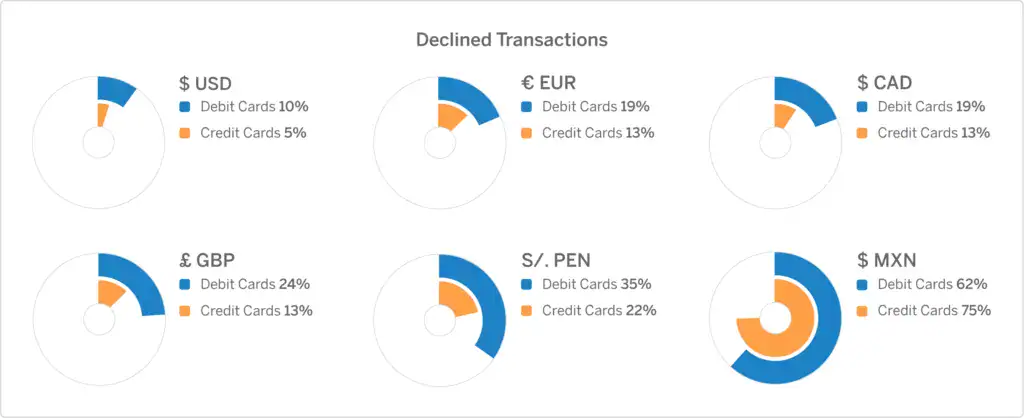
Declined Transactions By Currency And Card Type
(Reference: Medium)

Number of Cardholders and Adoption Rates

  • In 2025, approximately 82% of U.S. adults had at least one credit card.
  • Around 90% of adults held a debit card in 2024.
  • By age 25, 73% of Americans have a credit card.
  • Credit card adoption has been steadily increasing from 72% in early 2025 to 82% in the 2024 report.
  • Debit adoption exceeded credit adoption consistently (~90% vs ~82%).

Average Transaction Value and Volume

  • The average credit card transaction in 2024 was $83, compared with $70 for debit cards.
  • Credit card payment volume grew 8.2% year-over-year in 2022, outpacing GDP.
  • Credit cards account for around 31% of all payment transactions in 2025, while debit cards occupy about 30%.
  • Card spend per household rose at an SAAR of 1.6% as of April 2025.
  • YoY transaction growth per household has cooled from 2023 into early 2025, suggesting moderation.
  • In‑person credit card payments under $25 surged 76% from 2016 to 2024, while debit payments for the same category dropped 13%.
  • The median U.S. credit card holder spends approximately $2,500–$3,000 per month, with higher-income households spending significantly more.
  • Tap-to-pay speeds checkout by 40-60%, boosting credit card utility.

Market Share of Debit and Credit Card Brands

  • Visa dominates debit cards with a massive 76% market share, far ahead of Mastercard (23%) and Discover (2%).
  • Credit card usage is led by Visa (57%), followed by Mastercard (25%).
  • Discover holds 14% of the credit card market, stronger than its debit card presence.
  • American Express has a 4% share in the credit card segment, with no significant debit card presence.
Market Share Of Debit And Credit Card Brands
(Reference: Spreedly)

Total Spending by Card Type

  • Total credit card debt in the U.S. reached $1.182 trillion in Q1 2025, slightly down from $1.211 trillion in Q4 2024.
  • Credit cards handled a larger share of high-value purchases, credit equating to 73% of retail spending by value in 2024.
  • Debit card transaction value grew 84% from 2015 to 2021, while credit card volume grew 60%.
  • Visa processed $6.02 trillion in debit volume vs $5.31 trillion in credit in FY 2024.
  • Mastercard processed $4.87 trillion in debit/prepaid vs $3.64 trillion in credit during 2024.
  • Credit cards now account for 31% of all U.S. payments by number, debit cards account for 30%, with cash at 14%.
  • Credit card spending growth persistently exceeds debit growth across demographics.

Consumer Payment Preferences by Card Type

  • Credit card usage rose 48.11% from 2019 to 2024, and debit card transactions declined 0.98% over the same span.
  • Credit card usage surpassed debit for the first time in 2022.
  • Among individuals earning over $150K, credit card use is 3× higher than debit, the opposite is true for < $25K households, where debit dominates 1.9×.
  • Across all age brackets, credit card use is 3–9% higher than debit use.
  • In small purchases (< $25), credit usage surged 76% since 2016, and debit usage fell 13%.
  • Over 80% of consumers pick credit cards for rewards programs, cashback, points, and travel perks.
  • 77% prioritize fraud protection when choosing credit over debit.

Breakdown of U.S. Credit Card Debt by Age Group

  • Ages 50–59 hold the largest share of credit card debt at 22.6%.
  • Ages 40–49 follow closely with 21.9% of the total debt.
  • Ages 30–39 account for 18.0% of debt among U.S. consumers.
  • Ages 60–69 hold 17.5% of outstanding credit card balances.
  • Ages 70+ carry 12.8% of the debt load.
  • Young adults 18–29 have the smallest share, only 7.3% of total credit card debt.
Breakdown of U.S. Credit Card Debt by Age Group
(Reference: The Financial Brand)

Demographic Differences in Card Usage

  • By age 25, 73% of Americans have a credit card.
  • Gen Z and Millennials, 41% and 40% respectively, cite building credit history as a reason for credit use.
  • Individuals aged 30–39 report the highest incidence of credit‑card-related identity theft.
  • Credit card fraud per capita is highest in California (≈ $0.99) and Delaware (≈ $1.49 per person).
  • 15% of credit‑fraud victims in 2024 are people aged 80+, while 30‑39 is the most affected cohort (~111,000 cases).
  • Cardholders 60–69 reported the greatest total fraud loss ($1.18B) in 2024.

Credit Card Debt and Repayment Trends

  • Total U.S. credit card debt $1.182 trillion in Q1 2025, a slight decline from the prior quarter.
  • The average credit card interest rate in 2025 stands at 21.3%.
  • Less than half of adult cardholders carried a balance over the past 12 months.
  • Carrying balances remains common; about 73% of Americans by age 25 have credit cards, and many use them to cover expenses they can’t afford daily.
  • Interest rates have outpaced inflation, leading to rising minimum payments and longer payoff periods.
  • Rewards-driven spending contributes to escalating balances for those with revolving debt month‑to‑month.
  • BNPL via credit cards hit $133 billion in ecommerce in 2024, growing fast.
  • BNPL adoption further influences credit card utilization and debt levels among younger consumers.

Declined Card Transactions by Major U.S. Banks

  • Chase shows the highest debit card decline rate at 11.5%, with credit card declines at 5.3%.
  • US Bank has 10.2% debit card declines and 6.0% credit card declines.
  • Citi reports 9.0% debit card declines, but the lowest credit card decline rate at 4.5%.
  • Bank of America records 8.2% debit card declines and 5.0% credit card declines.
  • Wells Fargo shows 7.8% debit card declines and 5.8% credit card declines.
Declined Card Transactions by Major U.S. Banks
(Reference: Spreedly)

Rewards, Cashback, and Incentive Statistics

  • Over 80% of credit card users choose cards based on rewards programs.
  • Rewards yield about 1.6 cents per dollar spent for general-purpose cards.
  • Major issuers continue to expand bonus structures tied to travel, groceries, or gas categories.
  • BNPL growth via credit cards is encouraged by point-based financing schemes.
  • Credit incentives continue drawing higher-income users, over 3× more likely to earn travel rewards.
  • Debit cards rarely offer equivalent rewards, making credit the default for incentive-driven consumers.
  • Tap‑to‑pay programs also integrate loyalty features, boosting both ease and reward capture.

Card Usage for Online vs In‑Store Purchases

  • Credit cards account for about 64% of all U.S. online purchases, while debit cards account for around 28%.
  • In‑store purchases remain more evenly split, with debit cards used in roughly 51% of transactions and credit cards in 44%.
  • For purchases over $100 online, credit cards are used 3× more often than debit cards.
  • Debit cards dominate small in‑store transactions under $25, making up about 55% of those purchases.
  • Mobile wallet usage skews toward in‑store payments, but credit cards remain the primary funding method for these transactions.
  • Over 80% of online shoppers prefer credit cards for fraud protection and dispute resolution benefits.
  • Debit cards are more frequently linked to person‑to‑person (P2P) payment apps for in‑store bill‑splitting and small purchases.
  • The average online credit card transaction value is $121, compared to $84 for in‑store transactions.
  • The average online debit card transaction value is $76, compared to $42 for in‑store transactions.

Percentage of Active U.S. Credit Cards with a Balance

  • 40% of active U.S. credit cards carry a balance.
  • 36% of active credit cards have no balance.
  • 24% of credit cards are currently dormant and not in active use.
Percentage of Active U.S. Credit Cards with a Balance
(Reference: Zippia)

Fraud and Security Statistics

  • In 2023, an estimated 43 million U.S. adults were victims of credit or debit card fraud.
  • Roughly 63% of U.S. cardholders have been defrauded, and 51% faced fraud multiple times.
  • 46% of global credit card fraud occurs in the U.S., and domestic fraud is expected to top $12.5 billion in 2025.
  • Card-not-present transactions account for 65% of credit card fraud losses.
  • Debit card fraud accounted for roughly 30–35% of reported card fraud losses in 2023.
  • Fraud incidents surged, debit-related fraud grew 6%, with check fraud up 5%, and app-based losses up 1%.
  • 79% of U.S. organizations were targeted by payments fraud in 2024.
  • 73% of U.S. adults have experienced some form of online scam or fraud.

Impact of Fees and Costs

  • Credit card processing fees for merchants typically range from 1.10% to 3.15% per transaction.
  • U.S. merchants paid a total of $187.2 billion in swipe fees in 2024, up from $172 billion in 2023.
  • The average merchant pays around a 2.34% fee per credit card sale.
  • Debit card interchange averages 0.73% (~ 34¢ per transaction).
  • The average household paid $1,000 in card fees in 2024.
  • Credit card swipe fees have increased 50% since the pandemic.
  • Visa and Mastercard agreed to cap swipe fees in a settlement worth ~$30 billion.
  • Proposed CFPB rules aim to limit overdraft fees to as low as $3 from the current ~$35.

How U.S. Consumers Typically Pay for Purchases

  • Physical debit cards are the most common payment method, used by 49% of consumers.
  • Physical credit cards are the second most popular choice at 32%.
  • Cash or checks remain in use by 9% of respondents.
  • Virtual debit cards are used by 5% of consumers.
  • Virtual credit cards are the least common, with only 4% usage.
How U.S. Consumers Typically Pay for Purchases
(Reference: Forbes)

Regional and Country Comparisons

  • In 2024, credit cards comprised 35% of U.S. payment transactions, debit cards 30%, and cash 14%.
  • Debit card CNP fraud rose steadily in the U.S. from 2011 to 2021.
  • The U.S. ranks highest globally in credit card fraud volume.
  • Globally, digital wallet share in e-commerce rose to over 50% in 2025.
  • U.S. in-store digital wallet transactions jumped 4.3% from 2022 to 2024, reaching ~17% share.
  • Mobile wallet adoption, Google Wallet had ~48.6 million users in 2024, projected to reach ~50.9 million in 2025.

Credit Card vs Debit Card Adoption Trends Over Time

  • Credit card usage increased by 48% from 2019 to 2024, while debit dropped by ~1%.
  • Debit adoption has slightly declined as credit becomes more dominant.
  • Credit use overtook debit in total transaction volume in 2022 and has widened since.

Effects of Economic Changes on Card Usage

  • Rising grocery and household costs are pushing more Americans toward BNPL services and debit spending.
  • Average credit + debit card spending per household rose ~1% YoY in April 2025, with SAAR at 1.6%.
  • Higher-income households averaged stronger card spending growth (~2.3% YoY) than low-income households (~1.5%).

Mobile Wallet and Digital Payment Adoption by Card Type

  • Nearly 70% of online adults in the U.S. used mobile/digital payments in the past three months as of early 2025.
  • Mobile wallets account for 36.7% of online transactions, while 70% of P2P payments in the U.S. are via mobile/digital wallets.
  • For in-store purchases, 17% used mobile wallets, still low compared to credit/debit reliance.
  • QR-code mobile payments globally projected to hit $5.4 trillion in 2025, rising to $8 trillion by 2029.

Generational Trends in Credit and Debit Card Use

  • Millennials and Gen Z cite building credit history (~40–41%) as a key reason for using credit cards.
  • Older demographics (30–39, 60–69) are the most frequent victims of fraud.
  • Younger adults lean toward digital wallets and BNPL over traditional cards.

Conclusion

Credit and debit cards remain central to U.S. consumer spending today, with credit card usage continuing to grow in transaction volume, value, and market share, while debit usage remains steady or slowly declining. Fraud trends are shifting toward card-not-present transactions, especially affecting debit systems, even as fraud protection remains a strong credit card incentive. Swipe fees and processing costs continue to burden consumers and merchants, raising policy debates and signals of regulatory reforms ahead.

Mobile and digital wallets are gaining ground, particularly online and in P2P use, shifting part of the payments mix. Generational preferences and economic pressures are shaping future behavior. Understanding these dynamics now can help consumers, merchants, and policymakers align strategies in a changing payments landscape.


Definition of Gas Fee. Link to full glossary entry follows the description.Gas Fee

A gas fee is the transaction cost paid to Ethereum validators for the computational effort needed to process and confirm blockchain operations.

Read more

This article has been reviewed and fact-checked by Kathleen Kinder. CoinLaw follows strict Publishing Principles and a documented Fact-Check Policy to ensure accuracy, transparency, and editorial independence across all content. Our statistics are verified using a documented Research Process.

Add CoinLaw as a Preferred Source on Google for instant updates! Follow on Google News
Share ChatGPT Perplexity

References

  • Statista
  • Statista
  • Statista
  • TD Bank
  • CNBC
  • CardRates.com
  • Yahoo Finance
Barry Elad

Barry Elad

Founder & Senior Journalist


Barry Elad is a finance and tech journalist who loves breaking down complex ideas into simple, practical insights. Whether he's exploring fintech trends or reviewing the latest apps, his goal is to make innovation easy to understand. Outside the digital world, you'll find Barry cooking up healthy recipes, practicing yoga, meditating, or enjoying the outdoors with his child.

Related Posts

Digital Wallets vs. Bank Accounts Statistics 2026: Insights That Will Surprise You
Payments

Digital Wallets vs. Bank Accounts Statistics 2026: Insights That Will Surprise You

Credit Card Rewards Programs Statistics 2026: Smart Insights Now
Payments

Credit Card Rewards Programs Statistics 2026: Smart Insights Now

Credit Card Debt Statistics 2026: Big Insights
Payments

Credit Card Debt Statistics 2026: Big Insights

Disclaimer: The content published on CoinLaw is intended solely for informational and educational purposes. It does not constitute financial, legal, or investment advice, nor does it reflect the views or recommendations of CoinLaw regarding the buying, selling, or holding of any assets. All investments carry risk, and you should conduct your own research or consult with a qualified advisor before making any financial decisions. You use the information on this website entirely at your own risk.

Reader Interactions

Leave a Comment Cancel reply

Primary Sidebar

Connect With Us

facebook x linkedin google-news telegram pinterest whatsapp email
google-preferred-source-badge Add as a preferred source on Google

You Should Also Read

Credit Card Industry Statistics 2026: Explosive Growth
Cash Payments vs. Digital Payments Statistics 2026: What You Need to Know
BNPL vs. Credit Cards Statistics 2026: What’s Better?

Table of Contents

  • Editor’s Choice
  • Recent Developments
  • US Primary Payment Card Usage by Income Level
  • Credit Card Usage Statistics
  • Debit Card Usage Statistics
  • Declined Transactions by Currency and Card Type
  • Number of Cardholders and Adoption Rates
  • Average Transaction Value and Volume
  • Market Share of Debit and Credit Card Brands
  • Total Spending by Card Type
  • Consumer Payment Preferences by Card Type
  • Breakdown of U.S. Credit Card Debt by Age Group
  • Demographic Differences in Card Usage
  • Credit Card Debt and Repayment Trends
  • Declined Card Transactions by Major U.S. Banks
  • Rewards, Cashback, and Incentive Statistics
  • Card Usage for Online vs In‑Store Purchases
  • Percentage of Active U.S. Credit Cards with a Balance
  • Fraud and Security Statistics
  • Impact of Fees and Costs
  • How U.S. Consumers Typically Pay for Purchases
  • Regional and Country Comparisons
  • Credit Card vs Debit Card Adoption Trends Over Time
  • Effects of Economic Changes on Card Usage
  • Mobile Wallet and Digital Payment Adoption by Card Type
  • Generational Trends in Credit and Debit Card Use
  • Conclusion
Connect on Telegram

Footer

CoinLaw Logo

Bringing Finance Closer to You.

Connect With Us

Follow Us on Google News

Editorial & Trust

  • About
  • Publishing Principles
  • Fact-Check Policy
  • Corrections Policy
  • Ethics Policy
  • Disclaimer
  • Cookie Policy

Worth Checking

  • Best Cloud Mining Platforms
  • Millennial vs. Gen Z Banking
  • Ethereum Gas Fees Statistics
  • Binance vs. Coinbase Statistics
  • Zelle vs. Venmo Statistics
  • Traditional Banks vs. Neobanks
  • Crypto Exchange Hack Statistics
Contact Us
13570 Grove Dr #189,
Maple Grove, MN 55311,
United States
10 a.m. – 6 p.m. | Every day

Copyright © 2024–2026 CoinLaw. All Rights Reserved. Powered by the HODL Force ❤️

  • Privacy Policy
  • Terms
Manage your privacy

To provide the best experiences, we and our partners use technologies like cookies to store and/or access device information. Consenting to these technologies will allow us and our partners to process personal data such as browsing behavior or unique IDs on this site and show (non-) personalized ads. Not consenting or withdrawing consent, may adversely affect certain features and functions.

Click below to consent to the above or make granular choices. Your choices will be applied to this site only. You can change your settings at any time, including withdrawing your consent, by using the toggles on the Cookie Policy, or by clicking on the manage consent button at the bottom of the screen.

Functional Always active
The technical storage or access is strictly necessary for the legitimate purpose of enabling the use of a specific service explicitly requested by the subscriber or user, or for the sole purpose of carrying out the transmission of a communication over an electronic communications network.
Preferences
The technical storage or access is necessary for the legitimate purpose of storing preferences that are not requested by the subscriber or user.
Statistics
The technical storage or access that is used exclusively for statistical purposes. The technical storage or access that is used exclusively for anonymous statistical purposes. Without a subpoena, voluntary compliance on the part of your Internet Service Provider, or additional records from a third party, information stored or retrieved for this purpose alone cannot usually be used to identify you.
Marketing
The technical storage or access is required to create user profiles to send advertising, or to track the user on a website or across several websites for similar marketing purposes.
Statistics

Marketing

Features
Always active

Always active
  • Manage options
  • Manage services
  • Manage {vendor_count} vendors
  • Read more about these purposes
Manage options
  • {title}
  • {title}
  • {title}
Manage your privacy
To provide the best experiences, we use technologies like cookies to store and/or access device information. Consenting to these technologies will allow us to process data such as browsing behavior or unique IDs on this site. Not consenting or withdrawing consent, may adversely affect certain features and functions.
Functional Always active
The technical storage or access is strictly necessary for the legitimate purpose of enabling the use of a specific service explicitly requested by the subscriber or user, or for the sole purpose of carrying out the transmission of a communication over an electronic communications network.
Preferences
The technical storage or access is necessary for the legitimate purpose of storing preferences that are not requested by the subscriber or user.
Statistics
The technical storage or access that is used exclusively for statistical purposes. The technical storage or access that is used exclusively for anonymous statistical purposes. Without a subpoena, voluntary compliance on the part of your Internet Service Provider, or additional records from a third party, information stored or retrieved for this purpose alone cannot usually be used to identify you.
Marketing
The technical storage or access is required to create user profiles to send advertising, or to track the user on a website or across several websites for similar marketing purposes.
Statistics

Marketing

Features
Always active

Always active
  • Manage options
  • Manage services
  • Manage {vendor_count} vendors
  • Read more about these purposes
Manage options
  • {title}
  • {title}
  • {title}
Company
  • About Us
  • Our Team
  • Our Mission
  • Core Values
Discover
  • glossary icon
    Glossary
  • Stats
    Stats Research Process
  • Brand Guide Icon
    Brand Assets
Categories
  • Cryptocurrency
  • Payments
  • Finance
  • Banking
  • Insurance
Cryptocurrency
Coinbase vs Kraken Statistics 2026: Volume, Fees, Licenses
Solana vs Ethereum Statistics 2026: TVL, Fees, Validators, ETFs
Uniswap vs PancakeSwap Statistics 2026: Head-to-Head DEX Data
Cryptojacking Statistics 2026: 80+ Cloud, Cost & Threat Numbers
MetaMask vs Phantom Wallet Statistics 2026: Big Growth Data
Crypto Wallet Ecosystem Statistics 2026: Addresses, Security, Adoption
Payments
Toast Statistics 2026: ARR, GPV & Revenue Data
Rapyd Statistics 2026: TPV, Valuation & Licences
Marqeta Statistics 2026: TPV, Revenue and Customer Mix
Digital Payments Statistics 2026: Market Size, Users, and Growth
Cash App vs Venmo vs Zelle Statistics 2026: What You Must Know Now
Worldpay Statistics 2026: Massive Payment Growth
Finance
Emergency Fund Statistics 2026: How Much Americans Have Saved (and How Much They Should)
Financial Advisor Statistics 2026: Headcount, AUM, and Demographics
Wealth Inequality Statistics 2026: Hidden Wealth Divide
Blockchain in Supply Chain Finance Statistics 2026: Trade Breakthrough
Blockchain in Healthcare Finance Statistics 2026: Cost Breakthrough
AI-Powered Robo Trading Statistics 2026: Big Insights
Banking
N26 Statistics 2026: Customers, Deposits, Revenue and the BaFin Growth Cap
Revolut vs Monzo Statistics 2026: Customers & Profit
Islamic Banking Statistics 2026: Assets, Growth, and Top Markets
Credit Union Statistics 2026: Assets, Members, Loans
Banking API Statistics 2026: Market Size, Adoption, and Growth
Citigroup Statistics 2026: Growth Secrets Inside
Insurance
Lemonade Insurance Statistics 2026: Customers, In-Force Premium, Loss Ratio, Pet & Auto Segments
Chubb Statistics 2026: Powerful Data Insights
Virtual Reality In Insurance Statistics 2026: Innovations, Risks, and Opportunities
US Life Insurance Industry Statistics 2026: Growth Facts
US Auto Insurance Industry Statistics 2026: What You Must Know Now
UK Insurance Industry Statistics 2026: Growth Data
Categories
  • Cryptocurrency
  • Investments
  • Compliance
  • Fintech
  • Finance
Cryptocurrency
Kraken Launches Seamless On Chain Trading for Solana Tokens
Bitcoin Rodney Pleads Guilty in Massive $1.8B Crypto Scam
Aztec Hit by Second $2.1M Hack in Days as Bridge Drained
Tether Ends aUSDT Stablecoin as It Refocuses on XAUT Growth
CME Sues CFTC in High Stakes Battle Over Crypto Perps
Bhutan Transfers 533 BTC to Binance as Bitcoin Holdings Shrink
Investments
Ark Invest Buys $18M Coinbase Shares, Dumps Robinhood
Nvidia Unveils Huge $20B Bond Raise to Power AI Growth
Binance SpaceX IPO Offer Attracts Massive $557M Demand
Metaplanet Acquires Siiibo in Major Bitcoin Expansion Move
Morpho Raises $175M at $2B Value as MORPHO Token Jumps
Pyth Launches Groundbreaking 24/7 Stock and Commodity Indices
Compliance
Kentucky Sues Kalshi and Polymarket Over Illegal Sports Bets
Judge Deals Blow to Michelle Bond in FTX Campaign Case
BitGo Opens Fast Track to MiCA Compliance for Crypto Firms
Binance Could Lose EU Access After Reported MiCA Rejection
New York Moves to Align Stablecoin Rules With GENIUS Act
Polymarket Faces Major Blow as South Korea Probes Users
Fintech
Calais Makes History With UBS uMINT Collateral on Bybit
Bybit Unveils Powerful Broker API With Ultra Low Latency Access
Bitget and xStocks Bring SpaceX IPO Access Onchain
Bybit Launches IPO Express With Tokenized SpaceX Access
Pred Launches Sports Prediction Markets for FIFA World Cup
JPMorgan, Citi, BofA to Build Blockchain Deposit Network
Finance
Coinbase Sparks New Race With 1:1 Backed Tokenized Stocks
Bitmine Launches $300M Preferred Stock to Buy More ETH
Coinbase Lists SpaceX Pre IPO Perpetual Futures
Binance Expands Into US Stocks With New bStocks Service
SEC Clears Paxos to Settle U.S. Stocks on Blockchain
Mastercard Expands Stablecoin Strategy With NY BitLicense
Newsletter Img

Too much noise in crypto?

We respect your time. You get one high-impact briefing a week. If the market is quiet, so are we.

✅ Join readers from Visa, Vanguard, and the FDIC.
Newsletter Img

The Weekly Briefing

We track the market 24/7. You get a 5-minute summary. If it’s quiet, we skip it.

✅ Read by pros at Visa, Vanguard, and the FDIC.