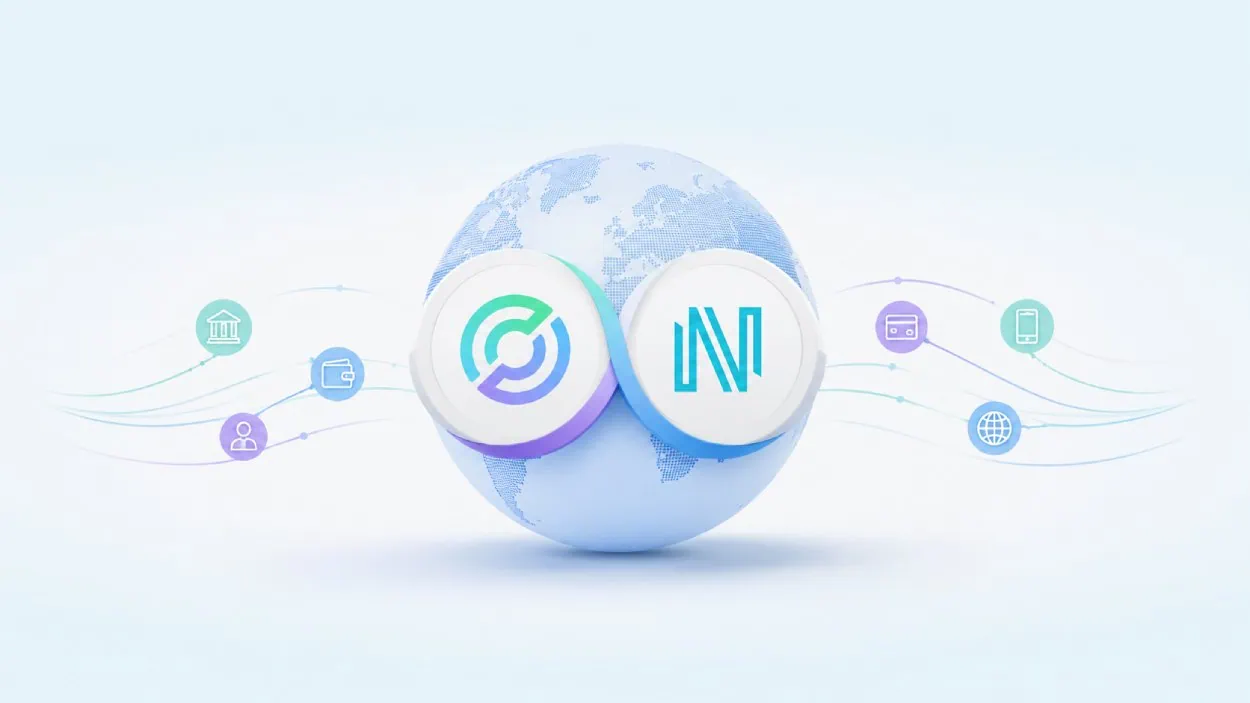






Circle and Nium have partnered to connect USDC settlement with real time global payout infrastructure, allowing financial institutions to move money faster across more than 190 countries.
Key Takeaways
- Circle and Nium announced a new partnership focused on global USDC powered payments.
- Nium joined Circle Payments Network to support payouts in over 190 countries and 100 currencies.
- The integration aims to reduce prefunding needs and simplify cross border transactions for institutions.
- Circle Payments Network has reached $8.3 billion in annualized transaction volume as institutional USDC adoption grows.
What Happened?
Circle Internet Group and global payments infrastructure provider Nium announced a strategic partnership to combine stablecoin settlement with global payout capabilities. The partnership integrates Nium into the Circle Payments Network (CPN) as a global payout partner.
The collaboration allows financial institutions to use USDC-powered settlement together with Nium’s payout infrastructure through a single integration. The companies say this will improve payment speed, transparency, and operational efficiency for banks, fintech firms, and enterprises handling international transactions.
Circle 🤝 @NiumGlobal
— Circle (@circle) May 27, 2026
Nium is joining Circle Payments Network (CPN), connecting USDC settlement to Nium’s global payout infrastructure across 190+ countries and 100 currencies.
For CPN participants, this can support:
→ Faster end-to-end payments
→ Reduced prefunding across…
Circle and Nium Expand Cross Border Payment Infrastructure
The new partnership focuses on solving one of the biggest issues in global payments, which is connecting fast settlement systems with reliable local payout networks. Through the integration, institutions using Circle Payments Network can now route transactions directly into Nium’s infrastructure for local currency delivery.
According to the announcement, Nium’s network supports payouts across more than 190 countries and in 100 currencies. Funds can be delivered into bank accounts, digital wallets, and cards worldwide using real time payout rails.
The integration also introduces built in FX optimization and smart routing, which can help institutions avoid managing multiple local payment providers across different regions.
The companies said this structure removes the need for fragmented integrations and reduces reliance on prefunded accounts across payment corridors.
Circle Payments Network Continues to Grow
Circle stated that its Circle Payments Network has reached $8.3 billion in annualized transaction volume based on trailing 30 day activity as of March 31, 2026. The company said the figure reflects rising institutional demand for stablecoin-based payment infrastructure.
The network is designed to support regulated global payments using USDC, Circle’s dollar backed stablecoin. Circle positions CPN as an institutional network that combines compliance features with blockchain based settlement.
As part of the partnership, financial institutions connected to CPN will now gain direct access to Nium’s payout capabilities through a single system integration.
The companies highlighted several advantages for institutions using the combined infrastructure:
- Faster end-to-end payment flows using USDC settlement.
- Reduced prefunding requirements across global payment corridors.
- Access to worldwide payout infrastructure through one integration.
- Real time transaction tracking with onchain transparency.

Executives Highlight Institutional Stablecoin Adoption
Nium Founder and CEO Prajit Nanu said the partnership reflects the growing convergence between traditional financial infrastructure and blockchain based payment systems. Prajit Nanu said:
Circle Chief Commercial Officer Kash Razzaghi said financial institutions are increasingly exploring stablecoins to improve payment efficiency. Kash Razzaghi said:
Why This Matters for Stablecoin Payments?
The partnership highlights how stablecoins are increasingly moving beyond crypto trading and into enterprise payment infrastructure. Companies are now focusing on real world financial use cases where blockchain settlement can reduce delays and operational costs tied to traditional cross border payments.
For Circle, the deal strengthens the utility of USDC within institutional finance. For Nium, joining Circle Payments Network expands its role in supporting blockchain enabled payment flows for global businesses.
As competition in stablecoin payments increases, partnerships like this could accelerate adoption among banks and fintech companies looking for faster and more efficient international transaction systems.
CoinLaw’s Takeaway
In my experience, one of the biggest barriers to stablecoin adoption has always been the final delivery layer. Sending digital dollars quickly means little if institutions still face delays, fragmented providers, and expensive settlement systems when moving money globally. I found this partnership important because it focuses on solving that exact issue.
Circle already has strong momentum with USDC, and Nium brings a massive real world payout network into the picture. Together, they are building infrastructure that looks much closer to a practical replacement for older cross-border payment systems. If institutional demand for stablecoin payments keeps growing, partnerships like this may become a major driver for mainstream blockchain adoption in finance.