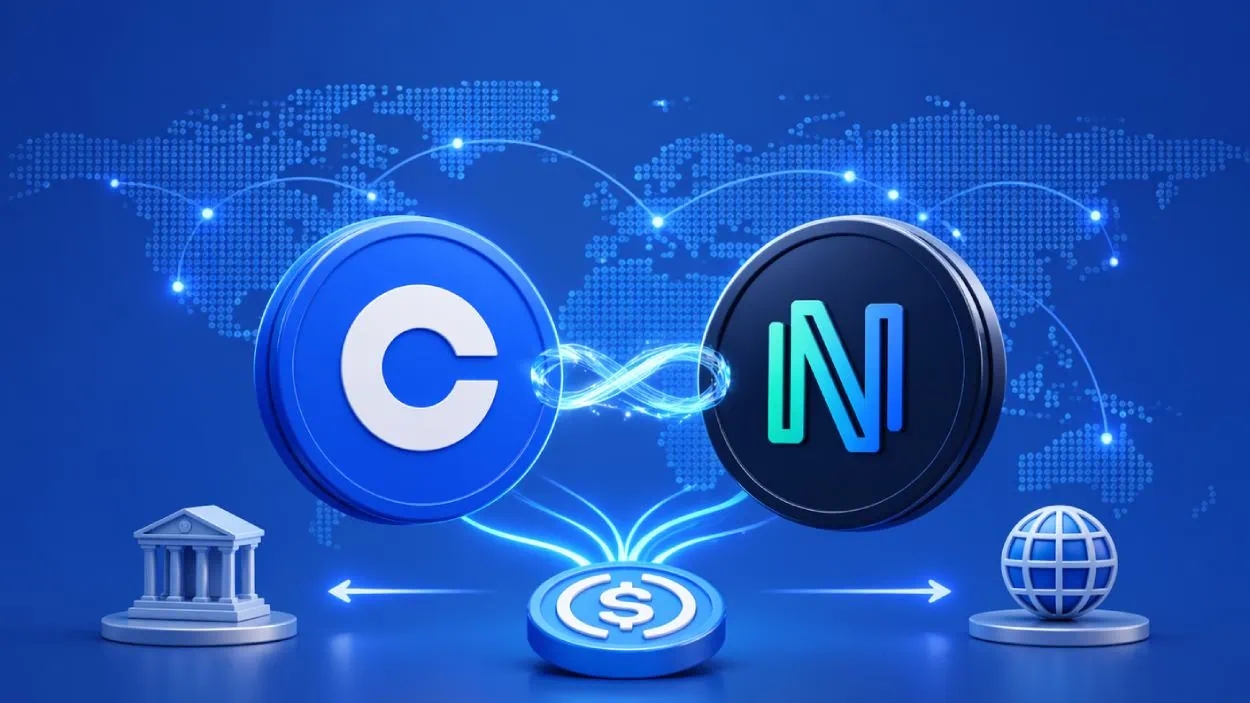






Nium has partnered with Coinbase to integrate USDC stablecoin capabilities into its global payments platform, enabling faster and more efficient cross border transactions.
Key Takeaways
- Nium and Coinbase have launched a live integration enabling USDC based cross border payments.
- Businesses can now fund payouts in stablecoins and settle in fiat or USDC in real time.
- The solution removes the need for prefunding accounts, improving capital efficiency.
- The partnership supports 190 plus countries and introduces stablecoin backed card payments.
What Happened?
Nium announced a partnership with Coinbase to integrate stablecoin payments into its cross-border infrastructure. The integration allows businesses to send, receive, and convert USDC within a unified platform that connects both blockchain and traditional payment systems.
The solution is already live and gives enterprises access to real time settlement, improved liquidity management, and simplified global payouts without relying on legacy banking delays.
We’re excited to see @NiumGlobal integrate @Coinbase‘s stablecoin payment infrastructure, enabling their customers to fund cross-border payouts in USDC and settle in local fiat across Nium’s global network of 190+ countries.
— Coinbase Developer Platform🛡️ (@CoinbaseDev) April 21, 2026
No prefunding. No wire delays. Stablecoin payment… https://t.co/E3o0HzuLbC
Stablecoins Move Into Core Payment Systems
The collaboration between Nium and Coinbase signals a broader shift in financial infrastructure. Stablecoins are no longer limited to trading and are now becoming part of everyday payment operations.
By embedding USD Coin directly into its platform, Nium allows clients to transact across both onchain and fiat rails without switching systems. Coinbase provides the backend infrastructure, including liquidity, custody, wallet services, and regulated compliance frameworks.
This setup enables businesses to manage payments, treasury functions, and currency conversions within a single environment, reducing operational complexity.
Just In Time Settlement Replaces Prefunding
Traditional cross-border payment systems often require companies to hold funds in multiple local accounts in advance. This prefunding model ties up capital and creates inefficiencies.
With the new integration, businesses can fund transactions using USDC and convert funds at the point of payout. This introduces a just in time liquidity model, allowing firms to deploy capital only when needed.
Key benefits include:
- Same day or near instant settlement, replacing delays of one to three days.
- Improved capital efficiency by reducing idle balances.
- Dynamic treasury management across multiple markets.
The system also offers transparent and auditable transactions through blockchain-based tracking.

Unified Infrastructure Across 190 Countries
Nium’s global network spans over 190 countries and supports more than 100 currencies. By connecting stablecoin balances directly to this network, businesses can seamlessly move funds across borders.
The integration simplifies complex processes such as:
- Managing liquidity providers.
- Handling regulatory compliance.
- Operating multiple payment systems.
Instead, companies can rely on a single platform that combines traditional financial rails with blockchain technology.
Stablecoin Cards Expand Real World Usage
Another key feature of the partnership is the launch of USDC-backed card programs. Businesses holding stablecoin balances can now use them for everyday transactions through global card networks.
This allows:
- Payments at millions of merchant locations worldwide.
- Conversion from stablecoin to fiat at the point of sale.
- Seamless use of digital assets in real world spending.
The feature builds on Nium’s earlier efforts to expand stablecoin utility beyond settlement and into daily financial operations.
Industry Leaders Highlight Multi Rail Future
Prajit Nanu, CEO and Founder of Nium, said:
Alec Lovett, Head of Infrastructure Products at Coinbase, added:
Their comments reflect a growing industry view that multi rail systems, which combine blockchain and traditional finance, will define the next phase of global payments.
CoinLaw’s Takeaway
In my experience, this is one of the clearest signs that stablecoins are moving from hype to real utility. What stands out to me is not just the technology, but how seamlessly it is being integrated into existing financial systems.
I found that the biggest win here is capital efficiency. Businesses no longer need to lock money across different countries just to keep operations running. That alone can change how global companies manage cash flow.
At the same time, reliance on integrated platforms like Coinbase and Nium will raise new questions around control, pricing, and compliance. Still, I believe this model is exactly where global payments are heading.