





Picture this: a world where every dollar, euro, or yen is digitized and seamlessly accessible through your phone. As financial technology evolves, Central Bank Digital Currencies (CBDCs) are becoming a hot topic, reshaping the future of money. These digital currencies promise to enhance transaction efficiency, financial inclusion, and transparency. With countries across the globe pushing forward with CBDC developments, it’s clear that this innovation is more than just a concept; it’s a revolution in how economies operate.
Editor’s Choice
- 146 countries and currency unions, representing over 98% of global GDP, are exploring a CBDC as of May 2026.
- Only 3 countries have fully launched a retail CBDC so far: The Bahamas, Jamaica, and Nigeria.
- The Bahamas’ Sand Dollar remains one of just 3 officially issued retail CBDCs globally in 2026.
- Jamaica’s JAM-DEX also remains among the world’s only 3 officially launched retail CBDCs.
- India’s e-Rupee in circulation reached ₹1,016 crore by March 2025, up over 330% year over year.
- India’s digital rupee now serves around 5 million users across 16 participating banks, making it one of the world’s largest CBDC pilots by user base.
- The ECB said that if digital euro legislation is adopted in 2026, pilot transactions could begin in 2027.
- The Eurosystem aims to be ready for a potential first issuance of the digital euro in 2029.
- The ECB estimates total digital euro development costs at about €1.3 billion until first issuance, with annual operating costs near €320 million from 2029.
Recent Developments
- Nigeria remains one of only 3 countries with a fully launched CBDC as of May 2026.
- Jamaica also remains among the just 3 countries worldwide with a live retail CBDC in 2026.
- JAM-DEX still accounts for only about 0.1% of Jamaica’s total money in circulation in early 2026, underscoring limited retail uptake so far.
- The ECB received over 50 applications from payment service providers for its digital euro pilot by March 2026.
- The digital euro pilot is scheduled to run for 12 months starting in the second half of 2027, with the Eurosystem aiming for potential first issuance in 2029 if legislation is adopted.
- The ECB plans to announce the outcome of its pilot participant screening in July 2026.
- The ECB published its call for digital euro pilot participation on 5 March 2026.
- The ECB released back-end specifications for the digital euro pilot on 23 April 2026.
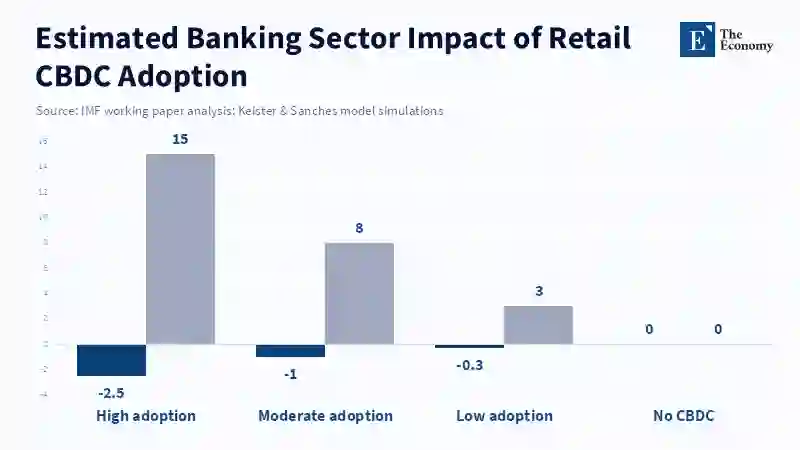
Estimated Banking Sector Impact of Retail CBDC Adoption
- High retail CBDC adoption could reduce banking sector stability metrics by -2.5%, while associated systemic impact indicators may rise to 15 points.
- Under moderate CBDC adoption, the banking sector impact declines to -1%, with secondary effects measured at around 8 points.
- Low CBDC adoption results in only a -0.3% banking sector impact, alongside a relatively small secondary impact value of 3.
- In a no CBDC scenario, the banking sector shows 0% impact, indicating no measurable disruption or systemic effect.
- The data suggests that higher CBDC adoption levels correlate with stronger pressure on traditional banking systems.
- IMF-based simulations indicate that widespread retail CBDC usage may lead to deposit migration away from commercial banks, especially in high-adoption environments.
- The gap between the 15-point high-adoption impact and the 3-point low-adoption impact highlights how significantly adoption rates can influence financial sector dynamics.
Digital Currency Market Share Insights
- North America leads globally with 37.0% market share in 2026.
- Bitcoin holds 41.6% of the cryptocurrency market in 2026 due to its first-mover advantage.
- Hardware dominates with 69.8% share by component in 2026.
- The global digital currency market is valued at $38.46 billion in 2026.
- The cryptocurrency market is valued at $51.85 billion in 2026, projected to reach $78.48 billion by 2033.
- Stablecoins account for roughly 7% of total cryptocurrency market capitalization in 2026.
- 97% of stablecoins are pegged to the US dollar.
- Two stablecoins, USDT and USDC, dominate 90% of the stablecoin market.
- User penetration will be 12.63% in 2026 with 993.64 million users worldwide.

CBDC Use Cases
- 146 countries and currency unions, representing over 98% of global GDP, are exploring a CBDC as of May 2026.
- China’s e-CNY had 230 million wallets by November 2025 and became interest-bearing starting January 1, 2026.
- Project mBridge cross-border CBDC transaction volume surged to $55.49 billion, a 2,500-fold increase from early-2022 pilots.
- The ECB aims for pilot transactions starting mid-2027, with potential first issuance during 2029.
- The ECB estimates digital euro development costs at about €1.3 billion until first issuance, with annual operating costs near €320 million from 2029 onward.
- Only 3 countries have fully launched retail CBDCs: The Bahamas (Sand Dollar), Jamaica (JAM-DEX), and Nigeria (eNaira).
- Sweden’s cash usage dropped to just 8% of the population in 2022, with over 80% using Swish mobile payments.
Global CBDC Development Status
- 146 countries and currency unions, representing over 98% of global GDP, are exploring a CBDC as of May 2026.
- 3 countries have fully launched retail CBDCs: Bahamas (Sand Dollar), Jamaica (JAM-DEX), and Nigeria (eNaira).
- 49 CBDC pilots are ongoing globally, reaching a new high in 2025.
- 66 countries are in the advanced phase (launch, pilot, or development), up from earlier years.
- 19 of the 20 G20 countries are exploring CBDCs, with 19 in the advanced stage of development.
- 13 G20 countries are actively piloting CBDCs, including Japan, India, Australia, South Korea, and Turkey.
- 44 CBDC pilots are in operation as of September 2024, with European countries leading testing efforts.
- 2 CBDCs have been implemented and abandoned: Finland and Ecuador.
- China’s e-CNY processed over 7 trillion yuan ($986 billion) by June 2024, four times the 2023 volume.
- India’s e-Rupee circulation reached ₹1,016 crore (₹10.16 billion, about $122 million) by March 2025, up over 330% from 2024.

Regional Breakdown of CBDC Transactions
- 146 countries representing over 98% of global GDP are exploring CBDCs as of May 2026.
- China’s e-CNY processed over 3.4 billion transactions worth about ¥16.7 trillion (~$2.3 trillion) by November 2025, dominating global CBDC volume.
- e-CNY represents approximately 95.3% of Project mBridge’s total cross-border settlement volume at $55.49 billion.
- North America held approximately 24.3% of the CBDC infrastructure market in 2025.
- North America’s digital currency market is projected to grow at a 20.0% CAGR from 2025 to 2033.
- 49 CBDC pilot projects are active globally as of May 2026, reaching a new high in recent years.
- Only 3 countries have fully launched retail CBDCs: Bahamas, Jamaica, and Nigeria.
- Latin America and the Caribbean has 85% of central banks engaged in CBDC research.
- Nearly two-thirds of Middle East and Central Asia countries are exploring CBDC adoption.
CBDC vs Cryptocurrency
- The global cryptocurrency market cap is $2.7 trillion in 2026, with Bitcoin at $1.56 trillion, representing 57.89% dominance.
- Bitcoin prices average $72,347–$77,234 in 2026, far more volatile than fiat-pegged CBDCs.
- Tether (USDT) holds $184 billion in circulating supply, the largest stablecoin, while USDC reached $80 billion.
- The global stablecoin market surged to $311 billion in total supply, an all-time high as of January 2026.
- Bitcoin consumes 87–150 TWh annually, comparable to Finland or the Netherlands, while CBDCs use centralized systems with minimal energy.
- 53% of Bitcoin mining electricity is renewable (hydro/nuclear), but proof-of-work remains energy-intensive compared to CBDCs.
- USDC processed $2.2 trillion in adjusted transaction volume in 2026, surpassing USDT’s $1.3 trillion.
- The industry is moving toward a hybrid model where CBDCs serve as the settlement layer for inter-bank transactions while cryptocurrencies operate on top.
- 146 countries are exploring CBDCs to counter private stablecoins and maintain monetary sovereignty.
Global Currency Share Breakdown
- The US dollar comprises 56.77% of allocated global foreign exchange reserves as of Q4 2025.
- The euro holds 20.25% of allocated reserves, remaining the second-largest reserve currency.
- The Chinese renminbi increased to 1.95% of global reserves in Q4 2025, up from 1.92% the previous quarter.
- Combined USD and euro account for nearly 77% of total foreign exchange reserves worldwide.
- Gold recently surpassed the euro as the second most important reserve asset, overtaking the euro in global reserve portfolios.
- The yuan ranked the 4th most active payment currency in December 2025, with 3.75% of global payments via SWIFT.
- The US dollar accounted for 49% of global payment share in December 2025, while the euro held 21.74%.
- The Japanese yen, British pound, Australian dollar, Canadian dollar, and Swiss franc collectively comprise 14.90% of reserves.
- The “other currencies” category (unidentified) increased to 6.13% of reserves, more than doubling since 2021.

Assessing Potential Transactional Demand for CBDC
- CBDC transactions are forecast to reach $213 billion annually by 2030, up from just $100 million in 2023, a 260,000% increase.
- Domestic payments are projected to account for 92% of CBDC transactions by 2030.
- China’s e-CNY processed about 3.4–3.5 billion transactions worth ¥16.7 trillion (~$2.3–$2.37 trillion) by November 2025.
- e-CNY became interest-bearing starting January 1, 2026, reclassified as digital deposit money with deposit insurance protection.
- 146 countries representing over 98% of global GDP are exploring CBDCs as of May 2026.
- 91% of 93 surveyed central banks are exploring retail CBDCs per the BIS 2025 survey.
- Only 3 countries have fully launched retail CBDCs: Bahamas, Jamaica, and Nigeria.
- mBridge executed 4,047 cross-border payments totaling ¥387.2 billion ($54.21 billion), with e-CNY at 95.3% of volume.
- The digital yuan wallet market is projected to reach ¥1 trillion by 2030, growing at a 25% CAGR.
Drivers of Demand for CBDC as a Means of Payment
- The global remittance market is valued at $751.49 billion in 2026, projected to reach $814.58 billion by 2035.
- 65% of remittance transfers are now conducted via online platforms, driven by digitalization and mobile payments adoption.
- The digital remittance market will reach $278.17 billion in 2026, growing at 4.24% CAGR to $342.35 billion by 2031.
- India’s e-Rupee pilot has approximately 5 million CBDC users across 16 participating banks as of January 2026.
- India’s cash propensity is 17% (cash withdrawn to GDP ratio), with e-Rupee expected to shift toward digital payments.
- A slight majority of US consumers are receptive to a US CBDC, but widespread adoption requires no fees, wide acceptance, and high security and privacy.
- China’s digital yuan processed over 3.4 billion transactions worth roughly ¥16.7 trillion (~$2.3 trillion) by December 2025.
- 146 countries representing over 98% of global GDP are exploring CBDCs as of May 2026.
- mBridge handled 4,047 transactions for around $55 billion, with e-CNY at 95.3% of volume.
- Europe’s digital euro will launch between 2026 and 2029, while the US likely ranks behind countries already developing retail CBDCs.
Objections and Concerns Regarding CBDCs
- 91% of 93 surveyed central banks are exploring retail CBDCs, but cybersecurity and privacy remain top challenges per the BIS 2025 survey.
- The U.S. House passed a bill in July 2024 prohibiting the Federal Reserve from issuing a digital dollar, citing privacy concerns.
- 63% of CFA Institute charterholders are concerned about data privacy with CBDCs, ranking it a top concern.
- 91% of central banks cite operational resilience and cybersecurity as key risks for CBDCs.
- The ECB plans to complete a digital euro pilot by 2028 and aims to be ready for potential first issuance in 2029, subject to European Parliament approval and legislation.
- The ECB completed its preparation phase in late 2025 and plans a digital euro pilot phase running roughly from 2027 to 2028, ahead of potential first issuance in 2029.
- 146 countries representing over 98% of global GDP are exploring CBDCs as of May 2026.
- Only 3 countries have fully launched retail CBDCs: Bahamas, Jamaica, and Nigeria.
- Citizens could pull too much money from banks at once by purchasing CBDCs, triggering a bank run and affecting lending capacity.
- CBDCs require a complex regulatory framework, including privacy, consumer protection, and anti-money laundering standards.

Impact on Financial Inclusion and Accessibility
- 1.3 billion adults remain unbanked globally as of 2024, down from 1.4 billion previously, with 79% of adults now having financial accounts.
- 650 million unbanked adults are concentrated in just 8 countries: Bangladesh, China, Egypt, India, Indonesia, Mexico, Nigeria, and Pakistan.
- Financial inclusion in Sub-Saharan Africa rose from 34% in 2014 to 58% in 2024, with 40% having mobile money accounts.
- Nigeria’s eNaira has only 700,000 downloads despite a population of over 200 million, reflecting low adoption rates.
- India’s e-Rupee has approximately 5 million CBDC users across 16 participating banks as of January 2026.
- Global remittances to EMDEs reached $630 billion in 2022, with CBDCs expected to reduce costs and improve efficiency.
- Sub-Saharan Africa has the highest remittance cost globally at just under 8% of the transfer amount.
- 146 countries representing over 98% of global GDP are exploring CBDCs as of May 2026.
- Only 3 countries have fully launched retail CBDCs: Bahamas, Jamaica, and Nigeria.
Transaction Cost and Time Reduction Benefits
- mBridge processed $55.49 billion in cross-border transactions, with 95.3% in e-CNY, demonstrating near-instant settlement.
- The G20 targets reducing retail cross-border payment costs to below 1% by the end of 2027, down from globally average 6.27% today.
- Global remittance costs average 6.27% of the $800 billion transferred annually.
- 80 countries have adopted real-time payment networks providing 24/7 instant payments to consumers and businesses.
- Wholesale CBDC twin projects lowered settlement costs by over 50% in Singapore and Hong Kong trials.
- eNaira has processed over 500,000 transactions worth over $1 million, with 100% offline capability for users without internet.
- China’s e-CNY processed 3.4 billion transactions worth about ¥16.7 trillion (~$2.3–$2.37 trillion) by December 2025 in near-real time.
- 146 countries representing over 98% of global GDP are exploring CBDCs, with 49 pilots in operation.
- Stablecoin market cap reached $300 billion in 2026, up from $31 billion in 2021, offering lower fees for cross-border payments.
Building Trust in CBDCs
- Sand Dollar reached around 150,000 wallets (about 35% of adults) by late 2023, with more than 100,000 active wallets (about 25% of the population) and over 1,800 merchants by 2024.
- 146 countries representing over 98% of global GDP are exploring CBDCs as of May 2026.
- Only 3 countries have fully launched retail CBDCs: Bahamas, Jamaica, and Nigeria.
- 91% of 93 surveyed central banks are exploring retail CBDCs, but low adoption and weak public trust remain top challenges.
- Jamaica’s JAM-DEX is one of just 3 retail CBDCs globally, launched in 2022 with offline payment capability.
- The Bahamas’ Sand Dollar launched in October 2020, the world’s first retail CBDC, with no fees and 100% offline capability.
- About $1.4 million in Sand Dollar is in circulation, up roughly 30% from 2022, but still under 1% of total currency in circulation.
- Nigeria’s eNaira has only 700,000 downloads despite a population of over 200 million, reflecting low adoption and limited trust.
- 49 CBDC pilots are ongoing globally, reaching a new high in 2025, with wholesale pilots accelerating faster than retail.
- China’s e-CNY processed over 7 trillion yuan ($986 billion) by June 2024, 4x the 2023 volume, with familiarity and trust growing.
Frequently Asked Questions (FAQs)
146 countries and currency unions, representing over 98% of global GDP, are exploring or developing CBDCs as of May 2026.
Only 3 countries have fully launched retail CBDCs: The Bahamas (Sand Dollar, 2020), Jamaica (JAM-DEX, 2022), and Nigeria (eNaira, 2021).
China’s e-CNY had around 230 million wallets by November 2025 and processed over 3.4 billion transactions worth ¥16.7 trillion (~$2.3 trillion) by November–December 2025, making it the world’s largest CBDC pilot.
India’s digital rupee has approximately 5 million users across 16 participating banks as of January 2026, with ₹1,016 crore (₹10.16 billion) in circulation as of March 2025.
The ECB aims to start a pilot exercise by mid-2027 and be ready for potential first issuance by 2029, assuming EU legislation is adopted in 2026.
Conclusion
Central Bank Digital Currencies (CBDCs) continue to reshape the global financial landscape. From enhancing financial inclusion to revolutionizing cross-border payments, CBDCs offer a promising future. However, challenges like privacy concerns, regulatory alignment, and public skepticism must be addressed to unlock their full potential. With innovations and pilot programs gaining traction worldwide, the next decade may witness CBDCs as a cornerstone of a digital-first financial ecosystem.