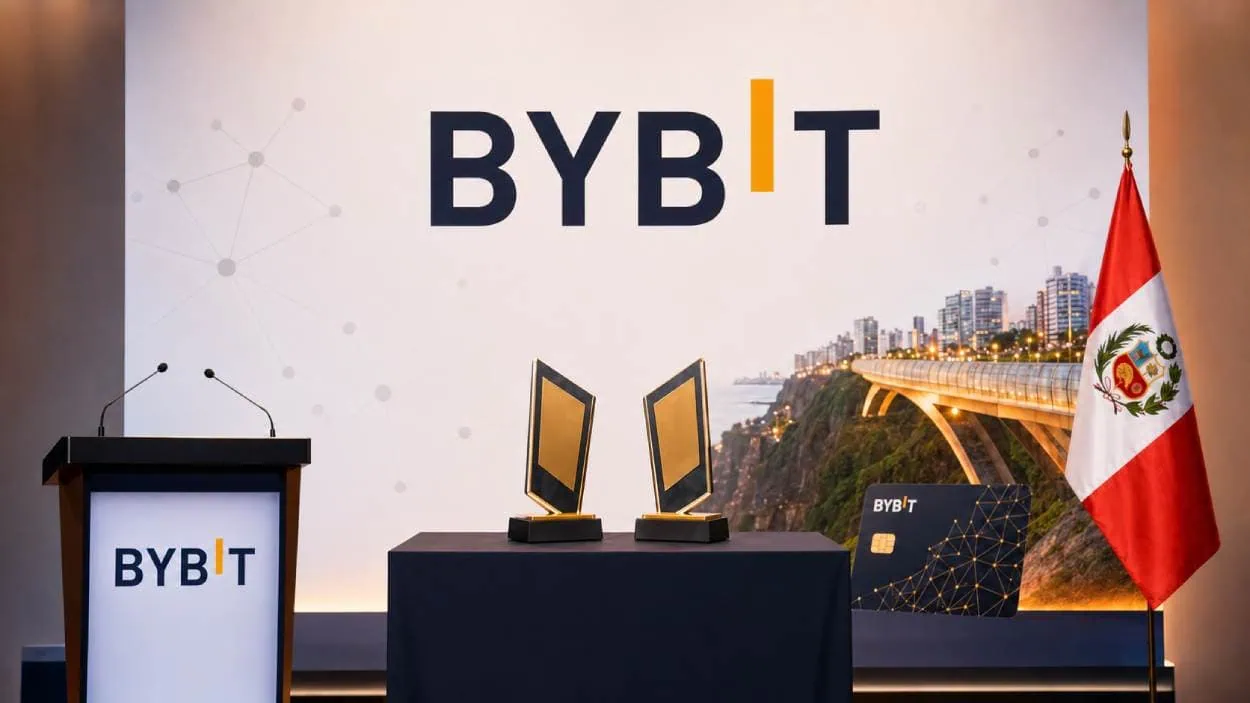






Bybit collected two industry awards at the Peru Blockchain Conference 2026, the exchange said on July 16, 2026. The prizes cover its trading and Web3 products and its regional strategy for Latin America.
Key Takeaways
- Bybit won the Excellence in Innovation for Trading and Web3 Ecosystems award at the Peru Blockchain Conference 2026.
- The exchange also took a Best Strategic Leadership for Latin America award, citing its regional product and user growth work.
- Patricio Mesri, Bybit’s country manager for Spanish-speaking Latin America, accepted the awards and joined a conference panel.
- The Bybit Card pays 100% cashback on eligible subscriptions including Netflix and Spotify, the company says.
- Bybit says it serves more than 80 million users and calls itself the second-largest exchange by trading volume.
What Happened?
Bybit announced the two wins at the Lima conference: Excellence in Innovation for Trading and Web3 Ecosystems, and Best Strategic Leadership for Latin America. The company attributed the recognition to its product work, user experience investment, and its role in the regional digital asset industry.
Patricio Mesri, country manager for Spanish-speaking Latin America, represented the exchange. He also sat on a panel titled “Building the Crypto Ecosystem in Latin America: Opportunities and Challenges 2026,” which examined Peru’s market and the wider regional outlook.
Awards handed out at industry conferences carry no regulatory weight and no independent audit. They function as positioning, and the positioning here is regional: Bybit is telling the Peruvian market that Latin America sits inside its core strategy rather than at its edge. That claim is worth reading against the products the company actually shipped to the region.
The Bybit Card carries the everyday-spending argument
Bybit built its Lima pitch around the Bybit Card, which the company designed to connect digital assets to routine payments. The card pays 100% cashback on eligible subscription services such as Netflix and Spotify. New users also get a limited-time 10% cashback on eligible purchases during the first month after activation.
The exchange presented the card as one piece of a single-platform offer. Bybit says its integrated setup lets users:
- Make international payments.
- Spend digital assets through the Bybit Card.
- Access multiple payment methods.
- Earn on their digital assets.
- Take part in global market opportunities.
Subscription cashback is a deliberate choice of hook. Netflix and Spotify are recurring, low value, cross border charges, which makes them the cheapest possible place to test whether a crypto funded card works in daily life. A user who never trades can still touch the product monthly. That is a customer-acquisition mechanic more than a returns proposition, and the promotional 10% rate runs for one month only.
Education framed as the adoption bottleneck
Mesri used the panel to place education ahead of speculation as the driver of regional growth. He said:
The framing matters because it shifts the sales argument from price to liquidity. Bybit is arguing that Latin American users adopt digital assets when the products solve a payment problem, and that understanding has to arrive before the product does. Read against the card, the two halves fit: a subscription cashback offer only works on someone who already trusts the rails enough to load funds.
The gap in the argument is measurement. Bybit named no education programs, no partners, and no participation figures in the announcement, so the commitment stays directional. Regional operators making similar claims tend to be judged on funded programs and local licensing rather than on conference statements.

CoinLaw’s Takeaway
Two conference awards do not change Bybit’s regulatory standing anywhere in Latin America, and the company’s user and volume figures come from the company. What the announcement does show is a strategy choice. Bybit is competing in Peru on utility and familiarity rather than on trading depth, and the Bybit Card is the instrument. Cashback on Netflix and Spotify targets a user who wants a payment tool, not a leveraged position.
The wider read is that regional competition among exchanges has moved toward payments and card products, where the differentiators are cashback economics, banking partnerships, and local compliance. Those are expensive to sustain, and promotional rates such as the first-month 10% offer are the easiest part of the package to withdraw.