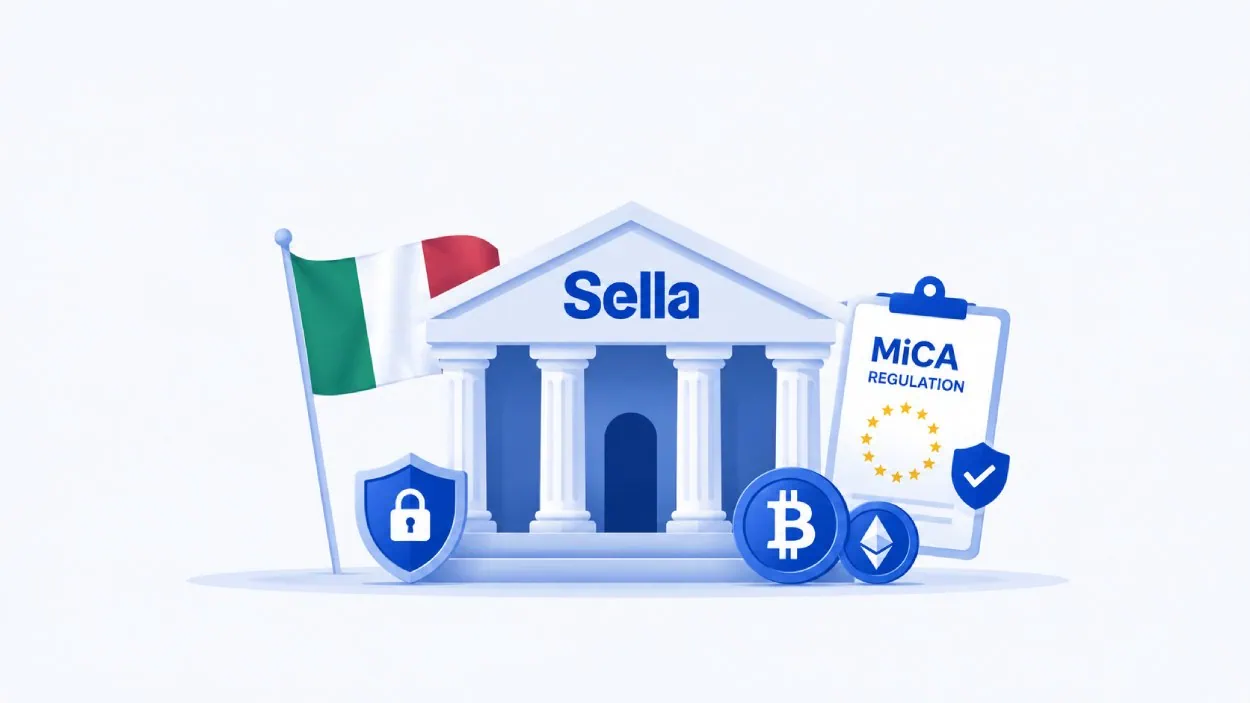






Italy’s Banca Sella has become the country’s first bank authorized under MiCA rules to offer regulated crypto asset services, marking another step in Europe’s push toward institutional digital finance.
Key Takeaways
- Banca Sella completed the MiCA notification process with the Bank of Italy.
- The bank plans to launch crypto custody and transfer services for selected clients by 2026.
- The offering will focus on institutional and corporate users instead of retail trading.
- Banca Sella is also involved in European stablecoin and blockchain initiatives.
What Happened?
Banca Sella announced that it has completed the notification process required under the European Union’s Markets in Crypto Assets regulation, also known as MiCA. The approval from the Bank of Italy allows the lender to provide regulated crypto asset services focused on custody, transfers, and the receipt of digital assets.
The bank said the platform will initially target selected categories of clients, with institutional and corporate users expected to take priority. The launch is planned before the end of 2026.
JUST IN: Banca Sella becomes the first Italian bank cleared to offer crypto custody and transfer services, after completing its notification with the Bank of Italy under MiCA. pic.twitter.com/ygU6sis58l
— CoinDesk (@CoinDesk) May 27, 2026
Banca Sella Becomes Italy’s First MiCA Approved Bank
The approval positions Banca Sella as the first Italian bank authorized to operate crypto asset services under the MiCA framework. The regulation was introduced by the European Union to create a unified legal structure for digital assets across member states.
Under the current plan, the bank will focus on infrastructure services rather than speculative crypto trading. This means customers will be able to store digital assets securely and transfer them between approved accounts through a regulated banking environment.
Importantly, Banca Sella has not announced direct crypto buying or selling features. The strategy appears aimed at serving institutions that require compliant custody and settlement solutions rather than retail traders seeking exchange style services.
Andrea Tessera, Managing Director of Digital Banking at Banca Sella, said the shift toward tokenization is helping create a financial system built around “instant, interoperable, and programmable” payments. He added that the bank’s crypto plans are part of this broader transition in digital finance.
Institutional Focus Shapes the Rollout
Banca Sella confirmed that the crypto service will launch in phases and focus on carefully selected clients during the early stages. This controlled rollout is designed to reduce operational and compliance risks while the bank expands its digital asset infrastructure.
The core product is expected to revolve around digital asset custody, a service increasingly demanded by institutional investors and financial firms entering the crypto market. Secure custody remains one of the biggest barriers for traditional institutions exploring digital assets.
The approval also gives Banca Sella an advantage in a market where many European banks are still experimenting with blockchain pilots and limited crypto partnerships. With MiCA now active across Europe, regulated lenders have a clearer legal path for entering the digital asset sector.

Bank Has Prior Experience With Crypto and Blockchain
Although this is Banca Sella’s first formal MiCA approval, the bank has already been involved in crypto related initiatives over the past few years.
In 2022, the lender participated in a distributed ledger technology pilot backed by the Bank of Italy’s Fintech Milano Hub. The bank also created an internal team focused on blockchain infrastructure and digital assets.
Banca Sella previously gained retail crypto exposure through Hype, its digital banking brand. Hype partnered with Italian crypto company Conio in 2020 to integrate Bitcoin wallet services for users. The partnership allowed customers to buy, sell, send, and receive digital assets through the banking app.
The lender is also among the founding members of Qivalis, a consortium of 37 European banks working on a euro denominated stablecoin project. The initiative highlights how European financial institutions are preparing for tokenized payments and blockchain-based settlement systems.
European Banks Continue Expanding Into Digital Assets
Banca Sella’s move reflects a broader trend across Europe, where traditional financial institutions are increasingly entering the digital asset space through regulated services rather than speculative trading products.
Many banks are focusing on custody, settlement infrastructure, tokenization, and stablecoins as they adapt to changing financial technology trends under MiCA regulations.
The approval may also encourage other Italian banks to explore similar services as the regulatory environment becomes more defined.
CoinLaw’s Takeaway
In my experience, the biggest obstacle stopping traditional banks from fully entering crypto has always been regulation and compliance uncertainty. That is now starting to change in Europe. I found Banca Sella’s approach interesting because the bank is not chasing hype driven retail trading products. Instead, it is focusing on infrastructure, custody, and institutional services that could have much longer lasting value.
This looks less like a short term crypto experiment and more like a strategic move toward the future of banking. If other European lenders follow the same path, MiCA could become the foundation that finally connects traditional finance with regulated digital assets at scale.