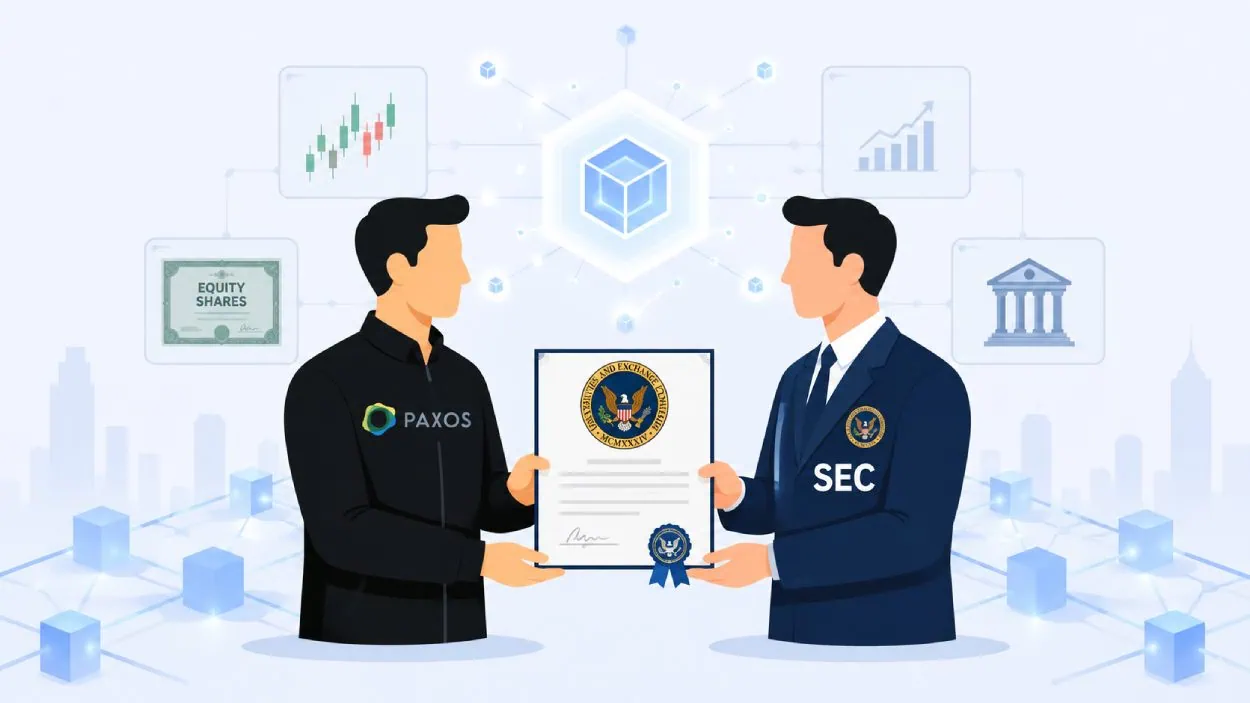






The U.S. Securities and Exchange Commission has approved Paxos to clear and settle U.S. equities on blockchain infrastructure, marking a major step toward bringing tokenized finance into regulated capital markets.
Key Takeaways
- Paxos Securities Settlement Company received full SEC registration as a clearing agency.
- The approval allows Paxos to provide blockchain-based clearing and settlement services for eligible U.S. equities.
- Paxos says it is the first blockchain native company authorized to operate as a central securities depository for traditional stocks in the United States.
- The move could enable same day or near instant settlement, reducing delays, capital lockups, and counterparty risks.
What Happened?
Paxos has secured a landmark regulatory victory after the SEC granted full registration to Paxos Securities Settlement Company (PSSC), allowing it to clear and settle securities transactions using blockchain technology.
The approval positions Paxos among the small group of firms responsible for critical post trade market infrastructure and could pave the way for faster, more efficient settlement of U.S. stock transactions through blockchain-based systems.
Paxos Securities Settlement Company has been granted registration as a clearing agency by the SEC.
— Paxos (@Paxos) May 28, 2026
We are now the only blockchain-native firm registered to provide clearing and settlement infrastructure as a central securities depository in the United States.
With this…
Paxos Enters a Market Dominated by Legacy Infrastructure
The SEC’s decision gives Paxos the authority to operate as a registered clearing agency and central securities depository for eligible U.S. equities. This places the company in direct competition with traditional market infrastructure providers such as the Depository Trust & Clearing Corporation (DTCC), which has long dominated securities clearing and settlement in the United States.
Clearing and settlement represent the final stage of a trade, where ownership of securities and cash officially changes hands. While stock trades are executed in milliseconds, settlement has historically taken longer due to intermediary processes and reconciliation requirements.
Paxos believes blockchain technology can modernize this system by streamlining operations and reducing friction across financial markets.
Seven Years of Regulatory Work
The approval follows years of engagement between Paxos and U.S. regulators.
The company first received SEC no-action relief in 2019, allowing it to develop and test blockchain-based settlement infrastructure. In February 2020, Paxos launched a live settlement pilot that processed U.S. equity transactions with major financial institutions including Bank of America, Credit Suisse, Société Générale, and Instinet.
Commenting on the milestone, Paxos Chief Executive Officer and Co-Founder Charles Cascarilla said:
Cascarilla added that the registration enables Paxos to provide one of the most complete blockchain infrastructure offerings available to financial institutions.

How Blockchain Settlement Could Change Capital Markets?
The newly granted registration allows Paxos to provide delivery versus payment settlement services, ensuring securities and cash are exchanged simultaneously.
The company says blockchain-based settlement can deliver several advantages over traditional infrastructure, including:
- Same day or T+0 settlement
- Reduced counterparty risk
- Improved liquidity management
- Greater transparency and auditability
- Lower operational complexity
- Reduced reconciliation errors
Although U.S. markets transitioned to a T+1 settlement cycle in 2024, industry participants continue searching for ways to improve efficiency and free up capital that remains tied up during the settlement process.
Paxos argues that blockchain can significantly shorten settlement timelines while maintaining regulatory oversight and market integrity.
Growing Momentum for Tokenized Finance
Beyond clearing and settlement, the approval is being viewed as a broader endorsement of blockchain infrastructure within regulated financial markets.
Paxos already operates under multiple regulatory frameworks, including oversight from the New York Department of Financial Services, and provides infrastructure supporting digital asset initiatives involving PayPal and Mastercard.
The latest approval could strengthen efforts to bring real world assets and traditional securities onto blockchain networks. Interest in tokenization has grown rapidly among banks and financial institutions seeking more efficient ways to issue, trade, and settle assets.
Industry observers also see the decision as evidence that blockchain technology and regulatory compliance can coexist within critical financial infrastructure.
CoinLaw’s Takeaway
In my experience, the biggest challenge facing blockchain adoption in finance has never been the technology itself. It has been gaining regulatory trust. That is why I see this SEC approval as far more important than a routine licensing announcement.
I found the most significant aspect of this development is that blockchain is no longer being discussed as a future possibility for Wall Street. It is now being integrated into the actual infrastructure that powers financial markets. If Paxos can successfully scale its clearing and settlement network, this approval could become one of the clearest examples of how tokenized finance moves from experimentation to mainstream adoption.